Deflection of a Filament Eruption with Three Parallel Flare Ribbons via Reconnection at an X-Point
Pith reviewed 2026-05-08 07:02 UTC · model grok-4.3
The pith
Localized reconnection at an X-point deflects an erupting filament and forms three parallel flare ribbons.
A machine-rendered reading of the paper's core claim, the machinery that carries it, and where it could break.
Core claim
The simulation establishes that filament deflection arises from localized reconnection at an X-point, confirmed by decomposing the Lorentz force into pressure and tension terms. Reconnection above two current channels of opposite helicity controls the overall eruption, with pressure gradients driving the observed deflection of the flux rope while tension restrains the rise of the surrounding arcade. The evolution of quasi-separatrix layers matches the observed flare ribbons and supplies evidence of reconnection between the two flux ropes in the sheared configuration.
What carries the argument
Localized reconnection at the X-point between two flux ropes of opposite helicity inside a sandwich magnetic configuration with double parallel polarity inversion lines.
If this is right
- The identified sandwich configuration with double polarity inversion lines offers a formation path for observed parallel three-ribbon flares.
- Reconnection between two flux ropes explains both the filament deflection and the ribbon morphology in this event.
- Quasi-separatrix layers serve as the topological link between the magnetic field and the locations of energy release seen in the flare ribbons.
- The Lorentz force decomposition isolates magnetic pressure as the dominant driver of the sideways deflection while tension limits vertical expansion.
Where Pith is reading between the lines
- The same X-point reconnection process may operate in other active-region eruptions that display deflected filaments or multi-ribbon flares.
- Higher-cadence observations of the low corona could directly image the X-point and test whether pressure-gradient forces indeed dominate the deflection.
- Similar double-polarity-inversion-line setups might be searched for in historical flare catalogs to assess how commonly they produce three-ribbon events.
Load-bearing premise
The zero-beta approximation together with the data-constrained initial magnetic field from limited observations is enough to capture the essential reconnection dynamics and force balance.
What would settle it
High-resolution vector magnetograms or extreme-ultraviolet images that show no X-point reconnection signatures or no match between quasi-separatrix layer footprints and the three parallel ribbons during the deflection phase would falsify the proposed driver.
Figures


read the original abstract
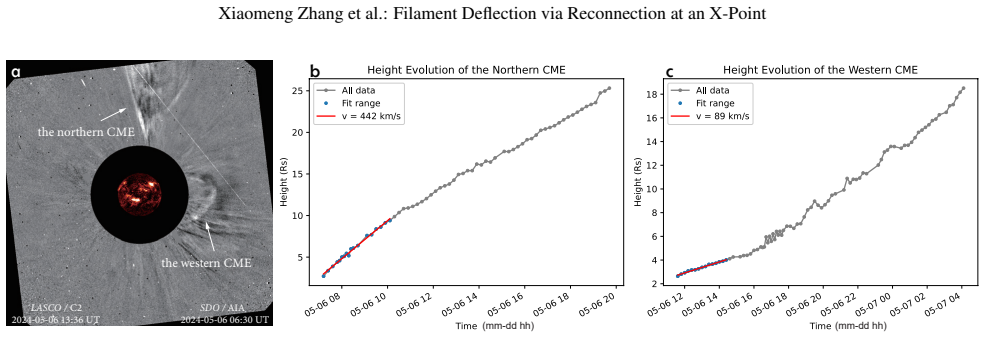
On 2024 May 6, Active Region 13663 produced an X4.5-class flare associated with a filament eruption that exhibited remarkable rotation and deflection dynamics. This study aims to investigate two key aspects of this event: the formation mechanisms of the complex flare ribbon structures and the physical drivers behind the observed filament deflection. We conduct a data-constrained magnetohydrodynamic simulation using the zero-beta approximation to reconstruct the filament's evolution. Through detailed analysis of quasi-separatrix layers (QSLs) and their comparison with observed flare ribbons, we establish crucial connections between magnetic topology and flare morphology. First, our simulation successfully reproduces key observational features of the eruption. Then, we connect the flare ribbon morphology with calculated QSLs. Finally, we find filament deflection resulting from localized reconnection at the X-point, as evidenced by Lorentz force decomposition. We demonstrate that reconnection above two current channels of opposite helicity governs the eruption dynamics, with magnetic pressure gradients driving flux rope deflection while magnetic tension force simultaneously restraining arcade ascent. The event features a "sandwich" magnetic configuration including double parallel polarity inversion lines with strong shear component. We suggest that this particular configuration could serve as a plausible formation mechanism for the observed parallel three-ribbon structure. In addition, the evolution of QSLs and flare ribbons provides clear evidence of reconnection between two flux ropes.
Editorial analysis
A structured set of objections, weighed in public.
Referee Report
Summary. The manuscript presents a data-constrained zero-beta MHD simulation of the 2024 May 6 X4.5 flare and filament eruption in AR 13663. It reproduces key observational features of the eruption, connects quasi-separatrix layers (QSLs) to the observed three parallel flare ribbons, and attributes the filament deflection to localized reconnection at an X-point between two flux ropes of opposite helicity. Magnetic pressure gradients are identified as driving the deflection while tension restrains arcade ascent; the double-PIL 'sandwich' configuration is proposed as a formation mechanism for parallel three-ribbon flares.
Significance. If the central claims hold, the work supplies a concrete numerical example of how X-point reconnection in a sheared double-PIL topology can produce both filament deflection and a three-ribbon morphology. The explicit QSL-to-ribbon mapping and Lorentz-force decomposition add mechanistic detail to existing topological models of eruptive flares.
major comments (2)
- [Simulation Setup] Simulation Setup section: the zero-beta approximation eliminates the gas-pressure gradient by construction. The Lorentz-force decomposition used to attribute deflection to the X-point reconnection therefore isolates only magnetic contributions; if plasma beta is not uniformly ≪1 near the filament or reconnection site, the reported force balance may omit dynamically important thermal or dynamic pressure terms.
- [Initial magnetic field] Initial magnetic field section: the pre-eruption field is extrapolated from limited magnetogram data with free parameters for scaling and shear. Because the precise location and connectivity of the X-point and QSLs are sensitive to these choices, the reported match between simulated deflection trajectory, ribbon timing, and the three-ribbon morphology risks being partly a fit rather than an independent prediction.
minor comments (1)
- [QSL analysis] The description of how QSLs are computed and thresholded for comparison with ribbons would benefit from an explicit equation or reference to the standard squashing-factor definition.
Simulated Author's Rebuttal
We thank the referee for the constructive and detailed comments on our manuscript. We address each major comment point by point below, with revisions made where appropriate to clarify limitations and strengthen the presentation.
read point-by-point responses
-
Referee: Simulation Setup section: the zero-beta approximation eliminates the gas-pressure gradient by construction. The Lorentz-force decomposition used to attribute deflection to the X-point reconnection therefore isolates only magnetic contributions; if plasma beta is not uniformly ≪1 near the filament or reconnection site, the reported force balance may omit dynamically important thermal or dynamic pressure terms.
Authors: We agree that the zero-beta approximation is a limitation of the model, as it excludes gas-pressure contributions by design. This choice is standard for focusing on magnetically dominated coronal dynamics, where beta is typically low. However, we acknowledge that beta may approach order unity near the filament or in the reconnection region, potentially affecting the precise force balance. In the revised manuscript, we have added a dedicated paragraph in the Simulation Setup section discussing the applicability of zero-beta for this event, citing typical active-region coronal conditions from the literature, and explicitly noting that the reported Lorentz-force analysis is valid only within the zero-beta framework. We also state that quantitative assessment of omitted pressure terms would require a finite-beta simulation with additional temperature constraints not available from the observations. This is a partial revision consisting of added discussion rather than a change to the simulation. revision: partial
-
Referee: Initial magnetic field section: the pre-eruption field is extrapolated from limited magnetogram data with free parameters for scaling and shear. Because the precise location and connectivity of the X-point and QSLs are sensitive to these choices, the reported match between simulated deflection trajectory, ribbon timing, and the three-ribbon morphology risks being partly a fit rather than an independent prediction.
Authors: The referee is correct that the initial field construction involves choices for scaling and shear to align with the limited magnetogram and observed filament properties. These parameters were not arbitrarily adjusted to reproduce the deflection or three-ribbon structure; they were fixed by matching the pre-eruption magnetogram, filament location, and overall active-region topology before running the simulation. The key features (X-point reconnection, QSL evolution, and deflection) then emerged self-consistently. To address the sensitivity concern, we have revised the Initial magnetic field section to include an explicit discussion of parameter choices, their observational constraints, and a qualitative assessment of robustness based on the setup process. We have not performed new full simulations for the revision, as that would exceed the scope of a major revision, but the added text clarifies the distinction between constrained setup and post-hoc fitting. revision: partial
Circularity Check
Data-constrained MHD simulation yields independent dynamical results with no reduction to inputs by construction
full rationale
The paper initializes a zero-beta MHD simulation from observational magnetograms of the active region and evolves the system forward in time. The filament deflection is then attributed to localized reconnection at an X-point via post-processing Lorentz force decomposition on the simulated fields. No equation or step in the abstract reduces this attribution to a fitted parameter renamed as a prediction, nor does any load-bearing premise collapse to a self-citation or ansatz smuggled from prior author work. The reproduction of observed ribbon morphology and deflection trajectory functions as an external consistency check against the input magnetograms rather than a definitional tautology. The zero-beta approximation is stated explicitly as a modeling choice, not derived from the target result. The derivation chain therefore remains self-contained against the supplied observational constraints.
Axiom & Free-Parameter Ledger
free parameters (1)
- initial magnetic field scaling and shear parameters
axioms (1)
- domain assumption zero-beta approximation
Reference graph
Works this paper leans on
- [1]
-
[2]
Brueckner, G. E., Howard, R. A., Koomen, M. J., et al. 1995, Sol. Phys., 162, 357 Cécere, M., Costa, A., Cremades, H., & Stenborg, G. 2023, Frontiers in Astron- omy and Space Sciences, 10, 1260432
work page 1995
-
[3]
Chintzoglou, G., Zhang, J., Cheung, M. C. M., & Kazachenko, M. 2019, ApJ, 871, 67
work page 2019
-
[4]
Domingo, V ., Fleck, B., & Poland, A. I. 1995, Sol. Phys., 162, 1 Dudík, J., Aulanier, G., Lörinˇcík, J., & Zemanová, A. 2025, Sol. Phys., 300, 139
work page 1995
- [5]
- [6]
-
[7]
Guo, Y ., Xia, C., Keppens, R., Ding, M. D., & Chen, P. F. 2019, ApJ, 870, L21
work page 2019
- [8]
-
[9]
Hood, A. W. & Priest, E. R. 1981, Geophysical and Astrophysical Fluid Dynam- ics, 17, 297
work page 1981
-
[10]
Isenberg, P. A. & Forbes, T. G. 2007, ApJ, 670, 1453
work page 2007
-
[11]
Jiang, Y ., Yang, J., Zheng, R., Bi, Y ., & Yang, X. 2009, ApJ, 693, 1851
work page 2009
- [12]
-
[13]
C., Filippov, B., Schmieder, B., et al
Joshi, N. C., Filippov, B., Schmieder, B., et al. 2016, ApJ, 825, 123
work page 2016
- [14]
-
[15]
Kay, C., Opher, M., & Evans, R. M. 2015, ApJ, 805, 168
work page 2015
-
[16]
Keppens, R., Popescu Braileanu, B., Zhou, Y ., et al. 2023, A&A, 673, A66
work page 2023
-
[17]
Kliem, B., Török, T., & Thompson, W. T. 2012, Sol. Phys., 281, 137
work page 2012
-
[18]
Kruskal, M. & Schwarzschild, M. 1954, Proceedings of the Royal Society of London Series A, 223, 348
work page 1954
-
[19]
Lemen, J. R., Title, A. M., Akin, D. J., et al. 2012, Sol. Phys., 275, 17
work page 2012
-
[20]
Liu, Y . A., Liu, Y . D., Hu, H., Wang, R., & Zhao, X. 2018, ApJ, 854, 126
work page 2018
- [21]
-
[22]
Manchester, W., Kilpua, E. K. J., Liu, Y . D., et al. 2017, Space Sci. Rev., 212, 1159 Müller, D., St. Cyr, O. C., Zouganelis, I., et al. 2020, A&A, 642, A1
work page 2017
- [23]
-
[24]
Parnell, C. E., Smith, J. M., Neukirch, T., & Priest, E. R. 1996, Physics of Plas- mas, 3, 759
work page 1996
-
[25]
Pesnell, W. D., Thompson, B. J., & Chamberlin, P. C. 2012, Sol. Phys., 275, 3
work page 2012
- [26]
- [27]
-
[28]
Scherrer, P. H., Schou, J., Bush, R. I., et al. 2012, Sol. Phys., 275, 207
work page 2012
-
[29]
Schou, J., Scherrer, P. H., Bush, R. I., et al. 2012, Sol. Phys., 275, 229
work page 2012
- [30]
- [31]
-
[32]
Titov, V . S. 2007, ApJ, 660, 863 Török, T. & Kliem, B. 2005, ApJ, 630, L97
work page 2007
- [33]
-
[34]
R., Török, T., Démoulin, P., van Driel-Gesztelyi, L., & Kliem, B
Williams, D. R., Török, T., Démoulin, P., van Driel-Gesztelyi, L., & Kliem, B. 2005, ApJ, 628, L163
work page 2005
-
[35]
Xia, C., Teunissen, J., El Mellah, I., Chané, E., & Keppens, R. 2018, ApJS, 234, 30
work page 2018
- [36]
- [37]
- [38]
-
[39]
Zhang, X. M., Guo, J. H., Guo, Y ., Ding, M. D., & Keppens, R. 2024, ApJ, 961, 145
work page 2024
-
[40]
Zhao, J., Gilchrist, S. A., Aulanier, G., et al. 2016, ApJ, 823, 62
work page 2016
-
[41]
Zhong, Z., Guo, Y ., & Ding, M. D. 2021, Nature Communications, 12, 2734
work page 2021
-
[42]
2019, ApJ, 870, 97 Article number, page 11 of 11
Zou, P., Jiang, C., Feng, X., et al. 2019, ApJ, 870, 97 Article number, page 11 of 11
work page 2019
discussion (0)
Sign in with ORCID, Apple, or X to comment. Anyone can read and Pith papers without signing in.