Signal Processing Foundations of Reconfigurable Antennas in the Tri-Hybrid MIMO Architecture
Pith reviewed 2026-05-08 05:45 UTC · model grok-4.3
The pith
Reconfigurable antennas in tri-hybrid MIMO couple the channel to the precoder through electromagnetic effects.
A machine-rendered reading of the paper's core claim, the machinery that carries it, and where it could break.
Core claim
The central claim is that electromagnetic reconfiguration of antennas creates a fundamental coupling between the channel and the precoder, which is captured by folding the antenna layer into an effective channel representation. This coupling must be respected when jointly optimizing digital, analog, and antenna-domain precoding under realistic hardware and power constraints, as shown by instantiating the model across seven architectures and quantifying tradeoffs via the reconfigurability efficiency factor.
What carries the argument
The generic input-output model that incorporates the reconfigurable antenna layer into an effective channel representation, thereby exposing the coupling among channel, precoder, and radiated power.
If this is right
- Joint optimization across digital, analog, and antenna domains becomes necessary to satisfy power constraints while maximizing spectral efficiency.
- The reconfigurability efficiency factor provides a concrete way to compare heterogeneous antenna architectures on equal footing.
- Electromagnetic-level reconfiguration changes the overall signal processing design space, favoring algorithms that treat the antenna layer as an active variable.
- Tradeoffs among aperture size, power consumption, hardware complexity, and spectral efficiency can be quantified systematically for different reconfigurable technologies.
Where Pith is reading between the lines
- Real-time reconfiguration algorithms could exploit the channel-precoder coupling to adapt to time-varying environments without increasing RF-chain count.
- The framework suggests that future massive MIMO deployments might achieve target rates with fewer analog components by moving precoding effort into the electromagnetic domain.
- The same modeling approach could be tested on additional antenna technologies beyond the seven examined to identify which ones deliver the highest efficiency gains.
Load-bearing premise
The generic input-output model accurately captures the electromagnetic characteristics of the seven diverse reconfigurable antenna technologies without requiring detailed per-architecture EM validation.
What would settle it
A direct measurement of effective channel matrix and radiated power in a tri-hybrid testbed while varying antenna reconfiguration states, checked against the model's predicted coupling between those quantities.
Figures




read the original abstract
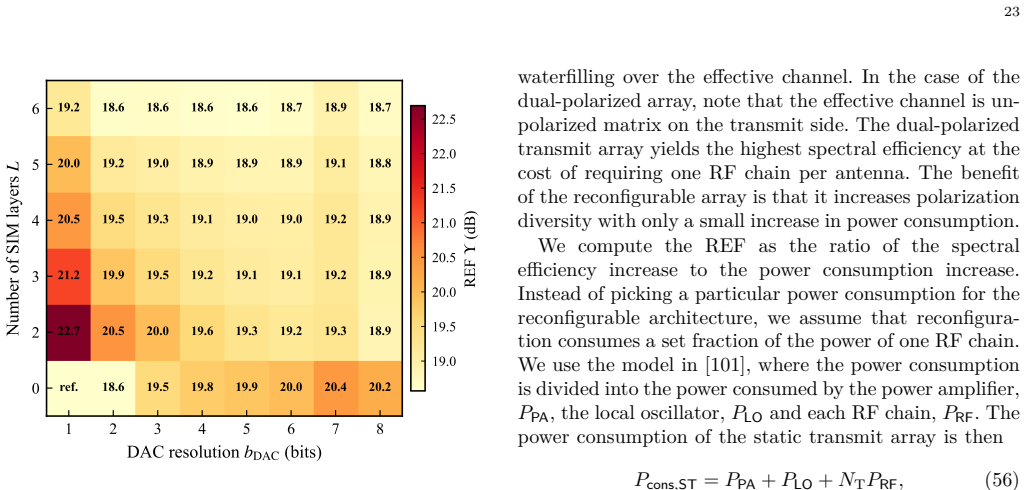
To enable larger apertures in multipleinput multipleoutput MIMO systems the trihybrid MIMO architecture offers a promising lowcost and lowpower solution by introducing reconfigurable antennas as a third layer of precoding on top of conventional digital and analog processing In this paper we develop a unified signal processing framework for trihybrid MIMO that explicitly captures the electromagnetic EM characteristics of diverse reconfigurable antenna technologies We first propose a generic inputoutput model that incorporates the reconfigurable antenna layer into an effective channel representation revealing a fundamental coupling between the channel precoder and radiated power Building on this model we formulate a general optimization problem that jointly accounts for digital analog and antennadomain precoding under hardware and power constraints We then instantiate this framework across seven representative reconfigurable antenna architectures including parasitic arrays dynamic metasurface antennas fluidpixel antennas polarizationreconfigurable antennas stacked intelligent metasurfaces pinching antenna systems and nonradiating wires To systematically compare these heterogeneous architectures we introduce a new metric the reconfigurability efficiency factor REF which quantifies the performance gains achievable through antenna reconfiguration under realistic constraints Numerical results demonstrate the tradeoffs among aperture size power consumption hardware complexity and spectral efficiency Our results establish that EMlevel reconfiguration reshapes the signal processing design space highlighting the need for new architectures and algorithms that jointly optimize across digital analog and electromagnetic domains This work reveals that electromagnetic reconfiguration couples the channel and precoder
Editorial analysis
A structured set of objections, weighed in public.
Referee Report
Summary. The manuscript develops a unified signal processing framework for tri-hybrid MIMO systems by adding a reconfigurable antenna layer as a third precoding stage atop digital and analog processing. It proposes a generic input-output model that incorporates electromagnetic characteristics into an effective channel, revealing coupling between the channel and precoder; formulates a joint optimization problem across the three domains under hardware and power constraints; instantiates the model for seven distinct reconfigurable antenna architectures; introduces the reconfigurability efficiency factor (REF) metric to compare them; and presents numerical results on trade-offs among aperture size, power consumption, hardware complexity, and spectral efficiency.
Significance. If the generic model is a faithful abstraction, the work would be significant for establishing that electromagnetic reconfiguration couples the channel and precoder, thereby expanding the MIMO design space to require joint optimization across digital, analog, and EM domains. The paper earns credit for instantiating the framework across seven heterogeneous architectures and for introducing the REF metric as a systematic comparison tool. The numerical results usefully illustrate performance trade-offs, though their interpretation hinges on model fidelity.
major comments (1)
- [Generic input-output model (and instantiations for the seven architectures)] The central claim that electromagnetic reconfiguration couples the channel and precoder (and the derived joint optimization and REF values) depends on the generic input-output model accurately capturing EM physics for the seven listed architectures. The manuscript provides no full-wave EM simulations, measurement data, or comparisons to established EM solvers to validate that the model reproduces radiation patterns, mutual coupling, reconfiguration-induced phase/amplitude shifts, or power constraints for each technology (parasitic arrays, dynamic metasurface antennas, fluid/pixel antennas, etc.). This is load-bearing, as technology-specific effects omitted by the abstraction would make the reported coupling and trade-offs modeling artifacts rather than robust insights.
minor comments (2)
- [Abstract] The abstract contains several unspaced compound terms (e.g., 'multipleinput multipleoutput', 'antennadomain') that reduce readability and should be corrected.
- [Numerical results] A summary table compiling key parameters, constraints, and REF values across the seven architectures would improve the clarity of the cross-technology comparison in the numerical results section.
Simulated Author's Rebuttal
We thank the referee for the thorough and constructive review. The feedback has helped us better position the theoretical contributions of the work. We address the major comment below.
read point-by-point responses
-
Referee: [Generic input-output model (and instantiations for the seven architectures)] The central claim that electromagnetic reconfiguration couples the channel and precoder (and the derived joint optimization and REF values) depends on the generic input-output model accurately capturing EM physics for the seven listed architectures. The manuscript provides no full-wave EM simulations, measurement data, or comparisons to established EM solvers to validate that the model reproduces radiation patterns, mutual coupling, reconfiguration-induced phase/amplitude shifts, or power constraints for each technology (parasitic arrays, dynamic metasurface antennas, fluid/pixel antennas, etc.). This is load-bearing, as technology-specific effects omitted by the abstraction would make the reported coupling and trade-offs modeling artifacts rather than robust insights.
Authors: We appreciate the referee's emphasis on empirical validation. Our manuscript presents a signal-processing abstraction rather than a hardware validation study. The generic input-output model is constructed by incorporating standard analytical EM representations drawn from the established antenna literature for each of the seven architectures (e.g., mutual-impedance matrices for parasitic arrays, tunable surface-impedance models for dynamic metasurface antennas, and analogous canonical models for fluid/pixel, polarization-reconfigurable, stacked metasurface, pinching, and non-radiating wire cases, with supporting citations). The coupling between the effective channel and the precoder is a direct mathematical consequence of defining the radiated field as a function of the reconfiguration variables; it is a structural property of the tri-hybrid architecture and does not rely on specific numerical values or omitted effects. We agree that full-wave simulations or measurements would provide useful additional support for practical hardware realizations, but such validation lies outside the scope of this foundational theoretical paper. In the revised manuscript we have added a dedicated subsection in Section II that explicitly states the modeling assumptions, lists the literature sources for each architecture's abstraction, and discusses potential technology-specific effects not captured by the generic model. We have also clarified that the numerical results illustrate the framework's behavior rather than predict performance of any particular physical implementation. revision: partial
Circularity Check
No significant circularity in the derivation chain
full rationale
The paper proposes a generic input-output model as an original contribution that incorporates the reconfigurable antenna layer, from which the coupling between channel and precoder is derived as a structural consequence. It then formulates a joint optimization problem and introduces the REF metric for comparison across seven architectures. These elements constitute modeling extensions and new metrics rather than reductions of outputs to fitted inputs or self-citations by construction. No equations or claims in the abstract reduce the central results to prior parameters or author-overlapping citations; numerical results and instantiations supply independent content. The derivation is self-contained as a signal-processing framework.
Axiom & Free-Parameter Ledger
axioms (1)
- domain assumption Reconfigurable antennas can be incorporated into an effective channel representation that couples with the precoder.
invented entities (1)
-
Reconfigurability efficiency factor (REF)
no independent evidence
Reference graph
Works this paper leans on
-
[1]
Increasing capacity in wireless broadcast systems using distributed transmission/directional reception (dtdr),
A. J. Paulraj and T. Kailath, “Increasing capacity in wireless broadcast systems using distributed transmission/directional reception (dtdr),” US patent US5345599A, pp. 3590–3600, 1994
1994
-
[2]
The Tri-Hybrid MIMO Architecture,
R. W. Heath, Jr., J. Carlson, N. V. Deshpande, M. R. Castellanos, M. Akrout, and C.-B. Chae, “The Tri-Hybrid MIMO Architecture,” IEEE Wireless Commun., vol. 33, no. 1, pp. 199–206, Feb. 2026
2026
-
[3]
Layered space-time architecture for wireless communication in a fading environment when using multi- element antennas,
G. J. Foschini, “Layered space-time architecture for wireless communication in a fading environment when using multi- element antennas,” Bell Labs Tech. J., pp. 41–59, Oct. 1996
1996
-
[4]
V-BLAST: an architecture for realizing very high data rates over the rich-scattering wireless channel,
P. W. Wolniansky, G. J. Foschini, G. D. Golden, and R. A. Valenzuela, “V-BLAST: an architecture for realizing very high data rates over the rich-scattering wireless channel,” in Proc. URSI Int. Symp. Signals, Syst. Electron., Pisa, Italy, Sep. 1998, pp. 295–300
1998
-
[5]
On limits of wireless com- munications in a fading environment when using multiple antennas,
G. J. Foschini and M. J. Gans, “On limits of wireless com- munications in a fading environment when using multiple antennas,” Wireless Pers. Commun., vol. 3, no. 6, p. 311–335, 1998
1998
-
[6]
Capacity of Multi-antenna Gaussian Channels,
E. Telatar, “Capacity of Multi-antenna Gaussian Channels,” Eur. Trans. Telecommun., vol. 10, no. 6, pp. 585–595, Nov. 1999
1999
-
[7]
Sum capacity of the vector Gaussian broadcast channel and uplink–downlink duality,
P. Viswanath and D. N. C. Tse, “Sum capacity of the vector Gaussian broadcast channel and uplink–downlink duality,” IEEE Trans. Inf. Theory, vol. 49, no. 8, pp. 1912–1921, Aug. 2003
1912
-
[8]
Noncooperative Cellular Wireless with Un- limited Numbers of Base Station Antennas,
T. L. Marzetta, “Noncooperative Cellular Wireless with Un- limited Numbers of Base Station Antennas,” IEEE Trans. Wireless Commun., vol. 9, no. 11, pp. 3590–3600, Nov. 2010. 25
2010
-
[9]
Channel Estimation and Hybrid Precoding for Millimeter Wave Cellular Systems,
A. Alkhateeb, O. El Ayach, G. Leus, and R. W. Heath, “Channel Estimation and Hybrid Precoding for Millimeter Wave Cellular Systems,” IEEE J. Sel. Topics Signal Process., vol. 8, no. 5, pp. 831–846, Oct. 2014
2014
-
[10]
Frequency-agile, polarization diverse microstrip antennas and frequency scanned arrays,
D. H. Schaubert, F. G. Farrar, S. T. Hayes, and A. R. Sindoris, “Frequency-agile, polarization diverse microstrip antennas and frequency scanned arrays,” Jan. 4 1983, US Patent 4,367,474
1983
-
[11]
Re- configurable antenna array testbed for quantized controlling,
M. Pokorny, I. Vertat, D. Panek, P. Hazdra, M. Svanda, J. Kracek, M. Mazanek, J. Masopust, and P. Karban, “Re- configurable antenna array testbed for quantized controlling,” IEEE Access, vol. 12, pp. 11 458–11 469, Jan. 2024
2024
-
[12]
Frequency tunable microstrip patch antenna using RF MEMS technology,
E. Erdil, K. Topalli, M. Unlu, O. A. Civi, and T. Akin, “Frequency tunable microstrip patch antenna using RF MEMS technology,” IEEE Trans. Antennas Propag., vol. 55, no. 4, pp. 1193–1196, Apr. 2007
2007
-
[13]
Reversibly deformable and mechanically tun- able fluidic antennas,
J.-H. So, J. Thelen, A. Qusba, G. J. Hayes, G. Lazzi, and M. D. Dickey, “Reversibly deformable and mechanically tun- able fluidic antennas,” Adv. Funct. Mater., vol. 19, no. 22, pp. 3632–3637, Nov. 2009
2009
-
[14]
Projector of the sharpest beam of electric waves,
H. Yagi and S. Uda, “Projector of the sharpest beam of electric waves,” Proceedings of the Imperial Academy, vol. 2, no. 2, pp. 49–52, 1926
1926
-
[15]
Reactively controlled directive arrays,
R. Harrington, “Reactively controlled directive arrays,” IEEE Trans. Antennas Propag., vol. 26, no. 3, pp. 390–395, 1978
1978
-
[16]
Electronically steerable passive array radiator antennas for low-cost analog adaptive beamforming,
T. Ohira and K. Gyoda, “Electronically steerable passive array radiator antennas for low-cost analog adaptive beamforming,” in Proc. of the 2000 IEEE International Conference on Phased Array Systems and Technology, 2000, pp. 101–104
2000
-
[17]
Near-field di- rect antenna modulation,
A. Babakhani, D. B. Rutledge, and A. Hajimiri, “Near-field di- rect antenna modulation,” IEEE Microwave Magazine, vol. 10, no. 1, pp. 36–46, 2009
2009
-
[18]
A new signal model for MIMO communication with compact parasitic arrays,
V. I. Barousis, C. B. Papadias, and R. R. Müller, “A new signal model for MIMO communication with compact parasitic arrays,” in Proc. of the 6th International Symposium on Communications, Control and Signal Processing (ISCCSP), 2014, pp. 109–113
2014
-
[19]
Design guide- lines for multi-active/multi-passive parasitic antenna arrays,
M. H. Tariq, D. K. Ntaikos, and C. B. Papadias, “Design guide- lines for multi-active/multi-passive parasitic antenna arrays,” IEEE Antennas Wireless Propag. Letters, vol. 19, no. 12, pp. 2141–2144, 2020
2020
-
[20]
Beamforming with hybrid reconfigurable parasitic antenna arrays,
N. V. Deshpande, M. R. Castellanos, S. R. Khosravirad, J. Du, H. Viswanathan, and R. W. Heath, “Beamforming with hybrid reconfigurable parasitic antenna arrays,” IEEE Trans. Wireless Commun., vol. 25, pp. 7048–7064, 2026
2026
-
[21]
Over-the-air multifunctional wideband electro- magnetic signal processing using dynamic scattering arrays,
D. Dardari, “Over-the-air multifunctional wideband electro- magnetic signal processing using dynamic scattering arrays,” IEEE Trans. Wireless Commun., vol. 25, pp. 5016–5028, 2026
2026
-
[22]
Parasitic antenna positioning for enhanced planar array performance,
N. Deshpande, M. Akrout, and R. W. Heath, “Parasitic antenna positioning for enhanced planar array performance,” in Proc. 59th Asilomar Conf. Signals, Syst., Comput., 2025, pp. 1475–1479
2025
-
[23]
Polarizability extraction of complementary metamaterial elements in waveguides for aperture modeling,
L. Pulido-Mancera, P. T. Bowen, M. F. Imani, N. Kundtz, and D. Smith, “Polarizability extraction of complementary metamaterial elements in waveguides for aperture modeling,” Phys. Rev. B, vol. 96, no. 23, p. 235402, Dec. 2017
2017
-
[24]
Waveguide-fed tunable metamaterial element for dynamic apertures,
T. Sleasman, M. F. Imani, W. Xu, J. Hunt, T. Driscoll, M. S. Reynolds, and D. R. Smith, “Waveguide-fed tunable metamaterial element for dynamic apertures,” IEEE Antennas Wireless Propag. Lett., vol. 15, pp. 606–609, 2016
2016
-
[25]
Analysis of a waveguide-fed metasurface antenna,
D. R. Smith, O. Yurduseven, L. Pulido-Mancera, P. T. Bowen, and N. B. Kundtz, “Analysis of a waveguide-fed metasurface antenna,” Phys. Rev. Appl., vol. 8, no. 5, p. 054048, Nov. 2017
2017
-
[26]
Hierarchical Codebook Design With Dynamic Metasurface Antennas for Energy-Efficient Arrays,
J. Carlson, M. R. Castellanos, and R. W. Heath, “Hierarchical Codebook Design With Dynamic Metasurface Antennas for Energy-Efficient Arrays,” IEEE Trans. Wireless Commun., vol. 23, no. 10, pp. 14 790–14 804, Oct. 2024
2024
-
[27]
Electronically steered metasurface antenna,
M. Boyarsky, T. Sleasman, M. F. Imani, J. N. Gollub, and D. R. Smith, “Electronically steered metasurface antenna,” Sci. Rep., vol. 11, no. 1, p. 4693, Feb. 2021
2021
-
[28]
Dynamic metasurface antennas for MIMO-OFDM receivers with bit-limited ADCs,
H. Wang, N. Shlezinger, Y. C. Eldar, S. Jin, M. F. Imani, I. Yoo, and D. R. Smith, “Dynamic metasurface antennas for MIMO-OFDM receivers with bit-limited ADCs,” IEEE Trans. Commun., vol. 69, no. 4, pp. 2643–2659, Apr. 2021
2021
-
[29]
Energy efficiency maximization of massive MIMO communications with dynamic metasurface antennas,
L. You, J. Xu, G. C. Alexandropoulos, J. Wang, W. Wang, and X. Gao, “Energy efficiency maximization of massive MIMO communications with dynamic metasurface antennas,” IEEE Trans. Wireless Commun., vol. 22, no. 1, pp. 393–407, Jan. 2023
2023
-
[30]
Flexible-antenna systems: A pinching-antenna perspective,
Z. Ding, R. Schober, and H. V. Poor, “Flexible-antenna systems: A pinching-antenna perspective,” IEEE Trans. Com- mun., vol. 73, no. 10, pp. 9236–9253, Oct. 2025
2025
-
[31]
Pinching- antenna systems (pass): A tutorial,
Y. Liu, H. Jiang, X. Xu, Z. Wang, J. Guo, C. Ouyang, X. Mu, Z. Ding, A. Nallanathan, G. K. Karagiannidis et al., “Pinching- antenna systems (pass): A tutorial,” IEEE Trans. Commun., 2026
2026
-
[32]
Modeling and beamforming optimization for pinching-antenna systems,
Z. Wang, C. Ouyang, X. Mu, Y. Liu, and Z. Ding, “Modeling and beamforming optimization for pinching-antenna systems,” IEEE Trans. Commun., 2025
2025
-
[33]
Multiuser beamform- ing for pinching-antenna systems: An element-wise optimiza- tion framework,
M. Sun, C. Ouyang, S. Wu, and Y. Liu, “Multiuser beamform- ing for pinching-antenna systems: An element-wise optimiza- tion framework,” IEEE Trans. Wireless Commun., 2025
2025
-
[34]
Pinching- antenna-enabled cognitive radio networks,
Z. Sun, X. Mu, S. Han, S. Xu, and M. Matthaiou, “Pinching- antenna-enabled cognitive radio networks,” arXiv preprint arXiv:2511.13272, 2025
-
[35]
Fluid antenna systems,
K.-K. Wong, A. Shojaeifard, K.-F. Tong, and Y. Zhang, “Fluid antenna systems,” IEEE Trans. Wireless Commun., vol. 20, no. 3, pp. 1950–1962, 2021
1950
-
[36]
Performance limits of fluid antenna systems,
K. K. Wong, A. Shojaeifard, K.-F. Tong, and Y. Zhang, “Performance limits of fluid antenna systems,” IEEE Com- munications Letters, vol. 24, no. 11, pp. 2469–2472, 2020
2020
-
[37]
Fluid antenna multiple access,
K.-K. Wong and K.-F. Tong, “Fluid antenna multiple access,” IEEE Trans. Wireless Commun., vol. 21, no. 7, pp. 4801–4815, 2022
2022
-
[38]
Fluid antenna multiple access for 6G: A holistic review,
H. Hong, K.-K. Wong, N. Waqar, X. Zhu, C. Rao, W. Zhang, F. R. Ghadi, R. Murch, and C.-B. Chae, “Fluid antenna multiple access for 6G: A holistic review,” IEEE Open J. Commun. Soc., vol. 7, pp. 2607–2633, 2026
2026
-
[39]
A tutorial on fluid an- tenna system for 6G networks: Encompassing communication theory, optimization methods and hardware designs,
W. K. New, K.-K. Wong, H. Xu, C. Wang, F. R. Ghadi, J. Zhang, J. Rao, R. Murch, P. Ramírez-Espinosa, D. Morales- Jimenez, C.-B. Chae, and K.-F. Tong, “A tutorial on fluid an- tenna system for 6G networks: Encompassing communication theory, optimization methods and hardware designs,” IEEE Commun. Surveys Tuts., vol. 27, no. 4, pp. 2325–2377, 2025
2025
-
[40]
The future is fluid: Revolutionizing doa estimation with sparse fluid antennas,
H. Xu, T. Wu, Y. Tian, M. Jin, W. Liu, Q. Guo, M. Elkashlan, M. C. Valenti, C.-B. Chae, K.-F. Tong, and K.-K. Wong, “The future is fluid: Revolutionizing doa estimation with sparse fluid antennas,” IEEE Trans. Wireless Commun., vol. 25, pp. 11 546–11 561, 2026
2026
-
[41]
Performance of multiantenna signaling techniques in the pres- ence of polarization diversity,
R. Nabar, H. Bolcskei, V. Erceg, D. Gesbert, and A. Paulraj, “Performance of multiantenna signaling techniques in the pres- ence of polarization diversity,” IEEE Trans. Signal Process., vol. 50, no. 10, pp. 2553–2562, Oct. 2002
2002
-
[42]
Simulation of MIMO channel capacity with antenna polarization diversity,
L. Dong, H. Choo, R. Heath, and H. Ling, “Simulation of MIMO channel capacity with antenna polarization diversity,” IEEE Trans. Wireless Commun., vol. 4, no. 4, pp. 1869–1873, Jul. 2005
2005
-
[43]
Polarization-agile anten- nas,
S. Gao, A. Sambell, and S. Zhong, “Polarization-agile anten- nas,” IEEE Antennas Propag. Mag., vol. 48, no. 3, pp. 28–37, Jun. 2006
2006
-
[44]
A reconfigurable microstrip antenna for switchable polarization,
Y. Sung, T. Jang, and Y.-S. Kim, “A reconfigurable microstrip antenna for switchable polarization,” IEEE Microw. Wireless Compon. Lett., vol. 14, no. 11, pp. 534–536, Nov. 2004
2004
-
[45]
A reconfigurable patch an- tenna using switchable slots for circular polarization diversity,
F. Yang and Y. Rahmat-Samii, “A reconfigurable patch an- tenna using switchable slots for circular polarization diversity,” IEEE Microw. Wireless Compon. Lett., vol. 12, no. 3, pp. 96– 98, Mar. 2002
2002
-
[46]
Wideband circular polarization recon- figurable antenna,
W. Lin and H. Wong, “Wideband circular polarization recon- figurable antenna,” IEEE Trans. Antennas Propag., vol. 63, no. 12, pp. 5938–5944, Dec. 2015
2015
-
[47]
A linearly polarized patch antenna with a continuously reconfigurable polarization plane,
M. Sano and M. Higaki, “A linearly polarized patch antenna with a continuously reconfigurable polarization plane,” IEEE Trans. Antennas Propag., vol. 67, no. 8, pp. 5678–5683, Aug 2019
2019
-
[48]
Turnstile polarizer: A broadband continuously reconfigurable polariza- tion modulator—part I: Principle, design and analysis,
P. Wang, N. Wang, Y. Wang, Y. Cheng, and J. Qi, “Turnstile polarizer: A broadband continuously reconfigurable polariza- tion modulator—part I: Principle, design and analysis,” IEEE Trans. Antennas Propag., pp. 1–14, 2025
2025
-
[49]
Graphene- based current-vector control method and its application to continuous polarization reconfigurable antennas,
J. Li, B. Wu, J. Zhou, J. Ning, Q. Sun, and Y. Liu, “Graphene- based current-vector control method and its application to continuous polarization reconfigurable antennas,” IEEE Trans. Antennas Propag., vol. 73, no. 5, pp. 2895–2907, May 2025
2025
-
[50]
Stacked intelligent metasurfaces for 26 efficient holographic MIMO communications in 6G,
J. An, C. Xu, D. W. K. Ng, G. C. Alexandropoulos, C. Huang, C. Yuen, and L. Hanzo, “Stacked intelligent metasurfaces for 26 efficient holographic MIMO communications in 6G,” IEEE J. Sel. Areas Commun., vol. 41, no. 8, pp. 2380–2396, Aug. 2023
2023
-
[51]
Stacked intelligent metasurface- aided MIMO transceiver design,
J. An, C. Yuen, C. Xu, H. Li, D. W. K. Ng, M. D. Renzo, M. Debbah, and L. Hanzo, “Stacked intelligent metasurface- aided MIMO transceiver design,” IEEE Wireless Commun., vol. 31, no. 4, pp. 123–131, Aug. 2024
2024
-
[52]
Sum-rate maximization in holographic MIMO com- munications with stacked intelligent metasurfaces,
S. Nassirpour, T.-V. Nguyen, T. Ratnarajah, and D. H. N. Nguyen, “Sum-rate maximization in holographic MIMO com- munications with stacked intelligent metasurfaces,” in Proc. IEEE Int. Conf. Commun. (ICC), Jun. 2025, pp. 6814–6819
2025
-
[53]
Achievable rate optimization for stacked intelligent metasurface-assisted holographic MIMO communi- cations,
A. K. Papazafeiropoulos, J. An, P. Kourtessis, T. Ratnarajah, and S. Chatzinotas, “Achievable rate optimization for stacked intelligent metasurface-assisted holographic MIMO communi- cations,” IEEE Trans. Wireless Commun., vol. 23, no. 10, pp. 13 173–13 186, Oct. 2024
2024
-
[54]
Scaling achievable rates in SIM-aided MIMO systems with metasurface layers: A hybrid optimization framework,
E. E. Bahingayi, N. S. Perović, and L.-N. Tran, “Scaling achievable rates in SIM-aided MIMO systems with metasurface layers: A hybrid optimization framework,” IEEE Wireless Commun. Lett., vol. 14, no. 9, pp. 2773–2777, Sep. 2025
2025
-
[55]
A frequency- and polarization-reconfigurable stub-loaded microstrip patch antenna,
N. Nguyen-Trong, L. Hall, and C. Fumeaux, “A frequency- and polarization-reconfigurable stub-loaded microstrip patch antenna,” IEEE Trans. Antennas Propag., vol. 63, no. 11, pp. 5235–5240, Nov. 2015
2015
-
[56]
A frequency-and pattern-reconfigurable two-element array an- tenna,
S. N. M. Zainarry, N. Nguyen-Trong, and C. Fumeaux, “A frequency-and pattern-reconfigurable two-element array an- tenna,” IEEE Antennas Wireless Propag. Lett., vol. 17, no. 4, pp. 617–620, Apr. 2018
2018
-
[57]
Digitally reconfigurable transmitarray with beam-steering and polarization switching capabilities,
B. Rana, I.-G. Lee, and I.-P. Hong, “Digitally reconfigurable transmitarray with beam-steering and polarization switching capabilities,” IEEE Access, vol. 9, pp. 144 140–144 148, Oct. 2021
2021
-
[58]
Using reconfigurable transmitarray to achieve beam-steering and polarization manipulation applications,
C. Huang, W. Pan, X. Ma, B. Zhao, J. Cui, and X. Luo, “Using reconfigurable transmitarray to achieve beam-steering and polarization manipulation applications,” IEEE Trans. Antennas Propag., vol. 63, no. 11, pp. 4801–4810, Nov. 2015
2015
-
[59]
Frequency, radia- tion pattern and polarization reconfigurable antenna using a parasitic pixel layer,
D. Rodrigo, B. A. Cetiner, and L. Jofre, “Frequency, radia- tion pattern and polarization reconfigurable antenna using a parasitic pixel layer,” IEEE Trans. Antennas Propag., vol. 62, no. 6, pp. 3422–3427, Jun. 2014
2014
-
[60]
Energy- efficient tri-hybrid precoding with dynamic metasurface an- tennas,
M. R. Castellanos, J. Carlson, and R. W. Heath, “Energy- efficient tri-hybrid precoding with dynamic metasurface an- tennas,” in Asilomar Conference on Signals, Systems, and Computers, 2023, pp. 1625–1630
2023
-
[61]
Embracing reconfigurable antennas in the tri-hybrid MIMO architecture for 6G and beyond,
M. R. Castellanos, S. Yang, C.-B. Chae, and R. W. Heath, “Embracing reconfigurable antennas in the tri-hybrid MIMO architecture for 6G and beyond,” IEEE Trans. Commun., pp. 1–1, 2025
2025
-
[62]
Tri-timescale beamforming design for tri-hybrid architectures with reconfigurable anten- nas,
M. Liu, M. Li, R. Liu, and Q. Liu, “Tri-timescale beamforming design for tri-hybrid architectures with reconfigurable anten- nas,” arXiv preprint arXiv:2503.03620, 2025
-
[63]
Y. Li, C. Qi, S. Mao, and O. A. Dobre, “Tri-hybrid beam- forming for radiation-center reconfigurable antenna array: Spectral efficiency and energy efficiency,” arXiv preprint arXiv:2508.15924, 2025
-
[64]
P. Zheng, Y. Zhang, T. Y. Al-Naffouri, M. J. Hossain, and A. Chaaban, “Tri-hybrid multi-user precoding using pattern- reconfigurable antennas: Fundamental models and practical algorithms,” arXiv preprint arXiv:2505.08938, 2025
-
[65]
Reconfigurable antennas for 6G: Technologies, prototypes, architectures, and signal processing,
P. Zheng, R. Wang, Y. Zhang, M. J. Hossain, A. Chaaban, A. Shamim, and T. Y. Al-Naffouri, “Reconfigurable antennas for 6G: Technologies, prototypes, architectures, and signal processing,” arXiv preprint arXiv:2506.00657, 2025
-
[66]
Recon- figurable antenna arrays: Bridging electromagnetics and signal processing,
M. Liu, M. Li, R. Liu, Q. Liu, and A. L. Swindlehurst, “Recon- figurable antenna arrays: Bridging electromagnetics and signal processing,” arXiv preprint arXiv:2510.17113, 2025
-
[67]
Towards Smart and Reconfigurable Environment: Intelligent Reflecting Surface Aided Wireless Network,
Q. Wu and R. Zhang, “Towards Smart and Reconfigurable Environment: Intelligent Reflecting Surface Aided Wireless Network,” IEEE Commun. Mag., vol. 58, no. 1, pp. 106–112, Jan. 2020
2020
-
[68]
A Tutorial on Beyond-Diagonal Reconfigurable Intelligent Surfaces: Mod- eling, Architectures, System Design and Optimization, and Applications,
H. Li, M. Nerini, S. Shen, and B. Clerckx, “A Tutorial on Beyond-Diagonal Reconfigurable Intelligent Surfaces: Mod- eling, Architectures, System Design and Optimization, and Applications,” IEEE Commun. Surveys Tuts., vol. 28, pp. 4086–4126, 2026
2026
-
[69]
Holographic MIMO Communications: Theoretical Foundations, Enabling Technologies, and Future Directions,
T. Gong, P. Gavriilidis, R. Ji, C. Huang, G. C. Alexan- dropoulos, L. Wei, Z. Zhang, M. Debbah, H. V. Poor, and C. Yuen, “Holographic MIMO Communications: Theoretical Foundations, Enabling Technologies, and Future Directions,” IEEE Commun. Surveys Tuts., vol. 26, no. 1, pp. 196–257, 2024
2024
-
[70]
Reconfigurable holographic surfaces for ultra- massive MIMO in 6G: Practical design, optimization and implementation,
R. Deng, Y. Zhang, H. Zhang, B. Di, H. Zhang, H. V. Poor, and L. Song, “Reconfigurable holographic surfaces for ultra- massive MIMO in 6G: Practical design, optimization and implementation,” IEEE J. Sel. Areas Commun., June 2023
2023
-
[71]
Channel estimation for extremely large- scale MIMO: far-field or near-field?
M. Cui and L. Dai, “Channel estimation for extremely large- scale MIMO: far-field or near-field?” IEEE Trans. Commun, vol. 70, no. 4, pp. 2663–2677, 2022
2022
-
[72]
Beam focusing for near-field multiuser MIMO communications,
H. Zhang, N. Shlezinger, F. Guidi, D. Dardari, M. F. Imani, and Y. C. Eldar, “Beam focusing for near-field multiuser MIMO communications,” IEEE Trans. Wireless Commun., vol. 21, no. 9, pp. 7476–7490, Mar. 2022
2022
-
[73]
Spatially sparse precoding in millimeter wave MIMO systems,
O. E. Ayach, S. Rajagopal, S. Abu-Surra, Z. Pi, and R. W. Heath, “Spatially sparse precoding in millimeter wave MIMO systems,” IEEE Trans. Wireless Commun., vol. 13, no. 3, pp. 1499–1513, Mar. 2014
2014
-
[74]
Frequency selective hybrid precoding for limited feedback millimeter wave systems,
A. Alkhateeb and R. W. Heath, “Frequency selective hybrid precoding for limited feedback millimeter wave systems,” IEEE Trans. Commun., vol. 64, no. 5, pp. 1801–1818, 2016
2016
-
[75]
Toward a circuit theory of communication,
M. T. Ivrlac and J. A. Nossek, “Toward a circuit theory of communication,” IEEE Trans. Circuits Syst. I: Regul. Pap., vol. 57, no. 7, pp. 1663–1683, Jul. 2010
2010
-
[76]
Analysis of dense array massive MIMO with practical constraints,
N. V. Deshpande, S. R. Khosravirad, J. Du, H. Viswanathan, M. R. Castellanos, and R. W. Heath, “Analysis of dense array massive MIMO with practical constraints,” in Proc. 26th Int. ITG Workshop Smart Antennas and 13th Conf. Syst., Commun., Coding. VDE, 2023, pp. 1–6
2023
-
[77]
Reincorpo- rating circuit theory into information theory,
A. Mezghani, M. Akrout, M. R. Castellanos, S. Saab, B. Hochwald, R. W. Heath, and J. A. Nossek, “Reincorpo- rating circuit theory into information theory,” IEEE BITS the Information Theory Magazine, 2023
2023
-
[78]
Mutual coupling in MIMO wireless systems: A rigorous network theory analysis,
J. Wallace and M. Jensen, “Mutual coupling in MIMO wireless systems: A rigorous network theory analysis,” IEEE Trans. Wireless Commun., vol. 3, no. 4, pp. 1317–1325, Jul. 2004
2004
-
[79]
Dynamic subarrays for hybrid precoding in wideband mmWave MIMO systems,
S. Park, A. Alkhateeb, and R. W. Heath, “Dynamic subarrays for hybrid precoding in wideband mmWave MIMO systems,” IEEE Trans. Wireless Commun., vol. 16, no. 5, pp. 2907–2920, May 2017
2017
-
[80]
Frequency-selective beamforming and single-shot beam training with dynamic metasurface antennas,
N. V. Deshpande, J. Carlson, M. R. Castellanos, and R. W. Heath Jr, “Frequency-selective beamforming and single-shot beam training with dynamic metasurface antennas,” submitted to IEEE Trans. Commun., arXiv preprint arXiv:2412.00215, 2024
discussion (0)
Sign in with ORCID, Apple, or X to comment. Anyone can read and Pith papers without signing in.