Sparsity-Aware Event-Driven Impulse Radio Transceivers for Reliable Neuromorphic Inference
Pith reviewed 2026-05-08 05:44 UTC · model grok-4.3
The pith
Sparsity-aware two-timescale repetition coding in event-driven ultra-wideband radios enables reliable neuromorphic inference with an SNR-dependent choice between digital and analog spike encoding.
A machine-rendered reading of the paper's core claim, the machinery that carries it, and where it could break.
Core claim
The paper establishes that a broadband multi-user remote inference architecture combining event-driven sensing and time-hopping on-off keying ultra-wideband communications achieves reliable neuromorphic inference by means of a two-timescale repetition coding scheme that uses intra-frame pulse sparsity to add low-latency redundancy. This coding supports two distinct inference methods: digital spike encoding, in which each pixel of the recovered event frame is detected via threshold adaptation driven by a spiking neural network sparsity estimator, and analog spike encoding, in which the receiver converts noisy correlator outputs directly into analog-valued inputs for end-to-end classification.
What carries the argument
The two-timescale repetition coding scheme that exploits intra-frame pulse sparsity for low-latency repetition, together with the paired digital and analog spike encoding paths at the receiver.
If this is right
- The repetition coding reduces transmission latency while preserving reliability for event streams.
- Digital encoding stays usable in low signal-to-noise ratio environments where conventional receivers would fail.
- Analog encoding improves classification accuracy once signal quality reaches mild or high levels.
- System designers can select the encoding path according to measured channel conditions to optimize overall performance.
- The approach lowers the transceiver complexity barrier for multi-user neuromorphic inference at the network edge.
Where Pith is reading between the lines
- The same sparsity-exploiting code could be tested in other low-power wireless sensing networks that carry sparse event data.
- An adaptive receiver that switches between the two encoding schemes on the basis of real-time signal-to-noise estimates might yield further gains.
- Hardware experiments with event cameras and ultra-wideband radios would be needed to confirm whether the simulated crossover translates to physical systems.
- The framework suggests similar coding ideas might help other impulse-radio applications that must combat interference while keeping latency low.
Load-bearing premise
The proposed repetition coding and either the spiking neural network sparsity estimator or the analog conversion step will actually overcome fading and multi-user interference in a deployed broadband multi-user system.
What would settle it
Real-world measurements on hardware with actual fading channels and simultaneous users in which either encoding scheme produces inference error rates that remain high or fail to show the predicted SNR crossover point would disprove the central claims.
Figures


read the original abstract
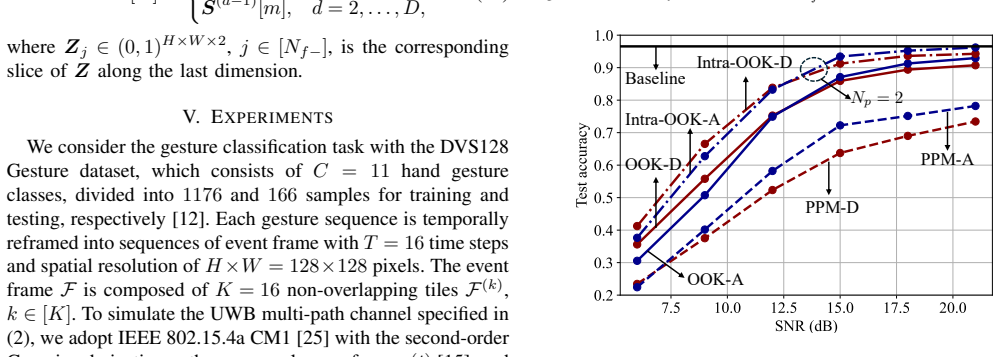
The growing number of Internet-of-Things (IoT) based artificial intelligence (AI) applications deployed at resource-constrained network edge call for ultra-reliable and low-latency data processing pipelines from distributed front-end sensors to remote inference units. Meanwhile, brain-inspired neuromorphic computing featuring spiking neural networks (SNNs) have arisen as a new paradigm for energy-efficient AI inference. However, significant energy and time expenses incurred in high-complexity transceivers that combat fading and multi-user interference hinder implementations of multi-user neuromorphic inference for edge intelligence. To address this challenge, we consider in this paper a broadband multi-user remote inference system that integrates event-based sensing and time-hopping (TH) on-off keying (OOK) based ultra-wideband (UWB) communications for reliable neuromorphic inference. Specifically, we propose a novel two-timescale repetition coding that leverages intra-frame pulse sparsity for low-latency repetition. We also develop two neuromorphic inference schemes based on: (i) digital spike encoding that recovers each pixel of the event-frame by threshold-adaptive detection via an SNN based sparsity estimator; and (ii) analog spike encoding that converts noisy correlator outputs at the receiver into analog-valued inputs for end-to-end (E2E) classification. Finally, numerical results validate the effectiveness of the proposed coding schemes, and reveal a signal-to-noise ratio (SNR)-dependent performance crossover between the two inference schemes, indicating that analog spike encoding based schemes are preferable with mild or high SNR while digital spike encoding based schemes remain robust in low SNR regime.
Editorial analysis
A structured set of objections, weighed in public.
Referee Report
Summary. The paper considers a multi-user remote neuromorphic inference system that combines event-based sensing with time-hopping on-off keying ultra-wideband communications. It introduces a two-timescale repetition coding scheme that exploits intra-frame pulse sparsity to achieve low-latency repetition while combating fading and multi-user interference. Two inference approaches are developed: (i) digital spike encoding that recovers event-frame pixels via threshold-adaptive detection using an SNN-based sparsity estimator, and (ii) analog spike encoding that feeds noisy correlator outputs directly into an end-to-end classifier. Numerical results are claimed to validate both schemes and to demonstrate an SNR-dependent performance crossover, with analog encoding preferred at mild-to-high SNR and digital encoding more robust at low SNR.
Significance. If the numerical validation holds, the work offers a concrete path toward energy-efficient, low-latency multi-user neuromorphic inference at the network edge by reducing transceiver complexity through sparsity-aware coding and neuromorphic processing. The reported SNR crossover supplies actionable guidance on scheme selection under varying channel conditions. The concrete system model (TH-OOK UWB with two-timescale coding and SNN/analog front-ends) is a strength that makes the claims falsifiable.
major comments (1)
- [§V] §V (Numerical Results) and the associated figures: the central claim that the proposed schemes are validated and exhibit a clear SNR crossover rests on numerical results whose supporting details (Monte-Carlo trial count, exact channel realizations, error-bar reporting, data-exclusion criteria, and explicit baseline comparisons against conventional repetition coding) are not provided. Without these, the magnitude and statistical reliability of the crossover cannot be assessed and the effectiveness statements remain unsubstantiated.
minor comments (2)
- [§II] The system model in §II would benefit from an explicit block diagram showing the two-timescale repetition encoder, the SNN sparsity estimator, and the analog conversion path to clarify the signal flow between sensing, communication, and inference stages.
- [§III] Notation for the intra-frame and inter-frame repetition factors (e.g., N_p and N_f) is introduced without a compact summary table; adding such a table would improve readability when comparing the digital and analog schemes.
Simulated Author's Rebuttal
We thank the referee for the constructive feedback and the recommendation of minor revision. We address the single major comment below and will incorporate the requested details into the revised manuscript to strengthen the numerical validation.
read point-by-point responses
-
Referee: [§V] §V (Numerical Results) and the associated figures: the central claim that the proposed schemes are validated and exhibit a clear SNR crossover rests on numerical results whose supporting details (Monte-Carlo trial count, exact channel realizations, error-bar reporting, data-exclusion criteria, and explicit baseline comparisons against conventional repetition coding) are not provided. Without these, the magnitude and statistical reliability of the crossover cannot be assessed and the effectiveness statements remain unsubstantiated.
Authors: We agree that these simulation details are necessary to allow readers to assess statistical reliability. In the revised manuscript we will explicitly report the Monte-Carlo trial count, describe the exact channel realizations (including the number of independent fading draws per SNR point and the power-delay profile), add error bars to all performance curves, state that no data points were excluded, and include a direct comparison against conventional single-timescale repetition coding for TH-OOK UWB. These additions will substantiate both the effectiveness of the two-timescale scheme and the reported SNR-dependent crossover between the digital and analog spike-encoding approaches. revision: yes
Circularity Check
No significant circularity detected
full rationale
The paper proposes concrete new schemes (two-timescale repetition coding for TH-OOK UWB, digital spike encoding via SNN sparsity estimator, and analog spike encoding for E2E classification) in a multi-user remote inference system. Performance claims rest on numerical validation of effectiveness and an SNR-dependent crossover between schemes. No equations, derivations, or self-citations in the provided abstract or described structure reduce the target results to inputs by construction, fitted parameters renamed as predictions, or load-bearing self-referential uniqueness theorems. The argument chain is self-contained against external benchmarks via simulation.
Axiom & Free-Parameter Ledger
Reference graph
Works this paper leans on
-
[1]
Task-oriented integrated sensing, computation and communication for wireless edge ai,
H. Xing, G. Zhu, D. Liu, H. Wen, K. Huang, and K. Wu, “Task-oriented integrated sensing, computation and communication for wireless edge ai,”IEEE Netw., vol. 37, no. 4, pp. 135–144, 2023
work page 2023
-
[2]
Energy-efficient distributed spiking neural network for wireless edge intelligence,
Y . Liu, J. Chen, L. Yu, and X. Ge, “Energy-efficient distributed spiking neural network for wireless edge intelligence,”IEEE Trans. Wireless Commun., vol. 23, no. 9, pp. 11 245–11 259, 2024
work page 2024
-
[3]
A survey of model compression techniques for TinyML applications,
I. Lamaakal, C. Yahyati, I. Ouahbi, K. El Makkaoui, and Y . Maleh, “A survey of model compression techniques for TinyML applications,” in Proc. IEEE International Conference on Circuit, Systems and Commu- nication (ICCSC), 2025, pp. 1–6
work page 2025
-
[4]
Cooperative knowledge-distillation-based tiny DNN for UA V-assisted mobile-edge network,
L. Sun, Z. Liu, L. Wan, Y . Lin, L. Lin, J. Wang, and M. Gen, “Cooperative knowledge-distillation-based tiny DNN for UA V-assisted mobile-edge network,”IEEE Internet Things J., vol. 11, no. 18, pp. 30 204–30 216, 2024
work page 2024
-
[5]
Learning algorithms and signal processing for brain-inspired computing [from the guest editors],
O. Simeone, B. Rajendran, A. Gruning, E. S. Eleftheriou, M. Davies, S. Deneve, and G.-B. Huang, “Learning algorithms and signal processing for brain-inspired computing [from the guest editors],”IEEE Signal Process. Mag., vol. 36, no. 6, pp. 12–15, 2019
work page 2019
-
[6]
Lead federated neuromorphic learning for wireless edge artificial intelligence,
H. Yang, H. Lee, J. Ma, and H.-J. Yoo, “Lead federated neuromorphic learning for wireless edge artificial intelligence,”Nature Commun., vol. 13, p. 4143, 2022
work page 2022
-
[7]
Towards spike-based machine intelligence with neuromorphic computing,
K. Roy, A. Jaiswal, and P. Panda, “Towards spike-based machine intelligence with neuromorphic computing,”Nature, vol. 575, no. 7784, pp. 607–617, 2019
work page 2019
-
[8]
Event-based vision meets deep learning on steering prediction for self- driving cars,
A. I. Maqueda, A. Loquercio, G. Gallego, N. Garc ´ıa, and D. Scaramuzza, “Event-based vision meets deep learning on steering prediction for self- driving cars,” inProc. IEEE Conference on Computer Vision and Pattern Recognition (CVPR), 2018, pp. 5419–5427
work page 2018
-
[9]
Bioinspired spiking architecture enables energy constrained touch encoding,
A. Ortone, M. Filosa, G. Indiveri, G. Desoli, A. Mazzoni, and C. M. Oddo, “Bioinspired spiking architecture enables energy constrained touch encoding,”Nature Commun., vol. 17, p. 2108, 2026
work page 2026
-
[10]
Embodied neuromorphic intelligence,
C. Bartolozzi, G. Indiveri, and E. Donati, “Embodied neuromorphic intelligence,”Nature Commun., vol. 13, p. 1024, 2022
work page 2022
-
[11]
A 128×128 120 db 15µs latency asynchronous temporal contrast vision sensor,
P. Lichtsteiner, C. Posch, and T. Delbruck, “A 128×128 120 db 15µs latency asynchronous temporal contrast vision sensor,”IEEE J. Solid- State Circuits, vol. 43, no. 2, pp. 566–576, 2008
work page 2008
-
[12]
A low power, fully event-based gesture recognition system,
A. Amir, B. Taba, D. Berget al., “A low power, fully event-based gesture recognition system,” inProc. IEEE Conference on Computer Vision and Pattern Recognition (CVPR), 2017, pp. 7243–7252
work page 2017
-
[13]
2022 roadmap on neuromorphic computing and engineering,
D. V . Christensen, R. Dittmann, B. Linares-Barrancoet al., “2022 roadmap on neuromorphic computing and engineering,”Neuromorphic Comput. Eng., vol. 2, no. 2, p. 022501, 2022
work page 2022
-
[14]
A review of training methods for spiking neural networks,
S. B. Shrestha and G. Orchard, “A review of training methods for spiking neural networks,”Neural Networks, vol. 153, pp. 395–412, 2022
work page 2022
-
[15]
Multiple access with time-hopping impulse modulation,
R. A. Scholtz, “Multiple access with time-hopping impulse modulation,” inProc. IEEE Military Communications Conference (MILCOM), vol. 2. IEEE, 1993, pp. 447–450
work page 1993
-
[16]
M. Z. Win and R. A. Scholtz, “Ultra-wide bandwidth time-hopping spread-spectrum impulse radio for wireless multiple-access communi- cations,”IEEE Trans. Commun., vol. 48, no. 4, pp. 679–689, 2000
work page 2000
-
[17]
The ultra-wide bandwidth indoor channel: From statistical model to simulations,
D. Cassioli, M. Z. Win, and A. F. Molisch, “The ultra-wide bandwidth indoor channel: From statistical model to simulations,”IEEE J. Sel. Areas Commun., vol. 20, no. 6, pp. 1247–1257, 2002
work page 2002
-
[18]
Neuromorphic wireless cognition: Event-driven semantic communications for remote inference,
J. Chen, N. Skatchkovsky, and O. Simeone, “Neuromorphic wireless cognition: Event-driven semantic communications for remote inference,” IEEE Trans. Cogn. Commun. Netw., vol. 9, no. 2, pp. 252–265, 2023
work page 2023
-
[19]
Neuromorphic integrated sensing and communications,
J. Chen, N. Skatchkovsky, and O. Simeone, “Neuromorphic integrated sensing and communications,”IEEE Wireless Commun. Lett., vol. 12, no. 3, pp. 476–480, 2023
work page 2023
-
[20]
Neuromor- phic split computing with wake-up radios: Architecture and design via digital twinning,
J. Chen, S. Park, P. Popovski, H. V . Poor, and O. Simeone, “Neuromor- phic split computing with wake-up radios: Architecture and design via digital twinning,”IEEE Trans. Signal Process., vol. 72, pp. 4143–4158, 2024
work page 2024
-
[21]
Neuro- morphic wireless split computing with multi-level spikes,
D. Wu, J. Chen, B. Rajendran, H. V . Poor, and O. Simeone, “Neuro- morphic wireless split computing with multi-level spikes,”IEEE Trans. Mach. Learn. Commun. Netw., vol. 3, pp. 502–516, 2025
work page 2025
-
[22]
SNN-SC: A spiking semantic communication framework for collaborative intelligence,
M. Wang, J. Li, M. Ma, and X. Fan, “SNN-SC: A spiking semantic communication framework for collaborative intelligence,”IEEE Trans. V eh. Technol., vol. 74, no. 4, pp. 5883–5896, 2025
work page 2025
-
[23]
S. Liu, N. Mohammadi, and Y . Yi, “Quantization-aware training of spiking neural networks for energy-efficient spectrum sensing on Loihi chip,”IEEE Trans. Green Commun. Netw., vol. 8, no. 2, pp. 827–838, 2024
work page 2024
-
[24]
DNN-SNN co-learning for sustainable symbol detection in 5G systems on Loihi chip,
S. Liu, Y . Liang, and Y . Yi, “DNN-SNN co-learning for sustainable symbol detection in 5G systems on Loihi chip,”IEEE Trans. Sustainable Comput., vol. 9, no. 2, pp. 170–181, 2024
work page 2024
-
[25]
IEEE standard for low-rate wireless networks,
“IEEE standard for low-rate wireless networks,”IEEE Std 802.15.4-2020 (Revision of IEEE Std 802.15.4-2015), pp. 1–800, 2020
work page 2020
-
[26]
Channel estimation for ultra- wideband communications,
V . Lottici, A. D’Andrea, and U. Mengali, “Channel estimation for ultra- wideband communications,”IEEE J. Sel. Areas Commun., vol. 20, no. 9, pp. 1638–1645, 2002
work page 2002
-
[27]
Low complexity RAKE receivers in ultra-wideband channels,
D. Cassioli, M. Z. Win, F. Vatalaro, and A. F. Molisch, “Low complexity RAKE receivers in ultra-wideband channels,”IEEE Trans. Wireless Commun., vol. 6, no. 4, pp. 1265–1275, 2007
work page 2007
-
[28]
N. Rathi, G. Srinivasan, P. Panda, and K. Roy, “DIET-SNN: A low- latency spiking neural network with direct input encoding and leakage and threshold optimization,”IEEE Trans. Neural Netw. Learn. Syst., vol. 34, no. 6, pp. 3174–3182, 2023
work page 2023
-
[29]
Incorporating learnable membrane time constant to enhance learning of spiking neural networks,
W. Fang, Z. Yu, Y . Chen, T. Masquelier, T. Huang, and Y . Tian, “Incorporating learnable membrane time constant to enhance learning of spiking neural networks,” inProc. IEEE/CVF International Conference on Computer Vision (ICCV), 2021, pp. 2661–2671
work page 2021
discussion (0)
Sign in with ORCID, Apple, or X to comment. Anyone can read and Pith papers without signing in.