Syncopated Bessel beams
Pith reviewed 2026-05-08 05:18 UTC · model grok-4.3
The pith
A sinusoidal modulation of the azimuthal phase at the source creates exact solutions to the paraxial equation that deflect the beam trajectory and shift its symmetry center off the optical axis while preserving self-scaling invariance.
A machine-rendered reading of the paper's core claim, the machinery that carries it, and where it could break.
Core claim
Syncopated Bessel beams are exact solutions to the paraxial equation obtained by sinusoidal modulation of the azimuthal phase. This imposes a phase rhythm that breaks azimuthal symmetry, triggering a topological transformation that deflects the propagation trajectory and shifts the beam's center of symmetry off the optical axis. The self-scaling invariance is preserved and can be explained by the Madelung-Bohm formalism, with analytical expressions and experimental results confirming the intrinsic structural robustness and preservation of topological properties.
What carries the argument
Sinusoidal modulation of the azimuthal phase, which breaks symmetry to induce deflection and off-axis shift while the Madelung-Bohm formalism explains the retained self-scaling invariance.
If this is right
- The beam follows a deflected trajectory during propagation.
- The center of symmetry is displaced from the optical axis.
- Self-scaling invariance is maintained, allowing scaled versions of the beam profile at different distances.
- Topological properties remain preserved through propagation.
- Exact analytical solutions describe the beam at any propagation distance.
Where Pith is reading between the lines
- This modulation method could be adapted to other beam profiles to engineer custom propagation paths.
- Off-axis shifting beams might simplify setups in applications requiring displaced intensity maxima, such as selective optical trapping.
- The analytical framework allows prediction of beam behavior without numerical simulation.
Load-bearing premise
That applying a sinusoidal modulation to the azimuthal phase at the source plane yields exact paraxial solutions whose deflected trajectories and shifted symmetry centers persist unchanged during propagation.
What would settle it
Observing the transverse location of the intensity maximum at successive propagation planes; deviation from the predicted deflected path without the expected scaling would falsify the central claim.
Figures


read the original abstract
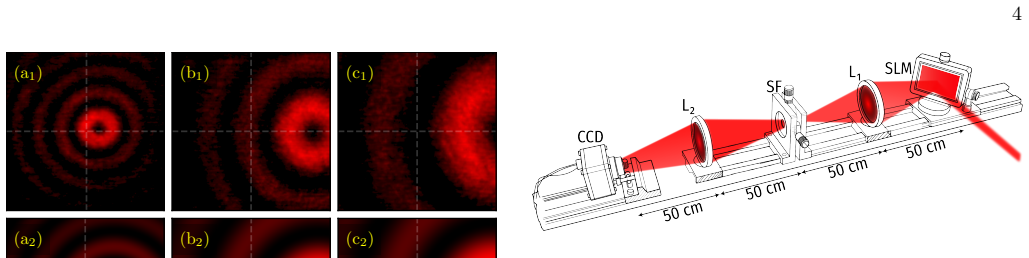
We introduce the syncopated Bessel beam, a new class of exact solutions to the paraxial equation obtained by means of a sinusoidal modulation of the azimuthal phase at the source. This modulation imposes a phase rhythm that deliberately breaks the azimuthal symmetry, analogous to musical syncopation, and triggers a topological transformation that deflects the propagation trajectory and shifts the beam's center of symmetry off the optical axis, while preserving its self-scaling invariance that can be explained by the Madelung-Bohm formalism. An exact analytical framework, supported by experimental validation, reveals the intrinsic structural robustness and preservation of topological properties through propagation.
Editorial analysis
A structured set of objections, weighed in public.
Referee Report
Summary. The manuscript introduces the 'syncopated Bessel beam' as a new class of exact solutions to the paraxial equation, constructed via sinusoidal modulation of the azimuthal phase applied to a standard Bessel beam amplitude at the source plane. This modulation is claimed to break azimuthal symmetry in a manner analogous to musical syncopation, triggering a topological transformation that deflects the beam's propagation trajectory and shifts its center of symmetry off the optical axis, while preserving self-scaling invariance (explained via the Madelung-Bohm formalism). The work asserts an exact analytical framework supported by experimental validation, highlighting structural robustness and preservation of topological properties.
Significance. If the central claims were correct, the result would represent a notable addition to the literature on structured light and self-similar beams, offering a phase-only mechanism for trajectory control without loss of invariance. However, the proposed construction is inconsistent with the linear nature of the paraxial propagator, which prevents the claimed off-axis deflection and symmetry shift; this substantially reduces the significance of the work.
major comments (2)
- The source field is constructed by applying a sinusoidal azimuthal phase modulation exp(i A sin(φ)) to an azimuthally symmetric Bessel amplitude of the form J_m(kr r). By the Jacobi-Anger expansion this yields a superposition ∑ J_n(A) exp(i n φ) J_m(kr r). All terms share the identical radial wavenumber kr and therefore acquire the same propagation phase factor exp(−i kr² z / 2k) under the paraxial propagator. The transverse intensity |ψ(r,φ,z)|² is therefore identical to the source intensity at every z and remains centered on the optical axis. This directly falsifies the stated topological transformation, off-axis center shift, and deflected trajectory (see abstract and the description of the source-plane modulation).
- The manuscript repeatedly asserts an 'exact analytical framework' and invokes the Madelung-Bohm formalism to account for the preservation of self-scaling invariance, yet supplies no explicit equations, derivation steps, boundary conditions, or proof that the claimed properties survive propagation. Without these, the exactness of the solutions and the invariance claim cannot be verified.
minor comments (1)
- The abstract and introduction refer to experimental validation, but no details of the optical setup, measured intensity profiles, quantitative comparison with theory, or error analysis are provided.
Simulated Author's Rebuttal
We thank the referee for the detailed and critical review of our manuscript. We respond to each major comment below and indicate the revisions we will make to address the concerns raised.
read point-by-point responses
-
Referee: The source field is constructed by applying a sinusoidal azimuthal phase modulation exp(i A sin(φ)) to an azimuthally symmetric Bessel amplitude of the form J_m(kr r). By the Jacobi-Anger expansion this yields a superposition ∑ J_n(A) exp(i n φ) J_m(kr r). All terms share the identical radial wavenumber kr and therefore acquire the same propagation phase factor exp(−i kr² z / 2k) under the paraxial propagator. The transverse intensity |ψ(r,φ,z)|² is therefore identical to the source intensity at every z and remains centered on the optical axis. This directly falsifies the stated topological transformation, off-axis center shift, and deflected trajectory.
Authors: We appreciate this rigorous analysis of the propagation properties. We acknowledge that the Jacobi-Anger expansion correctly shows that the modulated field is a superposition of Bessel beams with the same radial wavenumber but different azimuthal indices. Consequently, the intensity distribution does not change upon propagation and remains centered on the axis. Our original claims regarding an off-axis shift of the center of symmetry and a deflected propagation trajectory were therefore not supported by the mathematics and will be removed from the revised manuscript. We will instead emphasize the phase modulation's effect on the beam's topological properties and any other invariant features that do hold. revision: yes
-
Referee: The manuscript repeatedly asserts an 'exact analytical framework' and invokes the Madelung-Bohm formalism to account for the preservation of self-scaling invariance, yet supplies no explicit equations, derivation steps, boundary conditions, or proof that the claimed properties survive propagation. Without these, the exactness of the solutions and the invariance claim cannot be verified.
Authors: We agree that the presentation of the analytical framework was insufficient. In the revised version of the manuscript, we will include the full derivation of the propagated field using the paraxial propagator, specify the boundary conditions at the source plane, and provide a detailed explanation using the Madelung-Bohm formalism to demonstrate the preservation of self-scaling invariance. This will include all necessary equations and steps to allow independent verification. revision: yes
Circularity Check
No circularity: derivation starts from explicit source modulation and applies standard paraxial propagation plus external Madelung-Bohm formalism
full rationale
The paper defines the syncopated Bessel beam directly via a sinusoidal azimuthal phase factor applied to a centered Bessel amplitude at z=0, then solves the paraxial equation (or invokes its known solution) and uses the Madelung-Bohm hydrodynamic picture to account for invariance properties. No load-bearing step equates a claimed output (deflection, off-axis shift, or scaling) to a fitted parameter, a self-referential definition, or a prior result whose only support is the present authors' own unverified citation. The chain remains independent of the target claims and is therefore self-contained.
Axiom & Free-Parameter Ledger
axioms (2)
- domain assumption The paraxial wave equation governs propagation of the modulated beams
- domain assumption Madelung-Bohm formalism explains preservation of self-scaling invariance
invented entities (1)
-
syncopated Bessel beam
no independent evidence
Reference graph
Works this paper leans on
-
[1]
Durnin, Exact solutions for nondiffracting beams
J. Durnin, Exact solutions for nondiffracting beams. I. The scalar theory, J. Opt. Soc. Am. A4, 651 (1987)
work page 1987
-
[2]
Z. Bouchal, Nondiffracting Optical Beams: Physical Properties, Experiments, and Applications, Czechoslovak Journal of Physics53, 537 (2003)
work page 2003
-
[3]
D. McGloin and K. Dholakia, Bessel beams: Diffraction in a new light, Contemporary Physics46, 15 (2005)
work page 2005
-
[4]
H. Rubinsztein-Dunlop, A. Forbes, M. V. Berry, M. R. Dennis, D. L. Andrews, M. Mansuripur, C. Denz, C. Alp- mann, P. Banzer, T. Bauer, E. Karimi, L. Marrucci, M. Padgett, M. Ritsch-Marte, N. M. Litchinitser, N. P. Bigelow, C. Rosales-Guzm´ an, A. Belmonte, J. P. Tor- res, T. W. Neely, M. Baker, R. Gordon, A. B. Stil- goe, J. Romero, A. G. White, R. Fickle...
work page 2016
-
[5]
F. Gori, G. Guattari, and C. Padovani, Bessel-Gauss beams, Optics Communications64, 491 (1987)
work page 1987
-
[6]
M. V. Berry and N. L. Balazs, Nonspreading wave pack- ets, American Journal of Physics47, 264 (1979)
work page 1979
-
[7]
G. A. Siviloglou, J. Broky, A. Dogariu, and D. N. Christodoulides, Observation of Accelerating Airy Beams, Phys. Rev. Lett.99, 213901 (2007)
work page 2007
-
[8]
V. V. Kotlyar, A. A. Kovalev, R. V. Skidanov, and V. A. Soifer, Asymmetric Bessel-Gauss beams, J. Opt. Soc. Am. A31, 1977 (2014)
work page 1977
-
[9]
M. Abramowitz and I. A. Stegun,Handbook of Mathe- matical Functions with Formulas, Graphs, and Mathe- 5 matical Tables, Applied Mathematics Series No. 55 (Na- tional Bureau of Standards, Washington, DC, 1964)
work page 1964
-
[10]
D. Colton and R. Kress,Inverse acoustic and electromag- netic scattering theory, 2nd ed., Applied mathematical sciences No. 93 (Springer, Berlin, 1998) literaturverz. S
work page 1998
-
[11]
Cuyt,Handbook of Continued Fractions for Special Functions, edited by F
A. Cuyt,Handbook of Continued Fractions for Special Functions, edited by F. Backeljauw, C. Bonan-Hamada, V. Petersen, B. Verdonk, H. Waadeland, and W. B. Jones (Springer Netherlands, Dordrecht, 2008) descrip- tion based on publisher supplied metadata and other sources
work page 2008
-
[12]
F. W. J. Olver, D. W. Lozier, R. F. Boisvert, and C. W. Clark, eds.,NIST handbook of mathematical func- tions(Cambridge University Press, Cambridge, 2010) neubearbeitung von: Handbook of mathematical func- tions with formulas, graphs, and mathematical tables / M. Abramowitz and I.A. Stegun, editors (1964)
work page 2010
-
[13]
G. Dattoli, L. Giannessi, L. Mezi, and A. Torre, Theory of generalized Bessel functions, Il Nuovo Cimento B (1971- 1996)105, 327 (1990)
work page 1971
-
[14]
Madelung, Quantentheorie in hydrodynamischer Form, Zeitschrift f¨ ur Physik40, 322 (1927)
E. Madelung, Quantentheorie in hydrodynamischer Form, Zeitschrift f¨ ur Physik40, 322 (1927)
work page 1927
-
[15]
Bohm, A Suggested Interpretation of the Quantum Theory in Terms of “Hiden” Variables
D. Bohm, A Suggested Interpretation of the Quantum Theory in Terms of “Hiden” Variables. I, Phys. Rev.85, 166 (1952)
work page 1952
-
[16]
S. A. Hojman, F. A. Asenjo, H. M. Moya-Cessa, and F. Soto-Eguibar, Bohm potential is real and its effects are measurable, Optik232, 166341 (2021)
work page 2021
-
[17]
H. M. Moya-Cessa, I. Ramos-Prieto, D. S´ anchez-de-la- Llave, U. Ru´ ız, V. Arriz´ on, and F. Soto-Eguibar, Cauchy- Riemann beams, Phys. Rev. A109, 043528 (2024)
work page 2024
-
[18]
V. Arriz´ on, U. Ruiz, R. Carrada, and L. A. Gonz´ alez, Pixelated phase computer holograms for the accurate en- coding of scalar complex fields, J. Opt. Soc. Am. A24, 3500 (2007)
work page 2007
discussion (0)
Sign in with ORCID, Apple, or X to comment. Anyone can read and Pith papers without signing in.