Recognition: unknown
Graph Neural Ordinary Differential Equations for Power System Identification
Pith reviewed 2026-05-08 02:01 UTC · model grok-4.3
The pith
Message-passing graph neural ordinary differential equations identify power system voltage and frequency dynamics while supporting transfer learning for added or removed components.
A machine-rendered reading of the paper's core claim, the machinery that carries it, and where it could break.
Core claim
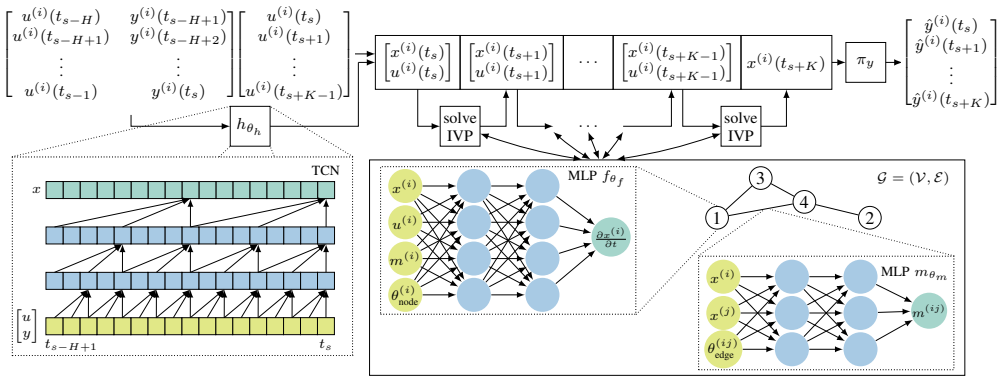
By extending graph NODEs with message passing, node and edge embeddings, and an autoregressive control scheme, the MPG-NODE learns latent representations of unmeasured states and identifies the dynamics of heterogeneous nodes and couplings. When applied to voltage and frequency dynamics under the same measurement assumptions used for a standard NODE, the graph-structured model exhibits greater flexibility, enabling transfer learning to modified power systems that add or remove lines and units with minimal additional training.
What carries the argument
Message-passing graph NODEs (MPG-NODEs) that propagate information across a graph encoding the power network while learning separate embeddings for each node type and edge type.
Load-bearing premise
The imposed graph structure and message-passing mechanism can accurately capture the underlying heterogeneous node dynamics and edge couplings from the available measurements without significant loss of fidelity.
What would settle it
If adding or removing a powerline on the IEEE 9-bus system forces full retraining or produces substantially higher voltage and frequency prediction errors after transfer, the flexibility advantage disappears.
Figures


read the original abstract
With the shift towards decentralized energy generation, the increasing complexity of power systems renders physics-based modeling challenging. At the same time the growing amount of available measurement data opens the door for obtaining models in a data-driven manner. A modern method to do so are neural ordinary differential equations (NODEs), offering a framework for continuous time system identification. Recent extensions, so called graph NODEs impose a structural inductive bias that has the potential to improve generalization of the learned representation. In this work, we employ graph NODEs and extend them with novel ideas to develop message-passing graph NODEs (MPG-NODEs) for identification of coupled systems with heterogeneous node dynamics and edge couplings. This encompasses state-of-the-art machine learning architectures to infer latent representations of unmeasured states from past measurements, local node and edge embeddings to account for heterogeneity as well as an autoregressive scheme to allow for piecewise constant control inputs. We apply MPG-NODEs to identify voltage and frequency dynamics of power systems and compare them to a monolith NODE under identical measurement assumptions. Our case study on the IEEE 9-bus system indicates that the proposed MPG-NODE offers a much more flexible framework with transfer learning options that allow to add or remove powerlines and units with little to no retraining.
Editorial analysis
A structured set of objections, weighed in public.
Referee Report
Summary. The paper proposes message-passing graph neural ordinary differential equations (MPG-NODEs) that extend graph NODEs with local node/edge embeddings, latent state inference from measurements, and autoregressive handling of piecewise-constant controls. The method is applied to identify voltage and frequency dynamics in power systems with heterogeneous nodes and edges. A case study on the fixed IEEE 9-bus system compares MPG-NODE performance to a monolithic NODE under identical measurement assumptions and claims that the graph-based approach yields a more flexible framework supporting transfer learning for addition or removal of powerlines and units with little retraining.
Significance. If the flexibility and transfer-learning claims are substantiated, the work would offer a data-driven alternative to physics-based modeling for increasingly complex, decentralized power systems. The application of established graph-NODE and message-passing techniques to this domain is a reasonable extension, though the absence of quantitative validation limits immediate impact.
major comments (2)
- [Abstract / Case study] Abstract and case-study description: the central claim that MPG-NODE 'offers a much more flexible framework with transfer learning options that allow to add or remove powerlines and units with little to no retraining' is unsupported. No experiments, zero-shot/few-shot metrics, or retraining-cost comparisons on modified topologies (altered adjacency, added/removed nodes or edges) are reported; the only comparison is to a monolithic NODE on the identical fixed IEEE 9-bus graph.
- [Case study / Results] Evaluation: the manuscript provides no quantitative metrics (prediction error, RMSE, R², etc.), ablation studies, or statistical analysis of how well the imposed graph structure and message-passing capture heterogeneous node dynamics and edge couplings. This absence makes it impossible to assess whether the architectural inductive bias actually improves fidelity over the baseline.
minor comments (2)
- Clarify the precise measurement assumptions and which states are treated as latent versus observed.
- Add explicit statements of the training loss, optimizer, and hyper-parameter choices to support reproducibility.
Simulated Author's Rebuttal
We thank the referee for their insightful comments, which help us improve the clarity and rigor of our work. We address each major comment below and outline the revisions we will make.
read point-by-point responses
-
Referee: [Abstract / Case study] Abstract and case-study description: the central claim that MPG-NODE 'offers a much more flexible framework with transfer learning options that allow to add or remove powerlines and units with little to no retraining' is unsupported. No experiments, zero-shot/few-shot metrics, or retraining-cost comparisons on modified topologies (altered adjacency, added/removed nodes or edges) are reported; the only comparison is to a monolithic NODE on the identical fixed IEEE 9-bus graph.
Authors: We agree with the referee that the manuscript does not provide experimental evidence for the transfer learning capabilities on modified topologies. The architectural design of MPG-NODEs, which relies on message passing over the graph structure with local embeddings, inherently allows the model to be applied to different graphs without retraining the core parameters, as the graph topology is an input. However, we recognize that this flexibility claim requires empirical support to be substantiated. In the revised manuscript, we will remove the specific claim about 'little to no retraining' from the abstract and case study section. We will also add a discussion on the potential for transfer learning based on the model structure. revision: yes
-
Referee: [Case study / Results] Evaluation: the manuscript provides no quantitative metrics (prediction error, RMSE, R², etc.), ablation studies, or statistical analysis of how well the imposed graph structure and message-passing capture heterogeneous node dynamics and edge couplings. This absence makes it impossible to assess whether the architectural inductive bias actually improves fidelity over the baseline.
Authors: We appreciate this observation. While the manuscript includes visual comparisons of the predicted dynamics against the ground truth for both the MPG-NODE and the monolithic NODE, we acknowledge the absence of explicit quantitative metrics and ablation studies. To address this, we will incorporate a new subsection in the case study with quantitative results, including RMSE values for voltage and frequency predictions, and perform ablations on key components such as the message-passing mechanism and latent state inference to quantify their contributions to performance. revision: yes
Circularity Check
No circularity; standard extension of GNNs and NODEs to power systems
full rationale
The paper defines MPG-NODEs via established message-passing graph neural networks combined with neural ODEs, local embeddings for heterogeneity, and an autoregressive control scheme. These components are introduced as architectural choices drawn from prior literature rather than derived from the target result. The IEEE 9-bus case study performs a direct empirical comparison to a monolithic NODE under identical fixed-topology measurements; the transfer-learning flexibility for topology changes is stated as an architectural property without any self-referential reduction, fitted-parameter renaming, or load-bearing self-citation that collapses the claim to its own inputs. No equations or steps reduce a prediction to a quantity defined by the result itself.
Axiom & Free-Parameter Ledger
Reference graph
Works this paper leans on
-
[1]
Application of neural ordinary differential equations to power system frequency dynamics,
T. Aryal, P. Aslami, N. Bhujel, H. M. Rekabdarkolaee, K. Fu, and T. M. Hansen, “Application of neural ordinary differential equations to power system frequency dynamics,” inNAPS, 2023, pp. 1–6
2023
-
[2]
Identification of power systems with droop-controlled units using neural ordinary differential equations,
H. M. H. Wolf and C. A. Hans, “Identification of power systems with droop-controlled units using neural ordinary differential equations,” in ECC, 2025, pp. 800–806
2025
-
[3]
Learning Power System Dynam- ics with Noisy Data Using Neural Ordinary Differential Equations,
S. Zhang, K. Yamashita, and N. Yu, “Learning Power System Dynam- ics with Noisy Data Using Neural Ordinary Differential Equations,” inIEEE PESGM, 2024, pp. 1–5
2024
-
[4]
Augmented neural ordinary differential equations for power system identification,
H. M. H. Wolf and C. A. Hans, “Augmented neural ordinary differential equations for power system identification,” 2025. [Online]. Available: https://arxiv.org/abs/2512.07757
-
[5]
Graph Neural Network and Koopman Models for Learning Networked Dynamics: A Comparative Study on Power Grid Transients Prediction,
S. P. Nandanoori, S. Guan, S. Kundu, S. Pal, K. Agarwal, Y . Wu, and S. Choudhury, “Graph Neural Network and Koopman Models for Learning Networked Dynamics: A Comparative Study on Power Grid Transients Prediction,”IEEE Access, vol. 10, pp. 32 337–32 349, 2022
2022
-
[6]
Structure-Informed Graph Learning of Networked Dependencies for Online Prediction of Power System Transient Dynamics,
T. Zhao, M. Yue, and J. Wang, “Structure-Informed Graph Learning of Networked Dependencies for Online Prediction of Power System Transient Dynamics,”IEEE Transactions on Power Systems, vol. 37, no. 6, pp. 4885–4895, Nov. 2022
2022
-
[7]
PIDGeuN: Graph Neural Network-Enabled Transient Dynamics Prediction of Networked Microgrids Through Full-Field Measurement,
Y . Yu, X. Jiang, D. Huang, Y . Li, M. Yue, and T. Zhao, “PIDGeuN: Graph Neural Network-Enabled Transient Dynamics Prediction of Networked Microgrids Through Full-Field Measurement,”IEEE Ac- cess, pp. 1–1, 2024
2024
-
[8]
A Multi-Task Spatiotemporal Graph Neural Network for Transient Stability and State Prediction in Power Systems,
S. Wang, X. Xiang, J. Zhang, Z. Liang, S. Li, P. Zhong, J. Zeng, and C. Wang, “A Multi-Task Spatiotemporal Graph Neural Network for Transient Stability and State Prediction in Power Systems,”Energies, vol. 18, no. 6, p. 1531, Mar. 2025
2025
-
[9]
arXiv preprint arXiv:1911.07532 , year=
M. Poli, S. Massaroli, J. Park, A. Yamashita, H. Asama, and J. Park, “Graph neural ordinary differential equations,”CoRR, vol. abs/1911.07532, 2019. [Online]. Available: http://arxiv.org/abs/1911. 07532
-
[10]
Decomposing heterogeneous dynamical systems with graph neural networks,
C. Allier, M. C. Schneider, M. Innerberger, L. Heinrich, J. A. Bogovic, and S. Saalfeld, “Decomposing heterogeneous dynamical systems with graph neural networks,” Aug. 2025, arXiv:2407.19160 [cs]. [Online]. Available: http://arxiv.org/abs/2407.19160
-
[11]
Generalizing Graph ODE for Learning Complex System Dynamics across Environments,
Z. Huang, Y . Sun, and W. Wang, “Generalizing Graph ODE for Learning Complex System Dynamics across Environments,” in29th ACM SIGKDD Int. Conf. Knowl. Discov. Data Min.Long Beach CA USA: ACM, Aug. 2023, pp. 798–809
2023
-
[12]
An empirical evaluation of generic convolutional and recurrent networks for sequence modeling,
S. Bai, J. Z. Kolter, and V . Koltun, “An empirical evaluation of generic convolutional and recurrent networks for sequence modeling,”
-
[13]
An Empirical Evaluation of Generic Convolutional and Recurrent Networks for Sequence Modeling
[Online]. Available: https://arxiv.org/abs/1803.01271
work page internal anchor Pith review arXiv
-
[14]
Stability and power sharing in microgrids,
J. Schiffer, “Stability and power sharing in microgrids,” PhD thesis, Technische Universit¨at Berlin, 2015
2015
-
[15]
Kundur, N
P. Kundur, N. J. Balu, and M. G. Lauby,Power system stability and control, ser. The EPRI power system engineering series. New York, USA: McGraw-Hill, 1994
1994
-
[16]
J. M. Guerrero, M. Chandorkar, T.-L. Lee, and P. C. Loh, “Advanced Control Architectures for Intelligent Microgrids—Part I: Decentralized and Hierarchical Control,”IEEE Transactions on Industrial Electronics, vol. 60, no. 4, pp. 1254–1262, Apr. 2013. [Online]. Available: http://ieeexplore.ieee.org/document/6184305/
-
[17]
Conditions for stability of droop-controlled inverter-based microgrids,
J. Schiffer, R. Ortega, A. Astolfi, J. Raisch, and T. Sezi, “Conditions for stability of droop-controlled inverter-based microgrids,”Automat- ica, vol. 50, no. 10, pp. 2457–2469, 2014
2014
-
[18]
Synchronization of droop-controlled microgrids with distributed rotational and electronic generation,
J. Schiffer, D. Goldin, J. Raisch, and T. Sezi, “Synchronization of droop-controlled microgrids with distributed rotational and electronic generation,” in52nd IEEE CDC, 2013, pp. 2334–2339
2013
-
[19]
Neural Ordinary Differential Equations,
R. T. Q. Chen, Y . Rubanova, J. Bettencourt, and D. K. Duvenaud, “Neural Ordinary Differential Equations,” inNeurIPS, vol. 31, 2018
2018
-
[20]
Dissect- ing Neural ODEs,
S. Massaroli, M. Poli, J. Park, A. Yamashita, and H. Asama, “Dissect- ing Neural ODEs,” inNeurIPS, vol. 33, 2020, pp. 3952–3963
2020
-
[21]
Learning neural state-space models: do we need a state estimator?
M. Forgione, M. Mejari, and D. Piga, “Learning neural state-space models: do we need a state estimator?” 2022. [Online]. Available: https://arxiv.org/abs/2206.12928
- [22]
-
[23]
Mat- power: Steady-state operations, planning, and analysis tools for power systems research and education,
R. D. Zimmerman, C. E. Murillo-S ´anchez, and R. J. Thomas, “Mat- power: Steady-state operations, planning, and analysis tools for power systems research and education,”IEEE Trans. Power Syst., vol. 26, no. 1, pp. 12–19, 2011
2011
-
[24]
torchdiffeq,
R. T. Q. Chen, “torchdiffeq,” 2018. [Online]. Available: https: //github.com/rtqichen/torchdiffeq
2018
-
[25]
C. A. Hans,Operation control of islanded microgrids, 1st ed. DE: Shaker Verlag GmbH, 2021
2021
-
[26]
Continuous-time system identification with neural networks: Model structures and fitting criteria,
M. Forgione and D. Piga, “Continuous-time system identification with neural networks: Model structures and fitting criteria,”Eur. J. Control, vol. 59, pp. 69–81, 2021
2021
-
[27]
Adam: A Method for Stochastic Optimization,
D. P. Kingma and J. Ba, “Adam: A Method for Stochastic Optimization,” 2017. [Online]. Available: https://arxiv.org/abs/1412. 6980
2017
-
[28]
Algorithms for hyper-parameter optimization,
J. Bergstra, R. Bardenet, Y . Bengio, and B. K ´egl, “Algorithms for hyper-parameter optimization,” inNeurIPS, vol. 24, 2011
2011
-
[29]
Optuna: A next-generation hyperparameter optimization framework,
T. Akiba, S. Sano, T. Yanase, T. Ohta, and M. Koyama, “Optuna: A next-generation hyperparameter optimization framework,” inACM SIGKDD Int. Conf. Knowl. Discov. Data Min., 2019, pp. 2623–2631
2019
discussion (0)
Sign in with ORCID, Apple, or X to comment. Anyone can read and Pith papers without signing in.