Multilevel radial basis function surrogates for noise-robust DSMC-CFD coupling
Pith reviewed 2026-05-08 01:30 UTC · model grok-4.3
The pith
Multilevel radial basis functions let the MMS-Sparse method couple DSMC to CFD on complex geometries while staying robust to particle noise.
A machine-rendered reading of the paper's core claim, the machinery that carries it, and where it could break.
Core claim
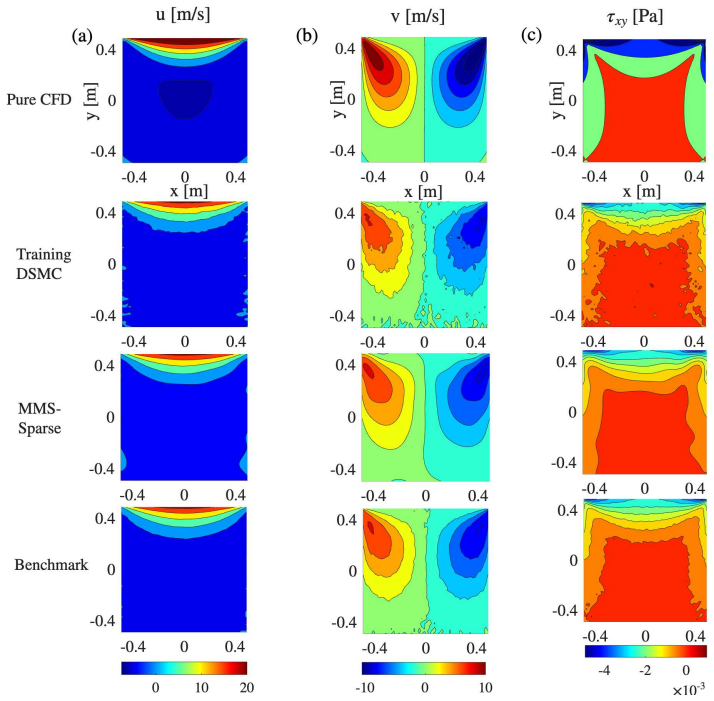
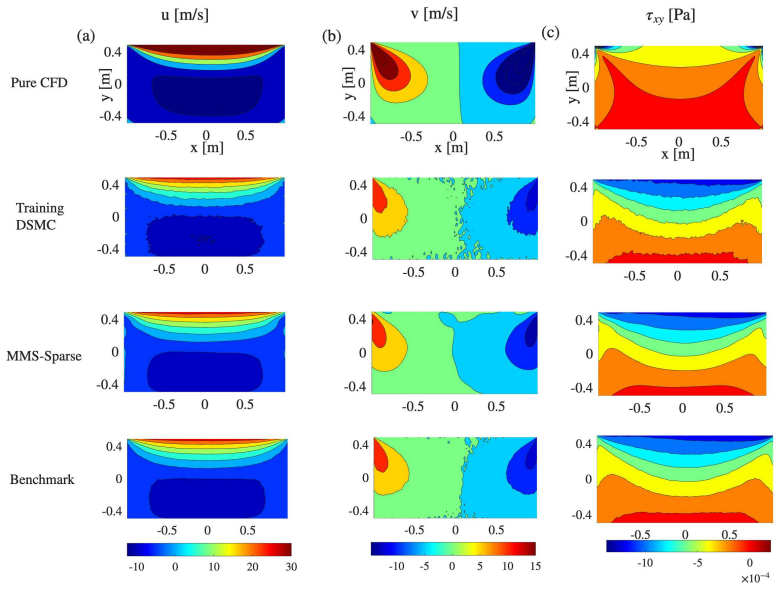
The central claim is that multilevel radial basis functions can be substituted for global polynomials inside the MMS-Sparse framework so that the resulting smooth constitutive corrections remain accurate enough for stable DSMC-CFD coupling on spatially complex domains, as shown by agreement with reference solutions on the lid-driven cavity test case.
What carries the argument
Multilevel radial basis functions that combine coarse and fine local kernels to represent the Bayesian surrogate corrections to the CFD constitutive relations at multiple spatial scales.
If this is right
- The hybrid solver can be applied to arbitrary two-dimensional domains without requiring geometry-specific manual tuning of basis functions.
- Statistical noise from the DSMC region continues to be filtered by the Bayesian surrogate, preserving stability of the coupled system.
- The method integrates directly with existing finite-volume CFD codes such as OpenFOAM.
- The same surrogate construction retains the automation and noise-robustness properties of the original MMS-Sparse approach.
Where Pith is reading between the lines
- The local character of the multilevel functions suggests the surrogate could be refined adaptively in regions of high flow gradient, potentially lowering overall computational cost.
- The same replacement of global by multilevel bases might be tested in three-dimensional hybrid simulations of devices with realistic internal geometry.
- Because the corrections remain smooth, the approach could be examined for other particle-continuum couplings that suffer from statistical fluctuations, such as certain plasma or granular-flow problems.
Load-bearing premise
That multilevel radial basis functions can represent the required smooth constitutive corrections accurately enough across complex geometries without introducing new errors or instabilities into the DSMC-CFD coupling.
What would settle it
A quantitative comparison of hybrid simulation results against a converged full-DSMC reference on a geometry containing sharp corners or curved boundaries, checking whether any macroscopic flow quantities diverge beyond the level of statistical fluctuations.
Figures






read the original abstract
Hybrid methods for simulating rarefied gas flows reduce computational cost by coupling a particle-based model, typically the direct simulation Monte Carlo (DSMC) method, to a continuum-based solver, i.e. a computational fluid dynamics (CFD) code. However, widespread adoption of these methods is hindered by numerical instabilities caused by statistical noise and difficulties in applying them to complex, arbitrary geometries. To be effective, a hybrid framework must be robust to noise, reliable in not introducing errors to the flow physics, automated, and flexible enough for general spatial domains. Previous iterations of the micro-macro-surrogate-sparse (MMS-Sparse) method successfully addressed the first three requirements using Bayesian surrogate models to provide smooth, constitutive corrections to the CFD. However, they relied on global basis functions, limiting their applicability to relatively simple geometries. In this work, we address the fourth requirement - flexibility - by introducing a set of multilevel radial basis functions (RBFs) to represent the smooth corrections within the MMS-Sparse framework. Unlike global polynomials, multilevel RBFs can resolve broad and fine flow details locally, allowing the method to be applied to complex geometrical systems. We couple this approach with a finite-volume CFD solver (OpenFOAM) and validate it using the rarefied lid-driven cavity flow problem. This serves as a rigorous test case for spatially two-dimensional coupling. Our results demonstrate that this enhanced MMS-Sparse method produces estimates in good agreement with benchmarks while retaining the noise-robust and automated benefits of the Bayesian approach.
Editorial analysis
A structured set of objections, weighed in public.
Referee Report
Summary. The paper extends the MMS-Sparse Bayesian surrogate framework for hybrid DSMC-CFD coupling of rarefied flows by replacing global basis functions with multilevel radial basis functions (RBFs). This change is intended to enable application to complex arbitrary geometries while preserving noise robustness and automation. The method is coupled to OpenFOAM and validated on the 2D rarefied lid-driven cavity flow, with results claimed to agree with benchmarks.
Significance. If the multilevel RBF construction can be shown to deliver accurate constitutive corrections without introducing interpolation errors or coupling instabilities on non-rectangular domains, the work would meaningfully advance hybrid methods by removing a key geometric restriction from prior MMS-Sparse versions. The retention of the Bayesian noise-robustness property is a clear strength.
major comments (2)
- [§4 and Abstract] §4 (Numerical Results) and Abstract: The validation is performed exclusively on the lid-driven cavity in a rectangular domain. This geometry does not exercise the claimed flexibility for complex or arbitrary boundaries, leaving untested whether multilevel RBFs avoid the interpolation errors or instabilities that previously limited global bases.
- [Abstract and §4] Abstract and §4: No quantitative error metrics (e.g., L2 or L∞ norms versus benchmark solutions), convergence rates, or explicit measures of statistical-noise impact are supplied to substantiate the statements of “good agreement” and retained “noise robustness.”
minor comments (1)
- [§3] The description of the multilevel RBF construction (partitioning, overlap, and conditioning) would benefit from an explicit algorithmic outline or pseudocode to aid reproducibility.
Simulated Author's Rebuttal
We thank the referee for their constructive and detailed review. We address each major comment point by point below, with proposed revisions to the manuscript where the comments identify areas for improvement.
read point-by-point responses
-
Referee: [§4 and Abstract] §4 (Numerical Results) and Abstract: The validation is performed exclusively on the lid-driven cavity in a rectangular domain. This geometry does not exercise the claimed flexibility for complex or arbitrary boundaries, leaving untested whether multilevel RBFs avoid the interpolation errors or instabilities that previously limited global bases.
Authors: We agree that the validation case is restricted to the rectangular lid-driven cavity. This geometry was selected as a standard, well-documented benchmark for 2D rarefied hybrid coupling that permits direct quantitative comparison with existing DSMC and hybrid results. The multilevel RBF construction is intended to remove the geometric restrictions of global bases by providing local support that can be adapted to arbitrary boundaries within the OpenFOAM finite-volume framework. Nevertheless, we acknowledge that the absence of a non-rectangular test case leaves the claims about interpolation errors and coupling stability on complex domains unverified in the present work. In the revised manuscript we will temper the language in the abstract and §4 to clarify the current validation scope and add a concise discussion of how the local RBF property enables extension to irregular domains, without overstating the demonstrated flexibility. revision: partial
-
Referee: [Abstract and §4] Abstract and §4: No quantitative error metrics (e.g., L2 or L∞ norms versus benchmark solutions), convergence rates, or explicit measures of statistical-noise impact are supplied to substantiate the statements of “good agreement” and retained “noise robustness.”
Authors: We thank the referee for highlighting this point. The current manuscript presents agreement primarily through visual overlay of profiles and contour plots. To strengthen the evidence, the revised §4 will include explicit quantitative metrics: L2 and L∞ norms of velocity and temperature fields relative to benchmark solutions, observed convergence behavior with respect to DSMC sample size, and a direct assessment of how statistical noise in the DSMC data propagates through the Bayesian surrogate. These additions will be supported by new tables or figures as appropriate. revision: yes
Circularity Check
No circularity in derivation chain
full rationale
The paper extends the prior MMS-Sparse Bayesian surrogate framework by replacing global basis functions with multilevel RBFs to enable complex-geometry coupling. No equations, predictions, or first-principles results are shown to reduce by construction to fitted inputs, self-definitions, or self-citation chains. The lid-driven cavity validation is presented as an independent benchmark test rather than a tautological output. All load-bearing steps (surrogate construction, noise robustness, OpenFOAM coupling) retain independent content and are not forced by renaming or ansatz smuggling.
Axiom & Free-Parameter Ledger
Reference graph
Works this paper leans on
-
[1]
General physics: mechanics and molecular physics
Lev Davidovich Landau, Aleksandr Il’ich Akhiezer, and E M Lifshitz. General physics: mechanics and molecular physics . Pergamon Press, 1967
1967
-
[2]
Flow of rarefied gases
Samuel A Schaaf and Paul L Chambré. Flow of rarefied gases . Vol. 8. Princeton University Press Princeton, 1961
1961
-
[3]
Molecular gas dynamics and the direct simulation of gas flows
Graeme A Bird. Molecular gas dynamics and the direct simulation of gas flows . Oxford university press, 1994
1994
-
[4]
Statistical error in particle simulations of h ydrody- namic phenomena
Nicolas G Hadjiconstantinou, Alejandro L Garcia, Marti n Z Bazant, and Gang He. “Statistical error in particle simulations of h ydrody- namic phenomena”. In: Journal of computational physics 187.1 (2003), pp. 274–297
2003
-
[5]
Microflows and nanoflows: fundamentals and simulation
George Karniadakis, Ali Beskok, and Narayan Aluru. Microflows and nanoflows: fundamentals and simulation . Vol. 29. Springer Science & Business Media, 2006. 40
2006
-
[6]
Two-dimensional hybr id contin- uum/particle approach for rarefied flows
Dean Wadsworth and Daniel Erwin. “Two-dimensional hybr id contin- uum/particle approach for rarefied flows”. In: 23rd Plasmadynamics and Lasers Conference . 1992, p. 2975
1992
-
[7]
Molecular dynami cs– continuum hybrid computations: a tool for studying complex fluid flows
Sean T O’connell and Peter A Thompson. “Molecular dynami cs– continuum hybrid computations: a tool for studying complex fluid flows”. In: Physical Review E 52.6 (1995), R5792
1995
-
[8]
Adaptive mesh and algorithm refinement using direct simula- tion Monte Carlo
Alejandro L Garcia, John B Bell, William Y Crutchfield, an d Berni J Alder. “Adaptive mesh and algorithm refinement using direct simula- tion Monte Carlo”. In: Journal of computational Physics 154.1 (1999), pp. 134–155
1999
-
[9]
A hybrid part icle- continuum method applied to shock waves
Thomas E Schwartzentruber and Iain D Boyd. “A hybrid part icle- continuum method applied to shock waves”. In: Journal of Compu- tational Physics 215.2 (2006), pp. 402–416
2006
-
[10]
A hybrid continuum-pa rticle solver for unsteady rarefied gas flows
Sarantis Pantazis and H Rusche. “A hybrid continuum-pa rticle solver for unsteady rarefied gas flows”. In: Vacuum 109 (2014), pp. 275–283
2014
-
[11]
Coupling heterogeneous continuum-particl e fields to simulate non-isothermal microscale gas flows
Stephanie Y Docherty, Matthew K Borg, Duncan A Lockerby , and Jason M Reese. “Coupling heterogeneous continuum-particl e fields to simulate non-isothermal microscale gas flows”. In: International Journal of Heat and Mass Transfer 98 (2016), pp. 712–727
2016
-
[12]
Simulation of the head-disk interface gap using a hybrid multi-scale method
Benzi John, Duncan A Lockerby, Alexander Patronis, and David R Emerson. “Simulation of the head-disk interface gap using a hybrid multi-scale method”. In: Microfluidics and Nanofluidics 22.9 (2018), p. 106
2018
-
[13]
Particle-based hybrid and multiscale methods for nonequi librium gas flows
Jun Zhang, Benzi John, Marcel Pfeiffer, Fei Fei, and Dong sheng Wen. “Particle-based hybrid and multiscale methods for nonequi librium gas flows”. In: Advances in Aerodynamics 1.1 (2019), p. 12
2019
-
[14]
hybridDCFoam: A coupled DSMC/Navier–Stokes–Fourier solver for steady-state mult iscale rar- efied gas flows
Nikolaos Vasileiadis and Craig White. “hybridDCFoam: A coupled DSMC/Navier–Stokes–Fourier solver for steady-state mult iscale rar- efied gas flows”. In: Advances in Engineering Software 193 (2024), p. 103669
2024
-
[15]
Carte- sian grid-based hybrid NS-DSMC methodology for continuum- rarefied gas flows around complex geometries
Vinay Kumar, UV Bhandarkar, RK Singh, and Atul Sharma. “ Carte- sian grid-based hybrid NS-DSMC methodology for continuum- rarefied gas flows around complex geometries”. In: Numerical Heat Transfer, Part B: Fundamentals 85.7 (2024), pp. 883–905. 41
2024
-
[16]
Verification of a Modular DSMC-CFD Simula - tion Method Implementation for Expanding Rarefied Flows
Ioannis Nompelis, Michael D Kroells, Thomas Schwartze ntruber, and Graham V Candler. “Verification of a Modular DSMC-CFD Simula - tion Method Implementation for Expanding Rarefied Flows”. I n: AIAA SCITECH 2025 Forum . 2025, p. 0951
2025
-
[17]
A DSMC-CFD coupling method using surrogate modelling for low-speed ra refied gas flows
Giorgos Tatsios, Arun K Chinnappan, Arshad Kamal, Niko s Vasileiadis, Stephanie Y Docherty, Craig White, Livio Gibelli, Matthew K Borg, James R Kermode, and Duncan A Lockerby. “A DSMC-CFD coupling method using surrogate modelling for low-speed ra refied gas flows”. In: Journal of Computational Physics 520 (2025), p. 113500
2025
-
[18]
Bayesian regression-based continuum- particle method for low-speed rarefied flow: Application to unsteady P oiseuille flow
Arun Kumar Chinnappan, Arshad Kamal, James R Kermode, a nd Duncan A Lockerby. “Bayesian regression-based continuum- particle method for low-speed rarefied flow: Application to unsteady P oiseuille flow”. In: Physics of Fluids 37.3 (2025)
2025
-
[19]
Denoisi ng of direct simulation Monte Carlo data using proper orthogonal decompo- sition technique
Rakesh Kumar, Arun K Chinnappan, and MV Akhil. “Denoisi ng of direct simulation Monte Carlo data using proper orthogonal decompo- sition technique”. In: Journal of Spacecraft and Rockets 55.4 (2018), pp. 841–847
2018
-
[20]
Accel- erating multiscale modelling of fluids with on-the-fly Gauss ian process regression
David Stephenson, James R Kermode, and Duncan A Lockerb y. “Accel- erating multiscale modelling of fluids with on-the-fly Gauss ian process regression”. In: Microfluidics and Nanofluidics 22.12 (2018), p. 139
2018
-
[21]
Shape-informed surrogate models based on signed dis tance func- tion domain encoding
Linying Zhang, Stefano Pagani, Jun Zhang, and Francesc o Regaz- zoni. “Shape-informed surrogate models based on signed dis tance func- tion domain encoding”. In: Journal of Computational Physics (2025), p. 114178
2025
-
[22]
Data-Driven Surrog ate Modeling of DSMC Solutions Using Deep Neural Networks
Ehsan Roohi and Ahmad Shoja-sani. “Data-Driven Surrog ate Modeling of DSMC Solutions Using Deep Neural Networks”. In: arXiv preprint arXiv:2506.22453 (2025)
-
[23]
Ehsan Roohi. Accelerating Kinetic Fokker-Planck Simulations via a GPU-Native Deep Neural Network Surrogate: Application to R ar- efied Internal and Hypersonic External Flows . Jan. 2026. doi: 10.2139/ssrn.6203942
-
[24]
Pattern recognition and machine learning
Christopher M Bishop and Nasser M Nasrabadi. Pattern recognition and machine learning . Vol. 4. 4. Springer, 2006. 42
2006
-
[25]
The driven cavity flow over the whole range of the Knudsen number
Stergios Naris and Dimitris Valougeorgis. “The driven cavity flow over the whole range of the Knudsen number”. In: Physics of fluids 17.9 (2005)
2005
-
[26]
Investig ation of heat and mass transfer in a lid-driven cavity under nonequil ibrium flow conditions
Benzi John, Xiao-Jun Gu, and David R Emerson. “Investig ation of heat and mass transfer in a lid-driven cavity under nonequil ibrium flow conditions”. In: Numerical Heat Transfer, Part B: Fundamentals 58.5 (2010), pp. 287–303
2010
-
[27]
Sound propagation through a rarefied gas in rect angular chan- nels
Lei Wu. “Sound propagation through a rarefied gas in rect angular chan- nels”. In: Physical Review E 94.5 (2016), p. 053110
2016
-
[28]
Oscillatory rare fied gas flow inside a three dimensional rectangular cavity
Peng Wang, Wei Su, and Yonghao Zhang. “Oscillatory rare fied gas flow inside a three dimensional rectangular cavity”. In: Physics of fluids 30.10 (2018)
2018
-
[29]
Non- linear oscillatory rarefied gas flow inside a rectangular cav ity
Peng Wang, Lianhua Zhu, Wei Su, Lei Wu, and Yonghao Zhang . “Non- linear oscillatory rarefied gas flow inside a rectangular cav ity”. In: Phys- ical Review E 97.4 (2018), p. 043103
2018
-
[30]
Heat and mass transfer of oscillatory lid-driven cavity flow in the co ntinuum, transition and free molecular flow regimes
Peng Wang, Wei Su, Lianhua Zhu, and Yonghao Zhang. “Heat and mass transfer of oscillatory lid-driven cavity flow in the co ntinuum, transition and free molecular flow regimes”. In: International Journal of Heat and Mass Transfer 131 (2019), pp. 291–300
2019
-
[31]
Nu- merical modeling of the heat and mass transfer of rarefied gas flows in a double-sided oscillatory lid-driven cavity
Qing He, Shi Tao, Liang Wang, Jiechao Chen, and Xiaoping Yang. “Nu- merical modeling of the heat and mass transfer of rarefied gas flows in a double-sided oscillatory lid-driven cavity”. In: International Journal of Heat and Mass Transfer 230 (2024), p. 125788
2024
-
[32]
Varia nce reduction for Monte Carlo solutions of the Boltzmann equation
Lowell L Baker and Nicolas G Hadjiconstantinou. “Varia nce reduction for Monte Carlo solutions of the Boltzmann equation”. In: Physics of Fluids 17.5 (2005)
2005
-
[33]
A l ow- variance deviational simulation Monte Carlo for the Boltzm ann equa- tion
Thomas MM Homolle and Nicolas G Hadjiconstantinou. “A l ow- variance deviational simulation Monte Carlo for the Boltzm ann equa- tion”. In: Journal of Computational Physics 226.2 (2007), pp. 2341– 2358
2007
-
[34]
Low- variance direct Monte Carlo simulations using importance w eights
Husain A Al-Mohssen and Nicolas G Hadjiconstantinou. “ Low- variance direct Monte Carlo simulations using importance w eights”. In: ESAIM: Modélisation mathématique et analyse numérique 44.5 (2010), pp. 1069–1083. 43
2010
-
[35]
A varian ce-reduced di- rect Monte Carlo simulation method for solving the Boltzman n equa- tion over a wide range of rarefaction
Mohsen Sadr and Nicolas G Hadjiconstantinou. “A varian ce-reduced di- rect Monte Carlo simulation method for solving the Boltzman n equa- tion over a wide range of rarefaction”. In: Journal of Computational Physics 472 (2023), p. 111677
2023
-
[36]
Va riance re- duction for Fokker–Planck based particle Monte Carlo schem es
M Hossein Gorji, Nemanja Andric, and Patrick Jenny. “Va riance re- duction for Fokker–Planck based particle Monte Carlo schem es”. In: Journal of Computational Physics 295 (2015), pp. 644–664
2015
-
[37]
Varianc e reduced par- ticle solution of the Fokker-Planck equation with applicat ion to rarefied gas and plasma dynamics
Mohsen Sadr and Nicolas G Hadjiconstantinou. “Varianc e reduced par- ticle solution of the Fokker-Planck equation with applicat ion to rarefied gas and plasma dynamics”. In: Journal of Computational Physics 492 (2023), p. 112402
2023
-
[38]
A time-relaxed Monte Carlo method preserving the Navier- Stokes asymptotics
Fei Fei. “A time-relaxed Monte Carlo method preserving the Navier- Stokes asymptotics”. In: Journal of Computational Physics 486 (2023), p. 112128
2023
-
[39]
A multis cale stochastic particle method based on the Fokker-Planck mode l for nonequilibrium gas flows
Ziqi Cui, Kaikai Feng, Qihan Ma, and Jun Zhang. “A multis cale stochastic particle method based on the Fokker-Planck mode l for nonequilibrium gas flows”. In: Journal of Computational Physics 520 (2025), p. 113458
2025
-
[40]
Boosting the conve rgence of DSMC by GSIS
Liyan Luo, Qi Li, Fei Fei, and Lei Wu. “Boosting the conve rgence of DSMC by GSIS”. In: Journal of Computational Physics 532 (2025), p. 113959
2025
-
[41]
A Denois ing Multi- scale Particle Method for Nonequilibrium Flow Simulations
Hao Yang, Kaikai Feng, Ziqi Cui, and Jun Zhang. “A Denois ing Multi- scale Particle Method for Nonequilibrium Flow Simulations ”. In: Jour- nal of Computational Physics (2025), p. 114096
2025
-
[42]
Statistical simulation of low -speed rarefied gas flows
Jing Fan and Ching Shen. “Statistical simulation of low -speed rarefied gas flows”. In: Journal of Computational Physics 167.2 (2001), pp. 393– 412
2001
-
[43]
Fast marginal likel ihood max- imisation for sparse Bayesian models
Michael E Tipping and Anita C Faul. “Fast marginal likel ihood max- imisation for sparse Bayesian models”. In: International workshop on artificial intelligence and statistics . PMLR. 2003, pp. 276–283
2003
-
[44]
Direct simulation method based on BGK equation
Jun Li. “Direct simulation method based on BGK equation ”. In: AIP Conference Proceedings. Vol. 1333. 1. American Institute of Physics. 2011, pp. 283–288. 44
2011
-
[45]
A comparative study of the DSBGK and DVM methods for low-spe ed rarefied gas flows
Minh Tuan Ho, Jun Li, Lei Wu, Jason M Reese, and Yonghao Zh ang. “A comparative study of the DSBGK and DVM methods for low-spe ed rarefied gas flows”. In: Computers & Fluids 181 (2019), pp. 143–159
2019
-
[46]
A unified st ochastic particle Bhatnagar-Gross-Krook method for multiscale gas flows
Fei Fei, Jun Zhang, Jing Li, and ZhaoHui Liu. “A unified st ochastic particle Bhatnagar-Gross-Krook method for multiscale gas flows”. In: Journal of Computational Physics 400 (2020), p. 108972
2020
-
[47]
A Navier-Stokes asymptotic preserving direc t simulation Monte Carlo method for multi-species gas flows
Fei Fei. “A Navier-Stokes asymptotic preserving direc t simulation Monte Carlo method for multi-species gas flows”. In: Journal of Com- putational Physics (2025), p. 114196
2025
-
[48]
Monte-Carlo simulation in an engineering con text
GA Bird. “Monte-Carlo simulation in an engineering con text”. In: Progress in Astronautics and Aeronautics 74 (1981), pp. 239–255
1981
-
[49]
Direct simulation Monte Carlo o n petaflop supercomputers and beyond
Steve J Plimpton, SG Moore, A Borner, AK Stagg, TP Koehle r, JR Torczynski, and MA Gallis. “Direct simulation Monte Carlo o n petaflop supercomputers and beyond”. In: Physics of Fluids 31.8 (2019)
2019
-
[50]
https://sparta.github.io
SPARTA Direct Simulation Monte Carlo (DSMC) Simulator . https://sparta.github.io. Accessed: 2025-05-31
2025
-
[51]
A tensorial approach to computational continuum mechanic s using object-oriented techniques
Henry G Weller, Gavin Tabor, Hrvoje Jasak, and Christer Fureby. “A tensorial approach to computational continuum mechanic s using object-oriented techniques”. In: Computers in physics 12.6 (1998), pp. 620–631
1998
-
[52]
https://doc.cfd.direct/openfoam/user-guide-v9
OpenFOAM v9 User Guide. https://doc.cfd.direct/openfoam/user-guide-v9. Accessed: 2025-05-31
2025
-
[53]
Computational methods for fluid dynamics
Joel H Ferziger and Milovan Perić. Computational methods for fluid dynamics. Springer, 2002
2002
-
[54]
Sparse Bayesian learning and the re levance vec- tor machine
Michael E Tipping. “Sparse Bayesian learning and the re levance vec- tor machine”. In: Journal of machine learning research 1.Jun (2001), pp. 211–244
2001
-
[55]
Analysis of sparse Bay esian learning
Anita Faul and Michael Tipping. “Analysis of sparse Bay esian learning”. In: Advances in neural information processing systems 14 (2001)
2001
-
[56]
Arun Kumar Chinnappan, Arshad Kamal, James R Ker- mode, and Duncan A Lockerby. Data and Codes for the pa- per ’Bayesian regression-based continuum-particle metho d for low-speed rarefied flow: application to unsteady Poiseuille flow’ . https://doi.org/10.5281/zenodo.14968283. 2025. 45
-
[57]
Meshfree approximation methods with Matlab (With Cd-rom)
Gregory E Fasshauer. Meshfree approximation methods with Matlab (With Cd-rom) . Vol. 6. World Scientific Publishing Company, 2007
2007
-
[58]
Learning from data
Yaser S Abu-Mostafa, Malik Magdon-Ismail, and Hsuan-T ien Lin. Learning from data . Vol. 4. AMLBook New York, 2012
2012
-
[59]
Six strategies for defeating the Runge Phe nomenon in Gaussian radial basis functions on a finite interval
John P Boyd. “Six strategies for defeating the Runge Phe nomenon in Gaussian radial basis functions on a finite interval”. In: Computers & Mathematics with Applications 60.12 (2010), pp. 3108–3122
2010
-
[60]
Determining of Flow Non - equilibrium Regions using the Kolmogorov-Smirnov Criteri on
EV Titov, R Kumar, and DA Levin. “Determining of Flow Non - equilibrium Regions using the Kolmogorov-Smirnov Criteri on”. In: AIP Conference Proceedings. Vol. 1333. 1. American Institute of Physics. 2011, pp. 563–568
2011
-
[61]
Monte Carlo sim ulation of the Taylor–Couette flow of a rarefied gas
Stefan Stefanov and Carlo Cercignani. “Monte Carlo sim ulation of the Taylor–Couette flow of a rarefied gas”. In: Journal of Fluid Mechanics 256 (1993), pp. 199–213
1993
-
[62]
A m ulti- scale method for micro/nano flows of high aspect ratio
Matthew K Borg, Duncan A Lockerby, and Jason M Reese. “A m ulti- scale method for micro/nano flows of high aspect ratio”. In: Journal of Computational Physics 233 (2013), pp. 400–413
2013
-
[63]
Bayesian inference in statistical analysis (Vol
GE Box and George C Tiao. Bayesian inference in statistical analysis (Vol. 40). 2011
2011
-
[64]
Bayesian interpolation
David JC MacKay. “Bayesian interpolation”. In: Neural computation 4.3 (1992), pp. 415–447
1992
-
[65]
Bayesian data analysis
Andrew Gelman, John B Carlin, Hal S Stern, and Donald B Ru bin. Bayesian data analysis . Chapman and Hall/CRC, 1995. Appendix A. The Pressure-Implicit with Splitting of Operat ors al- gorithm For the macro-model, we use the icoFoam solver to solve the in - compressible, transient N-S equations (2) - (3), with Diric hlet boundary conditions for the flow vel...
1995
-
[66]
Set initial conditions for flow velocity and scalar pressu re
-
[67]
Start procedure to compute next time step values
-
[68]
Execute the PISO loop until updates in the corrected solut ion are suf- ficiently small: (a) Solve the momentum equation (2) for the flow velocity foun d by finite-volume discretisation ( Predictor Step ). (b) Given flow velocity and fluxes at the faces of the cells, sol ve the pressure-correction equation, found by discretising the c ontinuity equation (3), f...
-
[69]
Store converged flow velocity and scalar pressure values, as well as associated fluxes, at current time-step
-
[70]
Otherwise, go to St ep 2 for the next time-step
Terminate here if final time is reached. Otherwise, go to St ep 2 for the next time-step. Appendix B. Gamma hyperpriors in sparse Bayesian learning When the noise of the DSMC is very high, we found that the SSBL algorithm can produce over-fitted estimates that are unsuit able for use in a CFD model. Here, we briefly detail a strategy to overcome the o ver-fit...
-
[71]
Set threshold wthres for the weights wi based on known parameters (e.g., target vector ˆd and design matrix Ψ ): wthres = 10 − 4 × ||ˆd||/ ||Ψ ||
-
[72]
Set also thresholds for convergence in α and β (i.e., 10− 4)
-
[73]
Initialise α and β from gamma distributions of the form Γ(2 , 2/A i) and Γ(2 , 2/A ), where Ai and A are some large parameters. 47
-
[74]
Calculate mean m and covariance Σ as before, using equations (15) and (16)
-
[75]
Update α and β , taking into account the gamma distribution parame- ters a1 = a2 = 2 and b1 = 2/A i, b 2 = 2/A : α new i = γi + 2a1 m2 i + 2b1 , (B.1) (β new)− 1 = ||ˆd − Ψm ||2 + 2b2 NxNy − ∑ i γi + 2a2 , (B.2) where we have defined γi = 1 − α iΣ ii as in [64]
-
[76]
Prune components of α whose corresponding mean |mi|< w thres
-
[77]
In this algorithm, in Steps 3 and 5, we consider A = 5 × 10² for the inverse-variance β and Ai = 5 × 10² × i2 for level i corresponding to α i
Repeat Step 4 to Step 6 until convergence criteria is met fo r α and β . In this algorithm, in Steps 3 and 5, we consider A = 5 × 10² for the inverse-variance β and Ai = 5 × 10² × i2 for level i corresponding to α i. With these choices, the resulting posterior distributions are a ssumed to depend on the mode of the dataset [65]. Appendix B.1. Low-noise vs...
-
[78]
05 & M = 0
for high-noise DSMC data at Kn = 0. 05 & M = 0. 1. 50 Figure C.22: Regression estimates using SSBL, with β − 1 updates, up to and including level 4 for Benchmark DSMC data at Kn = 0. 05 & M = 0. 1. 51 with u, v & τxy as the target variables. Figure C.22 shows that considering RBFs up to level 4 (i.e., 17 × 17 = 289 RBFs) is sufficient to capture the require...
discussion (0)
Sign in with ORCID, Apple, or X to comment. Anyone can read and Pith papers without signing in.