Recognition: unknown
Mapping the Milky Way with Gaia Bp/Rp spectra-IV: the broken and asymmetric density profile of the stellar disk traced by a large sample of red clumps
Pith reviewed 2026-05-08 02:37 UTC · model grok-4.3
The pith
Gaia red clump stars map the Milky Way stellar disk as having four distinct radial density segments plus inner thickening and a localized bump.
A machine-rendered reading of the paper's core claim, the machinery that carries it, and where it could break.
Core claim
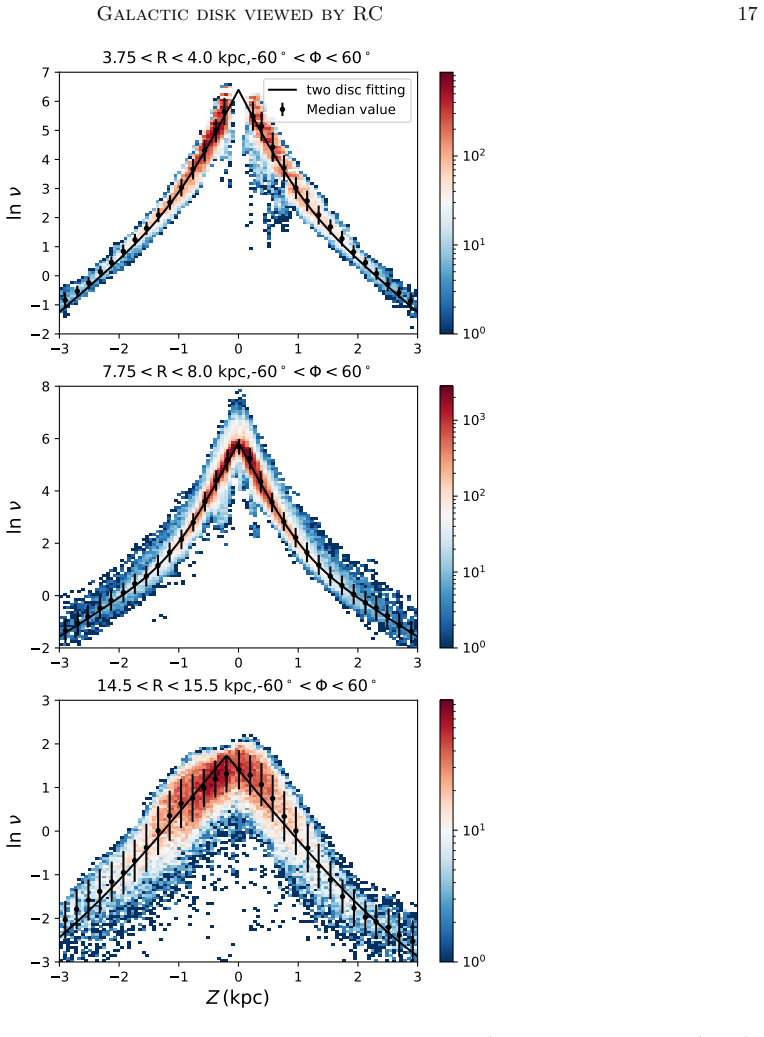
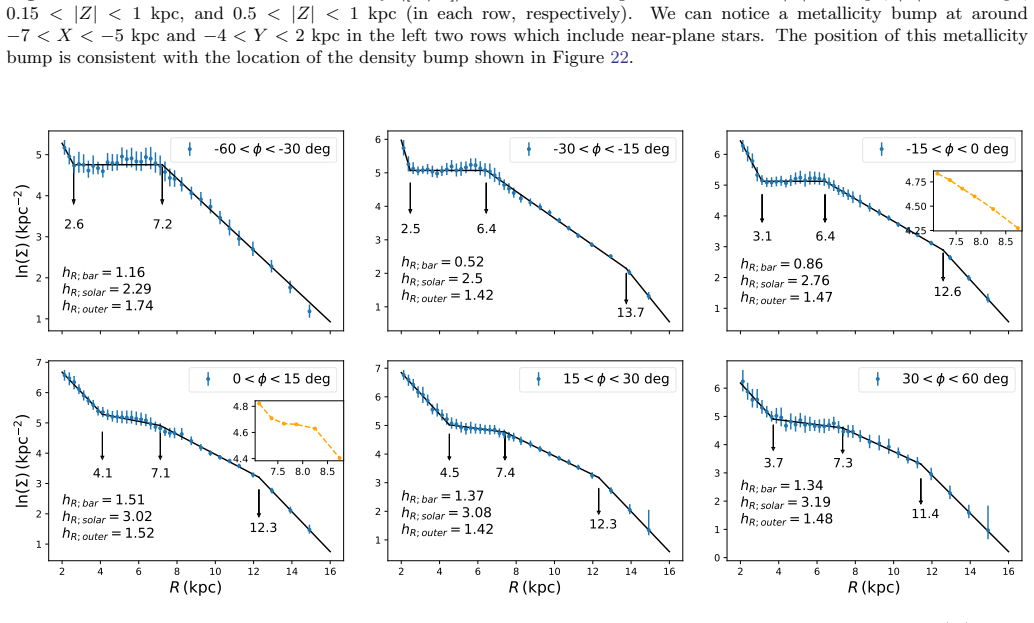
Using approximately 8.4 million red clump stars from Gaia Bp/Rp spectra, after correcting for selection effects and distance uncertainties, the vertical stellar density profile of the Galactic disk is fit with a two-component model of geometrically thin and thick disks. The resulting radial density profile exhibits four breaks: a steep exponential inside R ~ 3 kpc, a nearly flat plateau from R ~ 3 to ~7 kpc, an exponential decline beyond the solar radius to around 13 kpc, and a sharper exponential drop-off beyond R ~ 13 kpc. The thin disk additionally shows a smooth thickening or flaring feature toward the Galactic center at R < 6.4 kpc, while a localized density bump appears in the region 5
What carries the argument
Two-component vertical density model (thin plus thick geometrically defined disks) applied to selection-corrected star counts, which isolates the radial and azimuthal dependence of the underlying stellar density.
If this is right
- The termination radius of the steep inner component varies with azimuth, pointing to dynamical interaction with the bar or bulge.
- The thin-disk thickening inside 6.4 kpc occurs near the bar's co-rotation radius and is therefore likely produced by bar-driven heating.
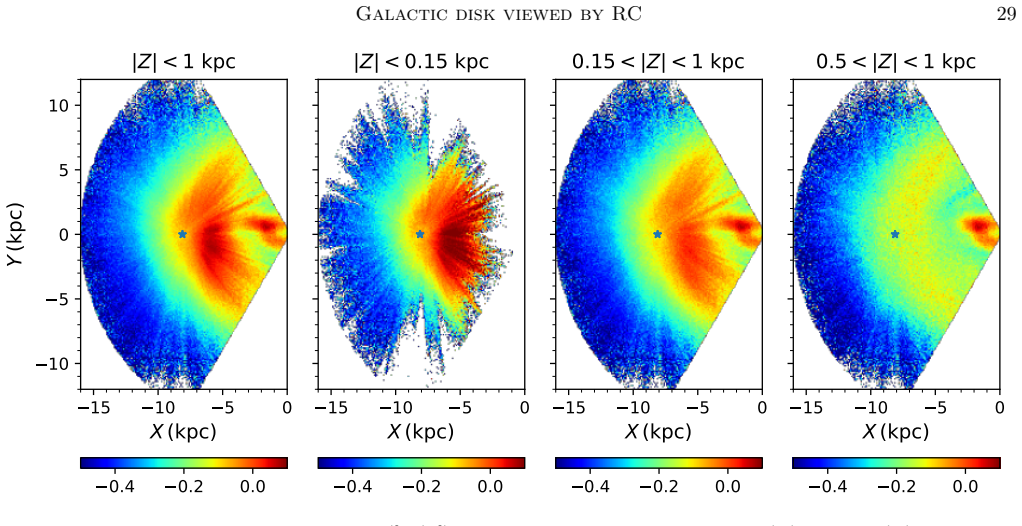
- The localized density and metallicity bump between 5 and 7 kpc and -30° to 15° in azimuth is consistent with radial migration of super metal-rich stars.
- All four radial components have azimuth-dependent parameters, so the disk density is not axisymmetric.
Where Pith is reading between the lines
- The broken profile supplies a concrete target for N-body simulations of Milky Way-like galaxies to reproduce without fine-tuning.
- Repeating the same analysis with other Gaia tracers such as main-sequence turnoff stars could test whether the breaks are population-dependent.
- The reported azimuthal asymmetry implies that local kinematic samples near the Sun may not represent the disk at other longitudes.
- If the inner flaring is bar-driven, similar thickening should appear in external barred galaxies observed edge-on.
Load-bearing premise
The corrections for selection effects and distance uncertainties are complete and unbiased so that the observed star counts accurately reflect the true underlying density profile.
What would settle it
An independent re-derivation of distances or selection functions on the same Gaia red-clump sample that removes the reported radial breaks or shifts the location of the inner flaring and density bump by more than 1 kpc.
Figures


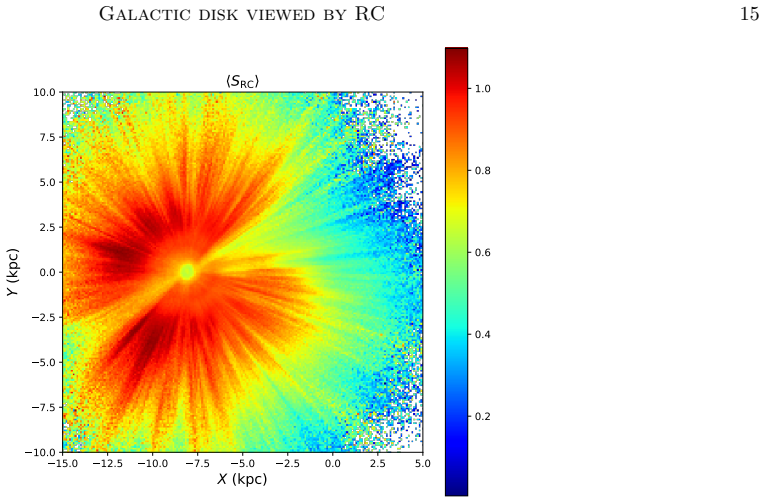




read the original abstract
This study explores the density profile of the stellar disk, radially and azimuthally, based on approximately 8.4 million red clump stars selected from Gaia Bp/Rp spectra. After correcting for selection effects and distance uncertainties, we fit the vertical stellar density profile of the Galactic disk with a two-component model consisting of geometrically thin and thick disks. Our derived density profile shows several breaks radially: (1) a steep exponential inside R$\sim3$ kpc; (2) a nearly flat plateau from R$\sim3$ to $\sim7$ kpc; (3) an exponential decline beyond the solar radius to around 13 kpc; (4) a sharper exponential drop-off beyond R$\sim$13 kpc. The parameters of these four main components depend on $\phi$ to some extent. Variation of the termination radius of the first component suggests an interaction with the bar/bulge. Besides the typical flaring at $R>6.4$ kpc, we find that the thin disk also exhibits a similar and smooth thickening/flaring feature toward the Galactic center at $R<6.4$ kpc. The observed inner flaring may indicate heating effects introduced by the Galactic bar, since $R=6.4$ kpc lies close to the co-rotation radius where the bar's dynamical influence becomes significant. Additionally, we identify a localized density bump in the region $5<R<7$ kpc and $-30^\circ<\phi<15^\circ$, where a corresponding metallicity bump is also visible near the Galactic plane. This density/metallicity bump may be related to the recently reported bimodal distribution of the guiding radius of super metal-rich stars in the solar vicinity through radial migration.
Editorial analysis
A structured set of objections, weighed in public.
Referee Report
Summary. The manuscript analyzes ~8.4 million red-clump stars selected from Gaia Bp/Rp spectra to map the radial and azimuthal stellar density profile of the Milky Way disk. After applying corrections for selection effects and distance uncertainties, the authors fit a two-component (geometrically thin and thick) vertical density model and report four radial regimes: a steep exponential inside R~3 kpc, a plateau from ~3 to ~7 kpc, an exponential decline from the solar radius to ~13 kpc, and a sharper drop beyond 13 kpc. They additionally identify inner flaring of the thin disk at R<6.4 kpc, azimuthal dependence of the component parameters, and a localized density plus metallicity bump in the 5<R<7 kpc, -30°<φ<15° region, which they link to bar dynamics and radial migration.
Significance. If the selection-function and distance corrections prove unbiased, the work supplies one of the largest homogeneous samples for disk mapping and offers concrete observational constraints on bar-disk coupling and radial migration. The explicit use of public Gaia data and a two-component vertical decomposition are positive features that allow direct comparison with simulations.
major comments (3)
- [§3] §3 (Correction pipeline): The reported breaks at R≈3, 7, and 13 kpc and the 5–7 kpc azimuthal bump are derived directly from binned counts after the selection and distance corrections. No recovery tests on mock catalogs with known input density profiles are described, leaving open the possibility that residual radial dependence in completeness or distance posterior shifts could fabricate or suppress these features.
- [§4.2] §4.2 (Inner flaring): The claim that the thin disk exhibits smooth thickening toward the Galactic center at R<6.4 kpc (interpreted as bar-induced heating near co-rotation) rests on the two-component scale-height fit. No propagation of distance uncertainties into the fitted h_z(R) or quantitative comparison with an alternative single-component model is provided, which is load-bearing for the dynamical interpretation.
- [§4.3] §4.3 (Localized bump): The density and metallicity bump in 5<R<7 kpc, -30°<φ<15° is presented as a distinct feature potentially linked to radial migration. The manuscript does not report Poisson uncertainties on the binned counts, a statistical significance test against a smooth model, or a control test excluding the metallicity selection, making it difficult to assess whether the feature is robust.
minor comments (3)
- [Figure 3] Figure 3: The radial density profiles are shown without overlaid model curves or residual panels, making it hard to judge the quality of the four-component fit.
- [Notation] Notation: The symbol φ is used for azimuth without an explicit definition or reference to the adopted Galactic coordinate convention in the text.
- [Abstract] Abstract: The statement that 'the parameters of these four main components depend on φ to some extent' is not accompanied by a quantitative measure (e.g., fractional variation) in the main body.
Simulated Author's Rebuttal
We thank the referee for the constructive and detailed comments. We address each major point below and will incorporate revisions to strengthen the validation of our results.
read point-by-point responses
-
Referee: [§3] §3 (Correction pipeline): The reported breaks at R≈3, 7, and 13 kpc and the 5–7 kpc azimuthal bump are derived directly from binned counts after the selection and distance corrections. No recovery tests on mock catalogs with known input density profiles are described, leaving open the possibility that residual radial dependence in completeness or distance posterior shifts could fabricate or suppress these features.
Authors: We agree that explicit recovery tests using mock catalogs are a valuable addition for validating the correction pipeline. While the manuscript includes internal consistency checks (varying selection criteria and comparing distance methods), we did not describe full end-to-end recovery tests. In the revised version we will add a new subsection to §3 that generates mock catalogs with known input density profiles (including the reported breaks and bump), applies the full selection function and distance uncertainty model, and demonstrates recovery of the input features to within the reported uncertainties. This will directly address the concern that the features could be artifacts. revision: yes
-
Referee: [§4.2] §4.2 (Inner flaring): The claim that the thin disk exhibits smooth thickening toward the Galactic center at R<6.4 kpc (interpreted as bar-induced heating near co-rotation) rests on the two-component scale-height fit. No propagation of distance uncertainties into the fitted h_z(R) or quantitative comparison with an alternative single-component model is provided, which is load-bearing for the dynamical interpretation.
Authors: The two-component vertical model was adopted after explicit model comparison using BIC values, which favored the two-component fit over a single-component model by a large margin. Distance uncertainties for the red-clump sample are modest (∼5–10 %). In the revision we will propagate these uncertainties into the h_z(R) profiles via Monte Carlo resampling of the distance posteriors and will add a quantitative side-by-side comparison of the single- versus two-component fits, including the radial dependence of the scale heights. These additions will make the inner-flaring claim more robust and will support the dynamical interpretation. revision: yes
-
Referee: [§4.3] §4.3 (Localized bump): The density and metallicity bump in 5<R<7 kpc, -30°<φ<15° is presented as a distinct feature potentially linked to radial migration. The manuscript does not report Poisson uncertainties on the binned counts, a statistical significance test against a smooth model, or a control test excluding the metallicity selection, making it difficult to assess whether the feature is robust.
Authors: We will add Poisson uncertainties to all binned density counts in the revised figures and text. A formal statistical test comparing the observed counts against a smooth radial-plus-azimuthal model (with χ² or likelihood-ratio statistics) will be included. We will also present a control analysis that repeats the density mapping after removing the metallicity cut, confirming that the bump remains visible in the purely photometric/density selection. These changes will allow readers to evaluate the feature’s significance directly. revision: yes
Circularity Check
No significant circularity in observational density mapping from corrected Gaia star counts
full rationale
The paper's derivation chain selects ~8.4 million red clump stars from Gaia Bp/Rp spectra, applies corrections for selection effects and distance uncertainties, bins the data radially and azimuthally, and fits a two-component (thin+thick) vertical density model to the corrected counts. The reported radial breaks (steep inner exponential, plateau 3-7 kpc, outer decline, sharp drop beyond 13 kpc), inner flaring, and localized 5-7 kpc bump are direct outputs of this empirical pipeline rather than quantities defined in terms of themselves, fitted parameters renamed as predictions, or load-bearing self-citations. No uniqueness theorems, ansatzes smuggled via prior work, or renaming of known results are invoked; the central claims remain self-contained mappings from the observed (corrected) star counts.
Axiom & Free-Parameter Ledger
free parameters (2)
- radial break radii =
3 kpc, 7 kpc, 13 kpc
- disk scale lengths and heights =
various values
axioms (2)
- domain assumption Red clump stars serve as reliable tracers of the underlying stellar population density after selection
- domain assumption Selection effects and distance uncertainties can be corrected without introducing significant bias
Reference graph
Works this paper leans on
-
[1]
Abazajian, K., Adelman-McCarthy, J. K., Ag¨ ueros, M. A., et al. 2004, AJ, 128, 502, doi: 10.1086/421365
-
[2]
2011, ApJS, 193, 29, doi: 10.1088/0067-0049/193/2/29
Aihara, H., Allende Prieto, C., An, D., et al. 2011, ApJS, 193, 29, doi: 10.1088/0067-0049/193/2/29
-
[3]
Alves, D. R. 2000, ApJ, 539, 732, doi: 10.1086/309278 Amˆ ores, E. B., Robin, A. C., & Reyl´ e, C. 2017, A&A, 602, A67, doi: 10.1051/0004-6361/201628461
-
[4]
An, D., Beers, T. C., & Chiti, A. 2024, ApJS, 272, 20, doi: 10.3847/1538-4365/ad3641
-
[5]
Anders, F., Khalatyan, A., Queiroz, A. B. A., et al. 2022, A&A, 658, A91, doi: 10.1051/0004-6361/202142369
-
[6]
2023, ApJS, 267, 8, doi: 10.3847/1538-4365/acd53e
Andrae, R., Rix, H.-W., & Chandra, V. 2023, ApJS, 267, 8, doi: 10.3847/1538-4365/acd53e Astropy Collaboration, Price-Whelan, A. M., Sip˝ ocz, B. M., et al. 2018, AJ, 156, 123, doi: 10.3847/1538-3881/aabc4f
-
[7]
Auvergne, M., Bodin, P., Boisnard, L., et al. 2009, A&A, 506, 411, doi: 10.1051/0004-6361/200810860
-
[8]
2025, A&A, 693, A3, doi: 10.1051/0004-6361/202450868
Barbillon, M., Recio-Blanco, A., Poggio, E., et al. 2025, A&A, 693, A3, doi: 10.1051/0004-6361/202450868
-
[9]
1994, A&AS, 103, 475
Barteldrees, A., & Dettmar, R.-J. 1994, A&AS, 103, 475
1994
-
[10]
2023, A&A, 674, A194, doi: 10.1051/0004-6361/202345921
Bellazzini, M., Massari, D., De Angeli, F., et al. 2023, A&A, 674, A194, doi: 10.1051/0004-6361/202345921
-
[11]
Vertical waves in the solar neighbourhood in Gaia DR2
Bennett, M., & Bovy, J. 2019, MNRAS, 482, 1417, doi: 10.1093/mnras/sty2813
-
[12]
2006, NewA, 12, 234, doi: 10.1016/j.newast.2006.10.001
Bilir, S., Karaali, S., Ak, S., Yaz, E., & Hamzao˘ glu, E. 2006, NewA, 12, 234, doi: 10.1016/j.newast.2006.10.001
-
[13]
2024, MNRAS, 535, 1898, doi: 10.1093/mnras/stae2481
Binney, J. 2024, MNRAS, 535, 1898, doi: 10.1093/mnras/stae2481
-
[14]
1987, Galactic dynamics
Binney, J., & Tremaine, S. 1987, Galactic dynamics
1987
-
[15]
2016, ARA&A, 54, 529, doi: 10.1146/annurev-astro-081915-023441
Bland-Hawthorn, J., & Gerhard, O. 2016, ARA&A, 54, 529, doi: 10.1146/annurev-astro-081915-023441
-
[16]
Bouquin, A. Y. K., Gil de Paz, A., Mu˜ noz-Mateos, J. C., et al. 2018, ApJS, 234, 18, doi: 10.3847/1538-4365/aaa384
-
[17]
The Astrophysical Journal Supplement Series , author =
Bovy, J. 2015, ApJS, 216, 29, doi: 10.1088/0067-0049/216/2/29
-
[18]
Finkbeiner, D. P. 2016a, ApJ, 818, 130, doi: 10.3847/0004-637X/818/2/130
-
[19]
The stellar population structure of the Galactic disk,
Bovy, J., Rix, H.-W., Schlafly, E. F., et al. 2016b, ApJ, 823, 30, doi: 10.3847/0004-637X/823/1/30
-
[20]
Bovy, J., Nidever, D. L., Rix, H.-W., et al. 2014, ApJ, 790, 127, doi: 10.1088/0004-637X/790/2/127
-
[21]
2021, MNRAS, 506, 150, doi: 10.1093/mnras/stab1242
Buder, S., Sharma, S., Kos, J., et al. 2021, MNRAS, 506, 150, doi: 10.1093/mnras/stab1242
-
[22]
Burke, B. F. 1957, AJ, 62, 90, doi: 10.1086/107463
-
[23]
1998, A&A, 331, 934
Buser, R., Rong, J., & Karaali, S. 1998, A&A, 331, 934
1998
-
[24]
2023, A&A, 669, A55, doi: 10.1051/0004-6361/202244784
Cantat-Gaudin, T., Fouesneau, M., Rix, H.-W., et al. 2023, A&A, 669, A55, doi: 10.1051/0004-6361/202244784
-
[25]
2024, A&A, 683, A128, doi: 10.1051/0004-6361/202348018
Cantat-Gaudin, T., Fouesneau, M., Rix, H.-W., et al. 2024, A&A, 683, A128, doi: 10.1051/0004-6361/202348018
-
[26]
Carney, B. W., & Seitzer, P. 1993, AJ, 105, 2127, doi: 10.1086/116591
-
[27]
M., Weiler, M., Jordi, C., et al
Carrasco, J. M., Weiler, M., Jordi, C., et al. 2021, A&A, 652, A86, doi: 10.1051/0004-6361/202141249
-
[28]
Castro-Ginard, A., Brown, A. G. A., Kostrzewa-Rutkowska, Z., et al. 2023, A&A, 677, A37, doi: 10.1051/0004-6361/202346547
-
[29]
Chambers, K. C., Magnier, E. A., Metcalfe, N., et al. 2016, arXiv e-prints, arXiv:1612.05560, doi: 10.48550/arXiv.1612.05560
work page internal anchor Pith review doi:10.48550/arxiv.1612.05560 2016
-
[30]
Chandra, V., Semenov, V. A., Rix, H.-W., et al. 2024, ApJ, 972, 112, doi: 10.3847/1538-4357/ad5b60
-
[31]
2025, arXiv e-prints, arXiv:2501.14089, doi: 10.48550/arXiv.2501.14089
Chen, B., Orkney, M., Ting, Y.-S., & Hayden, M. 2025, arXiv e-prints, arXiv:2501.14089, doi: 10.48550/arXiv.2501.14089
-
[32]
Chen, B., Stoughton, C., Smith, J. A., et al. 2001, ApJ, 553, 184, doi: 10.1086/320647
-
[33]
2019, Nature Astronomy, 3, 320, doi: 10.1038/s41550-018-0686-7
Chen, X., Wang, S., Deng, L., et al. 2019, Nature Astronomy, 3, 320, doi: 10.1038/s41550-018-0686-7
-
[34]
Q., Casagrande, L., Zhao, G., et al
Chen, Y. Q., Casagrande, L., Zhao, G., et al. 2017, ApJ, 840, 77, doi: 10.3847/1538-4357/aa6d0f
-
[35]
Chiba, R., Friske, J. K. S., & Sch¨ onrich, R. 2021, MNRAS, 500, 4710, doi: 10.1093/mnras/staa3585 Chrob´ akov´ a,ˇZ., Nagy, R., & L´ opez-Corredoira, M. 2020, A&A, 637, A96, doi: 10.1051/0004-6361/201937289 Chrob´ akov´ a,ˇZ., Nagy, R., & L´ opez-Corredoira, M. 2022, A&A, 664, A58, doi: 10.1051/0004-6361/202243296
-
[36]
2012, Research in Astronomy and Astrophysics, 12, 1197, doi: 10.1088/1674-4527/12/9/003
Cui, X.-Q., Zhao, Y.-H., Chu, Y.-Q., et al. 2012, Research in Astronomy and Astrophysics, 12, 1197, doi: 10.1088/1674-4527/12/9/003
-
[37]
Culpan, R., Pelisoli, I., & Geier, S. 2021, A&A, 654, A107, doi: 10.1051/0004-6361/202040074 Galactic disk viewed by RC33 De Angeli, F., Weiler, M., Montegriffo, P., et al. 2023, A&A, 674, A2, doi: 10.1051/0004-6361/202243680 de Jong, R. S., Agertz, O., Berbel, A. A., et al. 2019, The Messenger, 175, 3, doi: 10.18727/0722-6691/5117 De Silva, G. M., Freema...
-
[38]
P., Khachaturyants, T., Amarante, J
Debattista, V. P., Khachaturyants, T., Amarante, J. A. S., et al. 2025, MNRAS, 537, 1620, doi: 10.1093/mnras/staf035
-
[39]
1998, AJ, 115, 2384, doi: 10.1086/300364
Dehnen, W. 1998, AJ, 115, 2384, doi: 10.1086/300364
-
[40]
2024, ApJ, 975, 28, doi: 10.3847/1538-4357/ad7799 DESI Collaboration, Karim, M
Deng, M., Du, C., Yang, Y., Liao, J., & Ye, D. 2024, ApJ, 975, 28, doi: 10.3847/1538-4357/ad7799 DESI Collaboration, Karim, M. A., Adame, A. G., et al. 2025, arXiv e-prints, arXiv:2503.14745, doi: 10.48550/arXiv.2503.14745
-
[41]
Dobbie, P. S., & Warren, S. J. 2020, The Open Journal of Astrophysics, 3, 5, doi: 10.21105/astro.2003.05757 D’Onghia, E., & L. Aguerri, J. A. 2020, ApJ, 890, 117, doi: 10.3847/1538-4357/ab6bd6
-
[42]
A three-dimensional Galactic extinction model
Drimmel, R., Cabrera-Lavers, A., & L´ opez-Corredoira, M. 2003, A&A, 409, 205, doi: 10.1051/0004-6361:20031070
-
[43]
Drimmel, R., & Spergel, D. N. 2001, ApJ, 556, 181, doi: 10.1086/321556
-
[44]
Erwin, P., Pohlen, M., & Beckman, J. E. 2008, AJ, 135, 20, doi: 10.1088/0004-6256/135/1/20
-
[45]
Fallows, C. P., & Sanders, J. L. 2024, MNRAS, 531, 2126, doi: 10.1093/mnras/stae1303
-
[46]
Feast, M. W., Menzies, J. W., Matsunaga, N., & Whitelock, P. A. 2014, Nature, 509, 342, doi: 10.1038/nature13246
-
[47]
2017, ApJ, 843, 141, doi: 10.3847/1538-4357/aa77fd
Ferguson, D., Gardner, S., & Yanny, B. 2017, ApJ, 843, 141, doi: 10.3847/1538-4357/aa77fd
-
[48]
Foreman-Mackey, D., Hogg, D. W., Lang, D., & Goodman, J. 2013, PASP, 125, 306, doi: 10.1086/670067
-
[49]
Freeman, K. C. 1970, ApJ, 160, 811, doi: 10.1086/150474
-
[50]
Fujii, M. S., B´ edorf, J., Baba, J., & Portegies Zwart, S. 2019, MNRAS, 482, 1983, doi: 10.1093/mnras/sty2747 Gaia Collaboration, Brown, A. G. A., Vallenari, A., et al. 2016a, A&A, 595, A2, doi: 10.1051/0004-6361/201629512 Gaia Collaboration, Prusti, T., de Bruijne, J. H. J., et al. 2016b, A&A, 595, A1, doi: 10.1051/0004-6361/201629272 Gaia Collaboration...
-
[51]
Gilliland, R. L., Brown, T. M., Christensen-Dalsgaard, J., et al. 2010, PASP, 122, 131, doi: 10.1086/650399
-
[52]
Galactic structure towards the South Pole and the Galactic thick disc
Gilmore, G., & Reid, N. 1983, MNRAS, 202, 1025, doi: 10.1093/mnras/202.4.1025
-
[53]
Girardi, L. 2016, ARA&A, 54, 95, doi: 10.1146/annurev-astro-081915-023354 GRAVITY Collaboration, Abuter, R., Amorim, A., et al. 2018, A&A, 615, L15, doi: 10.1051/0004-6361/201833718
-
[54]
, year = 2019, month = dec, volume =
Finkbeiner, D. 2019, ApJ, 887, 93, doi: 10.3847/1538-4357/ab5362
-
[55]
Groenewegen, M. A. T. 2021, A&A, 654, A20, doi: 10.1051/0004-6361/202140862 Guti´ errez, L., Erwin, P., Aladro, R., & Beckman, J. E. 2011, AJ, 142, 145, doi: 10.1088/0004-6256/142/5/145
-
[56]
Hammersley, P. L., Cohen, M., Garz´ on, F., Mahoney, T., & L´ opez-Corredoira, M. 1999, MNRAS, 308, 333, doi: 10.1046/j.1365-8711.1999.02678.x
-
[57]
J., Conroy, C., & Hernquist, L
Han, J. J., Conroy, C., & Hernquist, L. 2023a, Nature Astronomy, 7, 1481, doi: 10.1038/s41550-023-02076-9
-
[58]
J., Semenov, V., Conroy, C., & Hernquist, L
Han, J. J., Semenov, V., Conroy, C., & Hernquist, L. 2023b, ApJL, 957, L24, doi: 10.3847/2041-8213/ad0641
-
[59]
Hawkins, K., Leistedt, B., Bovy, J., & Hogg, D. W. 2017, MNRAS, 471, 722, doi: 10.1093/mnras/stx1655
-
[60]
He, X.-J., Luo, A. L., & Chen, Y.-Q. 2022, MNRAS, 512, 1710, doi: 10.1093/mnras/stac484
-
[61]
2020, ApJS, 249, 29, doi: 10.3847/1538-4365/ab994f
Huang, Y., Sch¨ onrich, R., Zhang, H., et al. 2020, ApJS, 249, 29, doi: 10.3847/1538-4365/ab994f
-
[62]
Jin, S., Trager, S. C., Dalton, G. B., et al. 2024, MNRAS, 530, 2688, doi: 10.1093/mnras/stad557
-
[63]
Jog, C. J. 2026, PhR, 1163, 1, doi: 10.1016/j.physrep.2025.11.003 Juri´ c, M., Ivezi´ c,ˇZ., Brooks, A., et al. 2008, ApJ, 673, 864, doi: 10.1086/523619
-
[64]
Astronomy and Astrophysics , author =
Khalatyan, A., Anders, F., Chiappini, C., et al. 2024, A&A, 691, A98, doi: 10.1051/0004-6361/202451427
-
[65]
2025, A&A, 701, A270, doi: 10.1051/0004-6361/202452798
Khanna, S., Yu, J., Drimmel, R., et al. 2025, A&A, 701, A270, doi: 10.1051/0004-6361/202452798
-
[66]
2018, A&A, 611, L2, doi: 10.1051/0004-6361/201732521
Khoperskov, S., Di Matteo, P., Haywood, M., & Combes, F. 2018, A&A, 611, L2, doi: 10.1051/0004-6361/201732521
-
[67]
Kim, T., Gadotti, D. A., Sheth, K., et al. 2014, ApJ, 782, 64, doi: 10.1088/0004-637X/782/2/64
-
[68]
A., Rix, H.-W., Aerts, C., et al
Kollmeier, J. A., Rix, H.-W., Aerts, C., et al. 2025, arXiv e-prints, arXiv:2507.06989, doi: 10.48550/arXiv.2507.06989
-
[69]
1992, in Astronomical Society of the Pacific Conference Series, Vol
Kroupa, P. 1992, in Astronomical Society of the Pacific Conference Series, Vol. 32, IAU Colloquium 135: Complementary Approaches to Double and Multiple Star Research, ed. H. A. McAlister & W. I. Hartkopf, 228
1992
-
[70]
1989, MNRAS, 239, 571, doi: 10.1093/mnras/239.2.571
Kuijken, K., & Gilmore, G. 1989, MNRAS, 239, 571, doi: 10.1093/mnras/239.2.571
-
[71]
P., Belokurov, V., Koposov, S., et al
Kurbatov, E. P., Belokurov, V., Koposov, S., et al. 2024, arXiv e-prints, arXiv:2410.22250, doi: 10.48550/arXiv.2410.22250
-
[72]
2016, A&A, 596, A25, doi: 10.1051/0004-6361/201628397 34Wu et al
Laine, J., Laurikainen, E., & Salo, H. 2016, A&A, 596, A25, doi: 10.1051/0004-6361/201628397 34Wu et al
-
[73]
Lehmann, C., Murphy, M. T., Liu, F., & Flynn, C. 2025, MNRAS, 536, 498, doi: 10.1093/mnras/stae2656
-
[74]
Li, C., Zhao, G., Jia, Y., et al. 2019, ApJ, 871, 208, doi: 10.3847/1538-4357/aafa17
-
[75]
2024, ApJS, 272, 2, doi: 10.3847/1538-4365/ad2b4d
Chandra, V. 2024, ApJS, 272, 2, doi: 10.3847/1538-4365/ad2b4d
-
[76]
2025, MNRAS, 539, 1595, doi: 10.1093/mnras/staf583
Li, Y., Freeman, K., & Jerjen, H. 2025, MNRAS, 539, 1595, doi: 10.1093/mnras/staf583
-
[77]
2025a, ApJL, 984, L48, doi: 10.3847/2041-8213/adccb7
Lian, J., Du, M., Lu, S., et al. 2025a, ApJL, 984, L48, doi: 10.3847/2041-8213/adccb7
-
[78]
2025, ApJ, 990, L37, doi:10.3847/2041-8213/adfc73
Lian, J., Wang, T., Feng, Q., Huang, Y., & Guo, H. 2025b, ApJL, 990, L37, doi: 10.3847/2041-8213/adfc73
-
[79]
2024, Nature Astronomy, 8, 1302, doi: 10.1038/s41550-024-02315-7
Lian, J., Zasowski, G., Chen, B., et al. 2024, Nature Astronomy, 8, 1302, doi: 10.1038/s41550-024-02315-7
-
[80]
Lian, J., Zasowski, G., Mackereth, T., et al. 2022, MNRAS, 513, 4130, doi: 10.1093/mnras/stac1151
discussion (0)
Sign in with ORCID, Apple, or X to comment. Anyone can read and Pith papers without signing in.