Halfway to the Peak: Kinematic Signatures of Stable Rotating Disks in Luminous Infrared Galaxies at z=0.5-0.6
Pith reviewed 2026-05-08 02:33 UTC · model grok-4.3
The pith
Six luminous infrared galaxies at z=0.5-0.6 all exhibit stable rotating disk kinematics with V/σ ≥ 2, independent of AGN fraction.
A machine-rendered reading of the paper's core claim, the machinery that carries it, and where it could break.
Core claim
Using kinematic maps from the [Ar II] 6.99 μm line obtained with JWST MIRI/MRS, we derive rotation curves for six IR-luminous galaxies at z=0.5-0.6. All sources show ordered rotation with V/σ ≥ 2, consistent with stable disks. We find no correlation between V/σ and AGN fraction, although galaxies with higher AGN fractions exhibit elevated central velocity dispersions. These results suggest that AGN activity does not significantly disrupt global kinematics and that these galaxies represent mature, rotationally supported disks with AGN activation occurring after disk assembly.
What carries the argument
The V/σ ratio computed from [Ar II] 6.99 μm kinematic maps and rotation curves, which measures ordered rotation against random motions to classify the dynamical state as a stable disk.
Load-bearing premise
The [Ar II] 6.99 μm emission line accurately traces the bulk gravitational motions of the interstellar medium without major contamination from non-gravitational effects like outflows or inflows.
What would settle it
Finding even one IR-luminous galaxy at z=0.5-0.6 with V/σ below 2 or with clear kinematic evidence of a recent major merger or galaxy-wide outflow in similar mid-IR maps would undermine the claim that all such galaxies are stable disks.
Figures


read the original abstract
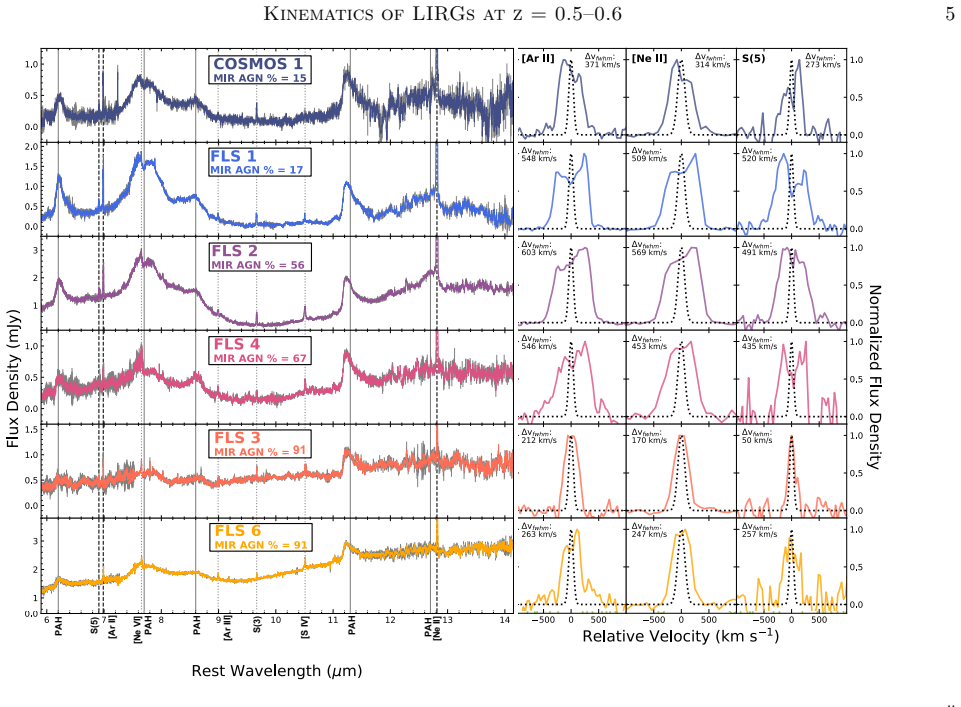
We present a kinematic study of six infrared-luminous galaxies observed with the Mid-InfraRed Instrument Medium-Resolution Spectrometer (MIRI/MRS) onboard JWST. These galaxies lie at $z = 0.5$--$0.6$, midway between the present day and the peak of cosmic star formation. Our sample spans a range of star formation (SF) and active galactic nucleus (AGN) contributions to the mid-infrared emission. We characterize the dynamical state of these IR-luminous galaxies and assess how AGN activity influences the kinematics of the interstellar medium. Using mid-IR atomic lines, we map galaxy kinematics beyond the local Universe for the first time. The spatial resolution of MIRI/MRS (3.0 kpc for 0.46$\arcsec$ at z $\sim$ 0.55) allows us to resolve the internal kinematics of our targets. We compute kinematic maps in three different emission lines ([Ar II]6.99$\mu$m, [Ne II]12.81$\mu$m, and H$_2$ 0-0 S(5)6.91$\mu$m). Using the [Ar II]6.99$\mu$m kinematic maps, we derive rotation curves for these sources. All galaxies exhibit ordered rotation, with \(V/\sigma \geq 2\), consistent with stable disks. Although some show minor disturbances, we find no strong evidence for recent major mergers or galaxy-wide ionized outflows. We find no correlation between \(V/\sigma\) and AGN fraction, suggesting AGN activity does not significantly disrupt global kinematics or that disk disruption is not required to trigger AGN. However, galaxies with higher AGN fractions show elevated central dispersions, indicating localized turbulence, possibly due to AGN feedback, stellar feedback, accretion or bulge structure. These IR-luminous galaxies likely represent mature, rotationally supported disks, with AGN activation occurring after disk assembly.
Editorial analysis
A structured set of objections, weighed in public.
Referee Report
Summary. The paper presents JWST MIRI/MRS mid-infrared spectroscopic observations of six luminous infrared galaxies at z=0.5-0.6. Using kinematic maps from the [Ar II] 6.99 μm line (with supporting maps from [Ne II] 12.81 μm and H2 0-0 S(5) 6.91 μm), the authors derive rotation curves and velocity dispersion maps. They report that all six galaxies exhibit ordered rotation with V/σ ≥ 2, consistent with stable, rotationally supported disks. The study finds no strong evidence for recent major mergers or galaxy-wide ionized outflows, no correlation between V/σ and AGN fraction, but notes elevated central dispersions in systems with higher AGN contributions, suggesting localized turbulence without global kinematic disruption.
Significance. If the central claims hold, this provides the first resolved mid-IR kinematic maps of IR-luminous galaxies beyond the local universe at intermediate redshift, supporting the view that these systems are mature disks in which AGN activity is triggered after disk assembly and does not require or cause global disruption. The multi-line approach and direct observational constraints on V/σ at ~3 kpc resolution are strengths that could inform galaxy evolution models between z=0 and the cosmic star-formation peak. The small sample limits statistical generalization, but the work offers valuable empirical benchmarks.
major comments (2)
- [Results / Kinematic Analysis] The classification of all six galaxies as stable disks with V/σ ≥ 2 (abstract) rests exclusively on rotation curves and dispersion maps derived from the [Ar II] 6.99 μm line. The manuscript does not report a quantitative cross-comparison of V and σ (or the resulting V/σ ratios) measured independently from the [Ne II] and H2 lines for the same spatial regions. Given the abstract's note of elevated central dispersions in higher-AGN systems, this omission leaves open the possibility that [Ar II] preferentially traces regions with shocks, AGN-driven turbulence, or ionization biases rather than the bulk gravitational potential, directly affecting the no-merger and no-global-disruption conclusions.
- [Discussion] The claim of no correlation between V/σ and AGN fraction (abstract) is based on only six galaxies. The paper should provide the individual V/σ values, AGN fractions, the correlation coefficient (e.g., Spearman), and associated p-value or uncertainty, ideally in a table, to substantiate the statistical robustness of this result and the inference that AGN activity does not significantly disrupt global kinematics.
minor comments (2)
- Clarify the precise definitions and measurement radii used for V (e.g., maximum line-of-sight velocity or at 3 kpc) and σ (global average, central, or beam-corrected) when computing V/σ, including any inclination or beam-smearing corrections applied at the stated 3 kpc resolution.
- The abstract refers to 'minor disturbances' in some galaxies; specify the nature of these disturbances (e.g., kinematic asymmetries, non-circular motions) and identify which sources exhibit them to allow readers to assess consistency with the overall stable-disk interpretation.
Simulated Author's Rebuttal
We thank the referee for their constructive and detailed review. The comments highlight important aspects of our kinematic analysis and statistical presentation that we will address to strengthen the manuscript. Below we respond point by point to the major comments.
read point-by-point responses
-
Referee: [Results / Kinematic Analysis] The classification of all six galaxies as stable disks with V/σ ≥ 2 (abstract) rests exclusively on rotation curves and dispersion maps derived from the [Ar II] 6.99 μm line. The manuscript does not report a quantitative cross-comparison of V and σ (or the resulting V/σ ratios) measured independently from the [Ne II] and H2 lines for the same spatial regions. Given the abstract's note of elevated central dispersions in higher-AGN systems, this omission leaves open the possibility that [Ar II] preferentially traces regions with shocks, AGN-driven turbulence, or ionization biases rather than the bulk gravitational potential, directly affecting the no-merger and no-global-disruption conclusions.
Authors: We selected the [Ar II] 6.99 μm line as the primary kinematic tracer because it is bright, relatively isolated, and less susceptible to AGN ionization effects compared to other mid-IR lines in our spectra. However, we agree that a quantitative cross-comparison with [Ne II] 12.81 μm and H2 0-0 S(5) 6.91 μm is valuable to confirm that the derived V/σ ratios reflect the bulk gravitational potential rather than tracer-specific biases. In the revised manuscript we will add a dedicated subsection and supplementary table that extracts V and σ (and V/σ) from all three lines in matched spatial apertures (central 3 kpc and outer disk regions). Preliminary inspection of the existing maps shows consistent rotation patterns and comparable V/σ values across tracers, which we will quantify and discuss. This addition will directly address concerns about potential shocks or ionization biases. revision: yes
-
Referee: [Discussion] The claim of no correlation between V/σ and AGN fraction (abstract) is based on only six galaxies. The paper should provide the individual V/σ values, AGN fractions, the correlation coefficient (e.g., Spearman), and associated p-value or uncertainty, ideally in a table, to substantiate the statistical robustness of this result and the inference that AGN activity does not significantly disrupt global kinematics.
Authors: We acknowledge that the small sample size (n=6) limits the strength of any statistical claim and that explicit quantitative measures are needed. The current manuscript states the absence of correlation based on the distribution of points, but we will revise the text and add a new table that lists, for each galaxy: the [Ar II]-derived V/σ, the AGN fraction (as derived from the mid-IR spectral decomposition), and the corresponding uncertainties. We will also compute and report the Spearman rank correlation coefficient together with its p-value and 95% confidence interval. In the discussion we will explicitly note the limited statistical power and frame the result as suggestive evidence that global disk kinematics remain stable despite varying AGN contributions, rather than a definitive null correlation. These changes will make the statistical basis transparent. revision: yes
Circularity Check
No significant circularity; derivation is direct from observations
full rationale
The paper's core claims (ordered rotation with V/σ ≥ 2 in all six galaxies, no correlation with AGN fraction) are obtained by extracting line centroids and velocity dispersions directly from the observed [Ar II], [Ne II], and H2 emission-line maps produced by MIRI/MRS. Rotation curves and V/σ ratios are computed from these measured quantities using standard kinematic definitions; no model is fitted to the data that would make the reported V/σ values equivalent to the input measurements by construction. No self-citations, uniqueness theorems, or ansatzes are invoked to justify the classification of the galaxies as stable disks. The result is therefore an independent empirical finding rather than a tautology.
Axiom & Free-Parameter Ledger
axioms (2)
- domain assumption Mid-IR atomic and molecular lines trace the bulk gravitational potential without dominant non-circular motions
- domain assumption V/σ ≥ 2 reliably indicates a stable disk rather than a dispersion-supported system
Reference graph
Works this paper leans on
-
[1]
2023, , 675, A111
Argyriou, I., Glasse, A., Law, D., et al. 2023, , 675, A111
2023
-
[2]
2014, , 568, A14
Arribas, S., Colina, L., Bellocchi, E., et al. 2014, , 568, A14
2014
-
[3]
\ 2012, , 542, A54
Bellocchi, E., Arribas, S., & Colina, L. \ 2012, , 542, A54
2012
-
[4]
\ 2013, , 557, A59
Bellocchi, E., Arribas, S., Colina, L., & Miralles-Caballero, D. \ 2013, , 557, A59
2013
-
[5]
Bushouse, H., Eisenhamer, J. Dencheva, N. et al. 2023, JWST Calibration Pipeline, v1.11.1, Zenodo, doi:10.5281/zenodo.8099867
-
[6]
Crespo G \'o mez, A., Piqueras L \'o pez, J., Arribas, S. et al. 2021, , 650, A149
2021
-
[7]
Dekel, A., Birnboim, Y., Engel, G. et al. 2009, , 457, 7228
2009
-
[8]
F \"o rster-Schreiber, N.M., Genzel, R., Bouch \'e , N. et al. 2009, , 706, 1364
2009
-
[9]
2006, , 455, 107
Flores, H., Hammer, F., Amram, P., et al. 2006, , 455, 107
2006
-
[10]
Fluetsch, A., Maiolino, R., Carniani, S. et al. 2021, , 505, 5753
2021
-
[11]
Z., et al
Fu, H., Yan, L., Scoville, N. Z., et al. \ 2010, , 722, 653
2010
-
[12]
2018, , 616, A1
Gaia Collaboration, et al. 2018, , 616, A1
2018
-
[13]
2016, , 595, A2
Gaia Collaboration, et al. 2016, , 595, A2
2016
-
[14]
2010, , 724, 1373
Gon c alves, T., Basu-Zych, A., Overzier, R., et al. 2010, , 724, 1373
2010
-
[15]
Hickox, R., Mullaney, J., Alexander, D. et al. 2014, , 782, 1
2014
-
[16]
\ 2009, , 691, 1168
Hopkins, P., Cox, T., Younger, J., & Hernquist, L. \ 2009, , 691, 1168
2009
-
[17]
\ 2010, , 402, 1693
Hopkins, P., Younger, J., Hayward, C., Narayanan, D., & Hernquist, L. \ 2010, , 402, 1693
2010
-
[18]
Hopkins, P., Somerville, R., Herquist, L. et al. 2006, , 652, 2
2006
-
[19]
Hung, C., Hayward, C., Smith, H. et al. 2016, , 816, 2
2016
-
[20]
JDADF Developers, Averbukh, J., Bradley, L., Buikhuizen, M. et al. 2024, Zenodo, DOI:https://doi.org/10.5281/zenodo.12797328
-
[21]
Kirkpatrick, A., Pope, A., Sajina, A. et al. 2015, , 814, 9
2015
-
[22]
Koekemoer, A.M., Aussel, H., Calzetti, D. et al. 2007, , 172, 196
2007
-
[23]
\ 2009, , 182, 216
Kormendy, J., Fisher, D., Cornell, M., & Bender, R. \ 2009, , 182, 216
2009
-
[24]
Lacy, M., Sajina, A., Petric, A. et al. 2007, , 669, L61
2007
-
[25]
Le Floc'h, E., Papovich, C., Dole, H. et al. 2005, , 632, 169
2005
-
[26]
Lotz , J., Jonsson, P., Cox, T.J. et al. 2008, , 391, 1137
2008
-
[27]
& Dickinson, M
Madau, P. & Dickinson, M. \ 2014, , 52, 415
2014
-
[28]
2013, , 553, A132
Magnelli, B., Popesso, P., Berta, S., et al. 2013, , 553, A132
2013
-
[29]
M., Wisnioski, E
Mai, Y., Croom, S. M., Wisnioski, E. et al.\ 2024, , 533, 4, 3878
2024
-
[30]
2018, , 480, 2266
Martin, G., Kaviraj, S., Devriemdt, J., et al. 2018, , 480, 2266
2018
-
[31]
Martizzi, D., Qutaert, E., Faucher-Gigu \`e re, C. et al. 2019, , 483, 2465
2019
-
[32]
2024, , 979, 229
McKinney, J., Casey, C., Long, A., et al. 2024, , 979, 229
2024
-
[33]
Michtchenko, T., L \'e pine J., Barros, D. et al. 2018, , 615, A10
2018
-
[34]
J., Condon, J., Schinnerer, E
Murphy, E. J., Condon, J., Schinnerer, E. et al. 2011, , 737, 67
2011
-
[35]
Moster, B., Macci\`o, A., Somerville, R. et al. 2010, , 403, 2
2010
-
[36]
Nesvadba, N., Boulanger, F., Lehnert, M. et al. 2011, , 536, L5
2011
-
[37]
Ogle, P., L \'o pez , I., Reynaldi, V. et al. 2024, , 962, 196
2024
-
[38]
Oh, S., Colless, M., D'Eugenio, F. et al. 2022, , 512, 1765
2022
-
[39]
\ 2011, , 731, 41
Ostriker, X., & Shetty, X. \ 2011, , 731, 41
2011
-
[40]
Pandya, V., Brennan, R., Somerville, R. et al. 2017, , 472, 2
2017
-
[41]
Pope, A., Chary, R., Alexander, D. et al. 2008, , 675, 1171
2008
-
[42]
and Hammer, F
Puech, M. and Hammer, F. and Lehnert, M. D. and Flores , H. \ 2007, , 466, 83
2007
-
[43]
et al.\ 2024, , 689, A273
Rizzo, F., Bacchini, C., Kohandel, M. et al.\ 2024, , 689, A273
2024
-
[44]
and Veilleux, S
Rupke, D. and Veilleux, S. \ 2013, , 768, 75
2013
-
[45]
Sajina, A., Yan, L., Fadda, D. et al. 2012, , 757, 13
2012
-
[46]
Sajina, A., Pope, A., Spoon, H. et al. 2025, , 985, 2
2025
-
[47]
Sajkov, L., Sajina, A., Pope, A. et al. 2025, , 977, 1
2025
-
[48]
\ 1996, , 34, 749
Sanders, D., and Mirabel, I. \ 1996, , 34, 749
1996
-
[49]
Schawinski, K., Koss, M., Berney, S., et al \ 2015, , 451, 2517
2015
-
[50]
and Genzel, Reinhard and F \"o rster-Schreiber et al
Shapiro, Kristen L. and Genzel, Reinhard and F \"o rster-Schreiber et al. 2008, , 682, 231
2008
-
[51]
and Genzel, Reinhard and Quataert, Eliot, et al
Shapiro, Kristen L. and Genzel, Reinhard and Quataert, Eliot, et al. 2009, , 701, 955
2009
-
[52]
Spinoglio, L., Pereira-Santaella, M., Dasyra, K. et al. 2015, , 799, 21
2015
-
[53]
\ 1987, , 99, 191
Stetson, P.B. \ 1987, , 99, 191
1987
-
[54]
Stierwalt, S., Armus, L., Charmandaris, V. et al. 2014, , 790, 124
2014
-
[55]
& Mazzarella, J
U, Vivian, Sanders, D. & Mazzarella, J. \ 2012, , 203, 9
2012
-
[56]
U, V., Lai, T., Bianchin, M. et al. 2022, , 940, L5
2022
-
[57]
\"U bler, H., Genzel, R., Wisnioski, E., et al.\ 2019, , 880, 1, 48. doi:10.3847/1538-4357/ab27cc
-
[58]
Veilleux, S., Maiolino, R., Bolatto, A. D. & Aalto, S. \ 2020, , 28, 2
2020
-
[59]
& Bland-Hawthorn, J
Veilleux, S., Cecil, G. & Bland-Hawthorn, J. \ 2005, , 43, 769
2005
-
[60]
and Xia, X
Wang, J. and Xia, X. & Mao, S. \ 2006, , 649, 722
2006
-
[61]
Karen \ 2020, , 493, 4065
Wang, Chaoran and Ruszkowski, Mateusz and Yang, H. Karen \ 2020, , 493, 4065
2020
-
[62]
Weiner, B., Willmer, C., Faber, S. et al. 2006, , 653, 1027
2006
-
[63]
Wisnioski, E., F \"o rster-Schreiber, N., Wuyts, S. et al. 2015, , 799, 209
2015
-
[64]
Wisnioski, E., Mendel, J. T., Leaman, R., et al.\ 2025, , 544, 3, 2777. doi:10.1093/mnras/staf1606
-
[65]
\ 2010, , 714, 1
Yan, L., Tacconi, L.J., Fiolet, N., Sajina, A., Omont, A., Lutz, D., Zamojski, M., Neri, R., Cox, P., & Dasyra, K.M. \ 2010, , 714, 1
2010
-
[66]
\ 2007, , 658, 778
Yan, L., Sajina, A., Fadda, D., Choi, P., Armus, L., Helou, G., Teplitz, H., Frayer, D., & Surace, J. \ 2007, , 658, 778
2007
-
[67]
2023, , 958, L5
Young, J., Pope, A., Sajina, A., et al. 2023, , 958, L5
2023
-
[68]
Young, J., Pope, A., Sajina, A., Yan, L., et al., in prep
-
[69]
Zamojski, M., Yan, L., Dasyra, K., Sajina, A. et al. 2011, , 730, 125
2011
discussion (0)
Sign in with ORCID, Apple, or X to comment. Anyone can read and Pith papers without signing in.