Recognition: unknown
Pair-Rich Corona of an Accreting Kerr Black Hole
Pith reviewed 2026-05-08 01:28 UTC · model grok-4.3
The pith
Self-consistent pair creation concentrates a dense scattering corona near an accreting Kerr black hole.
A machine-rendered reading of the paper's core claim, the machinery that carries it, and where it could break.
Core claim
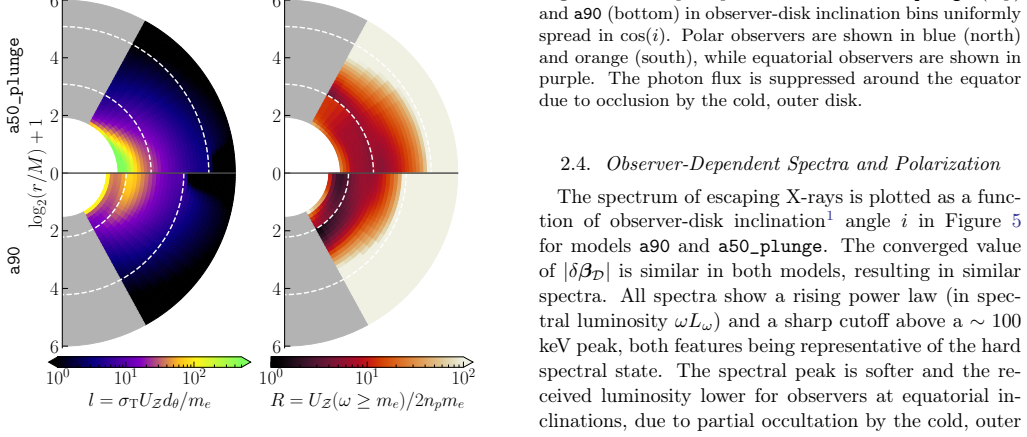
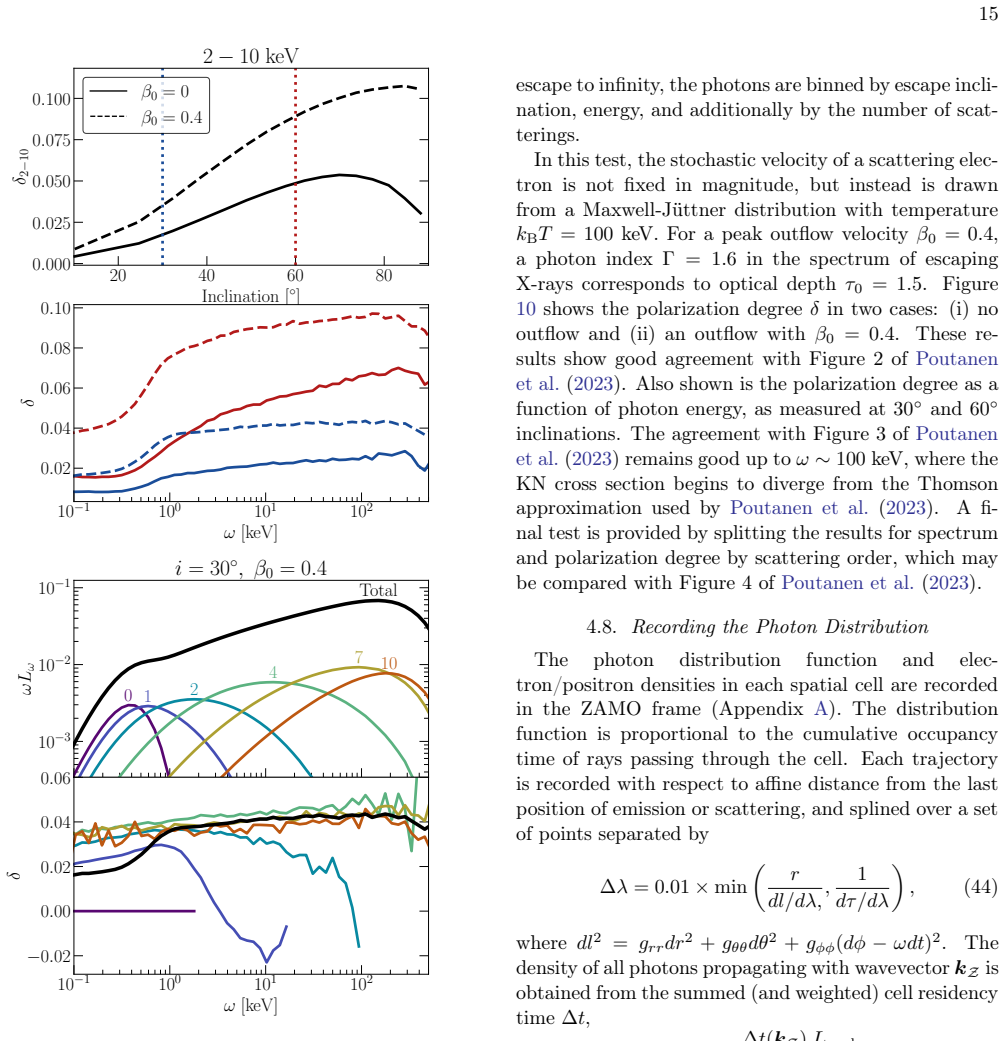
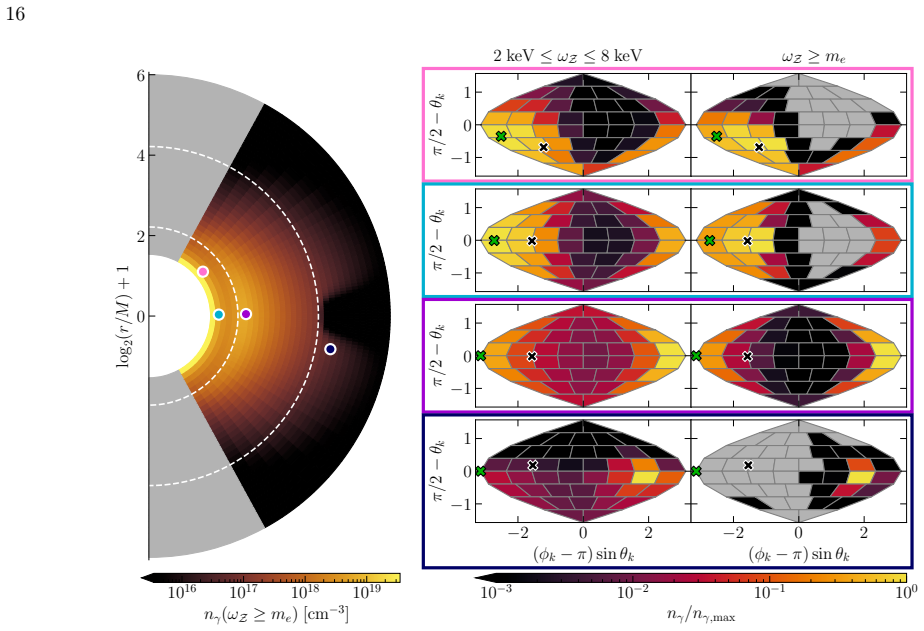
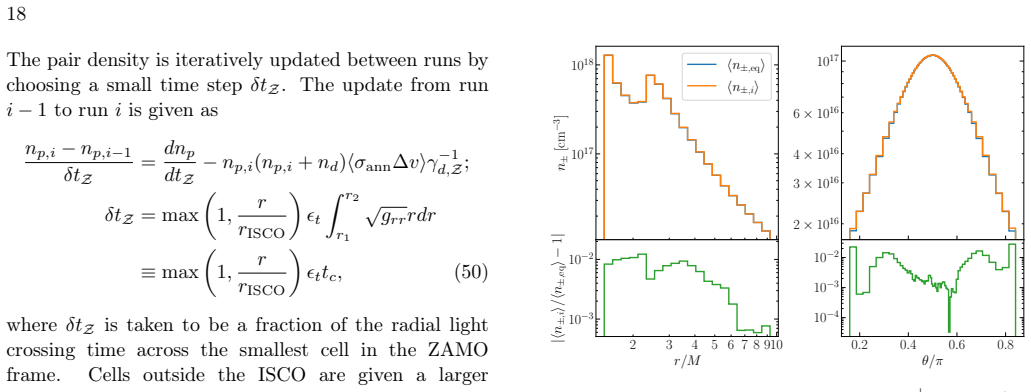
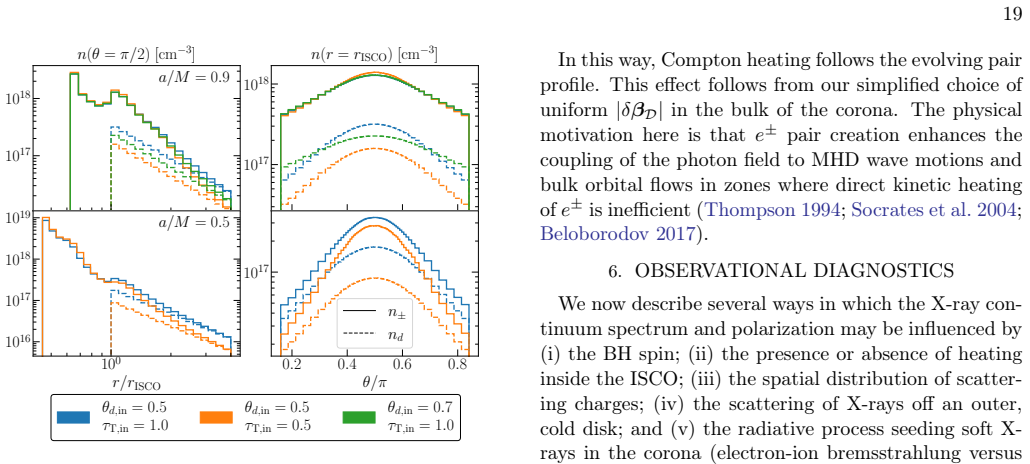
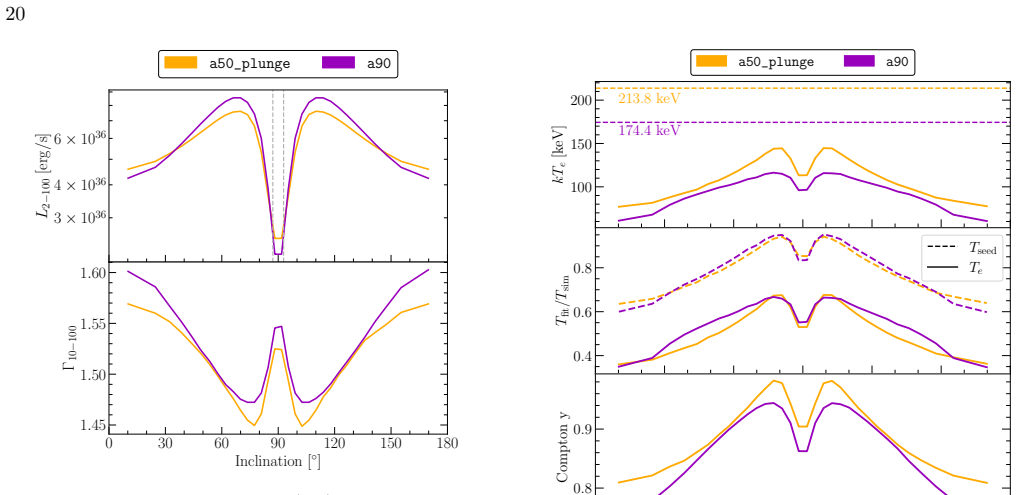
A self-consistent Monte Carlo treatment that includes Compton scattering, photon-photon pair creation, and Kerr-metric ray tracing produces a pair-rich corona whose density peaks closer to the black hole than the assumed thick ion disk. The emergent spectra yield temperatures and Compton parameters that match fits to the hardest spectral state of binary black holes, while the polarization degree reaches 4-10 percent in the 2-8 keV band when a kinematic upflow of electrons and positrons from the equatorial plane is included.
What carries the argument
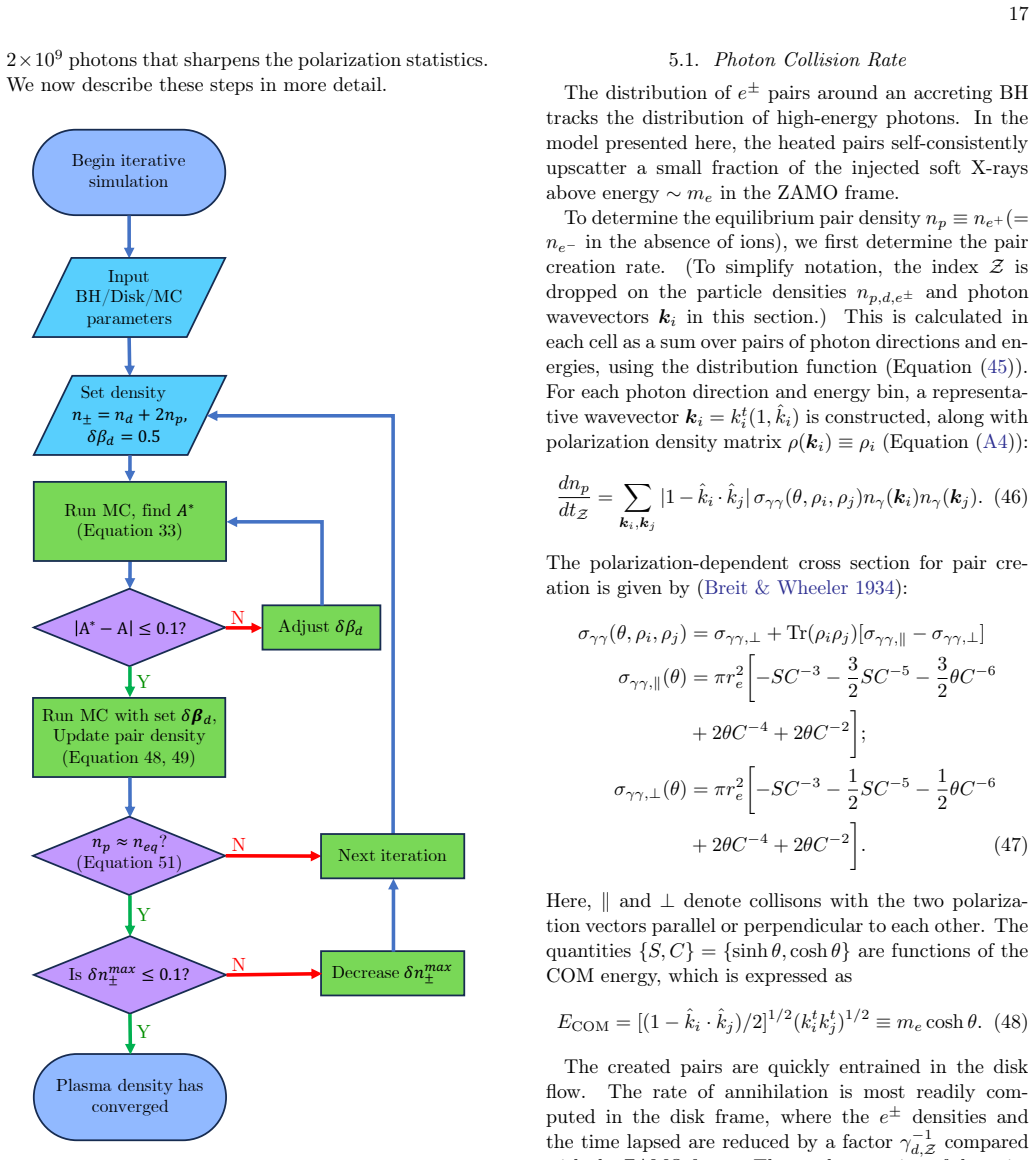
The iterative Monte Carlo procedure that self-consistently tracks Compton scattering, photon-photon pair creation, and general-relativistic lensing and frame-dragging while holding seed-luminosity amplification fixed.
If this is right
- The self-consistent pair cloud sits closer to the black hole than the original ion disk.
- The output spectra reproduce the temperature and Compton parameter values inferred from black-hole binary data in the hardest spectral state.
- Linear polarization of the escaping X-rays rises to 4-10 percent across the 2-8 keV band once an equatorial e± upflow is permitted.
- General-relativistic effects of lensing and frame dragging are folded into both the spectrum and the polarization pattern seen by a distant observer.
Where Pith is reading between the lines
- Polarization measurements with future instruments could directly test whether a pair-rich zone exists near the horizon rather than a purely thermal electron corona.
- The inward concentration of pairs may alter the expected reverberation lags between the corona and the disk, offering a timing signature distinguishable from other geometries.
- Extending the same Monte Carlo framework to higher accretion rates or to spinning black holes with different inclinations would show how the pair fraction and polarization scale with mass supply and spin.
Load-bearing premise
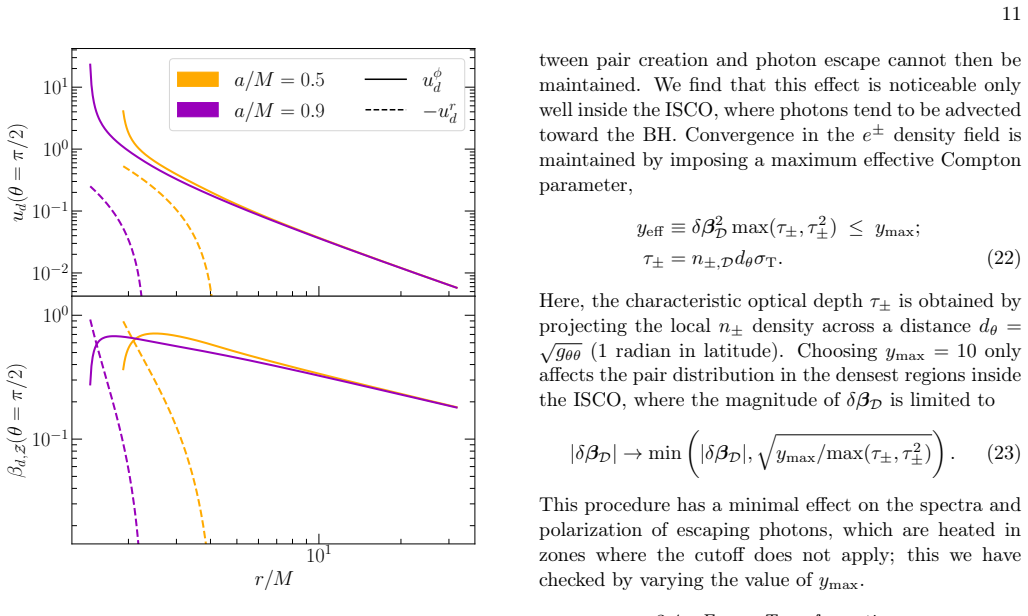
The innermost ion disk is assumed to be geometrically thick and rarefied compared with the disk outside ten gravitational radii, and the velocity dispersion of the electrons and positrons is tuned to keep the Compton amplification of the seed luminosity constant.
What would settle it
X-ray polarimetry of black-hole binaries in the hard state that measures a polarization degree well below 4 percent or well above 10 percent in the 2-8 keV band, or timing and reflection data that place the bulk of the scattering corona farther out than a few gravitational radii, would challenge the model's central prediction.
Figures








read the original abstract
We build a self-consistent model of a warm scattering corona near an accreting black hole in Kerr geometry, in the regime of slow ($\sim 0.01$ Eddington) mass accretion. An iterative Monte Carlo procedure is developed that incorporates self-consistently the effects of Compton scattering and electron-positron pair creation, as well as general relativistic lensing and frame dragging effects. Soft thermal photons are seeded in the inner disk and the velocity dispersion of the electrons and positrons adjusted to yield a fixed seed luminosity amplification through Compton scattering. A simple kinematic prescription is also added for bulk outflow. Pair creation by photon collisions raises significantly the density of scattering charges in and around the innermost ion disk, which is assumed to be geometrically thick and rarefied compared with the disk outside 10 gravitational radii. The self-consistent pair cloud is concentrated closer to the BH. The spectrum and polarization of the escaping X-rays are recorded as a function of the observer's orientation. The temperature and Compton parameter measured from the output spectra using the compPS package are consistent with fits to binary BH data in the hardest spectral state; the polarization degree rises to $4-10\%$ through the 2-8 keV band with allowance for $e^\pm$ upflow from the BH equator.
Editorial analysis
A structured set of objections, weighed in public.
Referee Report
Summary. The manuscript develops an iterative Monte Carlo model of a warm scattering corona around a slowly accreting Kerr black hole (~0.01 Eddington). It incorporates Compton scattering, electron-positron pair creation, general-relativistic lensing and frame-dragging, and a simple kinematic bulk outflow. Soft seed photons originate from the inner disk; the velocity dispersion of e± is adjusted to enforce a fixed luminosity amplification. The innermost ion disk is taken to be geometrically thick and rarefied inside ~10 r_g. Pair creation increases the scattering charge density, concentrating the pair cloud closer to the black hole. Output spectra and polarization (4–10% in 2–8 keV) are shown to be consistent with hard-state black-hole binary observations when fitted with compPS.
Significance. If the central results hold, the work supplies a physically motivated, GR-aware framework for the origin of hard X-ray emission and polarization in accreting black holes. The explicit treatment of pair production and its feedback on the corona location is a clear advance over purely phenomenological corona models. The reported consistency with observed temperatures, Compton y-parameters, and polarization degrees provides a concrete link to data that could be tested with IXPE and future missions. The Monte Carlo implementation itself is a reusable technical contribution.
major comments (3)
- [model description / iterative Monte Carlo procedure] Abstract and model-description section: the velocity dispersion of electrons and positrons is explicitly adjusted to enforce a fixed seed-luminosity amplification. This choice sets the effective temperature and Compton y-parameter by construction rather than solving the local heating–cooling balance or accretion-power budget, undermining the claim that the pair density and its radial concentration are fully self-determined from the physics.
- [disk geometry assumption] Abstract and § on disk structure: the innermost ion disk is assumed to be geometrically thick and rarefied inside ~10 r_g with no sensitivity study or physical justification provided. Because this assumption directly controls where seed photons are injected and where pairs can accumulate, the reported concentration of the pair cloud closer to the black hole is not robust to plausible variations in the disk geometry.
- [spectral and polarization results] Results section on spectral fitting: while the output spectra are stated to be consistent with compPS fits to hard-state data, no quantitative comparison (e.g., residuals, parameter uncertainties, or direct comparison to analytic Comptonization limits) is shown. Without such validation, the claimed agreement remains qualitative and does not yet demonstrate that the Monte Carlo implementation reproduces known limits.
minor comments (2)
- [methods] Notation for the Compton y-parameter and optical depth should be defined explicitly at first use; the current text leaves the reader to infer their precise definitions from the Monte Carlo output.
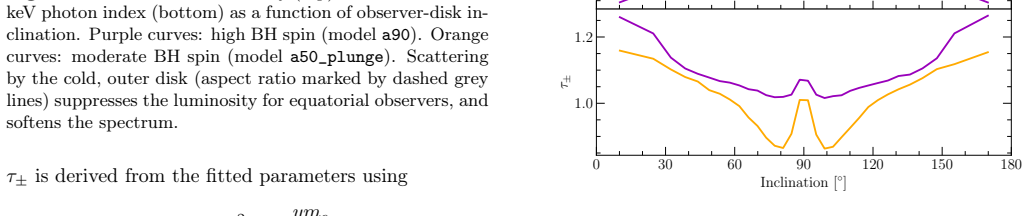
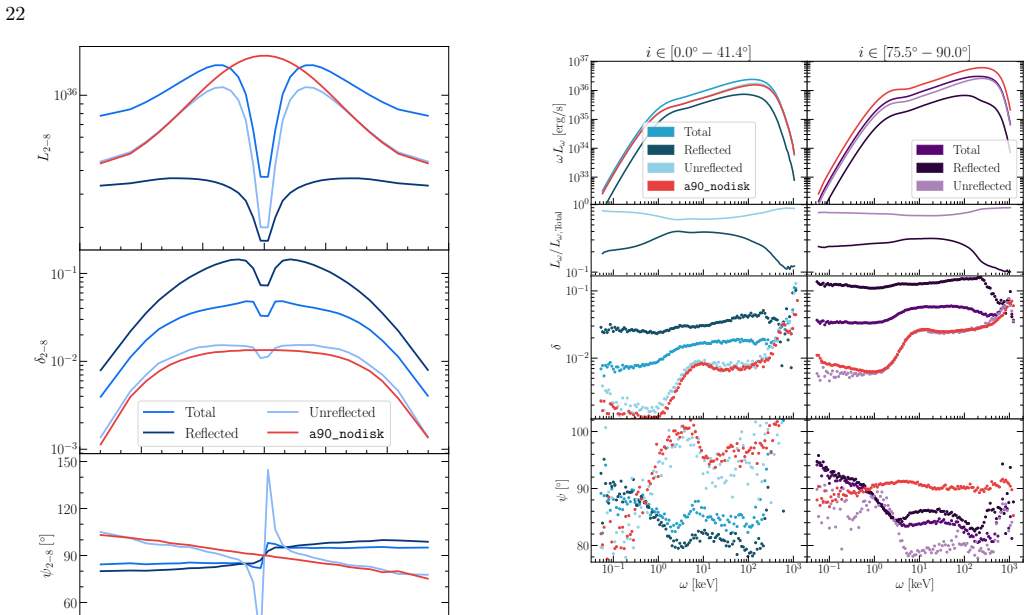
- [figures] Figure captions for the polarization curves should state the exact energy bands and observer inclinations used; the 4–10% range is quoted without specifying which viewing angles produce the upper and lower bounds.
Simulated Author's Rebuttal
We thank the referee for the positive assessment of the significance of our work and for the detailed comments. We address each major comment below and indicate the revisions we will make to the manuscript.
read point-by-point responses
-
Referee: Abstract and model-description section: the velocity dispersion of electrons and positrons is explicitly adjusted to enforce a fixed seed-luminosity amplification. This choice sets the effective temperature and Compton y-parameter by construction rather than solving the local heating–cooling balance or accretion-power budget, undermining the claim that the pair density and its radial concentration are fully self-determined from the physics.
Authors: We agree that the velocity dispersion is tuned to achieve a prescribed amplification, thereby setting the effective temperature and Compton y-parameter to match typical observed values. This approach is adopted to focus on the self-consistent treatment of pair production and its impact on the corona structure at fixed luminosity, rather than attempting to model the unknown heating mechanism explicitly. The pair density and its concentration near the black hole are nevertheless determined self-consistently through the Monte Carlo simulation of photon collisions and pair creation. We will revise the model description to make this distinction clearer and to note the approximation involved. revision: partial
-
Referee: Abstract and § on disk structure: the innermost ion disk is assumed to be geometrically thick and rarefied inside ~10 r_g with no sensitivity study or physical justification provided. Because this assumption directly controls where seed photons are injected and where pairs can accumulate, the reported concentration of the pair cloud closer to the black hole is not robust to plausible variations in the disk geometry.
Authors: The assumption of a geometrically thick and rarefied inner disk within approximately 10 gravitational radii is based on standard truncated-disk models for the hard state of black-hole binaries. We will add a short paragraph in the revised manuscript providing physical justification with references to the literature on disk truncation and include a brief sensitivity analysis varying the truncation radius to confirm that the qualitative concentration of the pair cloud persists. revision: yes
-
Referee: Results section on spectral fitting: while the output spectra are stated to be consistent with compPS fits to hard-state data, no quantitative comparison (e.g., residuals, parameter uncertainties, or direct comparison to analytic Comptonization limits) is shown. Without such validation, the claimed agreement remains qualitative and does not yet demonstrate that the Monte Carlo implementation reproduces known limits.
Authors: We acknowledge that the current presentation of the spectral results is qualitative. In the revised version, we will add a quantitative comparison, including best-fit compPS parameters, residuals, and a discussion of how the Monte Carlo spectra align with analytic Comptonization expectations to better validate the implementation. revision: yes
Circularity Check
Velocity dispersion tuned to fixed amplification, so pair cloud concentration depends on input choice
specific steps
-
fitted input called prediction
[Abstract]
"Soft thermal photons are seeded in the inner disk and the velocity dispersion of the electrons and positrons adjusted to yield a fixed seed luminosity amplification through Compton scattering."
The dispersion is adjusted to enforce a specific fixed amplification factor. This directly controls the Compton y-parameter and pair-production threshold, so the self-consistent pair cloud density and its concentration closer to the BH are influenced by this input choice rather than being fully determined by the iterative solution alone.
full rationale
The iterative Monte Carlo for Compton scattering, pair creation, and GR effects is self-contained and follows standard physics. However, the velocity dispersion is explicitly adjusted to enforce a fixed seed luminosity amplification, which sets the effective temperature and y-parameter by construction. This makes the pair density, cloud concentration closer to the BH, and resulting polarization partly determined by the tuning rather than emerging solely from energy balance or accretion power. The consistency with compPS fits to hard-state data is then a post-hoc check. No self-citations, uniqueness theorems, or other load-bearing reductions to inputs are present. This is a single minor fitted-input step, so overall circularity remains low.
Axiom & Free-Parameter Ledger
free parameters (2)
- accretion rate
- electron/positron velocity dispersion
axioms (3)
- standard math Standard Compton scattering and photon-photon pair creation cross sections from QED
- domain assumption Kerr metric for spacetime around the spinning black hole
- ad hoc to paper Innermost ion disk is geometrically thick and rarefied inside ~10 gravitational radii
Reference graph
Works this paper leans on
-
[1]
Bardeen, J. M., Press, W. H., & Teukolsky, S. A. 1972, ApJ, 178, 347, doi: 10.1086/151796
-
[2]
Belloni, T. M. 2010, in Lecture Notes in Physics, Berlin Springer Verlag, ed. T. Belloni, Vol. 794, 53, doi: 10.1007/978-3-540-76937-8_3
-
[3]
Beloborodov, A. M. 1999, ApJL, 510, L123, doi: 10.1086/311810 —. 2017, ApJ, 850, 141, doi: 10.3847/1538-4357/aa8f4f
-
[4]
B., Lifshitz, E
Berestetskii, V. B., Lifshitz, E. M., & Pitaevskii, V. B. 1971, Relativistic quantum theory. Pt.1
1971
-
[5]
Breit, G., & Wheeler, J. A. 1934, Physical Review, 46, 1087, doi: 10.1103/PhysRev.46.1087
-
[6]
J., Gilfanov, M., & Sunyaev, R
Burke, M. J., Gilfanov, M., & Sunyaev, R. 2017, MNRAS, 466, 194, doi: 10.1093/mnras/stw2514
-
[7]
Global structure of the Kerr family of gravitational fields,
Carter, B. 1968, Physical Review, 174, 1559, doi: 10.1103/PhysRev.174.1559
-
[8]
Celotti, A., Fabian, A. C., & Rees, M. J. 1992, MNRAS, 255, 419, doi: 10.1093/mnras/255.3.419
-
[9]
Chan, H.-S., Dexter, J., & Begelman, M. C. 2026, MNRAS, 547, stag424, doi: 10.1093/mnras/stag424
-
[10]
Connors, P. A., & Stark, R. F. 1977, Nature, 269, 128, doi: 10.1038/269128a0
-
[11]
Coppi, P. S., & Blandford, R. D. 1990, MNRAS, 245, 453, doi: 10.1093/mnras/245.3.453
-
[12]
Leung, P. K. 2009, ApJS, 184, 387, doi: 10.1088/0067-0049/184/2/387
-
[13]
Done, C., & Fabian, A. C. 1989, MNRAS, 240, 81, doi: 10.1093/mnras/240.1.81
-
[14]
Dove, J. B., Wilms, J., & Begelman, M. C. 1997a, ApJ, 487, 747, doi: 10.1086/304632
-
[15]
B., Wilms, J., Maisack, M., & Begelman, M
Dove, J. B., Wilms, J., Maisack, M., & Begelman, M. C. 1997b, ApJ, 487, 759, doi: 10.1086/304647
-
[16]
Draghis, P. A., Miller, J. M., Kara, E., et al. 2025, ApJL, 995, L12, doi: 10.3847/2041-8213/ae2276
-
[17]
2025, MNRAS, doi: 10.1093/mnras/staf859
Ewing, M., Parra, M., Mastroserio, G., et al. 2025, MNRAS, doi: 10.1093/mnras/staf859
-
[18]
C., Lohfink, A., Kara, E., et al
Fabian, A. C., Lohfink, A., Kara, E., et al. 2015, MNRAS, 451, 4375, doi: 10.1093/mnras/stv1218
-
[19]
Farris, B. D., Li, T. K., Liu, Y. T., & Shapiro, S. L. 2008, PhRvD, 78, 024023, doi: 10.1103/PhysRevD.78.024023
-
[20]
2022, ApJL, 929, L26, doi: 10.3847/2041-8213/ac64a5
Fishbach, M., & Kalogera, V. 2022, ApJL, 929, L26, doi: 10.3847/2041-8213/ac64a5
-
[21]
, archivePrefix = "arXiv", eprint =
Gou, L., McClintock, J. E., Remillard, R. A., et al. 2014, ApJ, 790, 29, doi: 10.1088/0004-637X/790/1/29 Grošelj, D., Hakobyan, H., Beloborodov, A. M., Sironi, L., & Philippov, A. 2024, PhRvL, 132, 085202, doi: 10.1103/PhysRevLett.132.085202 31
-
[22]
Guilbert, P. W., Fabian, A. C., & Rees, M. J. 1983, MNRAS, 205, 593, doi: 10.1093/mnras/205.3.593
-
[23]
1993, ApJ, 413, 507, doi: 10.1086/173020
Haardt, F., & Maraschi, L. 1993, ApJ, 413, 507, doi: 10.1086/173020
-
[24]
Kawashima, T., Ohsuga, K., & Takahashi, H. R. 2023, ApJ, 949, 101, doi: 10.3847/1538-4357/acc94a
-
[25]
2022, Science, 378, 650, doi: 10.1126/science.add5399
Krawczynski, H., Muleri, F., Dovčiak, M., et al. 2022, Science, 378, 650, doi: 10.1126/science.add5399
-
[26]
Lightman, A. P. 1982, ApJ, 253, 842, doi: 10.1086/159686
-
[27]
Liska, M. T. P., Musoke, G., Tchekhovskoy, A., Porth, O., & Beloborodov, A. M. 2022, ApJL, 935, L1, doi: 10.3847/2041-8213/ac84db
-
[28]
Malzac, J., Beloborodov, A. M., & Poutanen, J. 2001, MNRAS, 326, 417, doi: 10.1046/j.1365-8711.2001.04450.x
-
[29]
1996, Radiation Physics and Chemistry, 48, 403, doi: 10.1016/0969-806X(95)00472-A
Matt, G., Feroci, M., Rapisarda, M., & Costa, E. 1996, Radiation Physics and Chemistry, 48, 403, doi: 10.1016/0969-806X(95)00472-A
-
[30]
Mehlhaff, J. M., Chen, A. Y., Luepker, M., & Yuan, Y. 2026, arXiv e-prints, arXiv:2602.22168, doi: 10.48550/arXiv.2602.22168
-
[31]
2022, PhRvL, 129, 161101, doi: 10.1103/PhysRevLett.129.161101 Nättilä, J
Mummery, A., & Balbus, S. 2022, PhRvL, 129, 161101, doi: 10.1103/PhysRevLett.129.161101 Nättilä, J. 2024, Nature Communications, 15, 7026, doi: 10.1038/s41467-024-51257-1
-
[32]
Noble, S. C., Krolik, J. H., & Hawley, J. F. 2010, ApJ, 711, 959, doi: 10.1088/0004-637X/711/2/959
-
[33]
Parfrey, K., Philippov, A., & Cerutti, B. 2019, PhRvL, 122, 035101, doi: 10.1103/PhysRevLett.122.035101 Podgorný, J., Svoboda, J., Dovčiak, M., et al. 2024, A&A, 686, L12, doi: 10.1051/0004-6361/202450566
-
[34]
1996, ApJ, 470, 249, doi: 10.1086/177865
Poutanen, J., & Svensson, R. 1996, ApJ, 470, 249, doi: 10.1086/177865
-
[35]
Poutanen, J., Veledina, A., & Beloborodov, A. M. 2023, ApJL, 949, L10, doi: 10.3847/2041-8213/acd33e
-
[36]
Poutanen, J., Veledina, A., & Zdziarski, A. A. 2018, A&A, 614, A79, doi: 10.1051/0004-6361/201732345
-
[37]
2009, ApJL, 690, L97, doi: 10.1088/0004-637X/690/2/L97
Poutanen, J., & Vurm, I. 2009, ApJL, 690, L97, doi: 10.1088/0004-637X/690/2/L97
-
[38]
2019, ApJL, 870, L18, doi: 10.3847/2041-8213/aaf97b
Qin, Y., Marchant, P., Fragos, T., Meynet, G., & Kalogera, V. 2019, ApJL, 870, L18, doi: 10.3847/2041-8213/aaf97b
-
[39]
Reynolds, C. S. 2021, ARA&A, 59, 117, doi: 10.1146/annurev-astro-112420-035022
-
[40]
Ryan, B. R., Dolence, J. C., & Gammie, C. F. 2015, ApJ, 807, 31, doi: 10.1088/0004-637X/807/1/31
-
[41]
B., & Lightman, A
Rybicki, G. B., & Lightman, A. P. 1986, Radiative Processes in Astrophysics
1986
-
[42]
Schnittman, J. D., & Krolik, J. H. 2013, ApJ, 777, 11, doi: 10.1088/0004-637X/777/1/11
-
[43]
2021, A&A, 652, A138, doi: 10.1051/0004-6361/202141214
Sen, K., Xu, X.-T., Langer, N., et al. 2021, A&A, 652, A138, doi: 10.1051/0004-6361/202141214
-
[44]
Shapiro, S. L., Lightman, A. P., & Eardley, D. M. 1976, ApJ, 204, 187, doi: 10.1086/154162 Sądowski, A. 2016, MNRAS, 459, 4397, doi: 10.1093/mnras/stw913
-
[45]
Socrates, A., Davis, S. W., & Blaes, O. 2004, ApJ, 601, 405, doi: 10.1086/380301
-
[46]
Squire, J., Quataert, E., & Hopkins, P. F. 2025, The Open Journal of Astrophysics, 8, 39, doi: 10.33232/001c.136467
-
[47]
Stern, B. E., Begelman, M. C., Sikora, M., & Svensson, R. 1995, MNRAS, 272, 291, doi: 10.1093/mnras/272.2.291
-
[48]
A., & Titarchuk, L
Sunyaev, R. A., & Titarchuk, L. G. 1980, A&A, 86, 121
1980
-
[49]
, year = 1982, month = jul, volume = 258, pages =
Svensson, R. 1982, ApJ, 258, 335, doi: 10.1086/160082 The LIGO Scientific Collaboration, the Virgo Collaboration, the KAGRA Collaboration, et al. 2025, arXiv e-prints, arXiv:2508.18083, doi: 10.48550/arXiv.2508.18083
-
[50]
, year = 1994, month = oct, volume =
Thompson, C. 1994, MNRAS, 270, 480, doi: 10.1093/mnras/270.3.480
-
[51]
2013, MNRAS, 430, 3196, doi: 10.1093/mnras/stt124
Veledina, A., Poutanen, J., & Vurm, I. 2013, MNRAS, 430, 3196, doi: 10.1093/mnras/stt124
-
[52]
Walker, M., & Penrose, R. 1970, Communications in Mathematical Physics, 18, 265, doi: 10.1007/BF01649445 Wardziński, G., & Zdziarski, A. A. 2000, MNRAS, 314, 183, doi: 10.1046/j.1365-8711.2000.03297.x
-
[53]
White, C. J., Mullen, P. D., Jiang, Y.-F., et al. 2023, ApJ, 949, 103, doi: 10.3847/1538-4357/acc8cf
-
[54]
2020, ApJL, 889, L18, doi: 10.3847/2041-8213/ab665e
Yan, Z., Xie, F.-G., & Zhang, W. 2020, ApJL, 889, L18, doi: 10.3847/2041-8213/ab665e
-
[55]
2023, ApJ, 945, 65, doi: 10.3847/1538-4357/acba11
You, B., Dong, Y., Yan, Z., et al. 2023, ApJ, 945, 65, doi: 10.3847/1538-4357/acba11
-
[56]
Yuan, Y., Chen, A. Y., & Luepker, M. 2025, ApJ, 985, 159, doi: 10.3847/1538-4357/adce79
-
[57]
A., Chand, S., Banerjee, S., et al
Zdziarski, A. A., Chand, S., Banerjee, S., et al. 2024, ApJL, 967, L9, doi: 10.3847/2041-8213/ad43ed
discussion (0)
Sign in with ORCID, Apple, or X to comment. Anyone can read and Pith papers without signing in.