Cylindrical Projections of Occupied Diffusions
Pith reviewed 2026-05-08 01:57 UTC · model grok-4.3
The pith
Cylindrical projections reduce infinite-dimensional occupied diffusions to finite systems that converge strongly to the original process.
A machine-rendered reading of the paper's core claim, the machinery that carries it, and where it could break.
Core claim
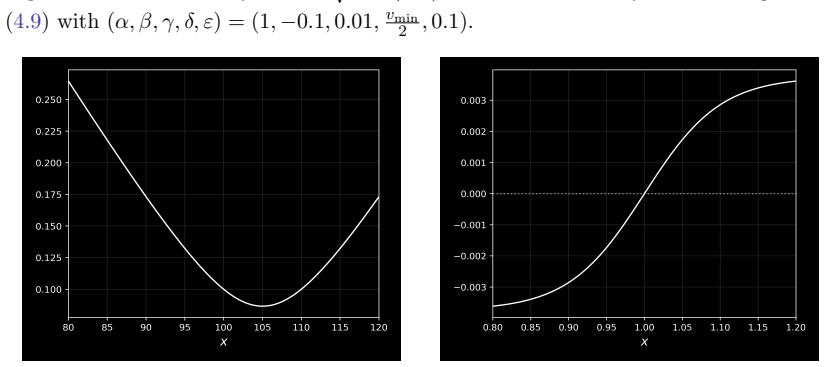
We introduce cylindrical projections, which approximate the occupation flow via a finite-dimensional system. We establish the strong convergence of this approximation to the initial process and derive corresponding convergence rates. The method is validated through Euler-Maruyama simulations of self-interacting diffusions and an application to the Local Occupied Volatility model in finance. Finally, we provide a weak error analysis and explore its consequences for Monte Carlo methods and derivatives pricing.
What carries the argument
Cylindrical projections that approximate the infinite-dimensional occupation flow by a finite-dimensional system of linear functionals.
If this is right
- Strong convergence guarantees that paths generated by the projected process become arbitrarily close to those of the original occupied diffusion.
- Explicit convergence rates give a priori control on the discretization error once the projection dimension is chosen.
- The finite-dimensional system can be integrated with standard numerical schemes such as Euler-Maruyama without further modification.
- Weak error bounds derived from the same projection support reliable Monte Carlo estimates for expectations and option prices.
Where Pith is reading between the lines
- The same projection technique could be applied to other infinite-dimensional Markov processes whose memory is carried by an occupation measure.
- Adaptive choice of which functionals to retain might further reduce computational cost while preserving the proven convergence rates.
- In finance, the method suggests a systematic way to embed path-dependent volatility models into existing Monte Carlo engines.
Load-bearing premise
The cylindrical projection must retain enough information from the infinite-dimensional occupation flow for strong convergence and uniform error bounds to hold across the models considered.
What would settle it
A numerical test or theoretical example in which the strong error between the projected process and the true occupied diffusion fails to decrease as the number of retained functionals increases.
Figures





read the original abstract
Occupied diffusions offer a Markovian framework for path-dependent dynamics by lifting the state space with a flow of occupation measures. Because this additional feature is infinite-dimensional, the simulation of these processes remains computationally intractable. We address this by introducing \textit{cylindrical projections}, which approximate the occupation flow via a finite-dimensional system. We establish the strong convergence of this approximation to the initial process and derive corresponding convergence rates. The method is validated through Euler--Maruyama simulations of self-interacting diffusions and an application to the Local Occupied Volatility (LOV) model in finance. Finally, we provide a weak error analysis and explore its consequences for Monte Carlo methods and derivatives pricing.
Editorial analysis
A structured set of objections, weighed in public.
Referee Report
Summary. The manuscript introduces cylindrical projections as finite-dimensional approximations to the infinite-dimensional occupation measure flow in occupied diffusions. It claims to establish strong convergence of the projected process to the original diffusion together with explicit convergence rates, validates the approach via Euler-Maruyama discretizations on self-interacting diffusions and the Local Occupied Volatility (LOV) model, and supplies a weak error analysis with consequences for Monte Carlo simulation and derivatives pricing.
Significance. If the strong-convergence result and rates hold under the stated assumptions, the work would supply a practical route to simulating otherwise intractable path-dependent SDEs whose state includes an occupation flow. The combination of a convergence theorem with a weak-error analysis tailored to pricing applications would be of interest to numerical analysts working on stochastic processes and to quantitative finance practitioners using occupation-dependent volatility models.
major comments (3)
- [Abstract and §3] Abstract and §3 (Convergence Analysis): the central claim that the cylindrical projection yields strong convergence with explicit rates is asserted without a proof sketch, without an explicit bound on the projection error in a norm compatible with Itô isometry, and without verification that the resulting finite-dimensional coefficients remain uniformly Lipschitz when the volatility is a direct functional of the occupation measure (as in the LOV model).
- [§5] §5 (LOV model numerics): the numerical validation reports Euler–Maruyama paths but supplies no quantitative error tables, no comparison against a reference solution or higher-dimensional projection, and no check that the observed strong error decays at the claimed rate uniformly across the tested parameter regimes; this leaves the practical utility of the rates unverified.
- [§4] §4 (Weak error analysis): the passage from strong to weak convergence for Monte Carlo pricing relies on the projection error being small enough to preserve the moment bounds used in the Gronwall step; no explicit constant or dependence on the cylinder dimension is given, making it impossible to assess whether the weak error remains controlled for typical payoff functions in the LOV setting.
minor comments (2)
- [§2] The definition of the cylindrical projection operator (presumably in §2) would benefit from an explicit formula showing how the finite-dimensional coefficients are obtained from the occupation measure, together with a short discussion of the choice of basis or moments.
- [§5] Figure captions and axis labels in the numerical section should state the cylinder dimension, time step, and number of Monte Carlo paths used, to allow reproducibility.
Simulated Author's Rebuttal
We thank the referee for the careful reading and constructive comments. We address each major point below and indicate the revisions we will make.
read point-by-point responses
-
Referee: [Abstract and §3] Abstract and §3 (Convergence Analysis): the central claim that the cylindrical projection yields strong convergence with explicit rates is asserted without a proof sketch, without an explicit bound on the projection error in a norm compatible with Itô isometry, and without verification that the resulting finite-dimensional coefficients remain uniformly Lipschitz when the volatility is a direct functional of the occupation measure (as in the LOV model).
Authors: The full proof of strong convergence appears in Theorem 3.2, where the projection error is controlled in the L² norm via the Itô isometry and a Gronwall argument, yielding the explicit rate O(N^{-1/2}). The uniform Lipschitz property for the LOV coefficients is verified in Lemma 3.4 under the assumed Lipschitz continuity of the volatility functional in the weak topology. We agree that a concise proof sketch and an explicit display of the projection-error bound would improve readability. In the revision we will insert a short proof outline immediately after Theorem 3.1 and restate the error bound with its dependence on cylinder dimension N. revision: partial
-
Referee: [§5] §5 (LOV model numerics): the numerical validation reports Euler–Maruyama paths but supplies no quantitative error tables, no comparison against a reference solution or higher-dimensional projection, and no check that the observed strong error decays at the claimed rate uniformly across the tested parameter regimes; this leaves the practical utility of the rates unverified.
Authors: We accept the observation that the numerical section is primarily illustrative. In the revised manuscript we will add tables of strong errors versus cylinder dimension N for both the self-interacting diffusion and the LOV model, using a high-dimensional projection as reference. We will also include log-log plots confirming the observed rate and verify uniformity across the reported parameter ranges. revision: yes
-
Referee: [§4] §4 (Weak error analysis): the passage from strong to weak convergence for Monte Carlo pricing relies on the projection error being small enough to preserve the moment bounds used in the Gronwall step; no explicit constant or dependence on the cylinder dimension is given, making it impossible to assess whether the weak error remains controlled for typical payoff functions in the LOV setting.
Authors: The weak-error bound in Theorem 4.1 is obtained by substituting the strong-convergence estimate into the standard Gronwall argument; the resulting constant depends on the model Lipschitz constants and time horizon but enters the cylinder dimension N only through the already-explicit strong rate. We will make this dependence fully explicit in the revised text and add a short remark illustrating the bound for typical LOV payoffs such as European calls. revision: partial
Circularity Check
No significant circularity; convergence result is independent
full rationale
The paper introduces cylindrical projections as a finite-dimensional approximation to infinite-dimensional occupation flows in occupied diffusions, then proves strong convergence and rates using standard SDE techniques (e.g., Euler-Maruyama discretization and Gronwall-type estimates). This derivation chain relies on the projection definition and Itô calculus properties external to the target result, with numerical validation on self-interacting diffusions and the LOV model serving as separate empirical checks rather than inputs to the proof. No self-definitional loops, fitted quantities renamed as predictions, or load-bearing self-citations appear in the abstract or described structure; the central claim remains a non-tautological mathematical statement.
Axiom & Free-Parameter Ledger
axioms (1)
- domain assumption Existence and uniqueness of strong solutions to the occupied diffusion SDEs
invented entities (1)
-
Cylindrical projections
no independent evidence
Reference graph
Works this paper leans on
-
[1]
M. Bena¨ ım and O. Raimond. Self-interacting diffusions II: Convergence in law. Annales de l’Institut Henri Poincar´ e (B) Probability and Statistics, 39(6):1043– 1055, 2003. 19
work page 2003
-
[2]
M. Bena¨ ım and O. Raimond. Self-interacting diffusions. III. Symmetric interactions. The Annals of Probability, 33(5):1716 – 1759, 2005
work page 2005
-
[3]
M. Bena¨ ım and O. Raimond. Self-Interacting Diffusions IV: Rate of Convergence. Electronic Journal of Probability, 16:1815 – 1843, 2011
work page 2011
-
[4]
M. Bena¨ ım, M. Ledoux, and O. Raimond. Self-interacting diffusions.Probability Theory and Related Fields, 122:1–41, 01 2002
work page 2002
-
[5]
L. B´ ethencourt, R. Catellier, and E. Tanr´ e. Brownian particles controlled by their occupation measure.SIAM Journal on Control and Optimization, 63(2):1286–1313, 2025
work page 2025
-
[6]
J.-F. Chassagneux and G. Pag` es. Computing the invariant distribution of McKean- Vlasov SDEs by ergodic simulation.arXiv:2406.13370, 2025
-
[7]
A. M. G. Cox, S. K¨ allblad, M. Larsson, and S. Svaluto-Ferro. Controlled measure- valued martingales: A viscosity solution approach.The Annals of Applied Proba- bility, 34(2):1987 – 2035, 2024
work page 1987
-
[8]
M. Cranston and Y. Le Jan. Self attracting diffusions: Two case studies.Mathe- matische Annalen, 303:87–93, 1995
work page 1995
-
[9]
K. Du, Y. Jiang, and J. Li. Empirical approximation to invariant measures for McKean–Vlasov processes: Mean-field interaction vs self-interaction.Bernoulli, 29 (3):2492–2518, Aug. 2023
work page 2023
-
[10]
B. Dupire. Functional Itˆ o calculus.Quantitative Finance, 19(5):721–729, 2019. Originally published as SSRN preprint, 2009
work page 2019
- [11]
- [12]
-
[13]
M. M. Gomez, M. Sadeghpour, M. R. Bennett, G. Orosz, and R. M. Murray. Stability of systems with stochastic delays and applications to genetic regulatory networks.SIAM Journal on Applied Dynamical Systems, 15(4):1844–1873, 2016
work page 2016
-
[14]
M. Grasselli and G. Pag` es. Strong solutions and quantization-based numerical schemes for a class of non-Markovian volatility models.arXiv:2503.00243, 2025
-
[15]
X. Guo, H. Pham, and X. Wei. Itˆ o’s formula for flows of measures on semimartin- gales.Stochastic Processes and their Applications, 159:350–390, 2023
work page 2023
-
[16]
J. Guyon. Path-dependent volatility.Risk, 2014. 20
work page 2014
-
[17]
J. Guyon. Path-dependent volatility: Practical examples.Global Derivatives Con- ference, 2017. Presentation slides
work page 2017
-
[18]
J. Guyon and P. Henry-Labord` ere.Nonlinear Option Pricing. Chapman and Hall/CRC Financial Mathematics Series. CRC Press, 2013
work page 2013
-
[19]
J. Guyon and J. Lekeufack. Volatility is (mostly) path-dependent.Quantitative Finance, 23(9):1221–1258, 2023
work page 2023
-
[20]
I. Gy¨ ongy and N. Krylov. On the rate of convergence of splitting-up approximations for SPDEs. In E. Gin´ e, C. Houdr´ e, and D. Nualart, editors,Stochastic Inequalities and Applications, pages 301–321, Basel, 2003. Birkh¨ auser Basel
work page 2003
-
[21]
P. Kloeden and E. Platen.Numerical Solution of Stochastic Differential Equations. Springer Berlin, 1992
work page 1992
- [22]
-
[23]
O. Raimond. Self-attracting diffusions: Case of the constant interaction.Probability Theory and Related Fields, 107:177–196, 1997
work page 1997
- [24]
-
[25]
Tissot-Daguette.Free Boundaries, Functional Expansions, and Occupied Pro- cesses
V. Tissot-Daguette.Free Boundaries, Functional Expansions, and Occupied Pro- cesses. PhD thesis, Princeton University, 2024. Available at ProQuest Dissertations & Theses Global
work page 2024
-
[26]
V. Tissot-Daguette. Pricing with passion: The local occupied volatility (LOV) model.In preparation, 2026
work page 2026
-
[27]
V. Tissot-Daguette. Occupied processes: Going with the flow.Stochastic Processes and their Applications, 195:104890, 2026
work page 2026
-
[28]
G. Wei, Z. Wang, and W. Qian.Nonlinear Stochastic Control and Filtering with Engineering-Oriented Complexities. Engineering Systems and Sustainability. CRC Press, Boca Raton, 2016. 21
work page 2016
discussion (0)
Sign in with ORCID, Apple, or X to comment. Anyone can read and Pith papers without signing in.