A nonlocal coupled system: analysis and discretization
Pith reviewed 2026-05-07 15:54 UTC · model grok-4.3
The pith
A coupled system of regional fractional Laplacians on disjoint domains admits a unique energy minimizer with fractional Sobolev regularity.
A machine-rendered reading of the paper's core claim, the machinery that carries it, and where it could break.
Core claim
Under suitable assumptions on the domains and the kernel, the energy functional has a unique minimizer and the solution satisfies regularity estimates in fractional Sobolev spaces. The finite element discretization satisfies a priori error estimates, and the alternating Schwarz-type method converges geometrically for both the continuous and discrete problems.
What carries the argument
The energy functional whose Euler-Lagrange equations are the coupled nonlocal system involving regional fractional Laplacians of orders s1 and s2 on disjoint domains and the interaction kernel J, solved via the alternating Schwarz iteration.
If this is right
- Existence and uniqueness of the energy minimizer for the coupled nonlocal system.
- Regularity of the solution in fractional Sobolev spaces.
- A priori error estimates for the finite element discretization.
- Geometric convergence of the alternating Schwarz method on both the continuous and discrete problems.
Where Pith is reading between the lines
- The same existence and convergence arguments could extend to systems with more than two domains or different fractional orders.
- The geometric convergence rate supports efficient parallel implementations for large-scale simulations.
- The a priori error estimates offer a starting point for adaptive mesh refinement strategies.
- Similar analysis may apply to time-dependent versions of the coupled system.
Load-bearing premise
Suitable assumptions on the domains and the kernel J that guarantee coercivity and continuity of the energy functional.
What would settle it
A concrete numerical example in which the alternating Schwarz iteration fails to converge geometrically or no energy minimizer exists when the kernel J violates the stated positivity or integrability conditions.
Figures

read the original abstract
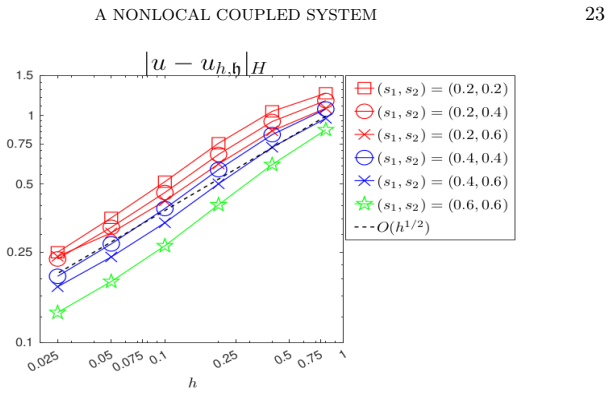
We analyze a nonlocal coupled system arising as the Euler--Lagrange equations of an energy functional involving regional fractional Laplacians of orders $s_1$ and $s_2$ ($ 0 < s_1,s_2 < 1$), each acting on a separate disjoint domain and coupled through a nonlocal interaction term depending on a kernel $J$. Under suitable assumptions on the domains and the kernel, we prove existence and uniqueness of the energy minimizer and derive regularity estimates in fractional Sobolev spaces. We introduce a finite element discretization and establish a priori error estimates. We develop an alternating Schwarz-type method for both the continuous and discrete problems and prove its geometric convergence. Numerical experiments validate the theoretical predictions and illustrate the performance of the method.
Editorial analysis
A structured set of objections, weighed in public.
Referee Report
Summary. The manuscript analyzes a nonlocal coupled system arising from an energy functional with regional fractional Laplacians of orders s1 and s2 (0 < s1,s2 < 1) acting on disjoint domains and coupled through a kernel J. Under suitable assumptions on the domains and kernel, it proves existence and uniqueness of the energy minimizer, derives regularity estimates in fractional Sobolev spaces, introduces a finite element discretization with a priori error estimates, develops an alternating Schwarz-type method for both continuous and discrete problems with a proof of geometric convergence, and presents numerical experiments validating the theory.
Significance. If the results hold, the work provides a complete theoretical and numerical treatment of a coupled nonlocal system, which is relevant for applications involving fractional operators on separate domains. The geometric convergence proof for the alternating Schwarz iteration (both continuous and discrete) is a notable strength, as is the combination of variational analysis, FEM error bounds, and reproducible numerical validation. This offers a solid foundation for extensions in nonlocal modeling and discretization.
minor comments (4)
- The assumptions on the domains and kernel J are repeatedly invoked as 'suitable'; a dedicated subsection or theorem statement listing them explicitly (with references to where each is used) would improve readability and verifiability.
- In the finite element section, the specific choice of approximation spaces (e.g., continuous piecewise polynomials of degree k) and the treatment of the nonlocal coupling term in the discrete variational form should be stated more explicitly to facilitate implementation.
- The numerical experiments section would benefit from quantitative comparison of observed convergence rates against the theoretical a priori error estimates, including tables or plots of error versus mesh size for varying s1 and s2.
- A few notational inconsistencies appear in the regularity estimates (e.g., the precise definition of the regional fractional Sobolev norms); ensuring uniform notation across sections would aid clarity.
Simulated Author's Rebuttal
We thank the referee for the careful reading of our manuscript and for the positive assessment of its contributions, including the existence/uniqueness results, regularity estimates, FEM error bounds, and the geometric convergence proof for the alternating Schwarz method. We appreciate the recommendation for minor revision. No specific major comments were raised in the report, so we have no detailed points to address. We are happy to incorporate any minor editorial suggestions from the editor.
Circularity Check
No significant circularity identified
full rationale
The derivation chain relies on standard direct-method arguments in the calculus of variations (coercivity and weak lower semicontinuity of the energy under explicit assumptions on disjoint domains and kernel J) for existence/uniqueness, known mapping properties of regional fractional Laplacians for regularity in fractional Sobolev spaces, Céa-type arguments plus fractional approximation theory for a priori FEM error estimates, and contraction-mapping or energy-decay arguments for geometric convergence of the alternating Schwarz method (continuous and discrete). These steps are independent of the paper's own fitted values or self-referential definitions; assumptions are listed explicitly and close the estimates without internal gaps or reduction to prior self-citations that themselves depend on the target results.
Axiom & Free-Parameter Ledger
axioms (1)
- domain assumption Suitable assumptions on the domains and the kernel
Reference graph
Works this paper leans on
-
[1]
Acosta, F
G. Acosta, F. M. Bersetche, and J. P. Borthagaray , A short fe implementation for a 2d homogeneous dirichlet problem of a fractional laplacian , Computers & Mathematics with Applications, 74 (2017), pp. 784–816
2017
-
[2]
G. Acosta, F. M. Bersetche, and J. D. Rossi, A domain decomposition scheme for couplings between local and nonlocal equations, Comput. Methods Appl. Math., 23 (2023), pp. 817– 830, https://doi.org/10.1515/cmam-2022-0140
-
[3]
A fractional Laplace equation: Regularity of solutions and finite element approximations
G. Acosta and J. P. Borthagaray , A fractional Laplace equation: regularity of solutions and finite element approximations , SIAM J. Numer. Anal., 55 (2017), pp. 472–495, https: //doi.org/10.1137/15M1033952
-
[4]
Y. Azdoud, F. Han, and G. Lubineau , A morphing framework to couple non-local and local anisotropic continua, International Journal of Solids and Structures, 50 (2013), pp. 1332– 1341, https://doi.org/10.1016/j.ijsolstr.2013.01.016
-
[5]
J. P. Borthagaray, D. Leykekhman, and R. H. Nochetto , Local energy estimates for the fractional Laplacian, SIAM J. Numer. Anal., 59 (2021), pp. 1918–1947, https://doi.org/ 10.1137/20M1335509
-
[6]
Brezis, Functional analysis, Sobolev spaces and partial differential equations , Universitext, Springer, New York, 2011
H. Brezis, Functional analysis, Sobolev spaces and partial differential equations , Universitext, Springer, New York, 2011
2011
-
[7]
A review of image denoising algorithms, with a new one
A. Buades, B. Coll, and J. M. Morel , Image denoising methods. A new nonlocal principle , SIAM Rev., 52 (2010), pp. 113–147, https://doi.org/10.1137/090773908. Reprint of “A review of image denoising algorithms, with a new one” [MR2162865]
-
[8]
C. Bucur and E. Valdinoci , Nonlocal diffusion and applications , vol. 20 of Lecture Notes of the Unione Matematica Italiana, Springer, [Cham]; Unione Matematica Italiana, Bologna, 2016, https://doi.org/10.1007/978-3-319-28739-3
-
[9]
P. Carr, H. Geman, D. B. Madan, and M. Yor , The fine structure of asset returns: An empirical investigation , The Journal of Business, 75 (2002), pp. 305–332, http://www. jstor.org/stable/10.1086/338705 (accessed 2025-05-05)
-
[10]
Clarke , Functional analysis, calculus of variations and optimal control , vol
F. Clarke , Functional analysis, calculus of variations and optimal control , vol. 264 of Graduate Texts in Mathematics, Springer, London, 2013, https://doi.org/10.1007/ 978-1-4471-4820-3
2013
-
[11]
Cont and P
R. Cont and P. Tankov , Financial modelling with jump processes , Chapman & Hall/CRC Financial Mathematics Series, Chapman & Hall/CRC, Boca Raton, FL, 2004
2004
-
[12]
M. D’Elia and M. Gunzburger, Optimal distributed control of nonlocal steady diffusion prob- lems, SIAM J. Control Optim., 52 (2014), pp. 243–273, https://doi.org/10.1137/120897857
-
[13]
M. D’Elia, M. Gunzburger, and C. Vollmann , Nonlocal Integral Equation Continuum Models: Nonstandard Symmetric Interaction Neighborhoods and Finite Element Dis- cretizations, Society for Industrial and Applied Mathematics, Philadelphia, PA, 2024, https://doi.org/10.1137/1.9781611978056
-
[14]
D’Elia, X
M. D’Elia, X. Li, P. Seleson, X. Tian, and Y. Yu , A review of local-to-nonlocal coupling methods in nonlocal diffusion and nonlocal mechanics , Journal of Peridynamics and Non- local Modeling, 4 (2022), pp. 1–50
2022
-
[15]
M. D’Elia, M. Perego, P. Bochev, and D. Littlewood, A coupling strategy for nonlocal and local diffusion models with mixed volume constraints and boundary conditions , Comput. Math. Appl., 71 (2016), pp. 2218–2230, https://doi.org/10.1016/j.camwa.2015.12.006
-
[16]
E. Di Nezza, G. Palatucci, and E. Valdinoci , Hitchhiker’s guide to the fractional Sobolev spaces, Bull. Sci. Math., 136 (2012), pp. 521–573, https://doi.org/10.1016/j.bulsci.2011.12. 004
-
[17]
M. Di Paola, G. Failla, and M. Zingales , Physically-based approach to the mechanics of strong non-local linear elasticity theory , J. Elasticity, 97 (2009), pp. 103–130, https://doi. org/10.1007/s10659-009-9211-7
-
[18]
Du, An invitation to nonlocal modeling, analysis and computation , in Proceedings of the International Congress of Mathematicians—Rio de Janeiro 2018
Q. Du, An invitation to nonlocal modeling, analysis and computation , in Proceedings of the International Congress of Mathematicians—Rio de Janeiro 2018. Vol. IV. Invited lectures, World Sci. Publ., Hackensack, NJ, 2018, pp. 3541–3569. A NONLOCAL COUPLED SYSTEM 25
2018
-
[19]
Du, Nonlocal modeling, analysis, and computation , vol
Q. Du, Nonlocal modeling, analysis, and computation , vol. 94 of CBMS-NSF Regional Con- ference Series in Applied Mathematics, Society for Industrial and Applied Mathematics (SIAM), Philadelphia, PA, 2019, https://doi.org/10.1137/1.9781611975628
-
[20]
Q. Du, M. Gunzburger, R. B. Lehoucq, and K. Zhou , Analysis and approximation of nonlocal diffusion problems with volume constraints , SIAM Review, 54 (2012), pp. 667– 696, https://doi.org/10.1137/110833294
-
[21]
B. o. Dyda, A. Kuznetsov, and M. Kwa ´snicki, Fractional Laplace operator and Mei- jer G-function , Constr. Approx., 45 (2017), pp. 427–448, https://doi.org/10.1007/ s00365-016-9336-4
2017
-
[22]
G. B. Folland , Real analysis, Pure and Applied Mathematics (New York), John Wiley & Sons, Inc., New York, second ed., 1999. Modern techniques and their applications, A Wiley-Interscience Publication
1999
-
[23]
G. Gilboa and S. Osher, Nonlocal operators with applications to image processing, Multiscale Modeling & Simulation, 7 (2009), pp. 1005–1028, https://doi.org/10.1137/070698592
-
[24]
F. Han and G. Lubineau , Coupling of nonlocal and local continuum models by the Arlequin approach, Internat. J. Numer. Methods Engrg., 89 (2012), pp. 671–685, https://doi.org/ 10.1002/nme.3255
-
[25]
A. Javili, R. Morasata, E. Oterkus, and S. Oterkus , Peridynamics review, Math. Mech. Solids, 24 (2019), pp. 3714–3739, https://doi.org/10.1177/1081286518803411
-
[26]
S. Jiang and C. Glusa, A splice method for local-to-nonlocal coupling of weak forms, Comput. Methods Appl. Mech. Engrg., 430 (2024), pp. Paper No. 117216, 24, https://doi.org/10. 1016/j.cma.2024.117216
-
[27]
Lions and E
J.-L. Lions and E. Magenes , Non-homogeneous boundary value problems and applications. Vol. I, Springer-Verlag, New York-Heidelberg, 1972
1972
-
[28]
Lions , On the Schwarz alternating method
P.-L. Lions , On the Schwarz alternating method. I , in First International Symposium on Domain Decomposition Methods for Partial Differential Equations (Paris, 1987), SIAM, Philadelphia, PA, 1988, pp. 1–42
1987
-
[29]
G. Lubineau, Y. Azdoud, F. Han, C. Rey, and A. Askari , A morphing strategy to couple non-local to local continuum mechanics , J. Mech. Phys. Solids, 60 (2012), pp. 1088–1102, https://doi.org/10.1016/j.jmps.2012.02.009
-
[30]
McLean, Strongly elliptic systems and boundary integral equations , Cambridge University Press, Cambridge, 2000
W. McLean, Strongly elliptic systems and boundary integral equations , Cambridge University Press, Cambridge, 2000
2000
-
[31]
S. Prudhomme, H. Ben Dhia, P. T. Bauman, N. Elkhodja, and J. T. Oden , Computa- tional analysis of modeling error for the coupling of particle and continuum models by the Arlequin method , Comput. Methods Appl. Mech. Engrg., 197 (2008), pp. 3399–3409, https://doi.org/10.1016/j.cma.2008.03.014
-
[32]
R. Schumer, D. A. Benson, M. M. Meerschaert, and B. Baeumer , Multiscaling fractional advection-dispersion equations and their solutions , Water Resources Research, 39 (2003), 1022, p. 1022, https://doi.org/10.1029/2001WR001229
-
[33]
H. Schwarz, Ueber einen Grenz¨ ubergang durch alternirendes Verfahren, Vierteljahrsschrift der Naturforschenden Gesellschaft in Z¨ urich, Druck von Z¨ urcher & Furrer, 1870, https: //books.google.cl/books?id=tMcxYAAACAAJ
-
[34]
S. A. Silling , Reformulation of elasticity theory for discontinuities and long-range forces , J. Mech. Phys. Solids, 48 (2000), pp. 175–209, https://doi.org/10.1016/S0022-5096(99) 00029-0
-
[35]
S. A. Silling, D. J. Littlewood, and P. Seleson, Variable horizon in a peridynamic medium, J. Mech. Mater. Struct., 10 (2015), pp. 591–612, https://doi.org/10.2140/jomms.2015.10. 591
-
[36]
J. L. Suzuki, M. Gulian, M. Zayernouri, and M. D’Elia , Fractional modeling in ac- tion: a survey of nonlocal models for subsurface transport, turbulent flows, and anoma- lous materials , Journal of Peridynamics and Nonlocal Modeling, 5 (2023), pp. 392–459, https://doi.org/10.1007/s42102-022-00085-2
-
[37]
Tartar, An introduction to Sobolev spaces and interpolation spaces, vol
L. Tartar, An introduction to Sobolev spaces and interpolation spaces, vol. 3 of Lecture Notes of the Unione Matematica Italiana, Springer, Berlin; UMI, Bologna, 2007
2007
-
[38]
Tian , Nonlocal models with a finite range of nonlocal interactions , ProQuest LLC, Ann Arbor, MI, 2017
X. Tian , Nonlocal models with a finite range of nonlocal interactions , ProQuest LLC, Ann Arbor, MI, 2017. Thesis (Ph.D.)–Columbia University
2017
-
[39]
Valdinoci, From the long jump random walk to the fractional Laplacian , Bol
E. Valdinoci, From the long jump random walk to the fractional Laplacian , Bol. Soc. Esp. Mat. Apl. SeMA, (2009), pp. 33–44
2009
discussion (0)
Sign in with ORCID, Apple, or X to comment. Anyone can read and Pith papers without signing in.