pith. sign in

arxiv: 2604.25211 · v1 · submitted 2026-04-28 · 🧮 math.CO

Scaffolds for Higher Tropical Grassmannians: Foundations

Pith reviewed 2026-05-07 15:55 UTC · model grok-4.3

classification 🧮 math.CO
keywords scaffoldstropical GrassmanniansCAT(0) planar graphstropical Plucker vectorsstrand combinatoricsaffine buildingspositive tropical geometry
0
0 comments X

The pith

Any integer positive tropical Plucker vector has a unique representation as a normal CAT(0) planar graph.

A machine-rendered reading of the paper's core claim, the machinery that carries it, and where it could break.

The paper establishes that scaffolds generalize phylogenetic trees to model all tropical Grassmannians using a k-point distance function. For the tropical Grassmannian of three-planes, it introduces CAT(0) planar graphs as positive scaffolds. The central result is that these normal graphs provide a unique representation for every integer positive tropical Plucker vector. This links the combinatorics of SL(3)-webs and affine buildings to tropical geometry through planar graphs with nonpositive curvature.

Core claim

We prove that scaffolds model points in all tropical Grassmannians via a k-point distance function. For three-planes, we show that any given integer positive tropical Plucker vector has a unique representation by a normal CAT(0) planar graph. These graphs embed into the tropical linear space as a Lam-Postnikov membrane and into the Keel-Tevelev membrane in the affine building. The planar basis expansion is computed directly from the strand combinatorics of the dual web.

What carries the argument

normal CAT(0) planar graphs, which are directed planar duals to SL(3)-webs and use strand combinatorics to encode distance data

If this is right

  • Scaffolds provide models for points in tropical Grassmannians of any rank using a k-point distance function.
  • The representation is unique for positive integer vectors in the three-plane case.
  • Basis expansions follow from the combinatorics of strands in the dual web.
  • The graphs embed canonically into both tropical linear spaces and affine buildings.

Where Pith is reading between the lines

These are editorial extensions of the paper, not claims the author makes directly.

  • This approach could lead to graph-theoretic algorithms for problems in tropical geometry.
  • Generalizing the uniqueness to higher k would create a uniform combinatorial model across dimensions.
  • The curvature properties might connect to new results in discrete geometry or topology.

Load-bearing premise

The defined properties of normal CAT(0) planar graphs and their strand combinatorics are assumed to exactly match and capture all positive tropical Plucker vectors without omissions or extra conditions.

What would settle it

An integer positive tropical Plucker vector that either has no corresponding normal CAT(0) planar graph or is represented by more than one distinct such graph.

Figures

Figures reproduced from arXiv: 2604.25211 by Nick Early, Thomas Lam.

Figure 1
Figure 1. Figure 1: A scaffold embeds isometrically in the tropical linear space, illustrated on the right by an embedding in R 3 with all triangles equilateral. In particular, note that the edge length of the bounding simplex is four, which is the PK weight of the positive tropical Pl¨ucker vector, which is also the number of columns in the noncrossing tableau; see our companion paper [EL26+]. The scaffold on the left will b… view at source ↗
Figure 2
Figure 2. Figure 2: A non-simple CAT(0) planar graph. Definition 4.5. Let (Q, z) be a labeled CAT(0) planar graph. We call a vertex v ∈ V (Q) normal if v is a distance minimizer for some triple {zi , zj , zk} of labeled vertices. Let Q be a CAT(0) planar graph with boundary oriented counterclockwise. Note that this implies that every vertex of Q has even degree and that every vertex is on the boundary of a triangular face of … view at source ↗
Figure 3
Figure 3. Figure 3: Left: A CCW-labeled CAT(0) planar graph Q. The boundary vertices z are simply labeled 1, . . . , 6. Middle: We have δ(v, 1) = 2, δ(v, 2) = 3, and δ(v, 4) = 3. Right: We have δ(x, 1) = 1, δ(x, 2) = 2, δ(x, 4) = 2. The Fermat-Le distance function is ΣQ(1, 2, 4) = 5. The vertex x is a distance-minimizer but v is not view at source ↗
Figure 4
Figure 4. Figure 4: Left: a labeled CAT(0) planar graph (Q, z) that is neither CCW-labeled nor normal. Middle: the same graph with the label z7 removed is a model for the positive tropical Pl¨ucker vector π• ≡ e 123 + e 345 + e 156 . Right: the normal cyclic-less CAT(0) planar graph for the positive tropical Pl¨ucker vector π• ≡ e 123 + e 345 + e 156 . 4.2. Main result. Let (Q, z) be a CAT(0) planar graph. Since Q is tiled by… view at source ↗
Figure 5
Figure 5. Figure 5: Scaffolds for the four rays of Trop>0X(3, 6) up to cyclic rotation. Below each scaffold we have recorded the planar basis expansion (Theorem 5.8). More rays are tabulated in Section A. 5. Webs and strands 5.1. Webs and their dual graphs. Definition 5.1. An SL3-web W is a planar graph embedded in a disk with n boundary vertices b1, b2, . . . , bn in counterclockwise order on the boundary of the disk, such t… view at source ↗
Figure 6
Figure 6. Figure 6: Examples of non-elliptic webs. Each vertex is incident to one white vertex (◦) and one black vertex (•). All interior vertices are trivalent. In (a), the web is nonstandard since some boundary vertices have degree 0. In (b) and (c), the webs are standard: all boundary vertices are black with valence 1. The interior face in (c) is an octagon. b2 b1 b3 b4 b5 b6 z1 z2 z3 z4 z5 z6 view at source ↗
Figure 7
Figure 7. Figure 7: A standard web W with n = 6 and its dual Q(W). The web W (gray) has three white interior vertices and one black interior vertex; its dual Q(W) (green edges, blue vertices) is a CCW-labeled CAT(0) planar graph. Each face of W contains a vertex za of Q, with za assigned to the face containing ba−1 and ba on its boundary. White vertices of W become CCW-oriented triangles z1z2z3, z3z4z5, z5z6z1, and the black … view at source ↗
Figure 8
Figure 8. Figure 8: Three basic operations on non-elliptic webs produce standard webs. b1 b2 b3 b4 b5 z1 z2 z3 z4 z5 z6 z1 z2 z3 z4 z5 b1 b2 b3 b4 b5 b6 z1 z2 z3 z4 z5 z6 b1 b2 b3 b4 b5 b6 z1 z2 z3 z4 z5 b1 b2 b3 b4 b5 z1 z2 z3 z4 z5 z6 b1 b2 b3 b4 b5 b6 z1 z2 z3 z4 z5 z6, z7 b1 b2 b3 b4 b5 b6 b7 view at source ↗
Figure 9
Figure 9. Figure 9: Basic operations for standardizing webs and scaffolds. 12 1 2 3 4 5 6 7 8 9 10 11 12 1 2 3 4 5 6 7 8 9 10 11 v view at source ↗
Figure 10
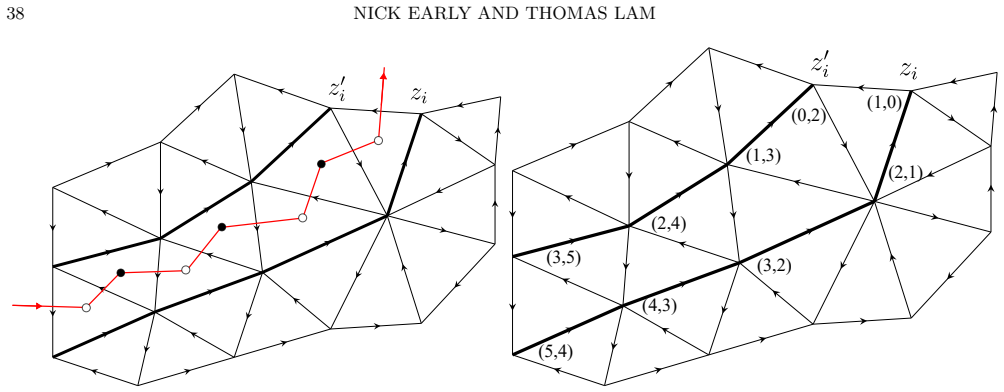
Figure 10. Figure 10: Left: A web W and two strands η3 and η10. Right: the vertex v has strand triple (3, 6, 8). It is straightforward to see that a web W is connected if and only if Q(W) is simple. If W is disconnected with components W1, W2, . . ., then Q(W) is obtained by gluing Q(W1), Q(W2), . . . along vertices. 5.2. Strands and the planar basis expansion. Definition 5.2. Let W be a web. The strands of W are the directed … view at source ↗
Figure 11
Figure 11. Figure 11: The CAT(0) planar graph in Example 6.8. The brown edge connecting z3 and v is computed and is found to be equal to e[5,2]. The red strand triple (2, 4, 7) encodes the vertices of the image under µ of the triangle (v, z3, z5) in the membrane. Additionally, all eight facets of Mv are identified in Example 22.3. We prove Theorem 6.10 in Section 21. 7. Application to symbol alphabet recursion In this section … view at source ↗
Figure 12
Figure 12. Figure 12: Illustrating Lemma 8.2. Claim (1): combinatorial distances from the vertices of a triangle are either {ℓ, ℓ, ℓ + 1} or {ℓ, ℓ + 1, ℓ + 1}. Claim (2): (a, b) is an edge with ℓ(a, v) = ℓ(b, v) = ℓ, and (a, b, c′ ) is the unique triangle with ℓ(c ′ , v) = ℓ − 1. Claim (3): among the neighbors of a, (i) exactly the vertices c ′ and c ′′ have combinatorial distance ℓ − 1 to v, (ii) exactly b and b ′ have combin… view at source ↗
Figure 13
Figure 13. Figure 13: Cyclic ordering on neighbors of v; in particular on the set F(v) with an edge directed to v. Definition 10.3 (Minimizing Neighbor fz(v)). For vertices v ̸= z, define fz(v) to be the unique neighbor of v (guaranteed by Lemma 9.5) that minimizes δ(·, z) among all neighbors of v view at source ↗
Figure 14
Figure 14. Figure 14: The canonical geodesics from v to z1, z2, z4 respectively have been indicated; the sets F(v, z1), F(v, z2), F(v, z4) have been indicated in blue. Since z1 and z2 are parallel at v, we have that v is not a focal point. Definition 10.4. For vertices v, z ∈ V (Q), define: F(v, z) =    F(v) if v = z, {a, a′} if v ̸= z, there is an edge v → fz(v), and a, fz(v), a′ are consecutive in cyclic order aro… view at source ↗
Figure 15
Figure 15. Figure 15: The three sets F(x, z1), F(x, z2), F(x, z4) have been indicated in blue. Since none of them coincide, and they have a SDR, x is a focal point for (z1, z2, z4). v view at source ↗
Figure 16
Figure 16. Figure 16: The red edges are the canonical geodesics from v to z2, z8, z13, z17. The vertex v is a focal point for (z2, z8, z13),(z2, z8, z17),(z2, z13, z17),(z8, z13, z17). Note that F(v, z2) = F(v, z17) but z2 and z17 are not parallel at v. All of {2, 8, 13}, {2, 8, 17}, {2, 13, 17}, {8, 13, 17} are among the bases for the matroid Mv (Definition 3.8). 10.3. Cyclic Ordering of Neighbor Sets. For concreteness, cycli… view at source ↗
Figure 17
Figure 17. Figure 17: A picture of two strands η and η ′ adjacent to the same face F, and later intersecting. η η ′ F F ′ view at source ↗
Figure 18
Figure 18. Figure 18: Two strands η and η ′ can both be adjacent to many faces, as long as the two strands never intersect. The dashed lines can be multiple edges: the starting and ending faces F and F ′ can have arbitrarily long perimeter. The middle faces are all hexagons. Since we have chosen γ to be a simple closed curve, we also have m − α ≥ 1 (resp. m′ − α ′ ≥ 1). Substituting, we get the inequality 2 ≥ (m − α) + (m′ − α… view at source ↗
Figure 19
Figure 19. Figure 19: Left: strand strips are bounded by combinatorial geodesics. See Lemma 13.1. Right: Distances (δ(·, z′ i ), δ(·, zi)) in Lemma 13.2. Proof. Immediate from Lemma 13.2. □ Lemma 13.4. (1) Let v be a vertex not on the strand strip Si. Then F(v, z′ i ) = F(v, zi). (2) Let v be on the strand strip, and on the side with z ′ i . Then |F(v, z′ i )| = 2, |F(v, zi)| = 1, and F(v, zi) ⊂ F(v, z′ i ). (3) Let v be on th… view at source ↗
Figure 20
Figure 20. Figure 20: Representative minimizers used in the calculation of u t i,j,k = 1. The triple of boundary red dots (a, b, c) ∈ {i, i + 1} × {j, j + 1} × {k, k + 1} indicate that we are computing Σa,b,c, while blue dots on the interior triangle are distance minimizers for Σa,b,c. Note that minimizers can always be found on the triangle, but upper right and lower left minimizer sets do not overlap. The distances are Σi,j,… view at source ↗
Figure 21
Figure 21. Figure 21: Representative minimizers used in the calculation of u t i,j,k = −1 as in view at source ↗
Figure 22
Figure 22. Figure 22: Three of the cases appearing in the proof of Proposition 15.8. In (a), S and S ′ are opposed and share the same spine edge; we have |T ∩ S ∩ S ′ | = 2. In (b), S and S ′ are not opposed; the spine edges are cyclically adjacent; we have |T ∩ S ∩ S ′ | = 1. In (c), one of several possibilities where |T ∩ S ∩ S ′ | = 0. Part 4. Noncrossing tableaux 16. Noncrossing tableau Two pairs (a < b),(a ′ < b′ ) ∈ view at source ↗
Figure 23
Figure 23. Figure 23: Left: The left arc of mJ (drawn dashed) intersects a number of edges of the web W′ (drawn solid). The strand triples of the white interior vertices on these edges are denoted (ai , bi , ci). Right: After resolving we create r + 1 new white vertices and r new black vertices with strand triples described by Lemma 17.5. Here r = 2. 17.4. Strand triples of resolution vertices. Let J = (J1, . . . , Jn) be a no… view at source ↗
Figure 24
Figure 24. Figure 24: The normal CAT(0) planar graph used in Example 17.8. The two examples which follow illustrate various perspectives on planar basis expansions and normal models. In the first example, we present the normal CAT(0) planar graph and web for the ray of Trop>0Gr(3, 9) whose planar basis expansion was computed in [Ear21, view at source ↗
Figure 25
Figure 25. Figure 25: Normal web, scaffold, and the planar basis expansion of the posi￾tive tropical Pl¨ucker vector π•(W(K)) corresponding to the (standard) noncrossing tableau K = {(1, 6, 8),(2, 3, 11),(4, 5, 10),(7, 14, 15),(9, 12, 13)}. Example 17.10. We continue Example 15.1, specifically with the Pl¨ucker vector given in (15.1), whose planar basis expansion is depicted schematically in view at source ↗
Figure 26
Figure 26. Figure 26: The planar basis expansion for the ray of Trop>0Gr(3, 10) from Ex￾ample 17.10 corresponding to a (non-standard) noncrossing tableau, constructed by standardizing, computing the standard web for Trop>0Gr(3, 21), taking the pla￾nar basis expansion and then reindexing. Summing the nodes gives Eq. (15.1), i.e. π•(W(J )) = −2h1,3,9 + 2h1,3,10 −h1,4,8 +h1,4,9 −h1,5,7 +h1,5,9 +h1,6,7 +h1,6,8 + 2h2,3,9 − h2,4,7 +… view at source ↗
Figure 27
Figure 27. Figure 27: Embedding of the CAT(0) graph Q into the PGL3(K) affine building, with vertices written as matrices in PGL3(K). The curvature is negative at the center vertex v := (e1, e2, e3), making it impossible to find a common basis which simultaneously diagonalizes v and its eight neighbors. This reflects that fact that Q cannot be embedded into a single apartment. 21. Keel-Tevelev isomorphism Let M = {v1, v2, . . … view at source ↗
Figure 28
Figure 28. Figure 28: Illustration for Example 22.3; the red, blue and green strands emanat￾ing from the edges lead us to compute the facets of the matroid polytope PMv for the vertex v in at center of Q. Example 22.3. We illustrate Corollary 22.2 by extracting the facet inequalities cutting out the matroid polytope PMv for Mv corresponding to the vertex v at the center of the octagon in view at source ↗
Figure 29
Figure 29. Figure 29: The two normal models for π• and π ′ • , respectively, in Equation (A.1). A.3. Trop>0X(3, 9). By [EL26+], the bounded complex of a positive tropical linear space L(π•) embeds into the dilated standard alcove PK(π•) · ∆std. The positive tropical Grassmannian Trop>0X(3, 9) has 75 planar basis rays (of NC weight one) and 168 rays with NC weight two, in bijection with the noncrossing but not weakly separated … view at source ↗
read the original abstract

Scaffolds are the one-dimensional skeleta of high-dimensional flag simplicial complexes of nonpositive curvature. They generalize the phylogenetic trees of Trop G(2,n) to arbitrary $k$, drawing together SL(k)-web bases, affine buildings, the combinatorics of the positive tropical Grassmannian and low-dimensional topology. We prove that scaffolds model points in all tropical Grassmannians via a $k$-point distance function. In this paper, we study in detail CAT(0) planar graphs, which are positive scaffolds for the tropical Grassmannian of three-planes. CAT(0) planar graphs are directed versions of the diskoids of Fontaine-Kamnitzer-Kuperberg, planar dual to SL(3)-webs. Our main result is the construction of a unique representation of any given integer positive tropical Plucker vector by a normal CAT(0) planar graph. We show that any normal CAT(0) planar graph embeds into the tropical linear space as a Lam-Postnikov membrane, and embeds into the Keel-Tevelev membrane within the affine building. We show that Early's planar basis expansion can be computed directly from the strand combinatorics of the dual web, and connect this expansion to Petersen-Pylyavskyy-Speyer's noncrossing tableaux, explored further in our companion paper.

Editorial analysis

A structured set of objections, weighed in public.

Desk editor's note, referee report, simulated authors' rebuttal, and a circularity audit. Tearing a paper down is the easy half of reading it; the pith above is the substance, this is the friction.

Referee Report

0 major / 3 minor

Summary. The paper introduces scaffolds as the 1-skeleta of high-dimensional flag simplicial complexes of nonpositive curvature, generalizing phylogenetic trees from Trop G(2,n) to arbitrary k. It proves that scaffolds model points in all tropical Grassmannians via a k-point distance function. For the k=3 case the central result is a canonical construction of a unique normal CAT(0) planar graph realizing any integer positive tropical Plücker vector; the graph is shown to embed as a Lam-Postnikov membrane in the tropical linear space and as a Keel-Tevelev membrane in the affine building, while Early’s planar basis expansion is recovered directly from the strand combinatorics of the dual web and connected to Petersen-Pylyavskyy-Speyer noncrossing tableaux.

Significance. If the constructions are correct, the work supplies a parameter-free combinatorial model for points of the positive tropical Grassmannian that is simultaneously geometric (CAT(0) planar graphs, embeddings into buildings) and algebraic (direct recovery of basis expansions). The uniqueness of the normal CAT(0) representative and the explicit link between strand combinatorics and Early’s expansion are concrete strengths that could enable new computational and structural results beyond the k=3 case treated here.

minor comments (3)
  1. [§2.3] §2.3 (Definition of normal CAT(0) planar graph): the four normality axioms are stated separately; a single enumerated list with cross-references to the subsequent lemmas that use each axiom would improve readability.
  2. [Theorem 4.1] Theorem 4.1 (unique representation): the proof sketch invokes the CAT(0) property to guarantee uniqueness, but the precise invocation of the Helly property for the intersection of convex sets is not written out; adding one sentence would make the argument self-contained.
  3. [Figure 5] Figure 5 (strand combinatorics example): several edge labels are partially obscured by crossings; redrawing with larger font or an inset legend would aid verification of the claimed distance-function values.

Simulated Author's Rebuttal

0 responses · 0 unresolved

We thank the referee for their positive and accurate summary of our work on scaffolds and normal CAT(0) planar graphs for the positive tropical Grassmannian. The report correctly identifies the generalization from phylogenetic trees, the uniqueness result for k=3, the embeddings into tropical linear spaces and affine buildings, and the recovery of Early's basis expansion from strand combinatorics. We appreciate the recommendation for minor revision.

Circularity Check

0 steps flagged

No significant circularity detected

full rationale

The paper's core contribution is an explicit combinatorial construction that associates to each integer positive tropical Plücker vector a unique normal CAT(0) planar graph (for the k=3 case), together with embeddings into the tropical linear space and affine building. These steps are presented as direct definitions and proofs rather than reductions to fitted parameters or prior self-referential results. References to Early's basis expansion and Lam-Postnikov membranes serve to connect the new objects to existing literature but are not invoked as load-bearing justifications for the uniqueness or modeling claims. No self-definitional loops, fitted-input predictions, or ansatz smuggling via citation appear in the stated results. The derivation chain therefore remains self-contained.

Axiom & Free-Parameter Ledger

0 free parameters · 2 axioms · 2 invented entities

The paper introduces new combinatorial objects (scaffolds and normal CAT(0) planar graphs) to model points in tropical Grassmannians. It relies on standard properties of CAT(0) spaces and tropical Plucker coordinates but provides no free parameters or fitted values in the abstract.

axioms (2)
  • standard math CAT(0) spaces are geodesic metric spaces of nonpositive curvature
    Invoked to define CAT(0) planar graphs as positive scaffolds for the tropical Grassmannian of three-planes.
  • domain assumption Positive tropical Plucker vectors correspond to points in the tropical Grassmannian
    Standard background assumption in tropical geometry used to link the graphs to the target objects.
invented entities (2)
  • Scaffolds no independent evidence
    purpose: One-dimensional skeleta that model points in tropical Grassmannians via a k-point distance function
    Newly defined combinatorial objects generalizing phylogenetic trees.
  • Normal CAT(0) planar graph no independent evidence
    purpose: Unique representation of any integer positive tropical Plucker vector
    Introduced as directed versions of diskoids that are planar duals to SL(3)-webs.

pith-pipeline@v0.9.0 · 5529 in / 1705 out tokens · 80098 ms · 2026-05-07T15:55:45.270512+00:00 · methodology

discussion (0)

Sign in with ORCID, Apple, or X to comment. Anyone can read and Pith papers without signing in.

Reference graph

Works this paper leans on

43 extracted references · 3 canonical work pages

  1. [1]

    Akhmejanov, Non-elliptic webs and convex sets in the affine building

    T. Akhmejanov, Non-elliptic webs and convex sets in the affine building. Documenta Math. \ 25 (2020), 2413--2443

  2. [2]

    Ardila, F

    F. Ardila, F. Rinc\'on, and L. Williams, Positroids and non-crossing partitions. Trans. Amer. Math. Soc. 368 (2016), 337--363

  3. [3]

    Arkani-Hamed, T

    N. Arkani-Hamed, T. Lam, and M. Spradlin, Positive configuration space. Comm.\ Math.\ Phys. \ 384 (2021), 909--954

  4. [4]

    Arkani-Hamed, T

    N. Arkani-Hamed, T. Lam, and M. Spradlin, Non-perturbative geometries for planar N = 4 SYM amplitudes. JHEP (2021), article number 065

  5. [5]

    Cachazo, N

    F. Cachazo, N. Early, A. Guevara, and S. Mizera, Scattering equations: from projective spaces to tropical Grassmannians. Journal of High Energy Physics 2019, no. 6 (2019): 39

  6. [6]

    Cachazo and N

    F. Cachazo and N. Early, Planar kinematics: cyclic fixed points, mirror superpotential, k -dimensional Catalan numbers, and root polytopes. Ann.\ Inst.\ Henri Poincar\'e Comb.\ Phys.\ Interact. \ (2024), 1--58

  7. [7]

    Cachazo, A

    F. Cachazo, A. Guevara, B. Umbert, and Y. Zhang, Planar matrices and arrays of Feynman diagrams. Communications in Theoretical Physics, 76 (2024), 035002

  8. [8]

    Drummond, J

    J. Drummond, J. Foster, O. G \"u rdo g an, and C. Kalousios, Tropical Grassmannians, cluster algebras and scattering amplitudes. JHEP (2020), article number 146

  9. [9]

    Early, Weighted blade arrangements and the positive tropical Grassmannian, preprint, 2020, arXiv:2005.12305

    N. Early, Weighted blade arrangements and the positive tropical Grassmannian, preprint, 2020, arXiv:2005.12305

  10. [11]

    Early, From weakly separated collections to matroid subdivisions

    N. Early, From weakly separated collections to matroid subdivisions. Combinatorial Theory 2 (2022), no. 2

  11. [12]

    Early, The CEGM NLSM

    N. Early, The CEGM NLSM. JHEP 2025, no. 4 (2025): 1-29

  12. [13]

    Early, L

    N. Early, L. Kühne, and L. Monin, When alcoved polytopes add, preprint, 2025, arXiv:2501.17249

  13. [14]

    Early and T

    N. Early and T. Lam, Noncrossing Duality and the Geometry of Positive Tropical Linear Spaces, preprint, 2026

  14. [15]

    Fontaine, J

    B. Fontaine, J. Kamnitzer, and G. Kuperberg, Buildings, spiders, and geometric Satake. Compos. Math. \ 149 (2013), 1871--1912

  15. [16]

    Fraser and I

    C. Fraser and I. Le, Tropicalization of positive Grassmannians. Selecta Math. \ 25 (2019), 75

  16. [17]

    Gaetz, O

    C. Gaetz, O. Pechenik, S. Pfannerer, J. Striker, and J. P. Swanson, Rotation-invariant web bases from hourglass plabic graphs. Invent. Math. 243 (2026), 703--804

  17. [18]

    Goncharov and L

    A. Goncharov and L. Shen, Geometry of canonical bases and mirror symmetry. Invent. Math. 202 (2015), no. 2, 487--633

  18. [19]

    Henke and G

    N. Henke and G. Papathanasios, How tropical are seven- and eight-particle amplitudes? JHEP (2020), article number 5

  19. [20]

    Herrmann, A

    S. Herrmann, A. Jensen, M. Joswig, and B. Sturmfels, How to draw tropical planes. Electron. J. Combin. 16 (2009), no. 2, Special volume in honor of Anders Bj¨orner, Research Paper 6, 26

  20. [21]

    Joswig, B

    M. Joswig, B. Sturmfels, and J. Yu, Affine buildings and tropical convexity. Albanian J.\ Math. \ 1 (2007), 187--211

  21. [22]

    Keel and J

    S. Keel and J. Tevelev, Geometry of Chow quotients of Grassmannians. Duke Math. J. 134 (2006), no. 2, 259--311

  22. [23]

    Khovanov and G

    M. Khovanov and G. Kuperberg, Web bases for sl (3) are not dual canonical. Pacific J.\ Math. \ 188 (1999), no. 1, 129--153

  23. [24]
  24. [25]

    Lam and A

    T. Lam and A. Postnikov, Alcoved Polytopes I. Discrete Comput. Geom. 38 (2007), no. 3, 453--478

  25. [26]

    Lam and A

    T. Lam and A. Postnikov, Polypositroids. Forum Math. Sigma 12 (2024), Paper No. e42, 67 pp

  26. [27]

    Le, Higher laminations and affine buildings

    I. Le, Higher laminations and affine buildings. Geom. Topol. 20 (2016), no. 3, 1673--1735

  27. [28]

    Le, Intersection Pairings for Higher Laminations

    I. Le, Intersection Pairings for Higher Laminations. Algebr. Comb. 4 (2021), no. 5, 823--841

  28. [29]

    Le and E

    I. Le and E. O'Dorney, Geometry of Positive Configurations in Affine Buildings. Doc. Math. 22 (2017), 1519--1538

  29. [30]

    Leclerc and A

    B. Leclerc and A. Zelevinsky, Quasicommuting families of quantum Pl\"ucker coordinates. Kirillov's Seminar on Representation Theory , Amer.\ Math.\ Soc.\ Transl.\ Ser. 2, vol. 181, 1998, pp. 85--108

  30. [31]

    T. K. Petersen, P. Pylyavskyy, and B. Rhoades, Promotion and cyclic sieving via webs. J. Alg. Comb. 30 (2009), 19--41

  31. [32]

    T. K. Petersen, P. Pylyavskyy, and D. E. Speyer, A non-crossing standard monomial theory. J. Algebra 324 (2010), no. 5, 951--969

  32. [33]

    Postnikov, Total positivity, Grassmannians, and networks, https://math.mit.edu/ apost/papers/tpgrass.pdf, 2007

    A. Postnikov, Total positivity, Grassmannians, and networks, https://math.mit.edu/ apost/papers/tpgrass.pdf, 2007

  33. [34]

    L. Ren, M. Spradlin, and A. Volovich, Symbol alphabets from tensor diagrams, J.\ High Energy Phys. \ 2021 , no. 12, 1--43

  34. [35]

    Russell, An explicit bijection between semistandard tableaux and non-elliptic sl_3 webs

    Heather M. Russell, An explicit bijection between semistandard tableaux and non-elliptic sl_3 webs. J. Alg. Combin. 38 (2013), 851--862

  35. [36]

    Russell, The SL_3 web algebra

    H. Russell, The SL_3 web algebra. J. Algebra 383 (2013), 23--74

  36. [37]

    Santos, C

    F. Santos, C. Stump, and V. Welker, Noncrossing sets and a Grassmann associahedron. Forum Math.\ Sigma 5 (2017), e5

  37. [38]

    L. Shen, Z. Sun, and D. Weng, Intersections of Dual SL3-Webs. Trans. Amer. Math. Soc. 378 (2025), 5513--5549

  38. [39]

    Speyer, Tropical linear spaces

    D.E. Speyer, Tropical linear spaces. SIAM J. Discrete Math. 22 (2008), no. 4, 1527--1558

  39. [40]

    Speyer and B

    D. Speyer and B. Sturmfels, The tropical Grassmannian. Adv. Geom. 4 (2004), no. 3, 389--411

  40. [41]

    Speyer and L

    D. Speyer and L. Williams, The tropical totally positive Grassmannian. J. Algebraic Combin. \ 22 (2005), 189--210

  41. [42]

    Speyer and L

    D. Speyer and L. Williams. The positive Dressian equals the positive tropical Grassmannian. Transactions of the American Mathematical Society, Series B 8, no. 11 (2021): 330-353

  42. [43]

    Tymoczko, A simple bijection between standard 3 n tableaux and irreducible webs for sl _3

    J. Tymoczko, A simple bijection between standard 3 n tableaux and irreducible webs for sl _3 . J. Algebraic Combin. \ 35 (2012), no. 4, 611--632

  43. [44]

    Zhang, Computing min-convex hulls in the affine building of _d

    L. Zhang, Computing min-convex hulls in the affine building of _d . Discrete Comput.\ Geom. \ 65 (2021), 510--530