A Miniaturized Broadband 1-Bit Coding Reconfigurable Intelligent Surface for NLOS UE Localization and Uplink Communication
Pith reviewed 2026-05-07 15:14 UTC · model grok-4.3
The pith
A 16 by 10 array of miniaturized 1-bit metasurface elements enables NLOS user localization and LTE uplink communication.
A machine-rendered reading of the paper's core claim, the machinery that carries it, and where it could break.
Core claim
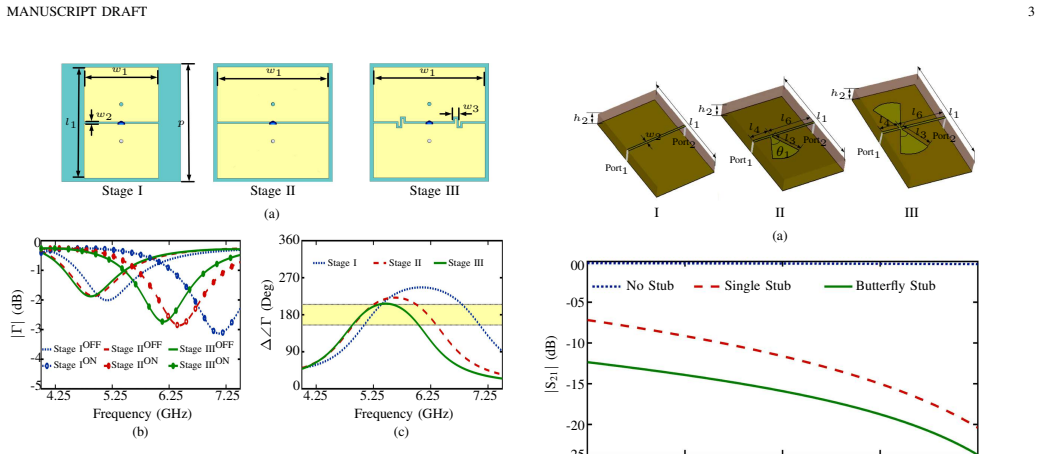
The authors design a unit cell consisting of a wide dipole with interdigital capacitors and an SMP 1340-040LF PIN diode that delivers a 180 degree plus or minus 30 degree phase difference between ON and OFF states from 4.85 GHz to 6.05 GHz for normal incidence, with reflection loss below 3 dB and usable phase stability up to 45 degree oblique incidence. A 16 by 10 array built from these cells and controlled by a low-cost microcontroller produces radiation patterns that match both theory and full-wave simulation. When the array is placed in an LTE communication link it supports accurate non-line-of-sight UE localization and robust uplink transmission, including potential use for UAVs at range
What carries the argument
The 1-bit coding metasurface unit cell: a wide dipole modified with interdigital capacitors and switched by a single PIN diode to produce a stable 180 degree reflection phase flip.
If this is right
- The array supports accurate UE localization when direct radio paths are blocked.
- Uplink data transmission remains reliable in the same NLOS LTE configuration.
- The same hardware can be applied to UAV localization and extended-range uplink links.
- Low-cost microcontroller biasing makes deployment of the 160-element surface practical.
Where Pith is reading between the lines
- The broadband phase stability may allow the same surface to serve multiple LTE or 5G frequency bands simultaneously.
- Larger arrays built on the same cell could provide coverage in dense urban canyons without additional base stations.
- Field trials outside the anechoic chamber would be needed to check performance under real multipath and weather conditions.
Load-bearing premise
The fabricated prototype's measured radiation patterns and communication results match the simulated unit-cell behavior without significant degradation from fabrication tolerances, connector losses, or mutual coupling.
What would settle it
A chamber measurement in which the phase difference between diode states falls outside the 180 plus or minus 30 degree window across 4.85-6.05 GHz, or in which NLOS localization error exceeds the values reported for the LTE test, would falsify the central performance claim.
Figures



read the original abstract
In this paper, a broadband 1-bit coding metasurface-based reconfigurable intelligent surface (RIS) is presented. The unit cell of the metasurface consists of a wide dipole modified with interdigital capacitors and loaded with an SMP 1340-040LF PIN diode. The proposed element offers cell miniaturization and a stable angular response. A phase difference of 180$\degree \pm$ 30$\degree$ is achieved for a frequency range of 4.85-6.05 GHz between the ON and OFF states for the normal incidence of the TE polarized wave, whereas it provides a fairly stable response with reflection loss of less than 3 dB and phase difference of 180$\degree$ $\pm$ 50$\degree$ for oblique incidence up to 45$\degree$. The RF is isolated from the DC on the bias lines using properly designed butterfly-shaped radial stubs. Using this unit cell, a prototype with an array of 16 $\times$ 10 elements is constructed. A low-cost microcontroller-based control circuit is designed, which can be plugged-in for biasing the PIN diodes of such array. The theoretically calculated and full-wave simulated radiation patterns of the array are validated using experiments inside anechoic chamber. Furthermore, the capability of the RIS for non-line of sight (NLOS) user equipment (UE) localization and robust uplink communication is demonstrated using LTE communication framework. This shows great potential of our RIS for applications, such as in unmanned aerial vehicle (UAV) localization and its uplink communication at NLOS or extended range.
Editorial analysis
A structured set of objections, weighed in public.
Referee Report
Summary. The manuscript presents the design of a miniaturized broadband 1-bit coding RIS unit cell based on a modified dipole with interdigital capacitors and an SMP1340-040LF PIN diode, achieving 180° ±30° phase difference over 4.85-6.05 GHz for normal TE incidence and stable response up to 45° oblique incidence. A 16×10 element prototype is fabricated with a low-cost microcontroller-based bias control circuit using butterfly radial stubs for RF-DC isolation. Radiation patterns are validated against theory and simulation in an anechoic chamber, and the RIS is demonstrated for NLOS UE localization and LTE uplink communication.
Significance. If the array-level phase control and localization performance hold under real fabrication conditions, the work offers a practical, low-cost RIS prototype suitable for UAV localization and extended-range communications. The broadband operation and angular stability of the unit cell are strengths, and the integration of hardware control with an LTE framework provides a concrete application example.
major comments (2)
- [Experimental validation] Experimental validation section: Radiation patterns of the 16×10 array are measured and compared to simulation, but no measured reflection-phase data or error bars are provided for the assembled array. Unit-cell periodic-boundary simulations cannot capture mutual coupling, bias-line parasitics, and diode placement variations, which may shift the phase difference outside the claimed 180° ±30° tolerance and directly degrade beam-steering precision required for NLOS localization.
- [Application demonstration] NLOS UE localization and LTE demonstration: The abstract and results claim robust localization and uplink communication, yet no quantitative metrics (localization error, standard deviation, baseline comparisons with/without RIS, or confidence intervals) are reported. This absence makes it impossible to evaluate whether the fabricated prototype meets the performance needed to support the central claims.
minor comments (1)
- Figure captions and legends should explicitly label ON/OFF states, frequency points, and incidence angles for all radiation pattern and phase plots to improve clarity.
Simulated Author's Rebuttal
We thank the referee for the detailed and constructive review. The comments highlight important aspects of experimental rigor and quantitative evaluation that we address below. We believe the manuscript's core contributions on the miniaturized broadband unit cell and prototype demonstration remain valid, and we outline revisions to strengthen the presentation.
read point-by-point responses
-
Referee: [Experimental validation] Experimental validation section: Radiation patterns of the 16×10 array are measured and compared to simulation, but no measured reflection-phase data or error bars are provided for the assembled array. Unit-cell periodic-boundary simulations cannot capture mutual coupling, bias-line parasitics, and diode placement variations, which may shift the phase difference outside the claimed 180° ±30° tolerance and directly degrade beam-steering precision required for NLOS localization.
Authors: We appreciate the referee's emphasis on array-level validation. Unit-cell periodic-boundary simulations were used during the design phase to optimize the 180° ±30° phase difference, as is standard for metasurface elements. However, the radiation patterns of the full 16×10 array were computed using full-wave simulations that incorporate mutual coupling, bias-line effects, and element interactions. The experimental radiation patterns measured in the anechoic chamber show close agreement with these full-array simulations, providing indirect but strong evidence that the phase control remains effective across the prototype. We acknowledge that direct reflection-phase measurements on the assembled array (with bias network active) would be ideal but are practically challenging without disassembling the structure. To address the concern, we will add error bars (derived from repeated measurements) to the radiation pattern figures and include a brief discussion of fabrication tolerances and their potential impact on phase stability. revision: partial
-
Referee: [Application demonstration] NLOS UE localization and LTE demonstration: The abstract and results claim robust localization and uplink communication, yet no quantitative metrics (localization error, standard deviation, baseline comparisons with/without RIS, or confidence intervals) are reported. This absence makes it impossible to evaluate whether the fabricated prototype meets the performance needed to support the central claims.
Authors: We agree that quantitative performance metrics are essential for rigorously supporting the application claims. The current demonstration serves as a proof-of-concept using the LTE framework to illustrate NLOS UE localization and uplink communication feasibility with the RIS prototype. In the revised manuscript, we will expand the results section to report specific quantitative metrics from the experiments, including localization error statistics (mean and standard deviation), baseline comparisons (with and without RIS), and any available confidence intervals. This will allow readers to better assess the prototype's effectiveness for the claimed applications. revision: yes
Circularity Check
No circularity: hardware design validated by simulation and measurement
full rationale
The manuscript describes the design, simulation, fabrication, and experimental characterization of a 1-bit RIS unit cell and 16x10 array, followed by LTE-based NLOS localization and uplink tests. No load-bearing derivations, predictions, or uniqueness claims appear that reduce to fitted parameters, self-citations, or ansatzes by construction. Phase-difference performance is obtained from full-wave unit-cell simulations and confirmed by array-level radiation-pattern measurements in an anechoic chamber; the application demonstrations rely on direct experimental outcomes rather than any closed-loop mathematical reduction. The work is therefore self-contained against external benchmarks.
Axiom & Free-Parameter Ledger
axioms (2)
- domain assumption Periodic boundary conditions in full-wave simulation accurately predict the infinite-array response of the unit cell.
- domain assumption The SMP1340-040LF diode can be modeled as a simple ON/OFF impedance switch using datasheet values.
Reference graph
Works this paper leans on
-
[1]
Flat optics with designer metasurfaces,
N. Yu and F. Capasso, “Flat optics with designer metasurfaces,”Nature Mater., vol. 13, no. 2, pp. 139–150, 2014
work page 2014
-
[2]
Re- configurable intelligent surfaces: design, implementation, and practical demonstration,
Y . Feng, Q. Hu, K. Qu, W. Yang, Y . Zheng, and K. Chen, “Re- configurable intelligent surfaces: design, implementation, and practical demonstration,”Electromag. Science, vol. 1, no. 2, pp. 1–21, 2023
work page 2023
-
[3]
M. Di Renzo, A. Zappone, M. Debbah, M.-S. Alouini, C. Yuen, J. de Rosny, and S. Tretyakov, “Smart radio environments empowered by reconfigurable intelligent surfaces: How it works, state of research, and the road ahead,”IEEE J. Sel. Areas Commun, vol. 38, no. 11, pp. 2450–2525, 2020
work page 2020
-
[4]
Wireless communication based on information metasurfaces,
J. Y . Dai, W. Tang, M. Z. Chen, C. H. Chan, Q. Cheng, S. Jin, and T. J. Cui, “Wireless communication based on information metasurfaces,” IEEE Trans. Microw. Theory Techn., vol. 69, no. 3, pp. 1493–1510, 2021
work page 2021
-
[5]
Coding metamaterials, digital metamaterials and programmable metamaterials,
T. J. Cui, M. Q. Qi, X. Wan, J. Zhao, and Q. Cheng, “Coding metamaterials, digital metamaterials and programmable metamaterials,” Light: Sci. Appl., vol. 3, no. 10, pp. e218–e218, 2014
work page 2014
-
[6]
A dual-polarized reconfigurable reflectarray antenna based on dual-channel programmable metasurface,
N. Zhang, K. Chen, J. Zhao, Q. Hu, K. Tang, J. Zhao, T. Jiang, and Y . Feng, “A dual-polarized reconfigurable reflectarray antenna based on dual-channel programmable metasurface,”IEEE Trans. Antennas Propag., vol. 70, no. 9, pp. 7403–7412, 2022
work page 2022
-
[7]
Space-time-coding digital metasurfaces,
L. Zhang, X. Q. Chen, S. Liu, Q. Zhang, J. Zhao, J. Y . Dai, G. D. Bai, X. Wan, Q. Cheng, G. Castaldiet al., “Space-time-coding digital metasurfaces,”Nat. commun., vol. 9, no. 1, p. 4334, 2018
work page 2018
-
[8]
A programmable metasurface with dynamic polarization, scattering and focusing control,
H. Yang, X. Cao, F. Yang, J. Gao, S. Xu, M. Li, X. Chen, Y . Zhao, Y . Zheng, and S. Li, “A programmable metasurface with dynamic polarization, scattering and focusing control,”Scientific reports, vol. 6, no. 1, p. 35692, 2016
work page 2016
-
[9]
Low-altitude uav detection based on vehicle-mounted wideband programmable metasur- face,
H. Xu, D. Guan, Z. Li, K.-D. Xu, Z. Liu, and Y . Liu, “Low-altitude uav detection based on vehicle-mounted wideband programmable metasur- face,”IEEE Trans. Microw. Theory Techn., 2024
work page 2024
-
[10]
Design and evaluation of reconfigurable intelligent surfaces in real- world environment,
G. C. Trichopoulos, P. Theofanopoulos, B. Kashyap, A. Shekhawat, A. Modi, T. Osman, S. Kumar, A. Sengar, A. Chang, and A. Alkhateeb, “Design and evaluation of reconfigurable intelligent surfaces in real- world environment,”IEEE Open J. Commun. Soc., vol. 3, pp. 462–474, 2022
work page 2022
-
[11]
Optimum beam- forming and grating lobe mitigation for intelligent reflecting surfaces,
S. S. Narayanan, U. K. Khankhoje, and R. K. Ganti, “Optimum beam- forming and grating lobe mitigation for intelligent reflecting surfaces,” IEEE Trans. Antennas Propag., 2024
work page 2024
-
[12]
Microstrip antennas on synthesized low dielectric-constant substrates,
G. P. Gauthier, A. Courtay, and G. M. Rebeiz, “Microstrip antennas on synthesized low dielectric-constant substrates,”IEEE Trans. Antennas Propag., vol. 45, no. 8, pp. 1310–1314, 1997
work page 1997
-
[13]
On the effect of substrate thickness and permittivity on printed circuit dipole properties,
P. Katehi and N. Alexopoulos, “On the effect of substrate thickness and permittivity on printed circuit dipole properties,”IEEE Trans. Antennas Propag., vol. 31, no. 1, pp. 34–39, 1983
work page 1983
-
[14]
J. Han, L. Li, G. Liu, Z. Wu, and Y . Shi, “A wideband 1 bit 12× 12 reconfigurable beam-scanning reflectarray: Design, fabrication, and measurement,”IEEE Antennas Wireless Propag. Lett., vol. 18, no. 6, pp. 1268–1272, 2019
work page 2019
-
[15]
H. Shi, R. Liu, Z. Zhang, X. Chen, L. Wang, J. Yi, H. Liu, and A. Zhang, “An ultra-wideband 1-bit suspended reconfigurable intelligent surface for enhancing wireless coverage,”IEEE Antennas Wireless Propag. Lett., 2024
work page 2024
-
[16]
An ultrawideband low-loss reconfigurable metasurface element with 1-bit resolution,
T. Li, H. Yang, Q. Li, J. Tian, K. Gao, L. Cong, S. Li, and X. Cao, “An ultrawideband low-loss reconfigurable metasurface element with 1-bit resolution,”IEEE Antennas Wireless Propag. Lett., vol. 23, no. 4, pp. 1206–1210, 2024
work page 2024
-
[17]
A wideband recon- figurable intelligent surface for 5g millimeter-wave applications,
R. Wang, Y . Yang, B. Makki, and A. Shamim, “A wideband recon- figurable intelligent surface for 5g millimeter-wave applications,”IEEE Trans. Antennas Propag., vol. 72, no. 3, pp. 2399–2410, 2024
work page 2024
-
[18]
User equipment (UE)- controlled reconfigurable intelligent surface (RIS) in sensing,
M. Yin, M. Huang, C. Wei, J. Dai, and H. Xu, “User equipment (UE)- controlled reconfigurable intelligent surface (RIS) in sensing,” Patent WO2 024 187 395A1, Jun., 2024, https://patentscope.wipo.int/search/en/ detail.jsf?docId=WO2024187395
work page 2024
-
[19]
Compact user-specific reconfigurable intelligent surfaces for uplink transmission,
K. Liu, Z. Zhang, L. Dai, and L. Hanzo, “Compact user-specific reconfigurable intelligent surfaces for uplink transmission,”IEEE Trans. Commun., vol. 70, no. 1, pp. 680–692, 2021
work page 2021
-
[20]
Energy-efficient uplink transmission in ris-aided m-mimo iot systems,
D. William Marques Guerra, J. Carlos Marinello, E. Hossain, and T. Abr˜ao, “Energy-efficient uplink transmission in ris-aided m-mimo iot systems,”Massive MIMO for Future Wireless Communication Systems: Technology and Applications, pp. 151–188, 2025. MANUSCRIPT DRAFT 11
work page 2025
-
[21]
W. Tang, M. Z. Chen, X. Chen, J. Y . Dai, Y . Han, M. Di Renzo, Y . Zeng, S. Jin, Q. Cheng, and T. J. Cui, “Wireless communications with reconfigurable intelligent surface: Path loss modeling and experimental measurement,”IEEE Trans. Wireless Commun., vol. 20, no. 1, pp. 421– 439, 2020
work page 2020
-
[22]
J. Wang, Y .-C. Liang, Y . Pei, and X. Shen, “Reconfigurable intelligent surface as a micro base station: A novel paradigm for small cell networks,”IEEE Trans. Wireless Commun., vol. 22, no. 4, pp. 2338– 2351, 2022
work page 2022
-
[23]
Marisa: A self-configuring metasurfaces absorption and reflec- tion solution towards 6g,
A. Albanese, F. Devoti, V . Sciancalepore, M. Di Renzo, and X. Costa- P´erez, “Marisa: A self-configuring metasurfaces absorption and reflec- tion solution towards 6g,” inIEEE INFOCOM 2022-IEEE Conference on Computer Communications. IEEE, 2022, pp. 250–259
work page 2022
-
[24]
Adaptively programmable metasurface for intelligent wireless communications in complex environments,
H. Q. Yang, J. Y . Dai, H. D. Li, L. Wu, Z. H. Shen, Q. Y . Zhou, M. Z. Zhang, S. R. Wang, Z. X. Wang, J. W. Wuet al., “Adaptively programmable metasurface for intelligent wireless communications in complex environments,”Nat. Commun., vol. 16, no. 1, p. 6070, 2025
work page 2025
-
[25]
S. Hao, X. Fan, X. Li, L. Zhen, and J. Cui, “Uplink performance analysis of ris-assisted uav communication systems with random 3-d mobile pattern,”IEEE Internet Things J., 2024
work page 2024
-
[26]
Reconfigurable intelligent surface- assisted system models for uplink communications,
H. Park, T.-H. Nguyen, and L. Park, “Reconfigurable intelligent surface- assisted system models for uplink communications,” in2022 13th In- ternational Conference on Information and Communication Technology Convergence (ICTC). IEEE, 2022, pp. 828–830
work page 2022
-
[27]
Skyworks Solutions, Inc. SMP1340 Series. Skyworks Solutions, Inc. Accessed: Nov. 20, 2024. [Online]. Available: https://www.skyworksinc. com/Products/Diodes/SMP1340-Series
work page 2024
-
[28]
J. Han, L. Li, G. Liu, Z. Wu, and Y . Shi, “A wideband 1 bit 12 × 12 reconfigurable beam-scanning reflectarray: Design, fabrication, and measurement,”IEEE Antennas Wireless Propag. Lett., vol. 18, no. 6, pp. 1268–1272, 2019
work page 2019
-
[29]
A. Abrardo, A. Toccafondi, and M. Di Renzo, “Design of recon- figurable intelligent surfaces by using s-parameter multiport network theory—optimization and full-wave validation,”IEEE Trans. Wireless Commun., vol. 23, no. 11, pp. 17 084–17 102, 2024
work page 2024
-
[30]
A single-layer broadband reflectarray in k-band using cross-loop slotted patch elements,
D. Kundu, D. Bhattacharya, and R. Ruchi, “A single-layer broadband reflectarray in k-band using cross-loop slotted patch elements,”IEEE Access, vol. 10, pp. 13 490–13 495, 2022
work page 2022
- [31]
-
[32]
J. Jeong, J. H. Oh, S. Y . Lee, Y . Park, and S.-H. Wi, “An improved path- loss model for reconfigurable-intelligent-surface-aided wireless commu- nications and experimental validation,”IEEe Access, vol. 10, pp. 98 065– 98 078, 2022
work page 2022
discussion (0)
Sign in with ORCID, Apple, or X to comment. Anyone can read and Pith papers without signing in.