A bound-preserving oscillation-eliminating discontinuous Galerkin scheme for compressible two-phase flow
Pith reviewed 2026-05-07 15:16 UTC · model grok-4.3
The pith
Operator splitting with implicit discretization yields a bound-preserving oscillation-eliminating DG scheme for Kapila two-phase flows that removes stiffness-induced CFL restrictions.
A machine-rendered reading of the paper's core claim, the machinery that carries it, and where it could break.
Core claim
The proposed BP-OEDG scheme, combined with the splitting strategy, is unconditionally bound-preserving and strictly satisfies the Abgrall condition, as established by rigorous proofs; the implicit treatment of the stiff source term removes the CFL restriction while a velocity-divergence reconstruction improves accuracy inside the implicit solver.
What carries the argument
The operator-splitting strategy that separates the transport model from the stiff kappa-source term, with the source advanced by an adaptive implicit method (backward Euler hybridized with SDIRK2) that is proven unconditionally bound-preserving.
If this is right
- Time steps become independent of the stiffness parameter, removing the dominant computational bottleneck in explicit treatments.
- Physical bounds on partial densities, pressure, and volume fraction are preserved at every stage without additional post-processing.
- Spurious oscillations are controlled without requiring characteristic-variable decomposition.
- The scheme satisfies the Abgrall condition, so uniform flow remains uniform after discretization.
Where Pith is reading between the lines
- The same splitting-plus-implicit approach may apply directly to other multiphase models that contain stiff algebraic source terms.
- Larger time steps could enable three-dimensional or long-time engineering simulations that remain out of reach for conventional explicit DG codes.
- The velocity-divergence reconstruction inside the implicit solver suggests a route to higher-order accuracy for source terms in other hyperbolic systems.
Load-bearing premise
The operator splitting accurately decouples transport and stiff source terms without introducing splitting errors large enough to violate the bound-preserving or Abgrall properties.
What would settle it
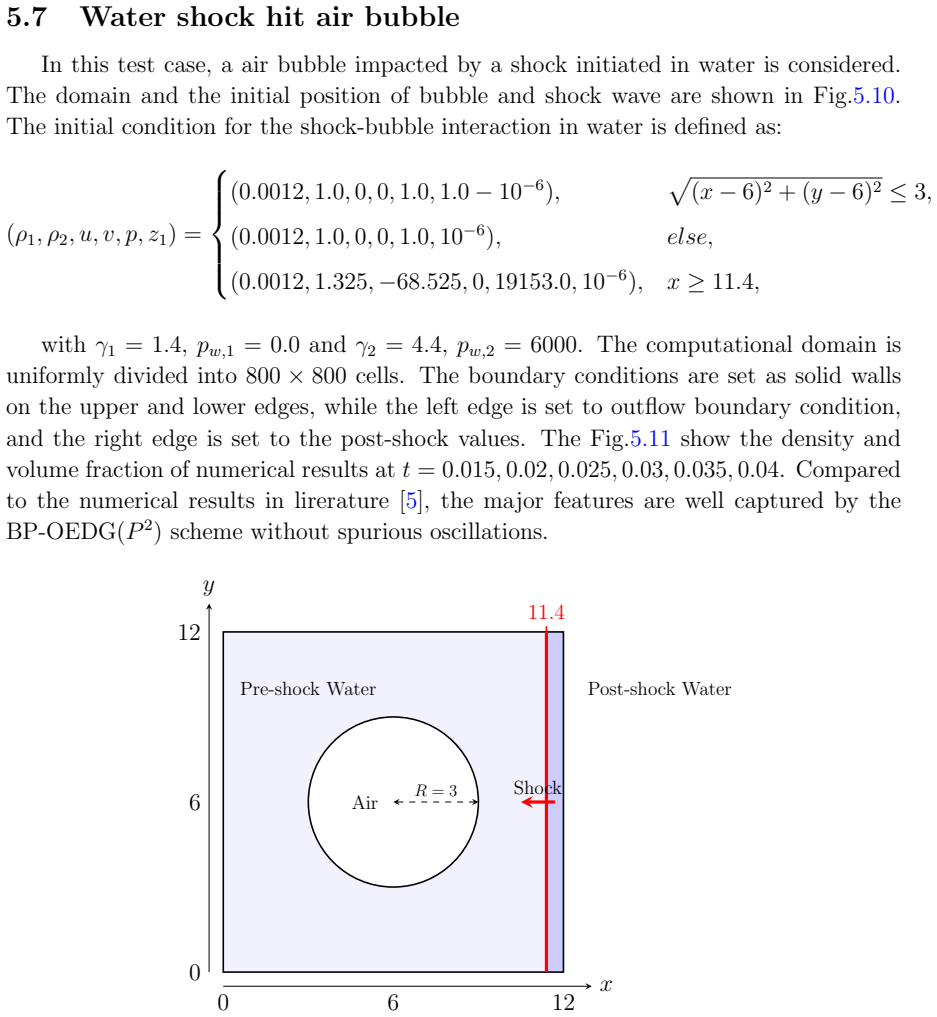
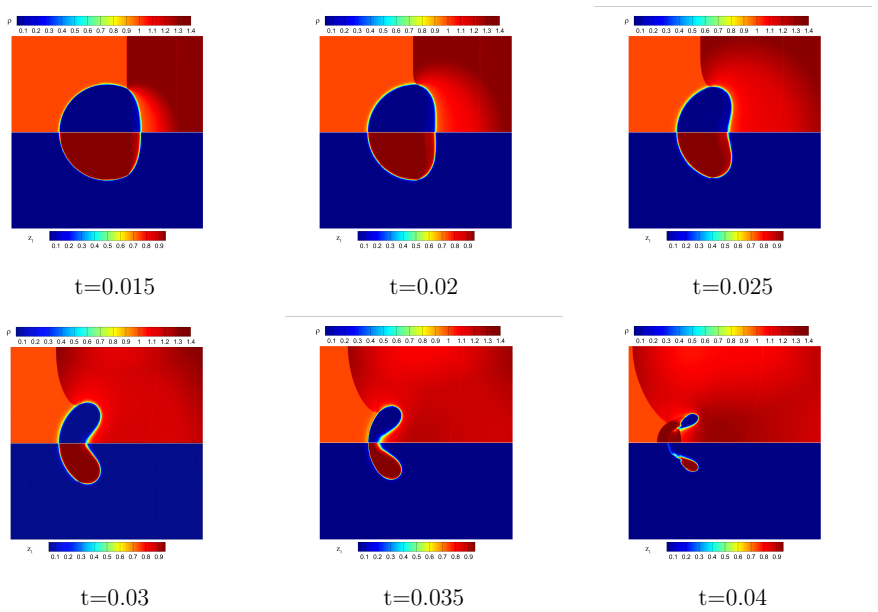
A computed solution on the water-air shock-bubble problem in which any volume fraction, partial density, or pressure falls outside its physical interval when the implicit source step is replaced by an explicit step or when the time step is increased beyond the usual explicit CFL limit.
Figures


read the original abstract
This paper presents a high-order bound-preserving oscillation-eliminating discontinuous Galerkin (BP-OEDG) scheme for simulating gas-gas and gas-liquid two-phase flows governed by the Kapila five-equation model with the Tammann equation of state (EOS). The primary computational bottleneck arises from the severe CFL restriction imposed by the stiff $\kappa$-source term in the volume fraction equation. To circumvent this, we propose a novel operator-splitting strategy that decouples the system into a transport model and a stiff $\kappa$-source term. The former is discretized via a quasi-conservative DG method \cite{cheng2020quasi}, while the latter is resolved by an adaptive implicit strategy hybridizing the backward Euler and SDIRK2 methods. We rigorously prove that this implicit treatment is unconditionally BP, effectively removing the stiffness-induced stability constraints inherent in traditional explicit schemes. To further enhance precision, a velocity divergence reconstruction inspired by the Local Discontinuous Galerkin (LDG) method is integrated into the implicit solver. Furthermore, an OE limiter is employed to suppress spurious oscillations without characteristic decomposition, complemented by a BP limiter to ensure the BP property of partial densities, pressure, and volume fraction. Crucially, we prove that the proposed BP-OEDG scheme, integrated with the splitting strategy, strictly satisfies the Abgrall condition. Extensive numerical experiments, including challenging water-air shock-bubble interactions, demonstrate the superior robustness and efficiency of the method.
Editorial analysis
A structured set of objections, weighed in public.
Referee Report
Summary. The manuscript presents a high-order bound-preserving oscillation-eliminating discontinuous Galerkin (BP-OEDG) scheme for the Kapila five-equation model of compressible two-phase flows with Tammann EOS. It introduces a novel operator-splitting strategy that decouples the transport equations (discretized by a quasi-conservative DG method) from the stiff kappa-source term in the volume-fraction equation (treated by an adaptive implicit solver hybridizing backward Euler and SDIRK2). The paper claims rigorous proofs that the implicit treatment is unconditionally bound-preserving and that the full BP-OEDG scheme with splitting strictly satisfies the Abgrall condition; an OE limiter and BP limiter are added, and numerical tests on water-air shock-bubble interactions are shown.
Significance. If the central proofs hold, the work removes the severe CFL restriction imposed by stiff source terms while preserving physical bounds and uniform velocity/pressure states, offering a practical efficiency gain for high-order simulations of gas-liquid flows without sacrificing robustness.
major comments (2)
- [operator-splitting strategy and Abgrall proof] The proof that the operator-splitting strategy preserves the Abgrall condition exactly (i.e., that the composed transport-plus-implicit-source operator maps uniform states to uniform states without residual splitting error in velocity or pressure) is load-bearing for the main claim, yet the abstract and high-level description provide no explicit steps showing how the implicit update on the kappa-source interacts with the quasi-conservative transport discretization to maintain exact uniformity.
- [implicit solver and BP proof] The rigorous proof of unconditional bound-preservation for the hybrid implicit solver (backward Euler + SDIRK2) on the stiff source term is central, but the manuscript must supply the full derivation, including the specific update formulas and the argument that positivity of partial densities, pressure, and volume fraction is guaranteed independently of the time-step size.
minor comments (2)
- [implicit solver description] The velocity-divergence reconstruction inspired by LDG is mentioned but its precise incorporation into the implicit step (e.g., which variables are reconstructed and at which quadrature points) should be stated explicitly to allow reproducibility.
- [numerical results] Numerical experiments would benefit from a table reporting maximum CFL numbers achieved and a direct comparison of wall-clock time against a standard explicit scheme on the same meshes.
Simulated Author's Rebuttal
We thank the referee for the positive assessment of the work's significance and for the constructive comments. We respond point-by-point to the major comments below, clarifying the location of the proofs in the manuscript and indicating revisions to improve their presentation and accessibility.
read point-by-point responses
-
Referee: [operator-splitting strategy and Abgrall proof] The proof that the operator-splitting strategy preserves the Abgrall condition exactly (i.e., that the composed transport-plus-implicit-source operator maps uniform states to uniform states without residual splitting error in velocity or pressure) is load-bearing for the main claim, yet the abstract and high-level description provide no explicit steps showing how the implicit update on the kappa-source interacts with the quasi-conservative transport discretization to maintain exact uniformity.
Authors: We thank the referee for this observation. The proof that the splitting strategy preserves the Abgrall condition is given in Section 4.2: the quasi-conservative DG discretization of the transport equations is shown to map uniform velocity/pressure states to uniform states, after which the implicit update on the volume-fraction equation (which leaves momentum and energy unchanged) preserves uniformity exactly. To address the concern that these steps are not visible at a high level, we will add a brief outline of the argument to the abstract and the introductory description in the revised manuscript. revision: partial
-
Referee: [implicit solver and BP proof] The rigorous proof of unconditional bound-preservation for the hybrid implicit solver (backward Euler + SDIRK2) on the stiff source term is central, but the manuscript must supply the full derivation, including the specific update formulas and the argument that positivity of partial densities, pressure, and volume fraction is guaranteed independently of the time-step size.
Authors: We agree that the full derivation must be supplied clearly. Section 3.3 contains the proof, including the explicit update formulas for the hybrid backward-Euler/SDIRK2 solver and the analysis showing that positivity of partial densities, pressure (via the Tammann EOS), and volume fraction holds for any time-step size. We will revise the manuscript to present this material in a dedicated, self-contained subsection with all intermediate steps written out explicitly. revision: yes
Circularity Check
No significant circularity; proofs and splitting strategy are independent of inputs
full rationale
The derivation relies on a novel operator-splitting strategy whose effect on Abgrall preservation is established by new proofs rather than reduction to prior fitted quantities or self-citations. The quasi-conservative DG discretization is imported from an external reference (cheng2020quasi) treated as an independent building block, while the implicit source treatment and overall BP/Abgrall properties are proved directly from the split operators without self-definitional loops or renaming of known results. No load-bearing step collapses to its own inputs by construction.
Axiom & Free-Parameter Ledger
axioms (2)
- domain assumption The Kapila five-equation model with Tammann EOS accurately describes the target gas-gas and gas-liquid flows.
- ad hoc to paper The operator splitting decouples transport and stiff source without order reduction or loss of conservation properties.
discussion (0)
Sign in with ORCID, Apple, or X to comment. Anyone can read and Pith papers without signing in.