Coherence Revivals and Lifetime Extension of Polariton Condensates by Mirror-Mediated Self-Feedback
Pith reviewed 2026-05-07 15:22 UTC · model grok-4.3
The pith
Reinjecting a fraction of emitted light with a tunable delay controls coherence in polariton condensates through revivals or lifetime extension.
A machine-rendered reading of the paper's core claim, the machinery that carries it, and where it could break.
Core claim
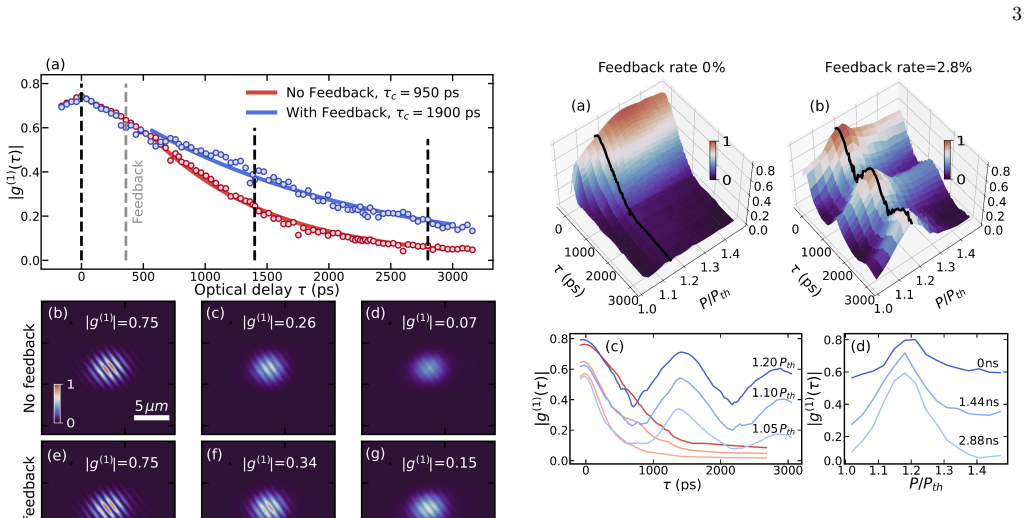
Reinjecting a small fraction of the emitted light from a trapped exciton-polariton condensate with a tunable delay reveals two regimes set by the ratio of delay time to intrinsic coherence time. Long delays result in pronounced coherence revivals at integer multiples of the feedback delay, while short delays suppress phase diffusion and nearly double the coherence time. A minimal stochastic delayed model reproduces both regimes and supports an interpretation in terms of phase stabilization and delay-induced spectral filtering.
What carries the argument
mirror-mediated time-delayed self-feedback, which reinjects a fraction of the emitted light after a tunable delay to induce phase stabilization and spectral filtering
If this is right
- Coherence revivals appear at integer multiples of the delay time when the delay exceeds the intrinsic coherence time.
- Short delays relative to the coherence time suppress phase diffusion and extend the coherence lifetime by nearly a factor of two.
- The transition between revival and extension regimes is controlled by the ratio of delay to intrinsic coherence time.
- The minimal stochastic model with phase noise and spectral filtering quantitatively reproduces the measured coherence functions in both regimes.
Where Pith is reading between the lines
- The same delay-feedback approach could be tested in other driven-dissipative systems such as atomic Bose-Einstein condensates or semiconductor lasers to suppress phase noise.
- Dynamically adjusting the delay during operation might enable switching between revival and extension modes on demand.
- The spectral filtering effect from the delay could be exploited to narrow or shape the emission linewidth in polariton devices beyond the coherence time improvement shown here.
Load-bearing premise
The observed coherence behaviors are fully captured by a minimal stochastic model that includes only phase noise and delay-induced spectral filtering, without requiring detailed many-body interactions or spatial inhomogeneities.
What would settle it
Scanning the delay time across the intrinsic coherence time and checking whether coherence revivals occur exactly at integer multiples of the delay for long values, or whether the lifetime extension for short values quantitatively matches the model's prediction, would test the claim; any mismatch would falsify the interpretation.
Figures



read the original abstract
Temporal coherence of driven-dissipative condensates is limited by phase noise. We show that mirror-mediated time-delayed self-feedback enables control of coherence in a trapped exciton-polariton condensate. Reinjecting a small fraction of the emitted light with a tunable delay reveals two regimes set by the ratio of delay time to intrinsic coherence time. Long delays result in pronounced coherence revivals at integer multiples of the feedback delay, while short delays suppress phase diffusion and nearly double the coherence time. A minimal stochastic delayed model reproduces both regimes and supports an interpretation in terms of phase stabilization and delay-induced spectral filtering.
Editorial analysis
A structured set of objections, weighed in public.
Referee Report
Summary. The manuscript demonstrates experimental control of temporal coherence in a trapped exciton-polariton condensate via mirror-mediated time-delayed self-feedback. Reinjecting a small fraction of emitted light with tunable delay reveals two regimes determined by the ratio of delay time to intrinsic coherence time: long delays produce pronounced coherence revivals at integer multiples of the feedback delay, while short delays suppress phase diffusion and nearly double the coherence time. A minimal stochastic delayed model incorporating phase noise and delay-induced spectral filtering is shown to reproduce both regimes.
Significance. If the central claims hold, the work is significant for offering a simple, tunable method to extend coherence lifetimes in driven-dissipative polariton systems without added complexity. The minimal model provides a clear physical interpretation in terms of phase stabilization and spectral filtering, and the paper earns credit for demonstrating reproduction of the observed regimes with a stochastic model that includes only a small number of free parameters (feedback fraction and delay time). This approach could inform coherence engineering in related platforms such as semiconductor lasers or feedback-controlled BECs.
major comments (2)
- [Model and interpretation sections (around the stochastic equations and regime comparison)] The central interpretation rests on the minimal stochastic delayed model being sufficient, yet the manuscript does not provide quantitative bounds or comparisons demonstrating that polariton-polariton interactions, reservoir fluctuations, or trap inhomogeneities remain negligible relative to the feedback term across the explored delay range. If these microscopic contributions are comparable, the attribution of revivals specifically to integer multiples of delay and the doubling of coherence time to spectral filtering would be incomplete. This issue is load-bearing for the claim that the minimal model captures the regimes without detailed many-body physics.
- [Results and model comparison] The abstract and model description state that the minimal model reproduces both regimes, but the manuscript lacks explicit details on the fitting procedure, error analysis, goodness-of-fit metrics, or cross-validation against held-out data. With two free parameters (feedback fraction and delay time) tuned to match observations, the reproduction risks circularity; a clearer demonstration of predictive power (e.g., using one regime to predict the other) is needed to substantiate the interpretation.
minor comments (2)
- [Figures] Figure captions and axis labels for the coherence revival plots should explicitly mark the integer multiples of the feedback delay to improve readability and direct comparison with the claimed revivals.
- [Notation and equations] Notation for coherence time, delay time, and feedback strength should be defined once early in the text and used consistently in equations, figures, and discussion to avoid minor ambiguity.
Simulated Author's Rebuttal
We thank the referee for the positive assessment of our work and the constructive major comments, which have prompted us to strengthen the manuscript. We address each point below and have revised the text and supplementary material accordingly.
read point-by-point responses
-
Referee: [Model and interpretation sections (around the stochastic equations and regime comparison)] The central interpretation rests on the minimal stochastic delayed model being sufficient, yet the manuscript does not provide quantitative bounds or comparisons demonstrating that polariton-polariton interactions, reservoir fluctuations, or trap inhomogeneities remain negligible relative to the feedback term across the explored delay range. If these microscopic contributions are comparable, the attribution of revivals specifically to integer multiples of delay and the doubling of coherence time to spectral filtering would be incomplete. This issue is load-bearing for the claim that the minimal model captures the regimes without detailed many-body physics.
Authors: We agree that explicit quantitative bounds would make the interpretation more robust. In the revised manuscript we have added estimates in the model section, derived from our measured condensate densities, literature values for the polariton interaction constant, and independently measured reservoir lifetimes, showing that the phase diffusion rate from polariton-polariton interactions and reservoir fluctuations is at least an order of magnitude smaller than the effective rate set by the feedback term for the experimental feedback fractions (1–5 %). We also note that neither interaction-induced diffusion nor static trap inhomogeneities can produce the observed sharp revivals precisely at integer multiples of the externally imposed delay; this structure is a direct signature of the time-delayed feedback. These additions are now included as a new paragraph and an accompanying supplementary figure. revision: yes
-
Referee: [Results and model comparison] The abstract and model description state that the minimal model reproduces both regimes, but the manuscript lacks explicit details on the fitting procedure, error analysis, goodness-of-fit metrics, or cross-validation against held-out data. With two free parameters (feedback fraction and delay time) tuned to match observations, the reproduction risks circularity; a clearer demonstration of predictive power (e.g., using one regime to predict the other) is needed to substantiate the interpretation.
Authors: We accept this criticism and have substantially expanded the supplementary information. The revised version now contains: (i) a step-by-step description of the least-squares fitting procedure applied to the measured first-order coherence function, (ii) the resulting best-fit values together with uncertainties obtained from the curvature of the chi-squared surface, and (iii) goodness-of-fit metrics (reduced chi-squared) for both the long-delay and short-delay data sets. To demonstrate predictive power and remove circularity, we performed a cross-validation test in which parameters extracted from the long-delay regime alone are used to predict the short-delay coherence doubling; the prediction lies within the experimental uncertainty of the measured data. The same exercise is shown in the opposite direction. These results are presented in a new supplementary section. revision: yes
Circularity Check
No significant circularity in derivation chain
full rationale
The paper reports experimental observations of coherence revivals at integer multiples of feedback delay for long delays and coherence time extension for short delays. It introduces a minimal stochastic delayed model (phase diffusion plus delay-induced filtering) that reproduces these regimes. No load-bearing self-citations, self-definitional loops, or ansatzes smuggled via prior work are present. The model parameters (delay, feedback fraction) are set to experimental values, but the reproduction serves as validation of the interpretation rather than a tautological fit renamed as prediction; the model structure itself is independent and not equivalent to the data by construction. The derivation remains self-contained against the experimental benchmarks.
Axiom & Free-Parameter Ledger
free parameters (2)
- feedback fraction
- delay time
axioms (1)
- domain assumption Phase dynamics can be captured by a stochastic delayed differential equation with additive noise
Reference graph
Works this paper leans on
-
[1]
Kasprzak, M
J. Kasprzak, M. Richard, S. Kundermann, A. Baas, P. Jeambrun, J. M. J. Keeling, F. M. Marchetti, M. H. Szymańska, R. André, J. L. Staehli, V. Savona, P. B. Littlewood, B. Deveaud, and L. S. Dang, Nature443, 409–414 (2006)
2006
-
[2]
H. Deng, H. Haug, and Y. Yamamoto, Reviews of Mod- ern Physics82, 1489–1537 (2010)
2010
-
[3]
Carusotto and C
I. Carusotto and C. Ciuti, Reviews of Modern Physics 5 85, 299–366 (2013)
2013
-
[4]
Amo and J
A. Amo and J. Bloch, Comptes Rendus. Physique17, 934–945 (2016)
2016
-
[5]
T. Boulier, M. J. Jacquet, A. Maître, G. Lerario, F. Claude, S. Pigeon, Q. Glorieux, A. Amo, J. Bloch, A. Bramati, and E. Giacobino, Advanced Quantum Technologies3(2020), 10.1002/qute.202000052
-
[6]
Kavokin, T
A. Kavokin, T. C. H. Liew, C. Schneider, P. G. Lagoudakis, S. Klembt, and S. Hoefling, Nature Reviews Physics4, 435–451 (2022)
2022
-
[7]
G. Tosi, G. Christmann, N. G. Berloff, P. Tsotsis, T. Gao, Z. Hatzopoulos, P. G. Savvidis, and J. J. Baumberg, Nature Physics8, 190–194 (2012)
2012
-
[8]
H.Ohadi, R.L.Gregory, T.Freegarde, Y.G.Rubo, A.V. Kavokin, N. G. Berloff, and P. G. Lagoudakis, Physical Review X6(2016), 10.1103/physrevx.6.031032
-
[9]
T. Cookson, K. Kalinin, H. Sigurdsson, J. D. Töpfer, S. Alyatkin, M. Silva, W. Langbein, N. G. Berloff, and P. G. Lagoudakis, Nature Communications12(2021), 10.1038/s41467-021-22121-3
-
[10]
N. Y. Kim, K. Kusudo, C. Wu, N. Masumoto, A. Löffler, S. Höfling, N. Kumada, L. Worschech, A. Forchel, and Y. Yamamoto, Nature Physics7, 681–686 (2011)
2011
-
[11]
Masumoto, N
N. Masumoto, N. Y. Kim, T. Byrnes, K. Kusudo, A. Löf- fler, S.Höfling, A.Forchel, andY.Yamamoto,NewJour- nal of Physics14, 065002 (2012)
2012
-
[12]
N. G. Berloff, M. Silva, K. Kalinin, A. Askitopoulos, J. D. Töpfer, P. Cilibrizzi, W. Langbein, and P. G. Lagoudakis, Nature Materials16, 1120–1126 (2017)
2017
-
[13]
C. E. Whittaker, E. Cancellieri, P. M. Walker, D. R. Gulevich, H. Schomerus, D. Vaitiekus, B. Royall, D. M. Whittaker, E. Clarke, I. V. Iorsh, I. A. Shelykh, M. S. Skolnick, and D. N. Krizhanovskii, Phys. Rev. Lett.120, 097401 (2018)
2018
-
[14]
S. Alyatkin, H. Sigurðsson, Y. V. Kartashov, I. Gnusov, K. Sitnik, J. D. Töpfer, and P. G. Lagoudakis, Applied Physics Letters124(2024), 10.1063/5.0180272
-
[15]
Crystal time-reversal symmetry breaking and spontaneous hall effect in collinear anti- ferromagnets,
S. Alyatkin, K. Sitnik, V. K. Daníelsson, Y. V. Kar- tashov, J. D. Töpfer, H. Sigurðsson, and P. G. Lagoudakis, Science Advances11(2025), 10.1126/sci- adv.adz2484
-
[16]
M. Klaas, H. Flayac, M. Amthor, I. G. Savenko, S. Brodbeck, T. Ala-Nissila, S. Klembt, C. Schneider, and S. Höfling, Physical Review Letters120(2018), 10.1103/physrevlett.120.017401
-
[17]
K. Orfanakis, A. F. Tzortzakakis, D. Petrosyan, P. G. Savvidis, and H. Ohadi, Physical Review B103(2021), 10.1103/physrevb.103.235313
-
[18]
B. R. Fabricante, M. Król, M. Wurdack, M. Pieczarka, M. Steger, D. W. Snoke, K. West, L. N. Pfeiffer, A. G. Truscott, E. A. Ostrovskaya, and E. Estrecho, Optica 11, 838 (2024)
2024
-
[19]
J. D. Töpfer, I. Chatzopoulos, H. Sigurdsson, T. Cook- son, Y. G. Rubo, and P. G. Lagoudakis, Optica8, 106 (2021)
2021
-
[20]
Ohadi, A
H. Ohadi, A. J. Ramsay, H. Sigurdsson, Y. del Valle- Inclan Redondo, S. I. Tsintzos, Z. Hatzopoulos, T. C. H. Liew, I. A. Shelykh, Y. G. Rubo, P. G. Savvidis, and J. J. Baumberg, Phys. Rev. Lett.119, 067401 (2017)
2017
-
[21]
Y. Wang, P. G. Lagoudakis, and H. Sigurdsson, Phys. Rev. B106, 245304 (2022)
2022
-
[22]
Alyatkin, J
S. Alyatkin, J. D. Töpfer, A. Askitopoulos, H. Sigurds- son, and P. G. Lagoudakis, Phys. Rev. Lett.124, 207402 (2020)
2020
-
[23]
J. D. Töpfer, H. Sigurdsson, L. Pickup, and P. G. Lagoudakis, Communications Physics3(2020), 10.1038/s42005-019-0271-0
-
[24]
Richard, Automatica39, 1667–1694 (2003)
J.-P. Richard, Automatica39, 1667–1694 (2003)
2003
-
[25]
Z.-H. Lin, M. Feng, M. Tang, Z. Liu, C. Xu, P. M. Hui, and Y.-C. Lai, Nature Communications11(2020), 10.1038/s41467-020-15860-2
-
[26]
Byrnes, N
T. Byrnes, N. Y. Kim, and Y. Yamamoto, Nature Physics10, 803–813 (2014)
2014
-
[27]
P. Comaron, E. Estrecho, M. Wurdack, M. Pieczarka, M. Steger, D. W. Snoke, K. West, L. N. Pfeiffer, A. G. Truscott, M. Matuszewski, M. H. Szymańska, and E. A. Ostrovskaya, Communications Physics8(2025), 10.1038/s42005-025-01977-7
-
[28]
R. Mirek, M. Furman, A. Opala, M. Król, W. Pacuski, J. Szczytko, H. Sigurdsson, and B. Piętka, ACS Photon- ics (2025), 10.1021/acsphotonics.5c01787
- [29]
-
[30]
P. Cilibrizzi, A. Askitopoulos, M. Silva, F. Basti- man, E. Clarke, J. M. Zajac, W. Langbein, and P. G. Lagoudakis, Applied Physics Letters105(2014), 10.1063/1.4901814
-
[31]
Giant increase of temporal coherence in optically trapped polariton condensate,
A. Askitopoulos, L. Pickup, S. Alyatkin, A. Zase- datelev, K. G. Lagoudakis, W. Langbein, and P. G. Lagoudakis, “Giant increase of temporal coherence in optically trapped polariton condensate,” (2019), arXiv:1911.08981
-
[32]
Sigurdsson, I
H. Sigurdsson, I. Gnusov, S. Alyatkin, L. Pickup, N. A. Gippius, P. G. Lagoudakis, and A. Askitopoulos, Phys. Rev. Lett.129, 155301 (2022). 6 Supplementary Information MICROCA VITY STRUCTURE The experiments were performed on a strain-compensated planar GaAs-based semiconductor microcavity described in Ref. [30]. The structure consists of a2λGaAs cavity bo...
2022
discussion (0)
Sign in with ORCID, Apple, or X to comment. Anyone can read and Pith papers without signing in.