On Physics-Based Loss Scaling for MF-PINNs applied to the neutron diffusion equation
Pith reviewed 2026-05-08 02:16 UTC · model grok-4.3
The pith
A loss function scaled by material cross sections makes MF-PINNs converge faster and more accurately on the neutron diffusion equation.
A machine-rendered reading of the paper's core claim, the machinery that carries it, and where it could break.
Core claim
The authors show that scaling the loss terms of an MF-PINN by the material cross sections yields a loss function that is equivalent to the unscaled classical form but accelerates convergence and raises accuracy when the network is trained on the neutron diffusion equation. This equivalence and the observed gains are verified across fixed-source and criticality problems, single-group to multi-group models, and two- to three-dimensional domains.
What carries the argument
Physics-Based Loss Scaling (PBLS), a reweighting of the mixed-formulation residual terms by the local material cross sections that balances their magnitudes during gradient descent without altering the underlying PDE solution.
If this is right
- The scaled loss applies unchanged to both fixed-source and k-eigenvalue formulations.
- Accuracy and speed gains persist from one-group to multigroup neutron models.
- The same scaling works for two-dimensional and three-dimensional spatial configurations.
- No new hyperparameters are required, keeping the training procedure as simple as the original MF-PINN.
Where Pith is reading between the lines
- A similar coefficient-based scaling may improve training stability for other diffusion-type PDEs solved by physics-informed networks.
- The approach points toward a systematic way to choose loss weights from the physical parameters already present in the governing equations.
- Tests on domains with strong material discontinuities would reveal whether the scaling remains effective when cross sections vary sharply.
Load-bearing premise
The cross-section scaling balances every loss component uniformly for any material properties, geometry, and problem type without introducing bias or needing per-case adjustments.
What would settle it
Training an MF-PINN on an identical neutron diffusion problem with and without the proposed cross-section scaling and finding no improvement in iteration count to reach a given error tolerance or in final solution accuracy would refute the performance claim.
Figures




read the original abstract
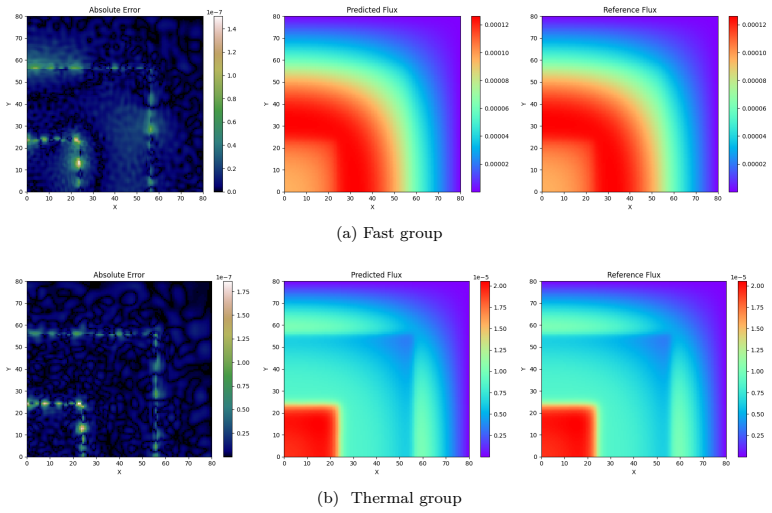
Physics-Based Loss Scaling (PBLS) is introduced for Mixed-Formulation PINNs (MF-PINNs) applied to the neutron diffusion equation. In particular, we propose a new \textit{scaled} loss function based on the material cross sections, which is equivalent to the classical MF-PINN loss, but accelerates the convergence and improves accuracy of MF-PINNs. Several numerical experiments on both the fixed source and the k-eigenvalue problem, from one-group to multigroup cases and from two-dimensional (2D) to three-dimensional (3D) configurations, illustrate the efficiency of the proposed scaling method.
Editorial analysis
A structured set of objections, weighed in public.
Referee Report
Summary. The manuscript introduces Physics-Based Loss Scaling (PBLS) for Mixed-Formulation Physics-Informed Neural Networks (MF-PINNs) applied to the neutron diffusion equation. It proposes a scaled loss function derived from material cross sections that is mathematically equivalent to the classical MF-PINN loss (preserving the same zero set for exact solutions) while accelerating convergence and improving accuracy. This is illustrated through numerical experiments on fixed-source and k-eigenvalue problems spanning one-group to multigroup cases and two- to three-dimensional geometries.
Significance. If the equivalence holds rigorously and the observed gains prove robust, PBLS offers a parameter-free way to improve optimizer behavior for PINNs in heterogeneous media, which could enhance the practicality of neural solvers for neutron diffusion in nuclear engineering applications. The approach leverages the physical coefficients directly, avoiding ad-hoc hyperparameters, and the experiments cover a useful range of problem types.
major comments (2)
- [Section 3] Section 3 (derivation of scaled loss): the construction multiplies residual terms by factors from the diffusion and removal operators so that any exact PDE solution remains a zero of the new loss; however, the manuscript should explicitly verify that this scaling preserves equivalence for the mixed formulation (including the current variable) and does not alter the conditioning of the loss landscape in a way that could introduce spurious local minima.
- [Section 5] Section 5 (numerical results): while faster convergence and lower errors are reported across test cases, the central claim of improved accuracy would be strengthened by including quantitative error tables (e.g., relative L2 errors or pointwise maxima) comparing scaled vs. unscaled MF-PINNs on identical network architectures and training budgets.
minor comments (3)
- [Throughout] Notation for cross sections (Σ_a, Σ_r, etc.) and the mixed variables (flux φ and current J) should be defined once in a nomenclature table or at first use to improve readability.
- [Section 5] Figure captions in the results section would benefit from listing the specific material properties and boundary conditions for each test case to aid reproducibility.
- [Abstract] The abstract states equivalence and empirical gains but omits any mention of the precise scaling factors or the range of cross-section values tested; a single sentence clarifying these would help readers.
Simulated Author's Rebuttal
We thank the referee for the positive assessment of our work and the recommendation for minor revision. The comments are constructive and we address each one below, indicating the revisions we will make to the manuscript.
read point-by-point responses
-
Referee: [Section 3] Section 3 (derivation of scaled loss): the construction multiplies residual terms by factors from the diffusion and removal operators so that any exact PDE solution remains a zero of the new loss; however, the manuscript should explicitly verify that this scaling preserves equivalence for the mixed formulation (including the current variable) and does not alter the conditioning of the loss landscape in a way that could introduce spurious local minima.
Authors: We thank the referee for highlighting this point. In Section 3 the scaled loss is obtained by multiplying the residual of the neutron balance equation by positive factors derived from the diffusion coefficient and removal cross section (inverse scaling). The mixed formulation augments the system with the current variable satisfying Fick's law; the corresponding residual term in the loss is left unscaled or scaled by the same physical coefficients so that the entire loss vanishes if and only if both the balance and constitutive residuals are zero. Because every scaling factor is strictly positive for physically admissible cross sections, the zero set of the loss is identical to that of the classical MF-PINN loss and therefore coincides exactly with the solutions of the original mixed system. Positive reweighting cannot create additional zeros and hence cannot introduce spurious local minima at non-solutions; it only improves the relative magnitudes of the loss terms, which is the source of the observed faster convergence. We will add a short clarifying paragraph at the end of Section 3 that explicitly states this equivalence for the mixed variables and notes the absence of new minima. revision: yes
-
Referee: [Section 5] Section 5 (numerical results): while faster convergence and lower errors are reported across test cases, the central claim of improved accuracy would be strengthened by including quantitative error tables (e.g., relative L2 errors or pointwise maxima) comparing scaled vs. unscaled MF-PINNs on identical network architectures and training budgets.
Authors: We agree that explicit quantitative tables would make the accuracy improvement more transparent. The present manuscript demonstrates the gains primarily through convergence curves and spatial error plots. In the revised version we will insert a new table (or set of tables) in Section 5 that reports, for every test case, the relative L2 error and maximum pointwise error of the scalar flux (and current when relevant) obtained by both the scaled and unscaled MF-PINNs. All entries will be computed on identical network architectures, the same number of training iterations, and the same optimizer settings, thereby providing a direct, quantitative comparison. revision: yes
Circularity Check
No significant circularity detected in the PBLS derivation
full rationale
The paper constructs the physics-based loss scaling directly from the neutron diffusion operators by multiplying each residual term (diffusion, removal, fission, etc.) by a factor involving the local material cross sections. This reweighting is shown algebraically to leave the zero set unchanged: any function satisfying the original PDE and boundary conditions yields zero loss under both the classical and scaled formulations. The equivalence is therefore an explicit identity derived from the PDE residuals rather than a fitted parameter, a self-referential definition, or a load-bearing self-citation. Subsequent numerical experiments on fixed-source and k-eigenvalue problems serve only to illustrate optimizer behavior and do not retroactively define the scaling itself. The derivation chain remains self-contained against the stated PDE and does not reduce any claimed result to its own inputs by construction.
Axiom & Free-Parameter Ledger
Reference graph
Works this paper leans on
-
[1]
Residual-based attention in physics-informed neural networks
Sokratis J Anagnostopoulos, Juan Diego Toscano, Nikolaos Stergiopulos, and George Em Karniadakis. Residual-based attention in physics-informed neural networks. Computer Methods in Applied Mechanics and Engineer- ing, 421:116805, 2024
work page 2024
-
[2]
Anne-Marie Baudron and Jean-Jacques Lautard. MINOS: a simplified PN solver for core calculation.Nuclear Science and Engineering, 155(2):250– 263, 2007
work page 2007
-
[3]
Maximilian Bernkopf and Jens Markus Melenk. Optimal convergence rates in L2 for a first order system least squares finite element method-part i: homogeneous boundary conditions. ESAIM: Mathematical Modelling and Numerical Analysis, 57(1):107–141, 2023
work page 2023
-
[4]
Maximilian Bernkopf and Jens Markus Melenk. Optimal convergence rates in L2 for a first order system least squares finite element method-part II: Inhomogeneous Robin boundary conditions. Computers & Mathematics with Applications, 173:1–18, 2024
work page 2024
-
[5]
Francisco M Bersetche and Juan Pablo Borthagaray. A deep first-order system least squares method for solving elliptic PDEs.Computers & Math- ematics with Applications, 129:136–150, 2023
work page 2023
-
[6]
Hongtao Bi, Meiqi Song, Tengfei Zhang, and Xiaojing Liu. FC-PINNs: Physics-informed neural networks for solving neutron diffusion eigenvalue problem with interface considerations.Journal of Computational Physics, page 114311, 2025
work page 2025
-
[7]
Shengze Cai, Zhiping Mao, Zhicheng Wang, Minglang Yin, and George Em Karniadakis. Physics-informed neural networks (PINNs) for fluid mechan- ics: A review.Acta Mechanica Sinica, 37(12):1727–1738, 2021
work page 2021
-
[8]
Zhiqiang Cai, Jingshuang Chen, Min Liu, and Xinyu Liu. Deep least- squares methods: An unsupervised learning-based numerical method for solving elliptic PDEs.Journal of Computational Physics, 420:109707, 2020
work page 2020
-
[9]
Ansar Calloo, Romain Le Tellier, and David Couyras. Anderson accelera- tion and linear diffusion for accelerating the k-eigenvalue problem for the transport equation. Annals of Nuclear Energy, 180:109406, 2023
work page 2023
-
[10]
Deterministic numerical methods for unstructured-mesh neutron transport calculation
Liangzhi Cao and Hongchun Wu. Deterministic numerical methods for unstructured-mesh neutron transport calculation. Woodhead Publishing, 2020
work page 2020
-
[11]
WenqianChen, AmandaAHoward, andPanosStinis. Self-adaptiveweights based on balanced residual decay rate for physics-informed neural net- works and deep operator networks. Journal of Computational Physics, page 114226, 2025. 26
work page 2025
-
[12]
Ciarlet, Jr., Minh-Hieu Do, Mario Gervais, and François Madiot
P. Ciarlet, Jr., Minh-Hieu Do, Mario Gervais, and François Madiot. A pos- teriori error estimates for mixed finite element discretization of the multi- group Neutron Simplified Transport equations with Robin boundary con- dition. Hal preprint hal-05578214, April 2026
work page 2026
-
[13]
Ciarlet, Jr., Minh-Hieu Do, and François Madiot
P. Ciarlet, Jr., Minh-Hieu Do, and François Madiot. Chapter five - Adap- tive mesh refinement on cartesian meshes applied to the mixed finite ele- ment discretization of the multigroup neutron diffusion equations. InError Control, Adaptive Discretizations, and Applications, Part 3, volume 60 of Advances in Applied Mechanics, pages 201–234. Elsevier, 2025
work page 2025
-
[14]
Scientific machine learning through physics–informed neural networks: Where we are and what’s next
Salvatore Cuomo, Vincenzo Schiano Di Cola, Fabio Giampaolo, Gianluigi Rozza, Maziar Raissi, and Francesco Piccialli. Scientific machine learning through physics–informed neural networks: Where we are and what’s next. Journal of Scientific Computing, 92(3):88, 2022
work page 2022
-
[15]
Tim De Ryck and Siddhartha Mishra. Numerical analysis of physics- informed neural networks and related models in physics-informed machine learning. Acta Numerica, 33:633–713, 2024
work page 2024
-
[16]
Tim De Ryck, Siddhartha Mishra, and Roberto Molinaro. wPINNs: Weak physics informed neural networks for approximating entropy solu- tions of hyperbolic conservation laws.SIAM Journal on Numerical Analy- sis, 62(2):811–841, 2024
work page 2024
-
[17]
Minh-Hieu Do, Karim Ammar, Nicolas Gerard Castaing, and François Ma- diot. Physics informed neural networks for the mixed dual form of the neutron diffusion equation with heterogeneous coefficients.Annals of Nu- clear Energy, 223:111607, 2025
work page 2025
-
[18]
Minh-Hieu Do, Karim Ammar, Nicolas Gerard Castaing, and François Ma- diot. MF-PINNs: Mixed-formulation physics-informed neural networks for the multigroup neutron diffusion equations. InPHYSOR 2026: The Inter- national Conference on Physics of Reactors, 2026
work page 2026
-
[19]
Mohamed H Elhareef and Zeyun Wu. Physics-informed neural network method and application to nuclear reactor calculations: A pilot study.Nu- clear Science and Engineering, 197(4):601–622, 2023
work page 2023
-
[20]
Xiaoxu Geng, Dandan Chen, Jiayi Yu, Chong Wang, Changjun Hu, and Zhaoshun Wang. Physics-informed neural network for solving neutron transport equation with differential order transformation and fourier fea- ture. Journal of Computational Physics, page 114519, 2025
work page 2025
-
[21]
Error analysis of the mixed residual method for elliptic equations
Kai Gu, Peng Fang, Zhiwei Sun, and Rui Du. Error analysis of the mixed residual method for elliptic equations. Numerical Mathematics: Theory, Methods and Applications, 17(2):534–554, 2024
work page 2024
-
[22]
Alain Hébert. Applied Reactor Physics. Presses internationales Polytech- nique, third edition, 2020. 27
work page 2020
-
[23]
V ariational physics-informed neural networks for solving partial di fferential equations
Ehsan Kharazmi, Zhongqiang Zhang, and George Em Karniadakis. Varia- tionalphysics-informedneuralnetworksforsolvingpartialdifferentialequa- tions. arXiv preprint arXiv:1912.00873, 2019
-
[24]
Diederik P. Kingma and Jimmy Ba. Adam: A Method for Stochastic Optimization. International Conference on Learning Representations, 2014
work page 2014
-
[25]
Jaeguk Lee and Hyung Jin Shim. Development of Convolutional Neural Network-based Physics-Informed Neural networks for solving the neutron diffusion equation.Annals of Nuclear Energy, 227:111920, 2026
work page 2026
-
[26]
Lingfeng Li, Xue-Cheng Tai, Jiang Yang, and Quanhui Zhu. A priori er- ror estimate of deep mixed residual method for elliptic pdes.Journal of Scientific Computing, 98(2):44, 2024
work page 2024
-
[27]
Fourier Neural Operator for Parametric Partial Differential Equations
Zongyi Li, Nikola Kovachki, Kamyar Azizzadenesheli, Burigede Liu, Kaushik Bhattacharya, Andrew Stuart, and Anima Anandkumar. Fourier Neural Operator for Parametric Partial Differential Equations. InInterna- tional Conference on Learning Representations, 2021
work page 2021
-
[28]
Physics-informed neural operator for learning partial differential equations
Zongyi Li, Hongkai Zheng, Nikola Kovachki, David Jin, Haoxuan Chen, Burigede Liu, Kamyar Azizzadenesheli, and Anima Anandkumar. Physics-informed neural operator for learning partial differential equations. ACM/IMS Journal of Data Science, 1(3):1–27, 2024
work page 2024
-
[29]
Learning nonlinear operators via DeepONet based on the universalapproximationtheoremofoperators
Lu Lu, Pengzhan Jin, Guofei Pang, Zhongqiang Zhang, and George Em Karniadakis. Learning nonlinear operators via DeepONet based on the universalapproximationtheoremofoperators. Nature machine intelligence, 3(3):218–229, 2021
work page 2021
-
[30]
Liyao Lyu, Keke Wu, Du Rui, and Chen Jingrun. Enforcing Exact Bound- ary and Initial Conditions in the Deep Mixed Residual Method.CSIAM Transactions on Applied Mathematics, 2(4):748–775, 2021
work page 2021
-
[31]
MIM: A deep mixed residual method for solving high-order partial differential equations
Liyao Lyu, Zhen Zhang, Minxin Chen, and Jingrun Chen. MIM: A deep mixed residual method for solving high-order partial differential equations. Journal of Computational Physics, 452:110930, 2022
work page 2022
-
[32]
Pietro Mosca, Lahbib Bourhrara, Ansar Calloo, Andrea Gammicchia, Franck Goubioud, L Mao, François Madiot, Fadhel Malouch, Emiliano Masiello, Frederic Moreau, et al. APOLLO3®: Overview of the new code capabilities for reactor physics analysis.Nuclear Science and Engineering, pages 1–14, 2024
work page 2024
-
[33]
Guofei Pang, Lu Lu, and George Em Karniadakis. fPINNs: Fractional physics-informed neural networks.SIAM Journal on Scientific Computing, 41(4):A2603–A2626, 2019. 28
work page 2019
-
[34]
Maziar Raissi, Paris Perdikaris, and George E Karniadakis. Physics- informed neural networks: A deep learning framework for solving for- wardandinverseproblemsinvolvingnonlinearpartialdifferentialequations. Journal of Computational physics, 378:686–707, 2019
work page 2019
-
[35]
Enhanced physics- informed neural networks with augmented Lagrangian relaxation method (AL-PINNs)
Hwijae Son, Sung Woong Cho, and Hyung Ju Hwang. Enhanced physics- informed neural networks with augmented Lagrangian relaxation method (AL-PINNs). Neurocomputing, 548:126424, 2023
work page 2023
-
[36]
Calculation of four thermal reactor benchmark problems in XY geometry
Jiri Stepanek, Theodor Auerbach, and Walter Hälg. Calculation of four thermal reactor benchmark problems in XY geometry. Technical report, Eidgenoessisches Inst. fuer Reaktorforschung, 1982
work page 1982
-
[37]
Victor Viallon, Elias Y Garcia Cervantes, and Laurent Buiron. Numerical validation of the APOLLO3®-FR deterministic calculation route based on a simplified Phenix configuration.Annals of Nuclear Energy, 208:110782, 2024
work page 2024
-
[38]
Anderson acceleration for fixed-point iter- ations
Homer F Walker and Peng Ni. Anderson acceleration for fixed-point iter- ations. SIAM Journal on Numerical Analysis, 49(4):1715–1735, 2011
work page 2011
-
[39]
Sifan Wang, Yujun Teng, and Paris Perdikaris. Understanding and mitigat- ing gradient flow pathologies in physics-informed neural networks.SIAM Journal on Scientific Computing, 43(5):A3055–A3081, 2021
work page 2021
-
[40]
Sifan Wang, Xinling Yu, and Paris Perdikaris. When and why PINNs fail to train: A neural tangent kernel perspective.Journal of Computational Physics, 449:110768, 2022
work page 2022
-
[41]
Chenxi Wu, Min Zhu, Qinyang Tan, Yadhu Kartha, and Lu Lu. A com- prehensive study of non-adaptive and residual-based adaptive sampling for physics-informed neural networks.Computer Methods in Applied Mechan- ics and Engineering, 403:115671, 2023
work page 2023
-
[42]
Solving a class of multi-scale elliptic PDEs by Fourier-based mixed physics informed neural networks
Jinran Wu, Xin Tai, Jianhua Xu, You-Gan Wang, et al. Solving a class of multi-scale elliptic PDEs by Fourier-based mixed physics informed neural networks. Journal of Computational Physics, 508:113012, 2024
work page 2024
-
[43]
Yuchen Xie, Yu Ma, and Yahui Wang. Automatic boundary fitting frame- work of boundary dependent physics-informed neural network solving par- tial differential equation with complex boundary conditions. Computer Methods in Applied Mechanics and Engineering, 414:116139, 2023
work page 2023
-
[44]
Yuchen Xie, Yahui Wang, and Yu Ma. Boundary dependent physics- informed neural network for solving neutron transport equation.Annals of Nuclear Energy, 195:110181, 2024
work page 2024
-
[45]
Accelerated stochastic power iteration
Peng Xu, Bryan He, Christopher De Sa, Ioannis Mitliagkas, and Chris Re. Accelerated stochastic power iteration. InInternational Conference on Artificial Intelligence and Statistics, pages 58–67. PMLR, 2018. 29
work page 2018
-
[46]
Qi-Hong Yang, Yu Yang, Yang-Tao Deng, Qiao-Lin He, He-Lin Gong, and Shi-Quan Zhang. Physics-constrained neural network for solving discon- tinuous interface K-eigenvalue problem with application to reactor physics. Nuclear Science and Techniques, 34(10):161, 2023
work page 2023
-
[47]
Qihong Yang, Yangtao Deng, Yu Yang, Qiaolin He, and Shiquan Zhang. Neural networks based on power method and inverse power method for solving linear eigenvalue problems.Computers and Mathematics with Ap- plications, 147:14–24, 2023
work page 2023
-
[48]
A physics- informed neural network approach for solving structural eigenvalue prob- lem
Seongjoon Yoo, Minseo Kang, Heonjun Yoon, and Taejin Kim. A physics- informed neural network approach for solving structural eigenvalue prob- lem. International Journal of Precision Engineering and Manufacturing, pages 1–14, 2025
work page 2025
-
[49]
Solving Multi-Group Neutron Diffusion Eigenvalue Problem with Decoupling Residual Loss Function
Shupei Yu, Qiaolin He, Shiquan Zhang, Qihong Yang, Yu Yang, and Helin Gong. Solving Multi-Group Neutron Diffusion Eigenvalue Problem with Decoupling Residual Loss Function. Communications in Computational Physics, 39(4):1231–1266, 2026. 30
work page 2026
discussion (0)
Sign in with ORCID, Apple, or X to comment. Anyone can read and Pith papers without signing in.