pith. sign in

arxiv: 2604.26369 · v2 · pith:J7BPKSNAnew · submitted 2026-04-29 · 🧮 math.GT

Reidemeister and movie moves for involutive links

Pith reviewed 2026-05-22 10:58 UTC · model grok-4.3

classification 🧮 math.GT
keywords involutive linksequivariant cobordismsmovie movesReidemeister movesequivariant isotopysingularity theoryknot cobordisms
0
0 comments X

The pith

A set of 39 equivariant movie moves suffices to connect any two movie presentations of equivariantly isotopic cobordisms between involutive links.

A machine-rendered reading of the paper's core claim, the machinery that carries it, and where it could break.

The paper proves an equivariant version of the Carter-Saito movie moves theorem for involutive links, which are links fixed by a 180-degree rotation in three-space. It identifies 39 local moves that generate all changes between diagrams of equivariantly isotopic cobordisms. This combinatorial control lets researchers track symmetries when studying surfaces between symmetric knots. The work also includes a singularity-based proof of the corresponding Reidemeister theorem for these symmetric objects.

Core claim

The authors show that 39 equivariant movie moves are sufficient to relate any two movie presentations of a pair of equivariantly isotopic cobordisms. Their proof proceeds by classifying codimension-2 singularities of equivariant maps from the circle to the plane and by using embedded equivariant Morse theory to handle the changes in height functions.

What carries the argument

The collection of 39 equivariant movie moves derived from codimension-2 singularities of equivariant maps S^1 to R^2.

If this is right

  • Equivariant cobordisms can be manipulated combinatorially using these moves.
  • The equivariant Reidemeister theorem follows from the same singularity analysis.
  • Loops formed by sequences of equivariant Reidemeister moves become classifiable.
  • This framework supports the development of equivariant link invariants.

Where Pith is reading between the lines

These are editorial extensions of the paper, not claims the author makes directly.

  • Algorithms for checking equivariant isotopy of cobordisms could be built from the moves.
  • The methods may extend to other finite group actions on links beyond order-two rotations.
  • Equivariant versions of Floer or Khovanov homologies might be defined using these diagrams.

Load-bearing premise

All isotopies of the equivariant cobordisms arise from the listed codimension-two singularities and the standard moves of equivariant Morse theory.

What would settle it

A pair of movie presentations of equivariantly isotopic cobordisms that cannot be transformed into each other using only the 39 moves would disprove the claim.

Figures

Figures reproduced from arXiv: 2604.26369 by Abhishek Mallick, Irving Dai, Maciej Borodzik, Matthew Stoffregen.

Figure 2.1
Figure 2.1. Figure 2.1: Perestroikas of critical points. A formal summary of this argument is given below: Corollary 2.21. Any two diagrams of the same knot can be connected by a sequence of isotopies and finitely many Reidemeister moves. Sketch of proof. A path ϕes : S → R 3 , s ∈ [0, 1] induces a path ϕs : S → R 2 via ϕs = π ◦ ϕes. We perturb ϕs to a regular path ϕs,n in such a way that ϕs,n agrees with ϕs for s = 0, 1. The p… view at source ↗
Figure 5.1
Figure 5.1. Figure 5.1: Top: a central tangency and an oblique tangency. Bottom: a perpendicular tangency and a fixed-point tangency. • Let ϕ ∈ O(t1, σt1) Z2 . We say ϕ is an on-axis perpendicular tangency if it satisfies Definition 5.27 at {t1, σt1} and ϕ ′ (t1) is horizontal. • Let ϕ ∈ O(t1, σt1, t2, σt2) Z2 . We say ϕ is an on-axis oblique tangency if it satisfies Definition 5.27 at either {t1, t2} or {t1, σt2} and ϕ(t1) ∈ L… view at source ↗
Figure 6.1
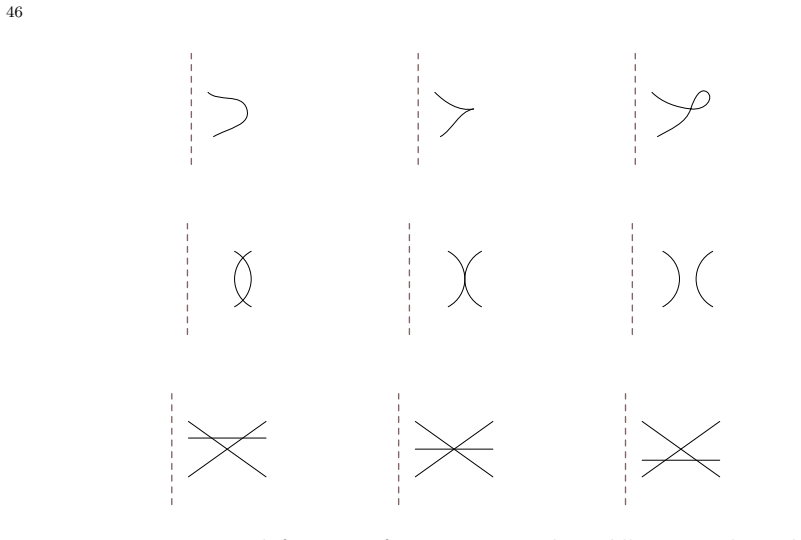
Figure 6.1. Figure 6.1: Top: bifurcation of an outer cusp. The middle picture shows the cusp singularity. Middle: bifurcation diagrams of an outer tangency. Bottom: bifurcation diagrams of an outer triple point. 6.1.3. Off-axis triple points. Define F 1 3 to be the space of ordinary triple points. Note that this comes from an ordinary strikethrough of the ordinary double point and hence has codi￾mension 1. Any extra tangency be… view at source ↗
Figure 6.2
Figure 6.2. Figure 6.2: Top: Bifurcation of central tangency. Middle: Bifurcation of perpendicularity tangency. Bottom: Bifurcaton of central double point. . 6.2.3. On-axis double point. Define F 1 6 to be the space of on-axis double points with no coincidences or strikethroughs, satisfying the additional condition that there are no tangencies between the four branches and that none of them are parallel or perpendicular to L. M… view at source ↗
Figure 6.3
Figure 6.3. Figure 6.3: Top: Bifurcation of a fixed point (2, 3) cusp. Bottom: Bifurca￾tion of a fixed double point. that for some t1 ∈ S− and t2 ∈ SZ2 , we have ϕ(t1) = ϕ(t2). To define F 1 8 , we require that none of {ϕ ′ (t1), τϕ′ (t1), ϕ′ (t2)} are parallel to each other (and that all of them are nonzero). Negating this condition adds an extra equation, so it is clear that Fe1 8 \ F1 8 consists of strata of codimension 2. A… view at source ↗
Figure 6.4
Figure 6.4. Figure 6.4: The equivariant Reidemeister moves. i = 1, 2. We assume r1 and r2 are sufficiently small so that they intersect K in small arc. Let κ be any smooth function which is zero inside C1 and π outside of C2. For s ∈ [0, 1], let ϕes : S 1 → R 3 by ϕes(u) = Rsκ(ϕe(u)) ◦ ϕe(u), where Rw is the rotation of R 3 about the z-axis by angle w. Clearly, ϕes consists of taking a knot and rotating all of it, except for th… view at source ↗
Figure 6.5
Figure 6.5. Figure 6.5: Crossing the point at infinity. Top: the fixed branch crosses the infinity point. Bottom: a pair of branches crossing the infinity point view at source ↗
Figure 6.6
Figure 6.6. Figure 6.6: Left: The I-move. The shaded part is the remaining diagram, which is not changed by the move. Right: the S-move. • If ti ∈ SZ2 , then a fixed-point branch of ϕsi hits ∞. As s varies, this fixed point sweeps over ∞ as indicated in view at source ↗
Figure 7.1
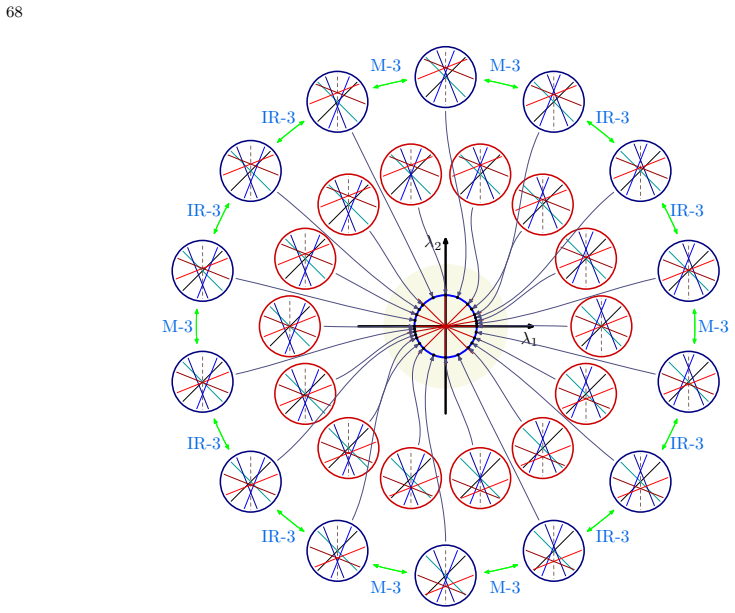
Figure 7.1. Figure 7.1: Off-axis singularities. From left-to-right: a (2, 5)-cusp, 2-fold tangency, strikethrough of a (2, 3)-cusp, strikethrough of a 1-fold tangency, and quadruple point. • ordinary strikethrough of an off-axis (2, 3)-cusp; • ordinary strikethrough of an off-axis 1-fold tangency; • ordinary strikethrough of an off-axis ordinary triple point (resulting in an off-axis quadruple point), called the X9 singularity.… view at source ↗
Figure 7.2
Figure 7.2. Figure 7.2: Off-axis (2, 5)-cusp. 7.2.2. 2-fold tangency. By Lemma 5.35, a 2-fold tangency has normal form with two branches y = 0 and (x = t, y = t 3 ) and versal deformation which perturbs the second branch to (x = t, y = t 3 + λ1t + λ2). There are no cusps or triple points regardless of λ1, λ2. A 1-fold tangency will occur if y(t) has a double root, which occurs along the locus {4λ 3 1 = −27λ 2 2 } and leads to a… view at source ↗
Figure 7.3
Figure 7.3. Figure 7.3: Off-axis 2-fold tangency. λ1 λ2 IR-3 IR-2 IR-1 IR-2 IR-1 view at source ↗
Figure 7.4
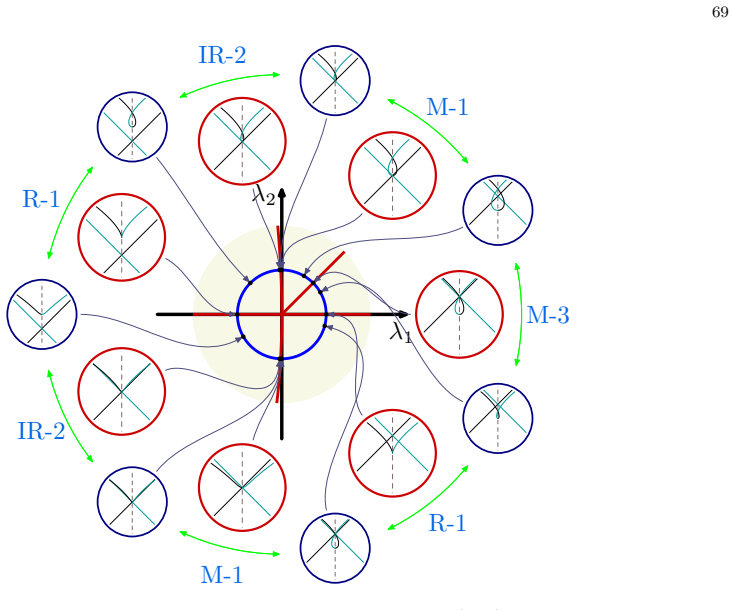
Figure 7.4. Figure 7.4: Strikethrough of an off-axis (2, 3)-cusp view at source ↗
Figure 7.5
Figure 7.5. Figure 7.5: Strikethrough of an off-axis 1-fold tangency. these. This occurs along the locus {λ2 = ± √ −λ1, λ1 ≤ 0}, leading to an (IR-3) move. The diagram is given in view at source ↗
Figure 7.6
Figure 7.6. Figure 7.6: Off-axis quadruple point view at source ↗
Figure 7.7
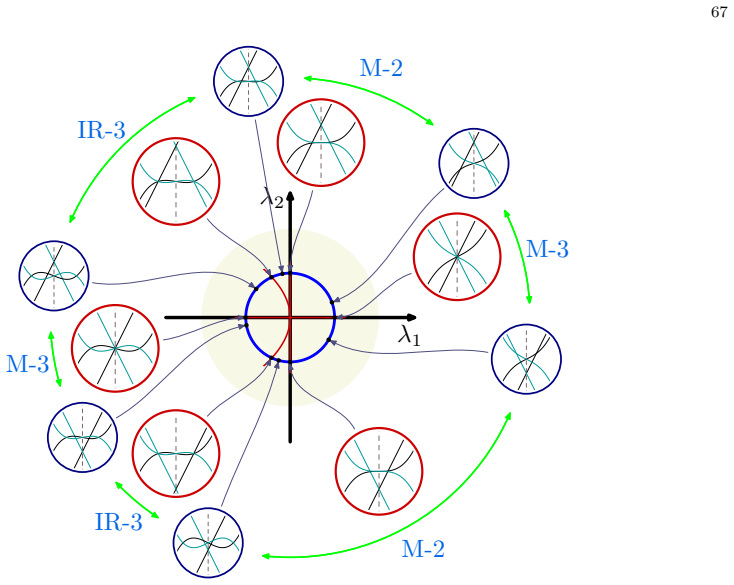
Figure 7.7. Figure 7.7: On-axis and fixed-point cusps. From left-to-right: an oblique (2, 3)-cusp, fixed-point (2, 5)-cusp, and fixed-point (3, 4)-cusp. the loci {λ1 = 0}, {λ2 = 0}, {λ1 = λ2}, and {λ1 = −λ2}, leading to (IR-3) moves. The diagram is given in view at source ↗
Figure 7.8
Figure 7.8. Figure 7.8: Oblique (2,3)-cusp. λ1 = −0.02 λ1 = −0.01 λ1 = −0.005 λ1 = 0 λ1 = 0.01 view at source ↗
Figure 7.10
Figure 7.10. Figure 7.10: Fixed-point (2, 5)-cusp. To determine the occurrence of other singularities, we first understand how our branch intersects itself. Setting p = t + t ′ , q = tt′ gives the identities t 2 − t ′2 = (t − t ′ )p, t3 − t ′3 = (t − t ′ )(p 2 − q), t4 − t ′4 = (t − t ′ )(p 3 − 2pq). Substituting these into x(t) = x(t ′ ) and y(t) = y(t ′ ) yields (7.6) p 2 − q + λ1 = 0, p3 − 2pq + λ2p = 0. Factor the second equ… view at source ↗
Figure 7.11
Figure 7.11. Figure 7.11: Fixed-point (3, 4)-cusp. the first class of solution to (7.6) gives λ1 = 0, while combining p 2 = 4q with the second gives 2λ1 = 3λ2. Both of these are subsumed by our casework for cusps. However, there is one more possibility for a tangency. This occurs when the two classes of solutions in p and q collide; i.e., when λ2 −2λ1 = 0. Note that in this case we require λ1 ≤ 0, so that p = t + t ′ = 0 and q =… view at source ↗
Figure 7.12
Figure 7.12. Figure 7.12: On-axis and fixed-point strikethroughs. From left-to-right: strikethrough of a line tangency, strikethrough of a perpendicular tangency, strikethrough of an on-axis double point, strikethrough of a fixed-point cusp, and strikethrough of a fixed double point. λ1 λ2 R-2 M-3 M-3 R-2 view at source ↗
Figure 7.13
Figure 7.13. Figure 7.13: Strikethrough of a 1-fold line tangency. is given by E1 = {x = t 2 + λ1, y = t}, E2 = {y = x − λ2}, with symmetric branches E3 = τ (E1) = {x = −t 2 − λ1, y = t}, E4 = τ (E2) = {y = −x − λ2}. For small values of λ1, λ2, the only tangency is between E1 and E3. This is a line tangency, which persists along the locus {λ1 = 0}. If λ1 > 0, then E1 and E3 are disjoint, leading to a regular diagram. For λ1 ≤ 0,… view at source ↗
Figure 7.14
Figure 7.14. Figure 7.14: Strikethrough of a 2-fold perpendicular tangency. 7.4.2. Strikethrough of a 2-fold perpendicular tangency. This has normal form (x = t, y = t 3 ) and y = ax for some a ̸= 0. Up to reparameterizing, we can assume a = 1. A versal deformation is given by E1 = {x = t, y = t 3 + λ1t}, E2 = {y = x + λ2}, with symmetric branches E3 = τ (E1) = {x = −t, y = t 3 + λ1t}, E4 = τ (E2) = {y = −x + λ2}. For small valu… view at source ↗
Figure 7.15
Figure 7.15. Figure 7.15: Strikethrough of a central double point. The deformation parameters are λ1, λ2, and a3. However, as in Section 7.2.5, we can freeze the a3 variable, leading to a3 being constant. For explicitness, we take a3 = 0.4, so that the slopes of the three lines are approximately ±22.5 ◦ , ±45◦ , and ±67.5 ◦ . No matter what the parameters λ1, λ2 are, each pair of lines intersects transversely. The lines E1, E2, … view at source ↗
Figure 7.16
Figure 7.16. Figure 7.16: Strikethrough of a fixed-point (2, 3)-cusp. λ1 = 0.005 λ1 = 0 λ1 = −0.005 λ1 = −0.01 λ1 = −0.015 view at source ↗
Figure 7.17
Figure 7.17. Figure 7.17: Close-up picture for λ1 ∼ 0 and λ2 ∼ 0.2. we have an on-axis double point. This occurs along the locus {λ1 = λ2, λ2 ≥ 0}, leading to an (M-3) move. As for tangencies, E2 is transverse to E3, so we consider tangencies between E1 and E2. For this, we find intersections between E1 and E2 and solve for a double root. Substituting the defining equations for E1 into that of E2, we must find when t 3 − t 2 − λ… view at source ↗
Figure 7.18
Figure 7.18. Figure 7.18: Close-up picture for λ1 ∼ 0 and λ2 ∼ −0.2. 7.4.5. Strikethrough of a fixed double point. We assume the branches involved in the fixed double point are y = 0 and y = a1x, along with its symmetric copy y = −a1x. Let the strikethrough line be y = a2x. By rescaling x and y, we can choose a1, as long as a1 ̸= 0 and a1 ̸= a2, but we cannot fix a2. For explicitness, we suppose a1 = 1/2. A versal deformation is… view at source ↗
Figure 7.19
Figure 7.19. Figure 7.19: Strikethrough of a fixed double point view at source ↗
Figure 7.20
Figure 7.20. Figure 7.20: On-axis and fixed-point tangencies. From left-to-right: 2-fold line tangency, 4-fold perpendicular tangency, 1-fold oblique tangency, fixed￾point (1, 2)-fold tangency, and a fixed-point branch intersecting a 1-fold line tangency. that our branch intersects its symmetric copy only at points on the x-axis. Hence tangencies occur when y(t) and y ′ (t) have a common root. This leads to t 4 + λ1t 2 + λ2 = 0 … view at source ↗
Figure 7.21
Figure 7.21. Figure 7.21: 2-fold line tangency. λ1 λ2 IR-2 M-2 M-2 view at source ↗
Figure 7.22
Figure 7.22. Figure 7.22: 4-fold perpendicular tangency view at source ↗
Figure 7.23
Figure 7.23. Figure 7.23: 1-fold oblique tangency. with symmetric branches E3 = τ (E1) = {u = λ1}, E4 = τ (E2) = {u = v 2 + λ2}. There are clearly no cusps. For λ1 = λ2, the tangency between E1 and E2 persists, and for small values of λ1, λ2 there are no other tangencies. Hence we obtain an off-axis tangency along the locus {λ1 = λ2}, leading to an (IR-2) move. To understand further singularities, we first determine the intersec… view at source ↗
Figure 7.24
Figure 7.24. Figure 7.24: Fixed-point (1, 2)-tangency. λ2 = −0.02 λ2 = −0.012 λ2 = −0.005 λ2 = 0 λ2 = 0.015 view at source ↗
Figure 7.25
Figure 7.25. Figure 7.25: Close-up picture for λ1 ∼ 0.2 and λ2 ∼ 0. λ2 = 0.015 λ2 = 0 λ2 = −0.005 λ2 = −0.013 λ2 = −0.02 view at source ↗
Figure 7.26
Figure 7.26. Figure 7.26: Close-up picture for λ1 ∼ −0.2 and λ2 ∼ 0. Reidemeister moves. We claim that one can pass from one sequence of Reidemeister moves to the other via a sequence of the following operations: (C-1) Replacing the order of two planar Reidemeister moves appearing in different places. (C-2) Introducing a birth or death of a pair of mutually inverse planar Reidemeister moves; that is, a planar Reidemeister move f… view at source ↗
Figure 7.27
Figure 7.27. Figure 7.27: Intersection of a fixed-point branch with 1-fold line tangency. Proof. We first observe that the two paths ϕs,0 and ϕs,1 are obviously path-homotopic via the linear homotopy ϕs,t = (1 − t)ϕs,0 + tϕs,1 defined for s, t ∈ [0, 1]. Note that each ϕs,t is indeed an equivariant map from S into R 2 . We aim to perturb ϕs,t to be generic, but first we have to define the space F 2 . Let F 2 0 be the subset of ma… view at source ↗
Figure 7
Figure 7. Figure 7: that goes along the upper arc of view at source ↗
Figure 7.28
Figure 7.28. Figure 7.28: Proof of Theorem 7.7. The two paths of Reidemeister moves differ by replacing a part of ∂D′ with the complement going in the opposite direction. The two arcs passing through the center of the disk represent the discriminant locus. If the singularity is not simple, then a few more details are needed. In each non-simple case instead of specifying a versal deformation, we produced a family transverse to th… view at source ↗
Figure 7.29
Figure 7.29. Figure 7.29: A schematic of a path which is non-transverse to F 1 . The three vertical lines represent three paths in the function space. The one to the right does not intersect the F 1 7 -stratum. The middle one is tangent to the stratum. Moving the path to the left creates two transverse intersection points with the F 1 7 -stratum. Each of the two points corresponds to an (R-1) move. locus corresponds to doing the… view at source ↗
Figure 8.1
Figure 8.1. Figure 8.1: Critical points outside the symmetry axis birth death saddle view at source ↗
Figure 8.2
Figure 8.2. Figure 8.2: Critical points on the symmetry axis • Critical points outside M ∩ Ω τ . The local form is ±x 2 1 ± x 2 2 + w1. Depending on signs we have: – A pair of births with the local form x 2 1 + x 2 2 + w1; – A pair of saddle points with the local form −x 2 1 + x 2 2 + w1; – A pair of deaths with the local form −x 2 1 − x 2 2 + w1. • A critical point in M ∩ Ω τ has local form ±x 2 1 ± y 2 1 + w1. Depending on si… view at source ↗
Figure 8.3
Figure 8.3. Figure 8.3: In these coordinates, we can specify what we mean by a good projection. Here, by a projection, we mean a smooth equivariant fibration R 3 → R 2 with fibers R. In general, we will consider projections that are C 1 -small perturbations of linear projections. Definition 8.27. A projection π : Rt0 → R 2 is good if it satisfies the following properties. (P-1) If u0 ∈/ Mτ , then π(u0) ∈ L/ ; (P-2) The vectors … view at source ↗
Figure 8.3
Figure 8.3. Figure 8.3: The surface M (left) and its intersection with the singular level set (right). We omit the v1–coordinate on both pictures. We defer the proof that good projections exist until Subsection 8.4.4. 8.4.2. Local compression of M and equivariant Morse moves. Suppose u0 is a critical point of F|M, but not of F itself. Let π be a good projection. Define the surface M′ ⊂ R 2 × [t0 − ε, t0 + ε] = {(π(u), F(u)): u … view at source ↗
Figure 8.4
Figure 8.4. Figure 8.4: Failure to regularity. Each linear equivariant projection takes the circle to the interval containing the image of the center. U ∩ Rt0 and equal to 1 on a smaller neighborhood of (0, 0, 0) ∈ Rt0 . Consider an equivariant map Ξ: Rt0 × R 2 → R 2 × R 2 by Ξ(x1, y1, v1, σ, ϕ) = (cos(ϕ)x1 + sin(ϕ)v1, y1 + σ(1 − θ)x 2 1 , σ, ϕ). If for some ϕ, σ, the preimage Ξ−1 (0, 0, σ, ϕ) does not contain any point of X ou… view at source ↗
Figure 9.1
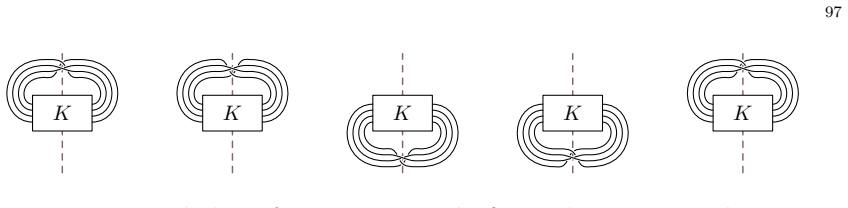
Figure 9.1. Figure 9.1: R-1 move at infinity induces a loop. We have R-1 move, then a sequence of I- and S-moves, the inverse of R-1 move and the I-move again. K K K K K view at source ↗
Figure 9.2
Figure 9.2. Figure 9.2: R-2 move at infinity induces a loop. We have R-2 move, then a sequence of two S-moves, the inverse of R-2 move and then an isotopy. K K K K K view at source ↗
Figure 9.3
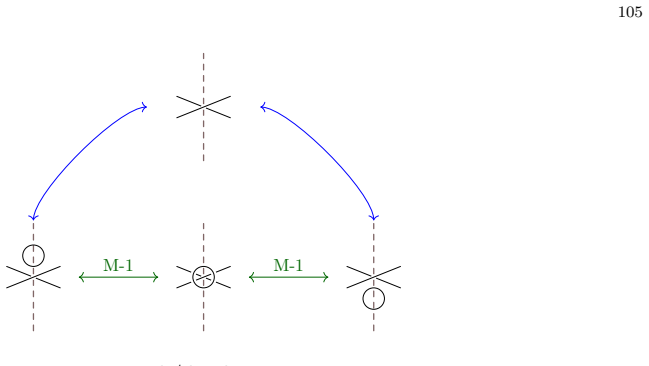
Figure 9.3. Figure 9.3: The loop of M-1 moves around infinity. We have M-1 move, then a sequence of I- and S-moves, the inverse of M-1 move and then a sequence of I- and S- moves. K K K K K view at source ↗
Figure 9.4
Figure 9.4. Figure 9.4: The loop of M-2 moves around infinity. The M-2 move is followed by S-moves and Reidemeister moves, then M-2 is undone and the S-move is applied. 9.4. Case (ML-2). The Morse point at infinity. This is the situation where there is a point x ∈ Σ that is mapped to ∞ × {t∞ i (s)} and it is a critical point of Hs at the same time. A dimension counting argument does not prohibit this situation. However, again b… view at source ↗
Figure 9.5
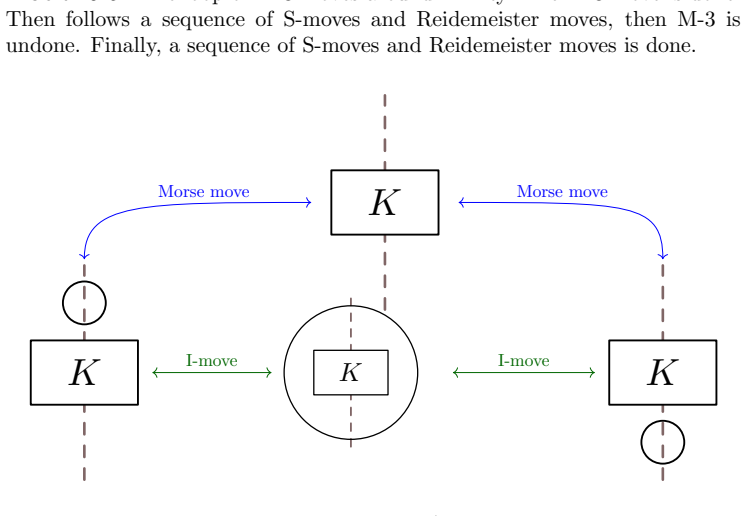
Figure 9.5. Figure 9.5: The loop of M-3 moves around infinity. The M-3 move is done. Then follows a sequence of S-moves and Reidemeister moves, then M-3 is undone. Finally, a sequence of S-moves and Reidemeister moves is done. K K K K Morse move Morse move I-move I-move view at source ↗
Figure 9.6
Figure 9.6. Figure 9.6: A loop of birth/death at infinity. The discussion in Subsection 8.4 implies that the diagram of the link obtained via π ι changes as in view at source ↗
Figure 9.7
Figure 9.7. Figure 9.7: The loop of saddle at infinity view at source ↗
Figure 9.8
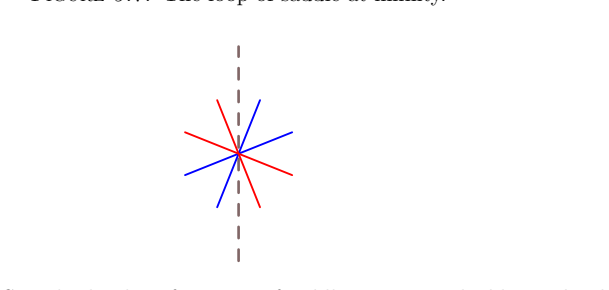
Figure 9.8. Figure 9.8: Singular level set for a pair of saddles on-axis. The blue and red lines indicate singular level sets for u0 and u1. enough that neither axis is parallel to or perpendicular to the symmetry axis L), the non￾generic leads to a codimension 2 behavior. With these choices, the diagram above the level set looks locally as in the middle picture in the bottom row of view at source ↗
Figure 9.9
Figure 9.9. Figure 9.9: A loop for an orbit of handles hitting the symmetry axis. The Morse label indicates birth or death depending on the direction. The diagram on the top is an empty diagram (other components of the link might be present, but do not interfere. R-2 IR-2 IR-2 R-2 isotopy isotopy saddle singular saddles saddle view at source ↗
Figure 9.10
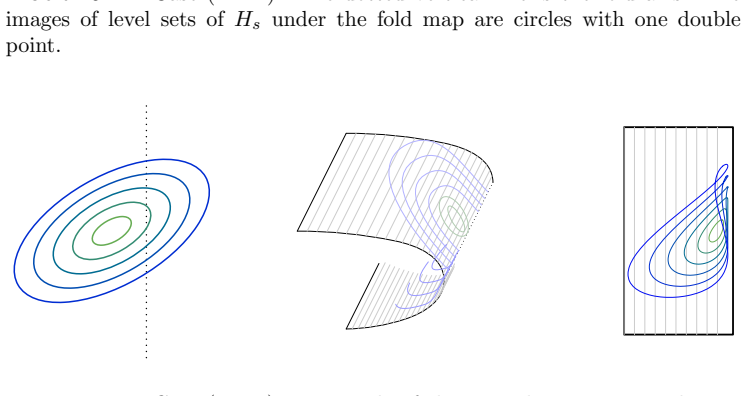
Figure 9.10. Figure 9.10: A loop for an orbit of handles on the symmetry axis. Saddle. [Gil82]. Recall that the changes of the link diagram are given by images of level sets of Hs under the map π ◦ Φs. The non-equivariant case. Dimension counting arguments indicate that π ◦ Φs must have the mildest possible (codimension 1) singularity as a map from R 2 to R 2 . Low-codimension singularities of such maps have been classified, and… view at source ↗
Figure 9.11
Figure 9.11. Figure 9.11: Case (ML-4). The dotted vertical line is the fold axis. The images of level sets of Hs under the fold map are circles with one double point view at source ↗
Figure 9.12
Figure 9.12. Figure 9.12: Case (ML-4), continued. If the critical point is moved away from the fold line, the level sets for small parameter are mapped into simple closed curves. A crossing occurs when the level sets cross the fold line. Instead, we assume that Hs(u1, u2) = B(u1, u2) + . . . , where B is a quadratic part and the dots denote higher order terms (of order 3 and more). The quadratic part is nondegenerate. Suppose B … view at source ↗
Figure 9.13
Figure 9.13. Figure 9.13: Case (ML-4), saddle point. The dotted vertical line is the fold axis. One set of hyperbolas (corresponding to the level sets of Hs below or above the critical point) are mapped bijectively by the fold map. The other set (corresponding to the opposite level sets) acquire a double point after the fold map. IR-1 IR-1 IR-1 Morse Morse view at source ↗
Figure 9.14
Figure 9.14. Figure 9.14: Twisted birth and death off-axis. The diagram is mirrored on the other side of the axis. In the middle diagrams, the smaller loop is done/undone by an IR-1 move. The equivariant case off-axis. This case is analogous to the non-equivariant case: the same movie is performed on both sides of the axis. That is, we have the following two off-axis movies from case (ML-4). We refer to them as singular Morse ha… view at source ↗
Figure 9.15
Figure 9.15. Figure 9.15: Twisted saddle off-axis. The diagram is mirrored on the other side of the axis. In the row, the R-1 moves are performed. IR-1 Saddle IR-1 Saddle view at source ↗
Figure 9.16
Figure 9.16. Figure 9.16: An actual movie move associated to the loop in view at source ↗
Figure 9.17
Figure 9.17. Figure 9.17: Twisted birth/death on-axis. R-1 R-1 view at source ↗
Figure 9.18
Figure 9.18. Figure 9.18: Twisted saddle on-axis. The arrows indicate the Morse moves (saddles). The row consists of Reidemeister moves. case: if the critical point is moved above the line {y1 = 0}, small ellipses (level sets of Hs) are disjoint from {y1 = 0}, and so, they are mapped curves with no self-intersections. Once they touch {y1 = 0}, they acquire a cusp and higher values of Hs lead to the circle with self-intersection.… view at source ↗
Figure 9.19
Figure 9.19. Figure 9.19: Birth/death over a point off-axis. IR-2 IR-2 view at source ↗
Figure 9.20
Figure 9.20. Figure 9.20: Saddle over a point off-axis. The arrows indicate the Morse move. Notice that neither the birth nor the saddle can possibly occur at the image of S Z2 . Indeed, this would mean that two fixed point of the τ action (the critical point and the point of S Z2 ) are mapped to the same point on L. This would imply that they are the same point, violating the assumption that ϕs is an embedding. The deformation … view at source ↗
Figure 9.21
Figure 9.21. Figure 9.21: Birth/death over a point on-axis M-1 M-1 view at source ↗
Figure 9.22
Figure 9.22. Figure 9.22: Saddle over a point on-axis view at source ↗
Figure 9.23
Figure 9.23. Figure 9.23: Birth and saddle off-axis can cancel. (NM-1) birth+saddle off-axis, see view at source ↗
Figure 9.24
Figure 9.24. Figure 9.24: Birth and saddle on-axis can cancel view at source ↗
Figure 9.25
Figure 9.25. Figure 9.25: Collision of critical points. A birth on the axis and a pair of saddles off-axis are equivalent to a saddle on-axis view at source ↗
Figure 9.26
Figure 9.26. Figure 9.26: Collision of critical points. A birth off the axis and a saddle on the axis can be traded for a birth on the axis. It might happen, for finitely many pairs (s0, t0) that ϕs0,t0 ∈ F2 , in which case the whole family is an unfolding of a codimension 2 Reidemeister singularity. This leads to one of the 18 loop (L-1)–(L-18) displayed in view at source ↗
read the original abstract

An involutive link is a link which is invariant under the standard rotation by 180 degrees in $S^3$. We establish an equivariant analogue of the work of Carter and Saito aimed at studying equivariant cobordisms between involutive links. This gives a set of $39$ equivariant movie moves that suffice to go between any two movie presentations of a pair of equivariantly isotopic cobordisms. Along the way, we give a singularity-theoretic proof of the equivariant Reidemeister theorem and study loops of equivariant Reidemeister moves. Our approach proceeds by analyzing codimension $2$ singularities of equivariant maps from $S^1$ to $\mathbb{R}^2$, as well as utilizing embedded equivariant Morse theory.

Editorial analysis

A structured set of objections, weighed in public.

Desk editor's note, referee report, simulated authors' rebuttal, and a circularity audit. Tearing a paper down is the easy half of reading it; the pith above is the substance, this is the friction.

Referee Report

2 major / 2 minor

Summary. The manuscript develops an equivariant analogue of the Carter-Saito theory for involutive links (links in S^3 invariant under the standard 180-degree rotation). It gives a singularity-theoretic proof of the equivariant Reidemeister theorem and classifies codimension-2 singularities of Z/2-equivariant maps S^1 → R^2 together with embedded equivariant Morse theory, concluding that a specific set of 39 equivariant movie moves suffices to relate any two movie presentations of equivariantly isotopic cobordisms.

Significance. If the classification of singularities and the resulting 39 moves are exhaustive, the work supplies a concrete combinatorial framework for equivariant cobordisms between involutive links. This extends classical results in a systematic way and could support further development of equivariant invariants or 4-dimensional constructions with involutions. The use of standard singularity theory and Morse theory to derive the moves, rather than ad-hoc listing, is a methodological strength.

major comments (2)
  1. [singularity classification of equivariant maps S¹→R²] The completeness of the 39-move list rests on the claim that all local changes arising from codim-2 singularities of equivariant S^1 → R^2 maps (including those forced to lie on or be preserved by the fixed set of the involution) are captured by the enumerated moves. The manuscript should supply an explicit case-by-case verification or reduction argument showing that symmetric or fixed-set degeneracies do not produce additional independent movie changes outside the 39.
  2. [proof of sufficiency of the 39 moves] The sufficiency statement for the movie moves requires that every equivariant isotopy of cobordisms can be realized by a generic 1-parameter family whose only singularities are the classified codim-2 events or the embedded equivariant Morse moves. A precise statement of the genericity theorem used (including the dimension count for the fixed-set contributions) would strengthen the argument that no further moves are needed.
minor comments (2)
  1. Notation for the involution and the fixed set should be introduced once and used consistently; currently the rotation is described in the abstract but the fixed-set notation varies in the singularity analysis.
  2. A table or diagram summarizing the 39 moves by type (Reidemeister, Morse, birth-death, etc.) would improve readability and allow direct comparison with the classical Carter-Saito list.

Simulated Author's Rebuttal

2 responses · 0 unresolved

We thank the referee for the careful reading and constructive suggestions. The comments identify places where additional explicit verification and precision would strengthen the exposition of the singularity classification and genericity arguments. We have revised the manuscript accordingly and address each point below.

read point-by-point responses
  1. Referee: [singularity classification of equivariant maps S¹→R²] The completeness of the 39-move list rests on the claim that all local changes arising from codim-2 singularities of equivariant S^1 → R^2 maps (including those forced to lie on or be preserved by the fixed set of the involution) are captured by the enumerated moves. The manuscript should supply an explicit case-by-case verification or reduction argument showing that symmetric or fixed-set degeneracies do not produce additional independent movie changes outside the 39.

    Authors: We agree that an explicit verification strengthens the argument. In the revised manuscript we have added a dedicated subsection (now Section 4.3) containing a case-by-case enumeration of all codimension-2 singularities of equivariant maps S¹ → R² that are either symmetric or intersect the fixed set. For each local model we compute the possible generic perturbations respecting the involution and show that the resulting movie changes are among the 39 already listed; no new independent moves appear. The analysis uses the standard classification of equivariant singularities together with direct normal-form computations on the fixed set (a circle or isolated points) and confirms that all degeneracies reduce to the enumerated list. revision: yes

  2. Referee: [proof of sufficiency of the 39 moves] The sufficiency statement for the movie moves requires that every equivariant isotopy of cobordisms can be realized by a generic 1-parameter family whose only singularities are the classified codim-2 events or the embedded equivariant Morse moves. A precise statement of the genericity theorem used (including the dimension count for the fixed-set contributions) would strengthen the argument that no further moves are needed.

    Authors: We have expanded the statement of the genericity result (now Theorem 5.1) to include explicit dimension counts. The fixed set of the involution is a circle; its contribution to the jet space raises the codimension of certain strata by 1 or 2 depending on whether the singularity is transverse or tangent to the fixed set. Standard equivariant transversality then shows that a generic 1-parameter family of equivariant embeddings encounters only the codimension-2 singularities already classified or the embedded equivariant Morse moves. We have included the relevant dimension calculations and a brief reference to the equivariant jet transversality theorem used. revision: yes

Circularity Check

0 steps flagged

No circularity: central claim derived from external singularity classification and equivariant Morse theory

full rationale

The paper establishes the 39 equivariant movie moves by classifying codimension-2 singularities of equivariant maps S¹ → ℝ² together with embedded equivariant Morse theory. This is a direct extension of the classical Carter-Saito approach using standard tools from singularity theory and Morse theory drawn from the prior literature rather than any self-definition, fitted parameter renamed as prediction, or load-bearing self-citation. The derivation chain therefore remains independent of the target result; the sufficiency statement follows from exhaustive enumeration of local changes under the Z/2-action and does not reduce to the input data by construction.

Axiom & Free-Parameter Ledger

0 free parameters · 2 axioms · 0 invented entities

The central claim rests on standard results in singularity theory for maps and equivariant Morse theory; no free parameters or new entities are introduced.

axioms (2)
  • standard math Standard classification of codimension-2 singularities for equivariant maps from S^1 to R^2
    Invoked to enumerate the possible local changes in symmetric diagrams.
  • domain assumption Embedded equivariant Morse theory applies to the isotopy of involutive links
    Used to relate movie presentations to cobordisms while preserving the involution.

pith-pipeline@v0.9.0 · 5657 in / 1314 out tokens · 45238 ms · 2026-05-22T10:58:20.450148+00:00 · methodology

discussion (0)

Sign in with ORCID, Apple, or X to comment. Anyone can read and Pith papers without signing in.

Lean theorems connected to this paper

Citations machine-checked in the Pith Canon. Every link opens the source theorem in the public Lean library.

What do these tags mean?
matches
The paper's claim is directly supported by a theorem in the formal canon.
supports
The theorem supports part of the paper's argument, but the paper may add assumptions or extra steps.
extends
The paper goes beyond the formal theorem; the theorem is a base layer rather than the whole result.
uses
The paper appears to rely on the theorem as machinery.
contradicts
The paper's claim conflicts with a theorem or certificate in the canon.
unclear
Pith found a possible connection, but the passage is too broad, indirect, or ambiguous to say the theorem truly supports the claim.

Reference graph

Works this paper leans on

57 extracted references · 57 canonical work pages · 1 internal anchor

  1. [1]

    auser Classics, Birkh\

    V. I. Arnold, S. M. Gusein-Zade, and A. N. Varchenko, Singularities of differentiable maps. V olume 1 , Modern Birkh\"auser Classics, Birkh\"auser/Springer, New York, 2012, Classification of critical points, caustics and wave fronts, Translated from the Russian by Ian Porteous based on a previous translation by Mark Reynolds, Reprint of the 1985 edition. 2896292

  2. [2]

    Manabu Akaho, Morse homology and manifolds with boundary, Commun. Contemp. Math. 9 (2007), no. 3, 301--334. 2336820

  3. [3]

    Manabu Akaho, Morse homology of manifolds with boundary revisited, preprint, arXiv:1408.1474

  4. [4]

    V. I. Arnold, Geometrical methods in the theory of ordinary differential equations, second ed., Grundlehren der mathematischen Wissenschaften [Fundamental Principles of Mathematical Sciences], vol. 250, Springer-Verlag, New York, 1988, Translated from the Russian by Joseph Sz\" u cs [J\' o zsef M. Sz u cs]. 947141

  5. [5]

    Soviet Math., vol

    , Plane curves, their invariants, perestroikas and classifications, Singularities and bifurcations, Adv. Soviet Math., vol. 21, Amer. Math. Soc., Providence, RI, 1994, With an appendix by F. Aicardi, pp. 33--91. 1310595

  6. [6]

    Maciej Borodzik and Weronika Buczyńska, Families of M orse functions for manifolds with boundary , preprint, arXiv 2507.15847

  7. [7]

    Keegan Boyle and Wenzhao Chen, Equivariant unknotting numbers of strongly invertible knots, 2025, preprint, arXiv 2412.09797

  8. [8]

    Maciej Borodzik, Irving Dai, Abhishek Mallick, and Matthew Stoffregen, Khovanov homology and equivariant surfaces, arXiv preprint arXiv:2507.13642 (2025)

  9. [9]

    Knot Theory Ramifications 19 (2010), no

    Christian Blanchet, An oriented model for K hovanov homology , J. Knot Theory Ramifications 19 (2010), no. 2, 291--312. 2647055

  10. [10]

    Dror Bar-Natan, Khovanov's homology for tangles and cobordisms, Geom. Topol. 9 (2005), 1443--1499. 2174270

  11. [11]

    Maciej Borodzik and Mark Powell, Embedded M orse T heory and R elative S plitting of C obordisms of M anifolds , J. Geom. Anal. 26 (2016), no. 1, 57--87. 3441503

  12. [12]

    Bredon, Introduction to compact transformation groups, Pure and Applied Mathematics, Vol

    Glen E. Bredon, Introduction to compact transformation groups, Pure and Applied Mathematics, Vol. 46, Academic Press, New York-London, 1972. 0413144

  13. [13]

    Maciej Borodzik and Henryk \.Zo adek, Complex algebraic plane curves via P oincar\'e- H opf formula. III . C odimension bounds , J. Math. Kyoto Univ. 48 (2008), no. 3, 529--570. 2511050

  14. [14]

    Jae Choon Cha and Ki Hyoung Ko, On equivariant slice knots, Proc. Amer. Math. Soc. 127 (1999), no. 7, 2175--2182. 1605928

  15. [15]

    David Clark, Scott Morrison, and Kevin Walker, Fixing the functoriality of K hovanov homology , Geom. Topol. 13 (2009), no. 3, 1499--1582. 2496052

  16. [16]

    Scott Carter, Joachim H

    J. Scott Carter, Joachim H. Rieger, and Masahico Saito, A combinatorial description of knotted surfaces and their isotopies, Adv. Math. 127 (1997), no. 1, 1--51. 1445361

  17. [17]

    Scott Carter and Masahico Saito, Reidemeister moves for surface isotopies and their interpretation as moves to movies, J

    J. Scott Carter and Masahico Saito, Reidemeister moves for surface isotopies and their interpretation as moves to movies, J. Knot Theory Ramifications 2 (1993), no. 3, 251--284. 1238875

  18. [18]

    J. M. S. David, Projection-generic curves, J. London Math. Soc. (2) 27 (1983), no. 3, 552--562. 697147

  19. [19]

    3, 1167--1236

    Irving Dai, Abhishek Mallick, and Matthew Stoffregen, Equivariant knots and knot F loer homology , Journal of Topology 16 (2023), no. 3, 1167--1236

  20. [20]

    Davis and Swatee Naik, Alexander polynomials of equivariant slice and ribbon knots in S^3 , Trans

    James F. Davis and Swatee Naik, Alexander polynomials of equivariant slice and ribbon knots in S^3 , Trans. Amer. Math. Soc. 358 (2006), no. 7, 2949--2964. 2216254

  21. [21]

    Alessio Di Prisa, The equivariant concordance group is not abelian, Bull. Lond. Math. Soc. 55 (2023), no. 1, 502--507. 4568356

  22. [22]

    , Equivariant algebraic concordance of strongly invertible knots, J. Topol. 17 (2024), no. 4, Paper No. e70006, 44. 4822933

  23. [23]

    Michael Ehrig, Daniel Tubbenhauer, and Paul Wedrich, Functoriality of colored link homologies, Proc. Lond. Math. Soc. (3) 117 (2018), no. 5, 996--1040. 3877770

  24. [24]

    Band 153, Springer-Verlag New York, Inc., New York, 1969

    Herbert Federer, Geometric measure theory, Die Grundlehren der mathematischen Wissenschaften, vol. Band 153, Springer-Verlag New York, Inc., New York, 1969. 257325

  25. [25]

    Thomas Fiedler and Vitaliy Kurlin, A 1-parameter approach to links in a solid torus, J. Math. Soc. Japan 62 (2010), no. 1, 167--211. 2648220

  26. [26]

    Golubitsky and V

    M. Golubitsky and V. Guillemin, Stable mappings and their singularities, Graduate Texts in Mathematics, Vol. 14, Springer-Verlag, New York-Heidelberg, 1973. 0341518

  27. [27]

    Giller, Towards a classical knot theory for surfaces in R 4 , Illinois J

    Cole A. Giller, Towards a classical knot theory for surfaces in R 4 , Illinois J. Math. 26 (1982), no. 4, 591--631. 674227

  28. [28]

    G. H. Hardy, Divergent series, \'Editions Jacques Gabay, Sceaux, 1992, With a preface by J. E. Littlewood and a note by L. S. Bosanquet, Reprint of the revised (1963) edition. 1188874

  29. [29]

    Kyle Hayden and Isaac Sundberg, Khovanov homology and exotic surfaces in the 4-ball, 2021, preprint, arXiv:2108.04810

  30. [30]

    Magnus Jacobsson, An invariant of link cobordisms from K hovanov homology , Algebr. Geom. Topol. 4 (2004), 1211--1251. 2113903

  31. [31]

    Mikhail Khovanov, A categorification of the J ones polynomial , Duke Math. J. 101 (2000), no. 3, 359--426. 1740682

  32. [32]

    , A functor-valued invariant of tangles, Algebr. Geom. Topol. 2 (2002), 665--741. 1928174

  33. [33]

    Robert Lipshitz and Sucharit Sarkar, Khovanov homology of strongly invertible knots and their quotients, Frontiers in geometry and topology, Proc. Sympos. Pure Math., vol. 109, Amer. Math. Soc., Providence, RI, [2024] 2024, pp. 157--182. 4772951

  34. [34]

    Andrew Lobb and Liam Watson, A refinement of K hovanov homology , Geom. Topol. 25 (2021), no. 4, 1861--1917. 4286365

  35. [35]

    4, e70001

    Abhishek Mallick, Knot F loer homology and surgery on equivariant knots , Journal of Topology 17 (2024), no. 4, e70001

  36. [36]

    Jean Martinet, D\'eploiements versels des applications diff\'erentiables et classification des applications stables, Singularit\'es d'applications diff\'erentiables ( S \'em., P lans-sur- B ex, 1975), Lecture Notes in Math., vol. Vol. 535, Springer, Berlin-New York, 1976, pp. 1--44. 649264

  37. [37]

    Morgan and Hyman Bass, The S mith conjecture , Pure Appl

    John W. Morgan and Hyman Bass, The S mith conjecture , Pure Appl. Math., vol. 112, Academic Press, Orlando, FL, 1984, pp. 3--6. 758460

  38. [38]

    Alice Merz, The A lexander and M arkov theorems for strongly involutive links , J. Lond. Math. Soc. (2) 111 (2025), no. 4, Paper No. e70156, 60. 4892887

  39. [39]

    Miller and Mark Powell, Strongly invertible knots, equivariant slice genera, and an equivariant algebraic concordance group, J

    Allison N. Miller and Mark Powell, Strongly invertible knots, equivariant slice genera, and an equivariant algebraic concordance group, J. Lond. Math. Soc. (2) 107 (2023), no. 6, 2025--2053. 4598178

  40. [40]

    Kunio Murasugi, On periodic knots, Comment. Math. Helv. 46 (1971), 162--174. 292060

  41. [41]

    Scott Morrison, Kevin Walker, and Paul Wedrich, Invariants of 4-manifolds from K hovanov- R ozansky link homology , Geom. Topol. 26 (2022), no. 8, 3367--3420. 4562565

  42. [42]

    Ciprian Manolescu, Kevin Walker, and Paul Wedrich, Skein lasagna modules and handle decompositions, Adv. Math. 425 (2023), Paper No. 109071, 40. 4589588

  43. [43]

    Swatee Naik, Periodicity, genera and A lexander polynomials of knots , Pacific J. Math. 166 (1994), no. 2, 357--371. 1313460

  44. [44]

    42, Polish Acad

    Dennis Roseman, Reidemeister-type moves for surfaces in four-dimensional space, Knot theory ( W arsaw, 1995), Banach Center Publ., vol. 42, Polish Acad. Sci. Inst. Math., Warsaw, 1998, pp. 347--380. 1634466

  45. [45]

    176--196

    Makoto Sakuma, On strongly invertible knots, Algebraic and topological theories ( K inosaki, 1984), Kinokuniya, Tokyo, 1986, pp. 176--196. 1102258

  46. [46]

    Taketo Sano, Involutive khovanov homology and equivariant knots, 2025

  47. [47]

    Math., vol

    Jan Stevens, On the classification of reducible curve singularities, Algebraic geometry and singularities ( L a R \'abida, 1991), Progr. Math., vol. 134, Birkh\"auser, Basel, 1996, pp. 383--407. 1395193

  48. [48]

    U ber I nvolutionen der 3 - S ph\

    Friedhelm Waldhausen, \" U ber I nvolutionen der 3 - S ph\" a re , Topology 8 (1969), 81--91. 236916

  49. [49]

    C. T. C. Wall, Equivariant jets, Math. Ann. 272 (1985), no. 1, 41--65. 794090

  50. [50]

    , Projection genericity of space curves, J. Topol. 1 (2008), no. 2, 362--390. 2399135

  51. [51]

    Wasserman, Equivariant differential topology, Topology 8 (1969), 127--150

    Arthur G. Wasserman, Equivariant differential topology, Topology 8 (1969), 127--150. 250324

  52. [52]

    Liam Watson, Khovanov homology and the symmetry group of a knot, Adv. Math. 313 (2017), 915--946. 3649241

  53. [53]

    Paul Wedrich, From link homology to topological quantum field theories, 2025, preprint, arXiv 2509.08478

  54. [54]

    4 (1937), 276--284

    Hassler Whitney, On regular closed curves in the plane, Compositio Math. 4 (1937), 276--284. 1556973

  55. [55]

    , Differentiable even functions, Duke Math. J. 10 (1943), 159--160. 7783

  56. [56]

    , On singularities of mappings of euclidean spaces. I . M appings of the plane into the plane , Ann. of Math. (2) 62 (1955), 374--410. 73980

  57. [57]

    Sarah Zampa, A bound on the equivariant unknotting number, 2025, preprint, 2512.17700