REVIEW 3 major objections 3 minor 3 references
Cosmological evolution of fast radio bursts and its rapid decline relative to star formation rate
T0 review · 3 major / 3 minor · reviewed 2026-05-07 · grok-4.3
Pith's one-line read The comoving formation rate of fast radio bursts declines steeply as (1+z) to the power of -5.38 after correcting for strong luminosity evolution, unlike the cosmic star formation rate.
desk verdict The claimed steep FRB rate decline after luminosity de-evolution rests on unvalidated pseudo-redshifts from the IllustrisTGN DM distribution, which is the weakest link despite standard methods on new catalog data. read the letter →
The pith
A machine-rendered reading of the paper's core claim, the machinery that carries it, and where it could break.
The reading
What carries the argument
The combination of Efron-Petrosian luminosity-evolution correction followed by Lynden-Bell's C-minus estimator applied to pseudo-redshifts obtained from the IllustrisTNG dispersion-measure probability distribution.
What would settle it
A large sample of spectroscopically confirmed high-redshift FRBs whose comoving rate density does not fall as steeply as (1+z) to the minus 5.4 would contradict the reported decline.
Extended reading notes
Core claim
Using the Efron-Petrosian method the authors identify strong luminosity evolution L proportional to (1+z) to the 6.38. After de-evolving the sample they apply Lynden-Bell's C-minus method to obtain the comoving formation rate rho(z) proportional to (1+z) to the -5.38 with uncertainty 0.02. This steep decline is inconsistent with direct tracing of the cosmic star formation rate yet closely follows the redshift evolution of short gamma-ray bursts, supporting an origin in old compact-object populations such as neutron stars and black holes.
Load-bearing premise
The probability distribution of dispersion measures taken from the IllustrisTNG simulation accurately represents the true distribution for the observed fast radio bursts.
Editorial extensions
If this is right
- FRB progenitors belong to old stellar populations rather than young stars.
- The FRB rate density does not follow the cosmic star formation rate.
- The redshift evolution is similar to that of short gamma-ray bursts.
- The result remains stable when redshift limits and flux thresholds are varied.
Reading between the lines
- A delay-time distribution between star formation and FRB production would naturally produce such a steep decline.
- Future wide-field surveys targeting z greater than 2 can directly test whether the rate continues to drop or flattens.
- The resemblance to short GRB rates strengthens models linking FRBs to compact-object mergers or recycled neutron stars.
- If confirmed, the rate evolution can be used to forecast detection yields for next-generation radio arrays at high redshift.
Signed reviews
Editorial analysis
A structured set of objections, weighed in public.
Referee Report
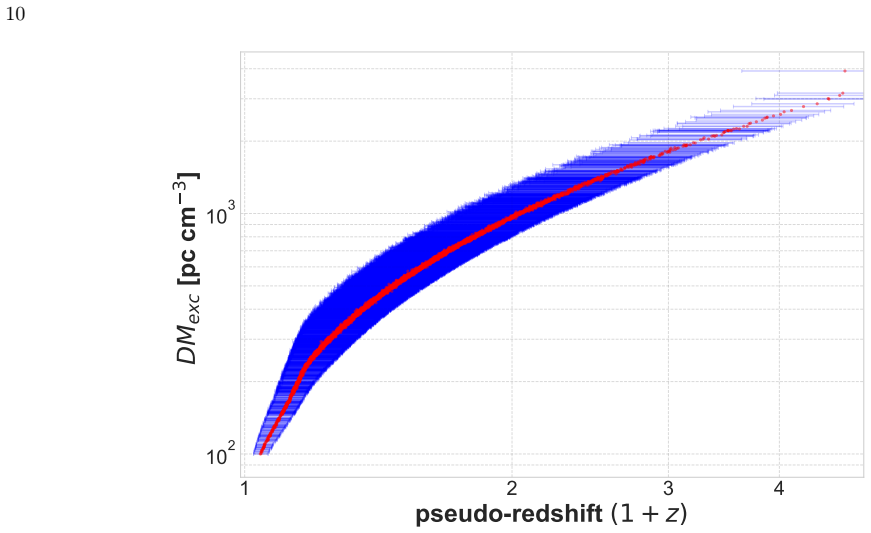
Summary. The manuscript analyzes the CHIME/FRB Catalog 2 by assigning pseudo-redshifts to each FRB using the dispersion measure probability distribution from the IllustrisTGN cosmological simulation. Employing the Efron-Petrosian method, it identifies strong luminosity evolution of the form L_0 ∝ (1+z)^{6.38}. After correcting for this evolution, the Lynden-Bell C^- method is used to determine the comoving FRB formation rate, which is found to decline steeply as ρ(z) ∝ (1+z)^{-5.38 ± 0.02}. This evolution is contrasted with the cosmic star formation rate and noted to resemble that of short gamma-ray bursts, leading to the conclusion that FRB progenitors are associated with old stellar populations such as neutron stars and black holes.
Significance. Should the pseudo-redshift assignment and subsequent statistical analysis prove robust, the result would provide important evidence favoring an old-population origin for FRBs over young stellar progenitors. The application of non-parametric methods (Efron-Petrosian and Lynden-Bell C^-) is a methodological strength, as it minimizes model assumptions in deriving the luminosity function and rate evolution. The reported robustness to flux cuts and pseudo-z bounds is noted positively.
major comments (3)
- [Methods (pseudo-redshift assignment)] The derivation of pseudo-redshifts in the methods relies on the DM probability distribution from IllustrisTGN; the manuscript does not validate this distribution against the small sample of FRBs with spectroscopic redshifts or against alternative hydrodynamical simulations, which is load-bearing because the steep high-z decline in ρ(z) is sensitive to the shape of the high-DM tail.
- [Results (robustness tests)] The robustness checks reported in the results section apply the upper and lower 1σ pseudo-z bounds but still draw from the identical IllustrisTGN DM pdf; no tests with empirical DM-z relations or different simulation suites are presented, leaving the claimed exponent -5.38 vulnerable to simulation-specific assumptions about IGM and host contributions.
- [Results (rate evolution)] The uncertainty ±0.02 on the rate exponent is quoted with high precision; the propagation of the 1σ pseudo-z errors through the Lynden-Bell C^- estimator and any binning choices should be shown explicitly (e.g., via bootstrap or Monte Carlo realizations) to justify this quoted precision.
minor comments (3)
- [Abstract] Abstract: 'dispersion measured (DM)' is a typographical error and should read 'dispersion measure (DM)'.
- [Figures] The figures presenting the derived comoving rate should overlay the cosmic star-formation rate and published short-GRB rate evolution curves (with references) to make the claimed resemblance quantitative rather than qualitative.
- [Throughout] Notation for the luminosity-evolution index (6.38) and the de-evolved rate index (-5.38) should clarify whether the near-opposite values are coincidental or arise from the specific de-evolution procedure.
Simulated Author's Rebuttal
We thank the referee for the thoughtful and detailed report. The comments highlight important aspects of our methodology that we address point by point below. We plan revisions to strengthen the presentation of robustness and uncertainty quantification while maintaining the core conclusions.
read point-by-point responses
-
Referee: The derivation of pseudo-redshifts in the methods relies on the DM probability distribution from IllustrisTGN; the manuscript does not validate this distribution against the small sample of FRBs with spectroscopic redshifts or against alternative hydrodynamical simulations, which is load-bearing because the steep high-z decline in ρ(z) is sensitive to the shape of the high-DM tail.
Authors: We agree that explicit validation would improve confidence in the high-DM tail. The IllustrisTGN suite was selected for its high resolution and detailed baryonic physics relevant to IGM and host contributions. In the revised manuscript we will add a direct comparison of the derived pseudo-redshift distribution against the 20+ localized FRBs with spectroscopic redshifts, using both the Macquart relation and the DM-z scatter reported in the literature. We will also note consistency checks with other simulation suites (e.g., IllustrisTNG) where public DM statistics are available. These additions will quantify the sensitivity of the high-z decline to the adopted DM model. revision: yes
-
Referee: The robustness checks reported in the results section apply the upper and lower 1σ pseudo-z bounds but still draw from the identical IllustrisTGN DM pdf; no tests with empirical DM-z relations or different simulation suites are presented, leaving the claimed exponent -5.38 vulnerable to simulation-specific assumptions about IGM and host contributions.
Authors: The current robustness tests already demonstrate that the exponent remains steep (approximately -5) when the full 1σ pseudo-z range is adopted. We acknowledge that these tests remain within the same simulation framework. In revision we will expand the section to include results obtained with an empirical DM-z relation (Macquart et al. 2020 plus host scatter) and will discuss the limited public data from alternative hydrodynamical runs. We will explicitly state that while the precise numerical value may shift slightly, the qualitative conclusion of a rapid decline inconsistent with the star-formation rate is preserved. revision: partial
-
Referee: The uncertainty ±0.02 on the rate exponent is quoted with high precision; the propagation of the 1σ pseudo-z errors through the Lynden-Bell C^- estimator and any binning choices should be shown explicitly (e.g., via bootstrap or Monte Carlo realizations) to justify this quoted precision.
Authors: The quoted uncertainty is the formal error returned by the Lynden-Bell C^- estimator applied to the de-evolved sample. We agree that propagating the pseudo-z uncertainties explicitly is necessary for full transparency. In the revised manuscript we will include a Monte Carlo procedure: 1000 realizations in which each FRB’s redshift is drawn from its IllustrisTGN posterior, the Efron-Petrosian de-evolution and Lynden-Bell C^- rate are recomputed, and the resulting distribution of the power-law index is reported. This will confirm that the exponent remains -5.38 with a dispersion consistent with the quoted ±0.02. revision: yes
Circularity Check
No circularity: external simulation input and standard non-parametric methods yield independent fitted exponents
full rationale
The derivation begins with an external input—the DM probability distribution taken from the IllustrisTGN simulation—to assign pseudo-redshifts. It then applies the established Efron-Petrosian method to the flux-limited sample to determine the luminosity evolution parameter (L0 ∝ (1+z)^6.38) and, after correction, the Lynden-Bell C^- method to obtain the comoving rate evolution (ρ(z) ∝ (1+z)^-5.38). Neither exponent is presupposed by the inputs; both are outputs of the statistical procedures applied to the constructed catalog. No self-definitional loop, fitted quantity renamed as prediction, or load-bearing self-citation appears in the chain. The result is a data-driven measurement whose validity rests on the accuracy of the simulation DM distribution and the applicability of the methods, not on any internal tautology.
Assumptions & free parameters
free parameters (2)
- luminosity evolution power-law index =
6.38
- rate decline power-law index =
-5.38
assumptions (3)
- domain assumption IllustrisTGN simulation DM probability distribution accurately models real FRB sightlines
- domain assumption Efron-Petrosian method removes luminosity evolution without introducing bias in this flux-limited sample
- domain assumption Lynden-Bell's C- method yields unbiased comoving rate after luminosity de-evolution
Cite this review
Pith. "Pith review of Cosmological evolution of fast radio bursts and its rapid decline relative to star formation rate." pith.science (2026). https://pith.science/paper/2604.26574
@misc{pith2026260426574,
  author       = {Pith},
  title        = {Pith review of: Cosmological evolution of fast radio bursts and its rapid decline relative to star formation rate},
  year         = {2026},
  howpublished = {\url{https://pith.science/paper/2604.26574}},
  note         = {Machine review of arXiv:2604.26574}
}
abstract
Fast radio bursts (FRBs) are enigmatic millisecond-duration radio transients whose physical origins remain debated. To shed light on this, we analyze the CHIME/FRB Catalog 2. By using the probability distribution of dispersion measured (DM) derived from the IllustrisTGN simulation, we compute the pseudo-redshift with $1\sigma$ error for each FRB. To derive the FRB luminosity function and event rate, we employ a non-parametric statistical method. Building upon Efron-Petrosian method, we find strong luminosity evolution with redshift, well described by $L_0 \propto (1+z)^{6.38}$. After de-evolving this trend, we apply Lynden-Bell's $C^-$ method to derive the comoving FRB formation rate which is found to decline rapidly at high redshift, following $\rho(z) \propto (1+z)^{-5.38 \pm 0.02}$. We also test the robustness of our results by considering the upper and lower limits of pseudo-redshifts, and different flux limits of CHIME. Similar results are found. This steep decline is inconsistent with a direct tracing of the cosmic star formation rate, but closely resembles the redshift evolution of short gamma-ray bursts-systems linked to compact object mergers. Our results support that the origin of FRBs is associated with old populations, such as neutron stars and black holes.
Figures


Figures from the paper (6 more)


Reference graph
Works this paper leans on
-
[1]
, " * write output.state after.block = add.period write newline
ENTRY address archivePrefix author booktitle chapter doi edition editor eprint howpublished institution journal key month number organization pages publisher school series title misctitle type volume year version url label extra.label sort.label short.list INTEGERS output.state before.all mid.sentence after.sentence after.block FUNCTION init.state.consts ...
-
[2]
" write newline "" before.all 'output.state := FUNCTION format.url url empty "" new.block "" url * "" * if FUNCTION format.eprint eprint empty "" archivePrefix empty "" archivePrefix "arXiv" = new.block " " eprint * " " * new.block " " eprint * " " * if if if FUNCTION format.doi doi empty "" " " doi * " " * if FUNCTION format.pid doi empty eprint empty ur...
-
[3]
thebibliography [1] 20pt to REFERENCES 6pt =0pt \@twocolumntrue 12pt -12pt 10pt plus 3pt =0pt =0pt =1pt plus 1pt =0pt =0pt -12pt =13pt plus 1pt =20pt =13pt plus 1pt \@M =10000 =-1.0em =0pt =0pt 0pt =0pt =1.0em @enumiv\@empty 10000 10000 `\.\@m \@noitemerr \@latex@warning Empty `thebibliography' environment \@ifnextchar \@reference \@latexerr Missing key o...
Reviewed May 7, 2026 · model on record in the stance chip above.
Discussion (0). Continue with ORCID to comment.