Mujic{Λ}: Reconstructing Initial Conditions from Incomplete Redshift Surveys with Projected Optimization
Pith reviewed 2026-05-07 11:43 UTC · model grok-4.3
The pith
MujicΛ reconstructs initial conditions from incomplete galaxy redshift surveys by augmenting L-BFGS optimization with a projection operator and rank-order matching to enforce Gaussianity.
A machine-rendered reading of the paper's core claim, the machinery that carries it, and where it could break.
Core claim
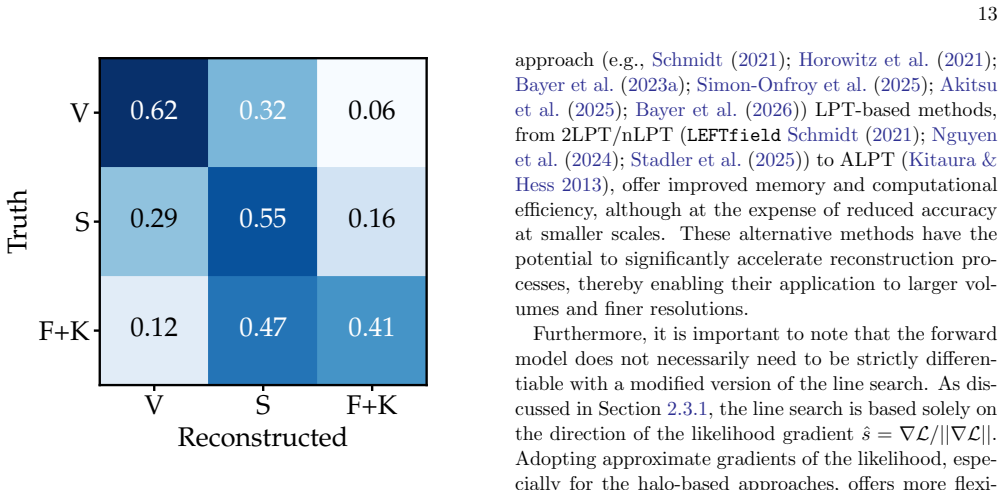
MujicΛ reaches good agreement with the true density field down to the scale of the forward model while maintaining consistency with the Gaussian prior through the projection step, and it also broadly recovers the cosmic web classification on a mock lightcone catalog built from the Millennium simulation with semi-analytic galaxy models.
What carries the argument
The projection operator combined with rank-order matching inside the L-BFGS loop, which enforces Gaussianity on the initial conditions at every iteration while the differentiable particle-mesh forward model accounts for survey incompleteness and observational effects.
If this is right
- The reconstructed initial conditions can serve directly as starting points for constrained N-body simulations of the local universe.
- The method supplies high-quality initial guesses that speed up subsequent field-level Bayesian inference on large-scale structure data.
- Recovered cosmic web classifications enable environmental studies of galaxy evolution that account for the full three-dimensional context.
- The framework remains robust when large fractions of the survey volume are unobserved, as demonstrated on the Millennium-based mock lightcone.
Where Pith is reading between the lines
- The same projection technique could be adapted to other forward-modeling problems where Gaussian priors must be respected under incomplete observations, such as weak-lensing or 21-cm intensity mapping.
- Because the forward model is differentiable, MujicΛ could be inserted as a fast pre-conditioning step inside gradient-based samplers for full cosmological parameter inference.
- Testing on real spectroscopic surveys would reveal whether residual systematics from the projection step affect downstream measurements of growth rate or neutrino mass.
Load-bearing premise
The projection operator and rank-order matching enforce Gaussianity without introducing systematic biases into the reconstructed initial conditions, and the forward model captures all relevant incompleteness and selection effects accurately enough for convergence to the true field.
What would settle it
Running MujicΛ on an independent mock catalog with known true initial conditions and finding that the reconstructed density field deviates from the true field by more than the expected forward-model resolution or shows clear non-Gaussian features in the power spectrum or higher-order statistics.
Figures




read the original abstract
In this paper, we introduce Mujic{\Lambda} (Mapping the Universe with Jax-based Initial Condition Reconstr{\Lambda}ction), an optimization-based framework for reconstructing initial conditions from realistic galaxy spectroscopic redshift surveys. Unlike standard optimization-based approaches, Mujic{\Lambda} augments the L-BFGS algorithm with a projection operator and rank-order matching to enforce Gaussianity of the initial conditions and substantially improve robustness to incomplete survey geometries. We validate Mujic{\Lambda} on a mock lightcone catalog derived from semi-analytic models applied to the Millennium simulation. We construct a differentiable forward model that incorporates a fast particle-mesh simulation at megaparsec resolution and a comprehensive treatment of observational effects and survey incompleteness. Mujic{\Lambda} reaches good agreement with the true density field down to the scale of the forward model, while maintaining consistency with the Gaussian prior through the projection step. It also broadly recovers the cosmic web classification, underscoring its value for deciphering environmental information in galaxy evolution studies. Beyond its key role in next-generation constrained simulations, the methodology offers a practical way to generate initial guesses and speed up field-level inference, especially for upcoming large-scale galaxy surveys.
Editorial analysis
A structured set of objections, weighed in public.
Referee Report
Summary. The manuscript introduces MujicΛ, an optimization-based framework that augments the L-BFGS algorithm with a projection operator and rank-order matching to reconstruct initial conditions from incomplete galaxy redshift surveys while enforcing Gaussianity. It employs a differentiable particle-mesh forward model incorporating observational effects and survey incompleteness, validated on a mock lightcone catalog from the Millennium simulation with semi-analytic galaxies. The central claims are that the method achieves good agreement with the true density field down to the forward-model scale, remains consistent with the Gaussian prior, and broadly recovers cosmic web classification.
Significance. If the quantitative validation holds, MujicΛ would provide a robust, practical tool for generating initial conditions for constrained N-body simulations and for initializing field-level inference pipelines. This is particularly relevant for next-generation surveys with complex selection functions, as the projected optimization improves robustness to incomplete geometries compared to standard approaches. The use of a fully differentiable forward model and JAX implementation are strengths that enable efficient optimization.
major comments (2)
- [Abstract, §4] Abstract and §4 (validation): The claim of 'good agreement with the true density field down to the scale of the forward model' is stated without quantitative metrics such as cross-correlation coefficients, power-spectrum ratios, or residual maps with error bars; this prevents assessment of whether agreement is limited by the projection step or by the particle-mesh resolution.
- [§3.2] §3.2 (projection operator): The rank-order matching and projection are asserted to enforce Gaussianity without introducing systematic biases, yet no controlled experiment isolates the effect of the projection on the recovered initial conditions (e.g., comparison of reconstructions with and without the projection operator under the same mask); the mock results therefore cannot distinguish faithful recovery from compensation by the projection.
minor comments (3)
- [Title, Abstract] The title and abstract use inconsistent LaTeX rendering of 'MujicΛ' (Mujic{Λ} vs. MujicΛ); standardize notation throughout.
- [§2.1] §2.1: The description of the differentiable forward model mentions 'comprehensive treatment of observational effects' but does not list the specific selection functions or completeness maps implemented; a table or explicit list would improve reproducibility.
- [§4] Figure captions (assumed in §4): Several figures lack scale bars or explicit units on the density-field slices, making it hard to judge the physical scale of the reported agreement.
Simulated Author's Rebuttal
We thank the referee for their constructive and positive review of our manuscript on MujicΛ. We address each major comment below, agreeing where the validation can be strengthened and outlining the revisions we will make.
read point-by-point responses
-
Referee: [Abstract, §4] Abstract and §4 (validation): The claim of 'good agreement with the true density field down to the scale of the forward model' is stated without quantitative metrics such as cross-correlation coefficients, power-spectrum ratios, or residual maps with error bars; this prevents assessment of whether agreement is limited by the projection step or by the particle-mesh resolution.
Authors: We agree that quantitative metrics are needed for a precise evaluation. In the revised manuscript we will add to §4 cross-correlation coefficients between the reconstructed and true initial conditions versus wavenumber, power-spectrum ratios (reconstructed over true), and residual maps with error bars estimated from the mock ensemble. These will quantify the scale-dependent fidelity and separate contributions from the projection operator versus the particle-mesh resolution. revision: yes
-
Referee: [§3.2] §3.2 (projection operator): The rank-order matching and projection are asserted to enforce Gaussianity without introducing systematic biases, yet no controlled experiment isolates the effect of the projection on the recovered initial conditions (e.g., comparison of reconstructions with and without the projection operator under the same mask); the mock results therefore cannot distinguish faithful recovery from compensation by the projection.
Authors: The referee is correct that a direct with/without comparison is absent. While the present results already demonstrate consistency with the Gaussian prior through one-point PDFs and power spectra, we will insert in the revised §3.2 a controlled experiment on the identical masked mock, comparing reconstructions performed with and without the projection and rank-order matching. Differences in recovered fields and any induced biases will be quantified to confirm that the projection enforces Gaussianity without systematic compensation. revision: yes
Circularity Check
No circularity: algorithmic optimization with external forward model and mock validation
full rationale
The paper describes an L-BFGS-based optimization framework augmented by a projection operator and rank-order matching to enforce Gaussianity on initial conditions. The central result (agreement with true density field down to forward-model scale) is obtained by minimizing a loss against a differentiable particle-mesh forward model plus observational effects, then validated on an independent mock lightcone from the Millennium simulation. No equation or claim reduces the output density field to a parameter fitted from the same data by construction, nor does any load-bearing step rely on a self-citation chain or imported uniqueness theorem. The projection step is explicitly designed to enforce the prior and is tested for consistency rather than assumed to recover truth. This is a standard self-contained algorithmic reconstruction validated against external benchmarks.
Axiom & Free-Parameter Ledger
Reference graph
Works this paper leans on
-
[1]
, " * write output.state after.block = add.period write newline
ENTRY address archivePrefix author booktitle chapter doi edition editor eprint howpublished institution journal key month number organization pages publisher school series title misctitle type volume year version url label extra.label sort.label short.list INTEGERS output.state before.all mid.sentence after.sentence after.block FUNCTION init.state.consts ...
-
[2]
" write newline "" before.all 'output.state := FUNCTION format.url url empty "" new.block "" url * "" * if FUNCTION format.eprint eprint empty "" archivePrefix empty "" archivePrefix "arXiv" = new.block " " eprint * " " * new.block " " eprint * " " * if if if FUNCTION format.doi doi empty "" " " doi * " " * if FUNCTION format.pid doi empty eprint empty ur...
-
[3]
- [1] #1 = = ^ ^ ^ .\!\!^ d .\!\!^ h .\!\!^ m .\!\!^ s .\!\!^ @mss
thebibliography [1] 20pt to REFERENCES 6pt =0pt -12pt 10pt plus 3pt =0pt =0pt =1pt plus 1pt =0pt =0pt -12pt =13pt plus 1pt =20pt =13pt plus 1pt \@M =10000 =-1.0em =0pt =0pt 0pt =0pt =1.0em @enumiv\@empty 10000 10000 `\.\@m \@noitemerr \@latex@warning Empty `thebibliography' environment \@ifnextchar \@reference \@latexerr Missing key on reference command E...
-
[4]
" write newline "" before.all 'output.state := FUNCTION blank.sep after.quote 'output.state := FUNCTION fin.entry output.state after.quoted.block = 'skip 'add.period if write newline FUNCTION new.block output.state before.all = 'skip output.state after.quote = after.quoted.block 'output.state := after.block 'output.state := if if FUNCTION new.sentence out...
discussion (0)
Sign in with ORCID, Apple, or X to comment. Anyone can read and Pith papers without signing in.