Optimizing Dynamic Metasurface Antenna Configurations for Direction-of-Arrival and Polarization Estimation Using an Experimentally Calibrated Multiport-Network Model
Pith reviewed 2026-05-07 10:10 UTC · model grok-4.3
The pith
Experimentally calibrated multiport model lets optimized DMA sequences outperform random ones for DoA and polarization estimation
A machine-rendered reading of the paper's core claim, the machinery that carries it, and where it could break.
Core claim
The experimentally calibrated MNT model predicts the dual-polarized far-field response of the 96-element DMA for arbitrary admissible configurations, enabling model-based optimization of sequences that outperform random ones most clearly in the intermediate-SNR and intermediate-sequence-length regime for joint DoA-P estimation and in dual-source jamming scenarios.
What carries the argument
The experimentally calibrated multiport-network (MNT) model that predicts dual-polarized far-field responses for any admissible DMA configuration without additional measurements, combined with effective-rank-based surrogate objectives for sequence optimization.
If this is right
- Optimized sequences deliver higher estimation accuracy for direction and polarization using only a single RF chain.
- The same model-based approach supports distinguishing a desired transmitter from a jammer in dual-source settings.
- Avoidance of per-configuration radiation measurements lowers the experimental burden for deploying programmable metasurface antennas.
Where Pith is reading between the lines
- Real-time adaptation of configurations using the same calibrated model could further improve performance in time-varying channels.
- The intermediate-regime gains point to potential benefits when combining DMAs with compressive sensing techniques in larger arrays.
- Integration into existing wireless standards might become feasible once the model calibration is shown to hold across fabrication batches.
Load-bearing premise
The experimentally calibrated multiport-network model accurately predicts the dual-polarized far-field response for arbitrary admissible configurations of the fabricated 96-element DMA without requiring additional radiation-pattern measurements.
What would settle it
Real-world over-the-air experiments comparing estimation error of optimized versus random sequences at intermediate SNR and sequence length would directly test whether the predicted gains materialize.
Figures




read the original abstract
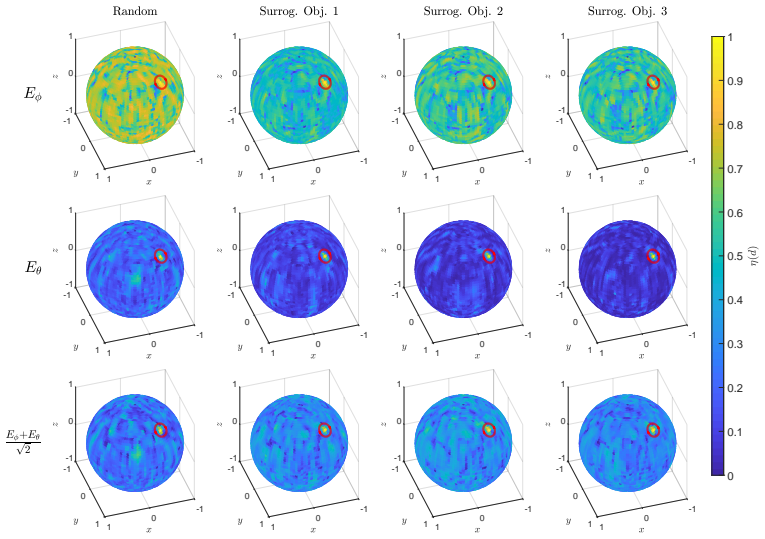
Sensing the direction of arrival and polarization of impinging signals is a key prerequisite for beamforming and interference mitigation in modern wireless communication systems. Dynamic metasurface antennas (DMAs) can multiplex direction- and polarization-dependent field information onto a single detector by sequentially switching between programmable configurations. This makes DMAs attractive for joint direction-of-arrival and polarization (DoA-P) estimation with a single radio-frequency chain. Experimental demonstrations have so far relied on random pre-measured configuration sequences because optimizing the configurations requires an accurate forward model of the fabricated DMA. Here, we use an experimentally calibrated model based on multiport-network theory (MNT) to optimize DMA configuration sequences for DoA-P estimation. Our experimentally calibrated MNT model predicts the dual-polarized far-field response of our 96-element DMA for arbitrary admissible configurations, enabling model-based optimization without additional radiation-pattern measurements. We optimize sequences using effective-rank-based surrogate objectives and compare them with random sequences as a function of the sequence length and the noise level. The optimized sequences yield the largest gains in the intermediate-SNR and intermediate-sequence-length regime, where the inverse problem is neither noise-limited nor already solved by random diversity. We also tackle a dual-source scenario involving a jammer and a desired transmitter. Our results illustrate some of the potential in the context of jamming-resilient communications that is unlocked by experimentally calibrated MNT models for fabricated DMAs.
Editorial analysis
A structured set of objections, weighed in public.
Referee Report
Summary. The paper claims that an experimentally calibrated multiport-network theory (MNT) model of a 96-element dynamic metasurface antenna (DMA) enables optimization of configuration sequences for joint DoA-P estimation using effective-rank surrogate objectives; these optimized sequences outperform random ones (with largest gains in intermediate-SNR and intermediate-length regimes) in simulations, and the approach is extended to a dual-source jamming scenario.
Significance. If the calibrated MNT model generalizes accurately to the optimized configurations, the work demonstrates a practical route to model-based DMA optimization that improves estimation performance without additional radiation-pattern measurements, particularly addressing the practically relevant intermediate operating regime where random diversity is insufficient but the problem is not yet noise-limited. This could support more capable single-RF-chain sensing in wireless systems.
major comments (2)
- [Numerical results / abstract] The reported performance gains (abstract and numerical results) are generated entirely inside the calibrated MNT model; no hardware-in-the-loop DoA-P estimation experiments that apply the optimized sequences to the physical 96-element DMA and measure actual RMSE or success rate against random sequences are presented, so any unmodeled effects (residual mutual coupling, fabrication variation, polarization leakage) could eliminate the advantage.
- [Model calibration section] The central assumption that the MNT model accurately predicts the dual-polarized far-field response for arbitrary admissible configurations (beyond the calibration measurements) is load-bearing for the optimization claim, yet the manuscript provides no explicit cross-validation, hold-out configuration tests, or quantification of prediction error on unseen states.
minor comments (2)
- [Figures] Performance plots versus SNR and sequence length lack error bars or statistical significance indicators, making it hard to judge whether the reported gains in the intermediate regime are robust.
- [Optimization and results] The correlation between the effective-rank surrogate objective and the actual estimation error metric (RMSE or success probability) is not shown or quantified, leaving unclear how directly the surrogate drives the observed improvements.
Simulated Author's Rebuttal
We thank the referee for the constructive and detailed feedback. We address each major comment point by point below, indicating whether revisions will be made to the manuscript.
read point-by-point responses
-
Referee: [Numerical results / abstract] The reported performance gains (abstract and numerical results) are generated entirely inside the calibrated MNT model; no hardware-in-the-loop DoA-P estimation experiments that apply the optimized sequences to the physical 96-element DMA and measure actual RMSE or success rate against random sequences are presented, so any unmodeled effects (residual mutual coupling, fabrication variation, polarization leakage) could eliminate the advantage.
Authors: We agree that the reported gains are evaluated entirely by simulating the estimation task inside the calibrated MNT model. This is by design: the central contribution is to show that an experimentally calibrated model enables optimization of configuration sequences without requiring radiation-pattern measurements for every admissible state. The model parameters were obtained from physical measurements on the 96-element DMA, so the simulations incorporate experimentally grounded behavior. We have added a dedicated limitations paragraph in the revised manuscript that explicitly discusses residual unmodeled effects and the conditions under which the predicted gains are expected to translate to hardware. Performing a full hardware-in-the-loop campaign with the optimized sequences would require a separate, resource-intensive measurement campaign and is therefore left as future work. revision: partial
-
Referee: [Model calibration section] The central assumption that the MNT model accurately predicts the dual-polarized far-field response for arbitrary admissible configurations (beyond the calibration measurements) is load-bearing for the optimization claim, yet the manuscript provides no explicit cross-validation, hold-out configuration tests, or quantification of prediction error on unseen states.
Authors: We acknowledge that explicit quantification of generalization error on unseen configurations strengthens the optimization claim. In the revised manuscript we have added a new subsection under model calibration that reports hold-out validation results: a subset of the experimental far-field measurements was withheld from the calibration procedure, and we now provide the average pattern mismatch (in dB) and polarization leakage error for those unseen states. These metrics are used to bound the expected prediction error when the model is queried during sequence optimization. revision: yes
- Hardware-in-the-loop validation of the optimized sequences on the physical 96-element DMA
Circularity Check
No circularity: derivation relies on experimental calibration and surrogate optimization independent of fitted inputs
full rationale
The paper calibrates a multiport-network model from experimental measurements on the fabricated DMA, then uses that model to optimize configuration sequences via effective-rank surrogate objectives for DoA-P estimation. Comparisons to random sequences are performed inside the calibrated model across SNR and sequence-length regimes. No derivation step reduces a prediction to its own fitted parameters by construction, no self-definitional loops appear in the equations, and self-citations to prior MNT work are not load-bearing because the present calibration and optimization rest on new experimental data and standard surrogate methods. The central claims remain falsifiable against hardware measurements outside the fitted values.
Axiom & Free-Parameter Ledger
Reference graph
Works this paper leans on
-
[1]
Metamaterial apertures for computational imaging,
J. Hunt, T. Driscoll, A. Mrozack,et al., “Metamaterial apertures for computational imaging,” Science339, 310–313 (2013)
2013
-
[2]
Computationalimagingusingamode-mixingcavityatmicrowave frequencies,
T.Fromenteze,O.Yurduseven,M.F.Imani,etal.,“Computationalimagingusingamode-mixingcavityatmicrowave frequencies,” Appl. Phys. Lett.106(2015)
2015
-
[3]
Large metasurface aperture for millimeter wave computational imaging at the human-scale,
J. Gollub, O. Yurduseven, K. P. Trofatter,et al., “Large metasurface aperture for millimeter wave computational imaging at the human-scale,” Sci. Rep.7, 42650 (2017)
2017
-
[4]
Dynamic metamaterial aperture for microwave imaging,
T. Sleasman, M. F Imani, J. N. Gollub, and D. R. Smith, “Dynamic metamaterial aperture for microwave imaging,” Appl. Phys. Lett.107, 204104 (2015)
2015
-
[5]
Transmission-type 2-bit programmable metasurface for single-sensor and single-frequency microwave imaging,
Y. B. Li, L. L. Li, B. B. Xu,et al., “Transmission-type 2-bit programmable metasurface for single-sensor and single-frequency microwave imaging,” Sci. Rep.6, 23731 (2016)
2016
-
[6]
Implementation and characterization of a two-dimensional printed circuit dynamic metasurface aperture for computational microwave imaging,
T. A. Sleasman, M. F. Imani, A. V. Diebold,et al., “Implementation and characterization of a two-dimensional printed circuit dynamic metasurface aperture for computational microwave imaging,” IEEE Trans. Antennas Propag. 69, 2151–2164 (2020)
2020
-
[7]
Learned integrated sensing pipeline: reconfigurable metasurface transceivers as trainable physical layer in an artificial neural network,
P. del Hougne, M. F. Imani, A. V. Diebold,et al., “Learned integrated sensing pipeline: reconfigurable metasurface transceivers as trainable physical layer in an artificial neural network,” Adv. Sci.7, 1901913 (2019)
2019
-
[8]
Noise-adaptive intelligent programmable meta-imager,
C. Qian and P. del Hougne, “Noise-adaptive intelligent programmable meta-imager,” Intell. Comput. p. 9825738 (2022)
2022
-
[9]
Intelligent meta-imagers: From compressed to learned sensing,
C. Saigre-Tardif, R. Faqiri, H. Zhao,et al., “Intelligent meta-imagers: From compressed to learned sensing,” Appl. Phys. Rev.9, 011314 (2022)
2022
-
[10]
Frequency-diversecomputationaldirectionofarrival estimation technique,
O.Yurduseven, M.A.B.Abbasi, T.Fromenteze, andV.Fusco, “Frequency-diversecomputationaldirectionofarrival estimation technique,” Sci. Rep.9, 16704 (2019)
2019
-
[11]
Conformal frequency-diverse metasurface for computational AoA detection,
M. F. Imani and I. Alamzadeh, “Conformal frequency-diverse metasurface for computational AoA detection,” IEEE Antennas Wirel. Propag. Lett.22, 2634–2638 (2023)
2023
-
[12]
Experimental demonstration of computational AoA detection using conformal frequency-diverse metasurface antennas,
I. Alamzadeh, M. Inman, and M. F. Imani, “Experimental demonstration of computational AoA detection using conformal frequency-diverse metasurface antennas,” IEEE Antennas Wirel. Propag. Lett.24, 3579–3583 (2025)
2025
-
[13]
Single-pixelpolarimetricdirectionofarrivalestimation using programmable coding metasurface aperture,
T.V.Hoang,V.Fusco,M.A.B.Abbasi,andO.Yurduseven,“Single-pixelpolarimetricdirectionofarrivalestimation using programmable coding metasurface aperture,” Sci. Rep.11, 23830 (2021)
2021
-
[14]
DetectingangleofarrivalonahybridRISusingintensity-onlydata,
I.AlamzadehandM.F.Imani, “DetectingangleofarrivalonahybridRISusingintensity-onlydata,” IEEEAntennas Wirel. Propag. Lett.22, 2325–2329 (2023)
2023
-
[15]
Computational angle of arrival detection using dynamic metasurfaces,
I. Alamzadeh, T. Williams, and M. F. Imani, “Computational angle of arrival detection using dynamic metasurfaces,” in58th Asilomar Conference on Signals, Systems, and Computers,(IEEE, 2024), pp. 602–608
2024
-
[16]
Microwave integrated sensing and imaging using reconfigurable metacavity,
M. Zhao, L. Wang, S. Zhu,et al., “Microwave integrated sensing and imaging using reconfigurable metacavity,” IEEE Trans. Microw. Theory Techn.73, 5592–5606 (2025)
2025
-
[17]
Experimental multiport-network parameter estimation for a dynamic metasurface antenna,
J. Tapie and P. del Hougne, “Experimental multiport-network parameter estimation for a dynamic metasurface antenna,” IEEE Trans. Antennas Propag (2026)
2026
-
[18]
J. Tapie, B. Sokal, A. L. de Almeida, and P. del Hougne, “Channel estimation via tensor decomposition for dynamic metasurface antennas with known mutual coupling: Algorithms and experiments,” arXiv:2603.19155 (2026)
-
[19]
Self-adaptive RISs beyond free space: convergence of localization, sensing, and communication under rich-scattering conditions,
C. Saigre-Tardif and P. del Hougne, “Self-adaptive RISs beyond free space: convergence of localization, sensing, and communication under rich-scattering conditions,” IEEE Wirel. Commun.30, 24–30 (2023)
2023
-
[20]
A survey on integrated sensing, communication, and computation,
D. Wen, Y. Zhou, X. Li,et al., “A survey on integrated sensing, communication, and computation,” IEEE Commun. Surv. Tutor.27, 3058–3098 (2025)
2025
-
[21]
End-to-end dynamic metasurface antenna wireless system: Prototype, opportunities, and challenges,
F. Yven, J. Tapie, J. Sol, and P. del Hougne, “End-to-end dynamic metasurface antenna wireless system: Prototype, opportunities, and challenges,” arXiv:2506.09732 (2025)
-
[22]
Dynamic metasurface antenna based anti-jamming with bit-limited ADC,
Y. Hao, H.-M. Wang, S. Xiao, and L. Jin, “Dynamic metasurface antenna based anti-jamming with bit-limited ADC,” IEEE Trans. Veh. Technol. (2025)
2025
-
[23]
Electromagnetic based communication model for dynamic metasurface antennas,
R. J. Williams, P. Ramírez-Espinosa, J. Yuan, and E. De Carvalho, “Electromagnetic based communication model for dynamic metasurface antennas,” IEEE Trans. Wirel. Commun.21, 8616–8630 (2022)
2022
-
[24]
Network-based design of reactive beamforming metasurfaces,
M. Almunif, F. Alsolamy, and A. Grbic, “Network-based design of reactive beamforming metasurfaces,” IEEE Trans. Antennas Propag.73, 5970–5980 (2025)
2025
-
[25]
Experimental multiport-network parameter estimation and optimization for multi-bit RIS,
P. del Hougne, “Experimental multiport-network parameter estimation and optimization for multi-bit RIS,” IEEE Wirel. Commun. Lett.15, 790–794 (2025)
2025
-
[26]
Systematic physics-compliant analysis of over-the-air channel equalization in RIS-parametrized wireless networks-on-chip,
J. Tapie, H. Prod’homme, M. F. Imani, and P. del Hougne, “Systematic physics-compliant analysis of over-the-air channel equalization in RIS-parametrized wireless networks-on-chip,” IEEE J. Sel. Areas Commun.42, 2026–2038 (2024)
2026
-
[27]
Metasurfac e-based fluid antennas: from electromagnetics to communications model,
P. Ramírez-Espinosa, C. Segura-Gómez, Á. Palomares-Caballero,et al., “Metasurface-based fluid antennas: from electromagnetics to communications model,” arXiv:2507.17982 (2025)
-
[28]
Extreme beam-forming with impedance metasurfaces featuring embedded sources and auxiliary surface wave optimization,
G. Xu, V. G. Ataloglou, S. V. Hum, and G. V. Eleftheriades, “Extreme beam-forming with impedance metasurfaces featuring embedded sources and auxiliary surface wave optimization,” IEEE Access10, 28670–28684 (2022)
2022
-
[29]
Wide-angle beam-steering and adaptive impedance matching with reconfigurable nonlocal leaky-wave antenna,
G. Xu, G. V. Eleftheriades, and S. V. Hum, “Wide-angle beam-steering and adaptive impedance matching with reconfigurable nonlocal leaky-wave antenna,” IEEE Open J. Antennas Propag.3, 1141–1153 (2022)
2022
-
[30]
Mutual coupling in dynamic metasurface antennas: Foe, but also friend,
H. Prod’homme and P. del Hougne, “Mutual coupling in dynamic metasurface antennas: Foe, but also friend,” IEEE Wirel. Commun.32, 30–36 (2025)
2025
-
[31]
Benefits of mutual coupling in dynamic metasurface antennas,
H. Prod’homme, J. Tapie, L. Le Magoarou, and P. del Hougne, “Benefits of mutual coupling in dynamic metasurface antennas,” IEEE Trans. Antennas Propag.74, 2589–2604 (2025)
2025
-
[32]
Optimally diverse communication channels in disordered environments with tuned randomness,
P. del Hougne, M. Fink, and G. Lerosey, “Optimally diverse communication channels in disordered environments with tuned randomness,” Nat. Electron.2, 36–41 (2019)
2019
-
[33]
Optimal multiplexing of spatially encoded information across custom-tailored configurations of a metasurface-tunable chaotic cavity,
P. del Hougne, M. Davy, and U. Kuhl, “Optimal multiplexing of spatially encoded information across custom-tailored configurations of a metasurface-tunable chaotic cavity,” Phys. Rev. Appl.13, 041004 (2020)
2020
-
[34]
A measurement mode selection method for computational microwave imaging,
A. Li, M. Zhao, M. A. B. Abbasi, and O. Yurduseven, “A measurement mode selection method for computational microwave imaging,” IEEE Antennas Wirel. Propag. Lett.23, 3382–3386 (2024)
2024
-
[35]
Compressive DoA estimation based on a reconfigurable metacavity antenna with selected measurement modes,
M. Zhao, S. Zhu, and O. Yurduseven, “Compressive DoA estimation based on a reconfigurable metacavity antenna with selected measurement modes,” inProc. 20th Eur. Conf. Antennas Propag., (2026)
2026
-
[36]
The effective rank: A measure of effective dimensionality,
O. Roy and M. Vetterli, “The effective rank: A measure of effective dimensionality,” inProc. 15th Eur. Signal Process. Conf., (IEEE, 2007), pp. 606–610
2007
-
[37]
Statistical multiport-network modeling and efficient discrete optimization of RIS,
C. Hammami, L. Le Magoarou, and P. del Hougne, “Statistical multiport-network modeling and efficient discrete optimization of RIS,” IEEE Wirel. Commun. Lett.15, 1425–1429 (2026)
2026
-
[38]
Efficientcomplementarymetamaterialelementforwaveguide-fed metasurface antennas,
I.Yoo,M.F.Imani,T.Sleasman,andD.R.Smith,“Efficientcomplementarymetamaterialelementforwaveguide-fed metasurface antennas,” Opt. Expr.24, 28686–28692 (2016)
2016
discussion (0)
Sign in with ORCID, Apple, or X to comment. Anyone can read and Pith papers without signing in.