Recognition: unknown
Coupling between stellar and HI lopsidedness in Milky Way-type galaxies from the Auriga Superstars cosmological simulations
Pith reviewed 2026-05-07 08:23 UTC · model grok-4.3
The pith
Old stellar lopsidedness correlates strongly with HI lopsidedness in Milky Way-type galaxies, both tracing global gravitational potential distortions.
A machine-rendered reading of the paper's core claim, the machinery that carries it, and where it could break.
Core claim
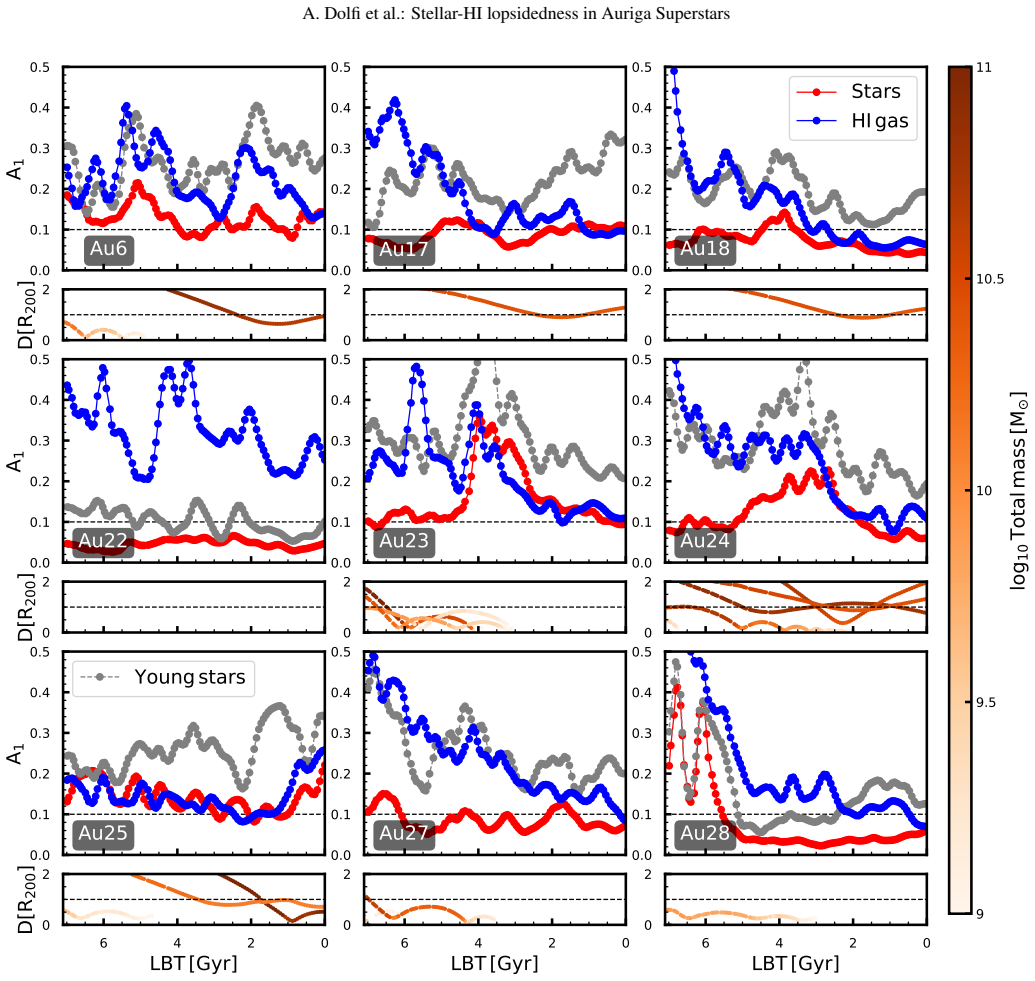
The central claim is that morphological lopsidedness measured by the m=1 Fourier mode in old stellar populations (>0.5 Gyr) correlates strongly with the identical measure in the HI gas between 0.5 and 1 optical radii at z=0, showing both trace distortions in the global gravitational potential. Young stars (<0.5 Gyr) instead exhibit lopsidedness tied to asymmetric star formation along spiral arms. Stellar morphological and kinematic lopsidedness correlate tightly, while HI shows weaker morphological-kinematic coupling with kinematics dominating. Bar strength anti-correlates with lopsidedness. Over cosmic time, satellite tidal interactions with mass ratio >1:50 induce coherent lopsidedness in
What carries the argument
The m=1 Fourier mode of face-on mass density and radial velocity maps, applied consistently to stars and HI in the 0.5-1 optical radius range.
Load-bearing premise
The high-resolution cosmological simulations accurately reproduce the dynamical processes that generate lopsidedness in the outer disks without introducing significant numerical artifacts or resolution biases.
What would settle it
A large sample of observed Milky Way-type galaxies in which old stellar morphological lopsidedness fails to correlate with HI lopsidedness at comparable radii would falsify the claimed coupling between the two components.
Figures


read the original abstract
Lopsidedness is common in disk galaxies, yet its origin and evolution remain unclear. Previous studies typically examined stellar and gas asymmetries separately, but a combined analysis offers a stronger probe of the mechanisms driving lopsidedness, recent galaxy evolution, and environment. We analyze the density and kinematics of stellar and atomic hydrogen (HI) components in nine Milky Way type galaxies from the Auriga Superstars cosmological zoom-in simulations. The high stellar mass resolution improves the visibility of disk features while reducing noise, enabling a detailed study of dynamical processes in a cosmological context. Morphological and kinematical lopsidedness are quantified using the first Fourier mode (m=1) of the face-on mass distribution and radial velocity maps, measured consistently for stars and gas between 0.5 and 1 stellar optical radius. At z=0, morphological lopsidedness in old stars (>0.5Gyr) strongly correlates with HI, tracing distortions in the global gravitational potential. In contrast, young stars (<0.5Gyr) trace asymmetric star formation along spiral arms. Stellar morphological and kinematical lopsidedness are strongly correlated, whereas HI shows a weaker correlation, with kinematic asymmetries dominating. We also find an anti-correlation between stellar lopsidedness and bar strength. Strongly barred galaxies tend to host more symmetric disks and higher central stellar mass densities. Tracing lopsidedness evolution over time, tidal interactions with massive satellites (mass ratio >1:50) induce coherent lopsidedness in both stars and HI. In contrast, smooth gas accretion mainly affects HI and young stars, leaving the total stellar component largely symmetric. Overall, these results demonstrate that lopsidedness is a powerful diagnostic of internal disk evolution, gas accretion, and environmental interactions across cosmic time.
Editorial analysis
A structured set of objections, weighed in public.
Referee Report
Summary. The paper examines morphological and kinematical lopsidedness (m=1 Fourier modes) in the stellar and HI components of nine Milky Way-type galaxies from the Auriga Superstars cosmological zoom-in simulations. Measurements are performed consistently in the 0.5–1 stellar optical radius annulus at z=0 and over time. The central claims are that old stars (>0.5 Gyr) show strong morphological lopsidedness correlation with HI (tracing global potential distortions), while young stars (<0.5 Gyr) trace asymmetric star formation along spirals; stellar morphological and kinematical lopsidedness correlate strongly (HI less so); lopsidedness anti-correlates with bar strength; and tidal interactions induce coherent lopsidedness while smooth accretion primarily affects HI and young stars.
Significance. If the results hold, the work offers a useful combined stellar-population and HI analysis of lopsidedness origins in a cosmological setting, distinguishing internal dynamical responses from environmental drivers. The direct Fourier-mode measurements on high-resolution snapshots and the evolutionary tracking of tidal versus accretion effects are strengths that could inform observational interpretations of disk asymmetries.
major comments (3)
- [§2 and §3] §2 (Methods) and §3 (Results): the central claim that old-star morphological lopsidedness traces global potential distortions via correlation with HI rests on the Auriga Superstars runs faithfully capturing m=1 modes in the 0.5–1 R_opt annulus. No convergence tests against lower-resolution Auriga runs, varied softening lengths, or particle-number variations are presented to demonstrate that the reported amplitudes and cross-correlations are stable and free of numerical heating or force inaccuracies that could affect old stars, young stars, and HI differently.
- [§3.1] §3.1 (z=0 correlations): the manuscript states that old-star lopsidedness 'strongly correlates' with HI and that stellar morphological/kinematical lopsidedness are 'strongly correlated' while HI shows weaker correlation, yet no correlation coefficients, p-values, bootstrap uncertainties, or sample-variance estimates are provided for the nine-galaxy sample. This absence makes it impossible to assess the statistical robustness of the claimed distinction between old and young stellar responses.
- [§3.2] §3.2 (age and radial cuts): the separation into old (>0.5 Gyr) and young (<0.5 Gyr) stars and the fixed 0.5–1 R_opt measurement annulus are used to support the main interpretive claims, but no robustness checks against alternative age thresholds or radial ranges are shown. If the reported correlations weaken or change sign under modest variations, the inference that old stars trace the global potential while young stars trace spiral-arm star formation would be undermined.
minor comments (2)
- [Abstract] The abstract would be strengthened by including the sample size (nine galaxies) and at least one quantitative measure of the reported correlations.
- [Figures] Figure captions and axis labels should explicitly state the radial annulus (0.5–1 R_opt) and age cuts used for each panel to improve reproducibility.
Simulated Author's Rebuttal
We thank the referee for the constructive and detailed comments, which highlight important aspects for strengthening the statistical and numerical robustness of our analysis. We address each major comment point by point below.
read point-by-point responses
-
Referee: [§2 and §3] §2 (Methods) and §3 (Results): the central claim that old-star morphological lopsidedness traces global potential distortions via correlation with HI rests on the Auriga Superstars runs faithfully capturing m=1 modes in the 0.5–1 R_opt annulus. No convergence tests against lower-resolution Auriga runs, varied softening lengths, or particle-number variations are presented to demonstrate that the reported amplitudes and cross-correlations are stable and free of numerical heating or force inaccuracies that could affect old stars, young stars, and HI differently.
Authors: We acknowledge that the manuscript does not include explicit convergence tests for the m=1 Fourier amplitudes and cross-correlations in the 0.5–1 R_opt annulus. The Auriga Superstars simulations adopt a stellar mass resolution of approximately 5×10^3 M_⊙ per particle (roughly an order of magnitude higher than the standard Auriga suite), which was chosen specifically to reduce numerical noise and better resolve disk substructure. Prior Auriga papers have shown convergence of global disk properties at these resolutions. To directly address the concern, we will add a new paragraph and supporting figure in the revised Methods or Results section comparing lopsidedness measurements for galaxies available in both Superstars and standard Auriga runs, confirming that the reported old-star–HI correlations remain stable and are not driven by resolution-dependent effects on different components. revision: yes
-
Referee: [§3.1] §3.1 (z=0 correlations): the manuscript states that old-star lopsidedness 'strongly correlates' with HI and that stellar morphological/kinematical lopsidedness are 'strongly correlated' while HI shows weaker correlation, yet no correlation coefficients, p-values, bootstrap uncertainties, or sample-variance estimates are provided for the nine-galaxy sample. This absence makes it impossible to assess the statistical robustness of the claimed distinction between old and young stellar responses.
Authors: The referee correctly identifies the lack of quantitative statistical measures. In the revised manuscript we will report Pearson (and where appropriate Spearman) correlation coefficients together with p-values and bootstrap uncertainties (1000 resamples) for all key relations in §3.1, including old-star vs. HI morphological lopsidedness, stellar morphological vs. kinematical lopsidedness, and the corresponding HI quantities. We will also add a short discussion of sample variance given the limited set of nine galaxies. These additions will allow readers to evaluate the strength and robustness of the claimed distinctions between old and young stellar populations. revision: yes
-
Referee: [§3.2] §3.2 (age and radial cuts): the separation into old (>0.5 Gyr) and young (<0.5 Gyr) stars and the fixed 0.5–1 R_opt measurement annulus are used to support the main interpretive claims, but no robustness checks against alternative age thresholds or radial ranges are shown. If the reported correlations weaken or change sign under modest variations, the inference that old stars trace the global potential while young stars trace spiral-arm star formation would be undermined.
Authors: We agree that sensitivity tests to the adopted age threshold and radial annulus are necessary to support the physical interpretation. In the revised §3.2 we will include additional panels or a supplementary table showing the old-star–HI and young-star–HI correlations for alternative age cuts (0.25 Gyr and 1 Gyr) and for shifted radial annuli (0.25–0.75 R_opt and 0.75–1.25 R_opt). We anticipate that the primary trends will persist, because the 0.5 Gyr division separates stars that have undergone significant phase mixing from those formed recently in asymmetric star-forming regions, while the chosen annulus avoids the bar-dominated inner disk. These checks will be presented to confirm the robustness of our conclusions. revision: yes
Circularity Check
No significant circularity: direct Fourier measurements on external simulation snapshots
full rationale
The paper's core results are empirical correlations obtained by computing m=1 Fourier amplitudes directly from the face-on mass and radial-velocity fields of the Auriga Superstars snapshots, separately for old stars, young stars, and HI, within the fixed 0.5-1 R_opt annulus. These amplitudes are then cross-correlated across components and with bar strength; no parameter is fitted to a subset of the data and then re-used to 'predict' a closely related quantity, nor is any claimed relation defined in terms of itself. Auriga simulation papers are cited only to identify the input data set; they do not supply a uniqueness theorem or ansatz that forces the reported distinctions. The analysis chain is therefore self-contained post-processing of externally generated snapshots and receives the default non-circularity finding.
Axiom & Free-Parameter Ledger
axioms (1)
- domain assumption The Auriga Superstars simulations provide a sufficiently accurate representation of Milky Way-type galaxy dynamics and gas physics at the employed resolution.
Reference graph
Works this paper leans on
-
[1]
, " * write output.state after.block = add.period write newline
ENTRY address archiveprefix author booktitle chapter edition editor howpublished institution eprint journal key month note number organization pages publisher school series title type volume year label extra.label sort.label short.list INTEGERS output.state before.all mid.sentence after.sentence after.block FUNCTION init.state.consts #0 'before.all := #1 ...
-
[2]
write newline
" write newline "" before.all 'output.state := FUNCTION n.dashify 't := "" t empty not t #1 #1 substring "-" = t #1 #2 substring "--" = not "--" * t #2 global.max substring 't := t #1 #1 substring "-" = "-" * t #2 global.max substring 't := while if t #1 #1 substring * t #2 global.max substring 't := if while FUNCTION word.in bbl.in " " * FUNCTION format....
-
[3]
E., Lynden-Bell , D., & Sancisi , R
Baldwin , J. E., Lynden-Bell , D., & Sancisi , R. 1980, , 193, 313
1980
-
[4]
Beale , J. S. & Davies , R. D. 1969, , 221, 531
1969
-
[5]
& Couch , W
Bekki , K. & Couch , W. J. 2011, , 415, 1783
2011
-
[6]
V., Busekool , E., Verheijen , M
Bilimogga , P. V., Busekool , E., Verheijen , M. A. W., & van der Hulst , J. M. 2025, arXiv e-prints, arXiv:2508.01425
-
[7]
& Rosolowsky , E
Blitz , L. & Rosolowsky , E. 2006, , 650, 933
2006
-
[8]
L., Bertin , G., Stockton , A., et al
Block , D. L., Bertin , G., Stockton , A., et al. 1994, , 288, 365
1994
-
[9]
1981, , 86, 1791
Bosma , A. 1981, , 86, 1791
1981
-
[10]
Bournaud , F., Combes , F., & Jog , C. J. 2004, , 418, L27
2004
-
[11]
J., & Puerari , I
Bournaud , F., Combes , F., Jog , C. J., & Puerari , I. 2005, , 438, 507
2005
-
[12]
J., Sweet , S
Deeley , S., Drinkwater , M. J., Sweet , S. M., et al. 2021, , 508, 895
2021
-
[13]
Dolfi , A., Gomez , F. A., Monachesi , A., et al. 2024, arXiv e-prints, arXiv:2411.19426
-
[14]
A., Monachesi , A., et al
Dolfi , A., G \'o mez , F. A., Monachesi , A., et al. 2023, , 526, 567
2023
-
[15]
2025, , 995, 18
Feng , S., Shen , S., Chen , Y., et al. 2025, , 995, 18
2025
-
[16]
A., Jaque Arancibia , M., Dolfi , A., & Monsalves , N
Fontirroig , V., G \'o mez , F. A., Jaque Arancibia , M., Dolfi , A., & Monsalves , N. 2025, , 699, A118
2025
-
[17]
Fragkoudi , F., Grand , R. J. J., Pakmor , R., et al. 2025, , 538, 1587
2025
-
[18]
Garavito-Camargo , N., Besla , G., Laporte , C. F. P., et al. 2019, , 884, 51
2019
-
[19]
Ghosh , S., Di Matteo , P., Jog , C. J., & Frankel , N. 2025, arXiv e-prints, arXiv:2511.07549
-
[20]
A., White , S
G \'o mez , F. A., White , S. D. M., Grand , R. J. J., et al. 2017, , 465, 3446
2017
-
[21]
A., White , S
G \'o mez , F. A., White , S. D. M., Marinacci , F., et al. 2016, , 456, 2779
2016
-
[22]
Grand , R. J. J., Fragkoudi , F., G \'o mez , F. A., et al. 2024, , 532, 1814
2024
-
[23]
Grand , R. J. J., Fragkoudi , F., Pakmor , R., et al. 2026, arXiv e-prints, arXiv:2602.15108
work page internal anchor Pith review Pith/arXiv arXiv 2026
-
[24]
Grand , R. J. J., G \'o mez , F. A., Marinacci , F., et al. 2017, , 467, 179
2017
-
[25]
Grand , R. J. J., Pakmor , R., Fragkoudi , F., et al. 2023, , 524, 801
2023
-
[26]
Grand , R. J. J., van de Voort , F., Zjupa , J., et al. 2019, , 490, 4786
2019
-
[27]
P., Hogg , D
Haynes , M. P., Hogg , D. E., Maddalena , R. J., Roberts , M. S., & van Zee , L. 1998, , 115, 62
1998
-
[28]
Jog , C. J. 1997, , 488, 642
1997
-
[29]
Jog , C. J. 2002, , 391, 471
2002
-
[30]
Jog, C. J. & Combes, F. 2009, Physics Reports, 471, 75
2009
-
[31]
Kalberla , P. M. W. & Dedes , L. 2008, , 487, 951
2008
-
[32]
2024, , 688, A53
Le Bail , A., Daddi , E., Elbaz , D., et al. 2024, , 688, A53
2024
-
[33]
K., Walter , F., Brinks , E., et al
Leroy , A. K., Walter , F., Brinks , E., et al. 2008, , 136, 2782
2008
-
[34]
okas , E. L. 2022, , 662, A53
2022
-
[35]
Marinacci , F., Grand , R. J. J., Pakmor , R., et al. 2017, , 466, 3859
2017
-
[36]
2019, Computational Astrophysics and Cosmology, 6, 2
Nelson , D., Springel , V., Pillepich , A., et al. 2019, Computational Astrophysics and Cosmology, 6, 2
2019
-
[37]
S., & Levine , S
Noordermeer , E., Sparke , L. S., & Levine , S. E. 2001, , 328, 1064
2001
-
[38]
2025 a , , 543, 1761
Pakmor , R., Bieri , R., Fragkoudi , F., et al. 2025 a , , 543, 1761
2025
-
[39]
Pakmor , R., Fragkoudi , F., Grand , R. J. J., et al. 2025 b , , 543, 4355
2025
-
[40]
Planck Collaboration , Ade , P. A. R., Aghanim , N., et al. 2014, , 571, A16
2014
-
[41]
A., Heckman , T
Reichard , T. A., Heckman , T. M., Rudnick , G., Brinchmann , J., & Kauffmann , G. 2008, , 677, 186
2008
-
[42]
& Sancisi , R
Richter , O.-G. & Sancisi , R. 1994, , 290, L9
1994
-
[43]
& Zaritsky , D
Rix , H.-W. & Zaritsky , D. 1995, , 447, 82
1995
-
[44]
Schoenmakers , R. H. M., Franx , M., & de Zeeuw , P. T. 1997, , 292, 349
1997
-
[45]
2010, , 401, 791
Springel , V. 2010, , 401, 791
2010
-
[46]
& Hernquist , L
Springel , V. & Hernquist , L. 2003, , 339, 289
2003
-
[47]
A., Schoenmakers , R
Swaters , R. A., Schoenmakers , R. H. M., Sancisi , R., & van Albada , T. S. 1999, , 304, 330
1999
-
[48]
A., Tissera , P
Varela-Lavin , S., G \'o mez , F. A., Tissera , P. B., et al. 2023, , 523, 5853
2023
-
[49]
2013, , 436, 3031
Vogelsberger , M., Genel , S., Sijacki , D., et al. 2013, , 436, 3031
2013
-
[50]
Weinberg , M. D. 1995, , 455, L31
1995
-
[51]
Wilcots , E. M. 2010, in Astronomical Society of the Pacific Conference Series, Vol. 421, Galaxies in Isolation: Exploring Nature Versus Nurture, ed. L. Verdes-Montenegro , A. Del Olmo , & J. Sulentic , 149
2010
-
[52]
& Rix , H.-W
Zaritsky , D. & Rix , H.-W. 1997, , 477, 118
1997
discussion (0)
Sign in with ORCID, Apple, or X to comment. Anyone can read and Pith papers without signing in.