Recognition: unknown
Characterizing six seismic solar analogs observed by Kepler, K2, and HERMES
Pith reviewed 2026-05-07 09:59 UTC · model grok-4.3
The pith
Six seismic solar analogs have been characterized with one, EPIC 206064678, identified as a close solar twin slightly older and more metal-rich than the Sun.
A machine-rendered reading of the paper's core claim, the machinery that carries it, and where it could break.
Core claim
By combining asteroseismic constraints from space photometry with high-resolution spectroscopy and Gaia astrometry, stellar modeling with seven independent codes yields masses, radii, and ages for six solar analogs. Star EPIC 206064678 has parameters very close to the Sun, with M = 1.016 solar masses, R = 0.990 solar radii, and an age of 5.40 billion years, making it a close solar twin that is slightly older and more metal-rich by 0.25 dex.
What carries the argument
Asteroseismic extraction of global properties and individual modes combined with multi-code stellar evolution modeling informed by spectroscopic and astrometric data to derive fundamental parameters.
If this is right
- The derived parameters provide benchmarks for testing stellar structure and evolution models across a range of ages and activity levels.
- The sample broadens the available references for solar-like stars to include a wider span of metallicities and ages.
- Four stars exhibit binarity signatures that must be accounted for in future seismic analyses.
- All targets show very low chromospheric activity, offering references for quiet phases of solar-like stars.
Where Pith is reading between the lines
- These solar twins could serve as calibration points to refine models of the Sun's interior structure and evolutionary history.
- Applying the same multi-code seismic approach to additional stars from ongoing or future surveys would expand the population of well-characterized solar analogs.
- The slight differences in age and metallicity for the identified twin may reveal how composition affects oscillation frequencies in stars near solar parameters.
Load-bearing premise
The assumption that the seven stellar evolution codes accurately capture the relevant physics of these stars and that the extracted oscillation modes and atmospheric parameters contain no significant systematic biases from binarity or activity.
What would settle it
An independent measurement of the mass, radius, or age of EPIC 206064678 that differs substantially from the reported values would falsify its identification as a close solar twin.
Figures


read the original abstract
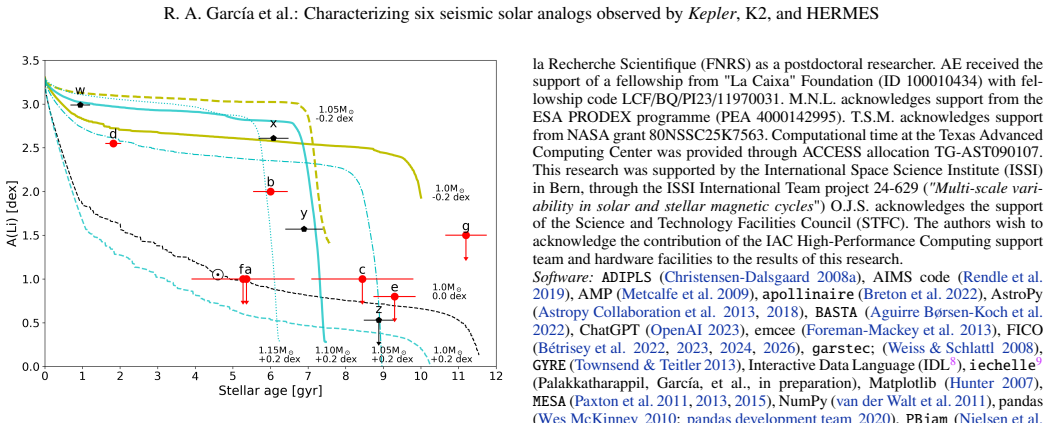
Solar analogs, stars that closely match the fundamental properties of the Sun, provide key benchmarks for testing stellar structure and evolution across different ages and activity levels. Their detailed characterization helps place the Sun in context within the broader population of solar-like stars. This study presents the characterization of six seismic solar analogs observed by the NASA Kepler and K2 missions. Combining asteroseismic constraints from space-based photometry with high-resolution spectroscopy and \textit{Gaia} astrometry, we derived their fundamental parameters and assessed their resemblance to the Sun. Global seismic properties and individual oscillation modes were extracted from the photometric light curves, while atmospheric parameters were obtained from data collected by the HERMES spectrograph at the Mercator telescope. Stellar modeling using seven independent stellar evolution codes yielded consistent masses, radii, and ages. These stars have masses between 0.91 and 1.04~$\mathrm{M}_\odot$, radii between 0.95 and 1.08~$\mathrm{R}_\odot$, and ages from about 1.8 to 9.1~Gyr, with typical systematic uncertainties of $\pm$ 0.02~$\mathrm{M}_\odot$, $\pm$ 0.01~$\mathrm{R}_\odot$, and $\pm$ 0.7~Gyr, respectively. One star, EPIC~206064678, exhibits properties very similar to those of the Sun, with $M = 1.016 \pm 0.033\,\mathrm{M}_\odot$, $R = 0.990 \pm 0.011\,\mathrm{R}_\odot$, and an age of $5.40 \pm 0.12$\,Gyr. It can therefore be considered a close solar twin, although it is slightly older and more metal-rich ($0.25 \pm 0.07$\,dex). Four targets display binarity signatures and all exhibit very low chromospheric activity. This work broadens the sample of well-characterized seismic solar analogs towards a larger sample of metallicities and ages, providing new references for comparative stellar studies and future asteroseismic investigations.
Editorial analysis
A structured set of objections, weighed in public.
Referee Report
Summary. The manuscript characterizes six seismic solar analogs using Kepler/K2 photometry, HERMES high-resolution spectroscopy, and Gaia astrometry. Global seismic properties and individual oscillation modes are extracted from the light curves, atmospheric parameters are derived spectroscopically, and the stars are modeled with seven independent stellar evolution codes. This yields masses between 0.91 and 1.04 M⊙, radii between 0.95 and 1.08 R⊙, and ages from 1.8 to 9.1 Gyr, with typical systematic uncertainties of ±0.02 M⊙, ±0.01 R⊙, and ±0.7 Gyr. One target, EPIC 206064678, is identified as a close solar twin (M = 1.016 ± 0.033 M⊙, R = 0.990 ± 0.011 R⊙, age = 5.40 ± 0.12 Gyr, [Fe/H] = 0.25 ± 0.07 dex), while four stars show binarity signatures and all exhibit very low chromospheric activity.
Significance. If the results hold, the work expands the sample of precisely characterized seismic solar analogs across a range of ages and metallicities, providing useful benchmarks for testing stellar evolution models. The consistency of results across seven independent modeling codes is a clear strength, as it quantifies systematic uncertainties arising from differences in input physics. This approach supports more reliable placement of the Sun in the context of solar-like stars and aids future asteroseismic studies.
major comments (2)
- Abstract: The age of EPIC 206064678 is reported as 5.40 ± 0.12 Gyr while the same paragraph states that the seven codes produce typical systematic uncertainties of ±0.7 Gyr. The ~0.8 Gyr offset from the solar age is therefore not demonstrably significant once the systematic component is included, weakening the claim that the star is 'slightly older' than the Sun.
- Abstract: Binarity signatures are reported in four targets, but the text does not indicate whether EPIC 206064678 is among them or how binarity was accounted for in the extraction of oscillation modes and derivation of atmospheric parameters for this star, which is central to the solar-twin identification.
minor comments (2)
- Abstract: The manuscript would benefit from brief mention of the mode-identification method and any data-exclusion criteria applied during the seismic analysis.
- Abstract: Explicitly stating the adopted solar reference age and metallicity used for the comparison would improve clarity.
Simulated Author's Rebuttal
We thank the referee for the careful and constructive report. The comments highlight important points about the presentation of uncertainties and the handling of binarity, which we address below. We have revised the manuscript to improve clarity on these issues.
read point-by-point responses
-
Referee: Abstract: The age of EPIC 206064678 is reported as 5.40 ± 0.12 Gyr while the same paragraph states that the seven codes produce typical systematic uncertainties of ±0.7 Gyr. The ~0.8 Gyr offset from the solar age is therefore not demonstrably significant once the systematic component is included, weakening the claim that the star is 'slightly older' than the Sun.
Authors: We agree that the systematic uncertainty must be considered when interpreting the age relative to the Sun. The value 5.40 ± 0.12 Gyr represents the statistical uncertainty from the individual modeling runs, while the ±0.7 Gyr quantifies the spread across the seven independent codes. The 0.8 Gyr difference from the solar age of ~4.6 Gyr therefore lies well within the total uncertainty. We have revised the abstract to state that the age is consistent with the solar value within the combined uncertainties, while retaining the central value and noting the slightly super-solar metallicity as the more robust distinguishing feature. revision: yes
-
Referee: Abstract: Binarity signatures are reported in four targets, but the text does not indicate whether EPIC 206064678 is among them or how binarity was accounted for in the extraction of oscillation modes and derivation of atmospheric parameters for this star, which is central to the solar-twin identification.
Authors: We apologize for the lack of explicit clarification in the abstract. EPIC 206064678 is not one of the four stars showing binarity signatures; those are the remaining targets in the sample. In the full text (Sections 2.2, 3.1, and 4.1), we detail that binarity was identified via photometric modulation, eclipse signatures, or double-lined spectra in the other four stars. For EPIC 206064678, neither the Kepler/K2 light curve nor the HERMES spectra show evidence of a companion, allowing standard single-star procedures for mode extraction and spectroscopic analysis. We have updated the abstract to explicitly note that EPIC 206064678 exhibits no binarity signatures and that its parameters were derived under the single-star assumption. revision: yes
Circularity Check
No significant circularity; parameters from external data and independent codes
full rationale
The paper derives masses, radii, and ages by fitting global and individual oscillation modes from Kepler/K2 photometry, atmospheric parameters from HERMES spectroscopy, and Gaia astrometry, using seven independent stellar evolution codes that produce consistent outputs. No equations reduce reported values to quantities defined by the fit itself, no predictions are statistically forced from fitted inputs, and no load-bearing self-citations or uniqueness theorems are invoked. The central claims rest on external observational constraints rather than internal redefinitions.
Axiom & Free-Parameter Ledger
free parameters (1)
- mixing-length parameter
axioms (2)
- domain assumption Stellar oscillation frequencies can be reliably extracted from Kepler/K2 photometry and interpreted with standard asymptotic relations.
- domain assumption The seven independent stellar evolution codes provide an adequate sampling of systematic modeling uncertainties.
Reference graph
Works this paper leans on
-
[1]
2022, ApJS, 259, 35
Abdurro’uf, Accetta, K., Aerts, C., et al. 2022, ApJS, 259, 35
2022
-
[2]
G., García, A., Robertson, R
Adelberger, E. G., García, A., Robertson, R. G. H., et al. 2011, Reviews of Mod- ern Physics, 83, 195 Aguirre Børsen-Koch, V ., Rørsted, J. L., Justesen, A. B., et al. 2022, MNRAS, 509, 4344
2011
-
[3]
R., Duvall, Jr., T
Anderson, E. R., Duvall, Jr., T. L., & Jefferies, S. M. 1990, ApJ, 364, 699
1990
-
[4]
2023, ApJS, 267, 8
Andrae, R., Rix, H.-W., & Chandra, V . 2023, ApJS, 267, 8
2023
-
[5]
1999, Nucl
Angulo, C., Arnould, M., Rayet, M., et al. 1999, Nucl. Phys. A, 656, 3
1999
-
[6]
J., & Scott, P
Asplund, M., Grevesse, N., Sauval, A. J., & Scott, P. 2009, ARA&A, 47, 481 Astropy Collaboration, Price-Whelan, A. M., Sip˝ocz, B. M., et al. 2018, AJ, 156, 123 Astropy Collaboration, Robitaille, T. P., Tollerud, E. J., et al. 2013, A&A, 558, A33
2009
-
[7]
2009, A&A, 506, 411
Auvergne, M., Bodin, P., Boisnard, L., et al. 2009, A&A, 506, 411
2009
-
[8]
2006, in COSPAR, Plenary Meet- ing, V ol
Baglin, A., Auvergne, M., Boisnard, L., et al. 2006, in COSPAR, Plenary Meet- ing, V ol. 36, 36th COSPAR Scientific Assembly, 3749
2006
-
[9]
Ball, W. H. & Gizon, L. 2014, A&A, 568, A123
2014
-
[10]
2011, A&A, 530, A97
Ballot, J., Gizon, L., Samadi, R., et al. 2011, A&A, 530, A97
2011
-
[11]
2009, A&A, 506, 51
Barban, C., Deheuvels, S., Baudin, F., et al. 2009, A&A, 506, 51
2009
-
[12]
2023, A&A, 674, A114
Barbato, D., Ségransan, D., Udry, S., et al. 2023, A&A, 674, A114
2023
-
[13]
2008, A&A, 492, 277
Bayo, A., Rodrigo, C., Barrado Y Navascués, D., et al. 2008, A&A, 492, 277
2008
-
[14]
L., Chaplin, W
Bazot, M., Campante, T. L., Chaplin, W. J., et al. 2012, A&A, 544, A106
2012
-
[15]
2018, A&A, 619, A172
Bazot, M., Creevey, O., Christensen-Dalsgaard, J., & Meléndez, J. 2018, A&A, 619, A172
2018
-
[16]
Beck, P. G. 2026, A&A, 707, A298
2026
-
[17]
G., Allende Prieto, C., Van Reeth, T., et al
Beck, P. G., Allende Prieto, C., Van Reeth, T., et al. 2016, A&A, 589, A27
2016
-
[18]
G., do Nascimento, Jr., J
Beck, P. G., do Nascimento, Jr., J. D., Duarte, T., et al. 2017, A&A, 602, A63
2017
-
[19]
G., Grossmann, D
Beck, P. G., Grossmann, D. H., Steinwender, L., et al. 2024, A&A, 682, A7
2024
-
[20]
G., Masseron, T., Pavlovski, K., et al
Beck, P. G., Masseron, T., Pavlovski, K., et al. 2026, A&A, 706, L19
2026
-
[21]
R., Kjeldsen, H., Campante, T
Bedding, T. R., Kjeldsen, H., Campante, T. L., et al. 2010, ApJ, 713, 935
2010
-
[22]
T., et al
Berloff, G., Broomhall, A.-M., Hookway, G. T., et al. 2026, MNRAS, 546, stag092
2026
-
[23]
2025, A&A, 700, A25 Bétrisey, J., Buldgen, G., Reese, D
Bessila, L., Deckx van Ruys, A., Buriasco, V ., et al. 2025, A&A, 700, A25 Bétrisey, J., Buldgen, G., Reese, D. R., et al. 2023, A&A, 676, A10 Bétrisey, J., Buldgen, G., Reese, D. R., & Meynet, G. 2024, A&A, 681, A99 Bétrisey, J., Pezzotti, C., Buldgen, G., et al. 2022, A&A, 659, A56 Bétrisey, J., Reese, D. R., Pezzotti, C., Goupil, M., & Cunha, M. S. 202...
2025
-
[24]
J., Koch, D., Jenkins, J., et al
Borucki, W. J., Koch, D., Jenkins, J., et al. 2009, Science, 325, 709
2009
-
[25]
N., García, R
Breton, S. N., García, R. A., Ballot, J., Delsanti, V ., & Salabert, D. 2022, A&A, 663, A118
2022
-
[26]
Brown, T. M. 1984, Science, 226, 687
1984
-
[27]
M., Latham, D
Brown, T. M., Latham, D. W., Everett, M. E., & Esquerdo, G. A. 2011, AJ, 142, 112
2011
-
[28]
2021, The Journal of Open Source Software, 6, 3001
Buchner, J. 2021, The Journal of Open Source Software, 6, 3001
2021
-
[29]
E., et al
Buder, S., Kos, J., Wang, X. E., et al. 2025, PASA, 42, e051 8 https://www.nv5geospatialsoftware.com/docs/home.html 9 https://gitlab.com/dinilbose/iechelle Article number, page 11 A&A proofs:manuscript no. aa59849-26
2025
-
[30]
2025, A&A, 702, A162
Buldgen, G., Bétrisey, J., Pezzotti, C., Borisov, S., & Noels, A. 2025, A&A, 702, A162
2025
-
[31]
W., V orontsov, S
Buldgen, G., Bétrisey, J., Roxburgh, I. W., V orontsov, S. V ., & Reese, D. R. 2022, Frontiers in Astronomy and Space Sciences, 9, 942373
2022
-
[32]
2019, A&A, 630, A126
Buldgen, G., Farnir, M., Pezzotti, C., et al. 2019, A&A, 630, A126
2019
-
[33]
2025, ApJ, 983, L31 Cayrel de Strobel, G
Carvalho-Silva, G., Meléndez, J., Rathsam, A., et al. 2025, ApJ, 983, L31 Cayrel de Strobel, G. 1996, A&A Rev., 7, 243 Cayrel de Strobel, G. & Bentolila, C. 1989, A&A, 211, 324 Cayrel de Strobel, G., Knowles, N., Hernandez, G., & Bentolila, C. 1981, A&A, 94, 1
2025
-
[34]
J., Bedding, T
Chaplin, W. J., Bedding, T. R., Bonanno, A., et al. 2011, ApJ, 732, L5
2011
-
[35]
& Talon, S
Charbonnel, C. & Talon, S. 2005, Science, 309, 2189
2005
-
[36]
& Gough, D
Christensen-Dalsgaard, J. & Gough, D. 1984, in Solar Seismology from Space, ed. R. K. Ulrich, J. Harvey, E. J. Rhodes, & J. Toomre, 199–204
1984
-
[37]
Cox, J. P. & Giuli, R. T. 1968, Principles of stellar structure (Gordon and Breach)
1968
-
[38]
L., Metcalfe, T
Creevey, O. L., Metcalfe, T. S., Schultheis, M., et al. 2017, A&A, 601, A67
2017
-
[39]
L., Sordo, R., Pailler, F., et al
Creevey, O. L., Sordo, R., Pailler, F., et al. 2023, A&A, 674, A26
2023
-
[40]
2012, Research in Astronomy and Astrophysics, 12, 1197
Cui, X.-Q., Zhao, Y .-H., Chu, Y .-Q., et al. 2012, Research in Astronomy and Astrophysics, 12, 1197
2012
-
[41]
G., & Mihalas, B
Daeppen, W., Mihalas, D., Hummer, D. G., & Mihalas, B. W. 1988, ApJ, 332, 261
1988
-
[42]
R., Chaplin, W
Davies, G. R., Chaplin, W. J., Farr, W. M., et al. 2015, MNRAS, 446, 2959
2015
-
[43]
R., Handberg, R., Miglio, A., et al
Davies, G. R., Handberg, R., Miglio, A., et al. 2014, MNRAS, 445, L94 De Silva, G. M., Freeman, K. C., Bland-Hawthorn, J., et al. 2015, MNRAS, 449, 2604 do Nascimento, J. D., J., de Almeida, L., Velloso, E. N., et al. 2020, ApJ, 898, 173 do Nascimento, Jr., J. D., Castro, M., Meléndez, J., et al. 2009, A&A, 501, 687 do Nascimento, Jr., J.-D., García, R. A...
2014
-
[44]
P., Davies, G
Doyle, A. P., Davies, G. R., Smalley, B., Chaplin, W. J., & Elsworth, Y . 2014, MNRAS, 444, 3592
2014
-
[45]
2017, ApJ, 835, 25
Egeland, R., Soon, W., Baliunas, S., et al. 2017, ApJ, 835, 25
2017
-
[46]
W., Alexander, D
Ferguson, J. W., Alexander, D. R., Allard, F., et al. 2005, ApJ, 623, 585
2005
-
[47]
W., Lang, D., & Goodman, J
Foreman-Mackey, D., Hogg, D. W., Lang, D., & Goodman, J. 2013, PASP, 125, 306
2013
-
[48]
2004, Physics Letters B, 591, 61 Gaia Collaboration, Arenou, F., Babusiaux, C., et al
Formicola, A., Imbriani, G., Costantini, H., et al. 2004, Physics Letters B, 591, 61 Gaia Collaboration, Arenou, F., Babusiaux, C., et al. 2023a, A&A, 674, A34 Gaia Collaboration, Prusti, T., de Bruijne, J. H. J., et al. 2016, A&A, 595, A1 Gaia Collaboration, Vallenari, A., Brown, A. G. A., et al. 2023b, A&A, 674, A1
2004
-
[49]
Y ., Lorenzo-Oliveira, D., Ferreira, T., et al
Galarza, J. Y ., Lorenzo-Oliveira, D., Ferreira, T., et al. 2025, ApJ, 983, 70 García, R. A. 2017, in European Physical Journal Web of Conferences, V ol. 160, European Physical Journal Web of Conferences, 01010 García, R. A. & Ballot, J. 2019, Living Reviews in Solar Physics, 16, 4 García, R. A., Hekker, S., Stello, D., et al. 2011, MNRAS, 414, L6 García,...
2025
-
[50]
2014, ApJ, 785, 5
Gaulme, P., Jackiewicz, J., Appourchaux, T., & Mosser, B. 2014, ApJ, 785, 5
2014
-
[51]
2020, A&A, 639, A63
Gaulme, P., Jackiewicz, J., Spada, F., et al. 2020, A&A, 639, A63
2020
-
[52]
2024, A&A, 686, A93
Gehan, C., Godoy-Rivera, D., & Gaulme, P. 2024, A&A, 686, A93
2024
-
[53]
L., Jenkins, J
Gilliland, R. L., Jenkins, J. M., Borucki, W. J., et al. 2010, ApJ, 713, L160
2010
-
[54]
2012, The Messenger, 147, 25
Gilmore, G., Randich, S., Asplund, M., et al. 2012, The Messenger, 147, 25
2012
-
[55]
A., et al
Godoy-Rivera, D., Mathur, S., García, R. A., et al. 2025, A&A, 696, A243
2025
-
[56]
2026b, A&A, submitted González-Cuesta, L., Mathur, S., García, R
Godoy-Rivera, D., Mathur, S., Richey-Yowell, T., et al. 2026b, A&A, submitted González-Cuesta, L., Mathur, S., García, R. A., et al. 2023, A&A, 674, A106
2023
-
[57]
& Sauval, A
Grevesse, N. & Sauval, A. J. 1998, Space Sci. Rev., 85, 161
1998
-
[58]
H., Beck, P
Grossmann, D. H., Beck, P. G., Mathur, S., et al. 2025, A&A, 696, A42
2025
-
[59]
H., Mathur, S., Beck, P
Grossmann, D. H., Mathur, S., Beck, P. G., et al. 2026, A&A, submitted
2026
-
[60]
2008, A&A, 486, 951
Gustafsson, B., Edvardsson, B., Eriksson, K., et al. 2008, A&A, 486, 951
2008
-
[61]
W., Fey, M., Kunz, R., et al
Hammer, J. W., Fey, M., Kunz, R., et al. 2005, Nucl. Phys. A, 758, 363
2005
-
[62]
1978, A&A, 63, 383
Hardorp, J. 1978, A&A, 63, 383
1978
-
[63]
1985, in ESA Special Publication, V ol
Harvey, J. 1985, in ESA Special Publication, V ol. 235, Future Missions in Solar, Heliospheric & Space Plasma Physics, ed. E. Rolfe & B. Battrick, 199–208
1985
-
[64]
R., Masseron, T., Sobeck, J., et al
Hayes, C. R., Masseron, T., Sobeck, J., et al. 2022, ApJS, 262, 34
2022
-
[65]
2021, A&A, 645, A106
Heiter, U., Lind, K., Bergemann, M., et al. 2021, A&A, 645, A106
2021
-
[66]
T., Nielsen, M
Hookway, G. T., Nielsen, M. B., Davies, G. R., et al. 2025, MNRAS, 544, 3247
2025
-
[67]
P., Falta, D., Anderson, L
Horch, E. P., Falta, D., Anderson, L. M., et al. 2010, AJ, 139, 205
2010
-
[68]
C., et al
Hourihane, A., François, P., Worley, C. C., et al. 2023, A&A, 676, A129
2023
-
[69]
B., Sobeck, C., Haas, M., et al
Howell, S. B., Sobeck, C., Haas, M., et al. 2014, PASP, 126, 398
2014
-
[70]
T., Haas, M
Huber, D., Bryson, S. T., Haas, M. R., et al. 2016, ApJS, 224, 2
2016
-
[71]
R., Metcalfe, T
Huber, D., White, T. R., Metcalfe, T. S., et al. 2022, AJ, 163, 79
2022
-
[72]
Hummer, D. G. & Mihalas, D. 1988, ApJ, 331, 794
1988
-
[73]
Hunter, J. D. 2007, Computing in Science & Engineering, 9, 90
2007
-
[74]
Iglesias, C. A. & Rogers, F. J. 1996, ApJ, 464, 943
1996
-
[75]
Irwin, A. W. 2012, FreeEOS: Equation of State for stellar interiors calculations
2012
-
[76]
S., Bauer, E
Jermyn, A. S., Bauer, E. B., Schwab, J., et al. 2023, ApJS, 265, 15
2023
-
[77]
2001–, SciPy: Open source scientific tools for Python
Jones, E., Oliphant, T., Peterson, P., et al. 2001–, SciPy: Open source scientific tools for Python
2001
-
[78]
S., Santos, Â
Karoff, C., Metcalfe, T. S., Santos, Â. R. G., et al. 2018, ApJ, 852, 46
2018
-
[79]
2019, A&A, 623, A72
Kervella, P., Arenou, F., Mignard, F., & Thévenin, F. 2019, A&A, 623, A72
2019
-
[80]
2013, Stellar Structure and Evolution
Kippenhahn, R., Weigert, A., & Weiss, A. 2013, Stellar Structure and Evolution
2013
discussion (0)
Sign in with ORCID, Apple, or X to comment. Anyone can read and Pith papers without signing in.