End-to-End and Phase-Level Performance Optimization for Hyperledger Fabric
Pith reviewed 2026-05-07 09:06 UTC · model grok-4.3
The pith
Block-level pipelining overlaps successive block validations to raise Hyperledger Fabric commit throughput up to 1.9 times.
A machine-rendered reading of the paper's core claim, the machinery that carries it, and where it could break.
Core claim
Block-level pipelining overlaps validation and private-data acquisition of successive blocks with state-consistency checks and ledger updates, improving commit throughput by up to 1.9x. Strategic waiting coordinates commit progress by temporarily pausing fast leaders and boosting laggers to sustain endorsement parallelism, yielding up to 1.2x higher throughput. Relaxed quorums for private-data dissemination cut latency in both endorsement and commit phases. Under light loads smaller blocks reduce end-to-end latency; under heavy loads larger blocks raise throughput. Relaxed leader selection lowers dropped transactions and lifts endorsement throughput with only modest MVCC invalidation growth.
What carries the argument
Block-level pipelining, which overlaps commit-phase work across consecutive blocks, together with strategic waiting that balances leader progress to preserve endorsement parallelism.
If this is right
- Relaxed private-data dissemination quorums reduce latency in both endorsement and commit phases.
- Smaller blocks lower end-to-end latency under light workloads while larger blocks improve throughput under heavy workloads.
- Relaxed leader selection reduces dropped transactions and raises endorsement throughput with only a modest rise in MVCC invalidations.
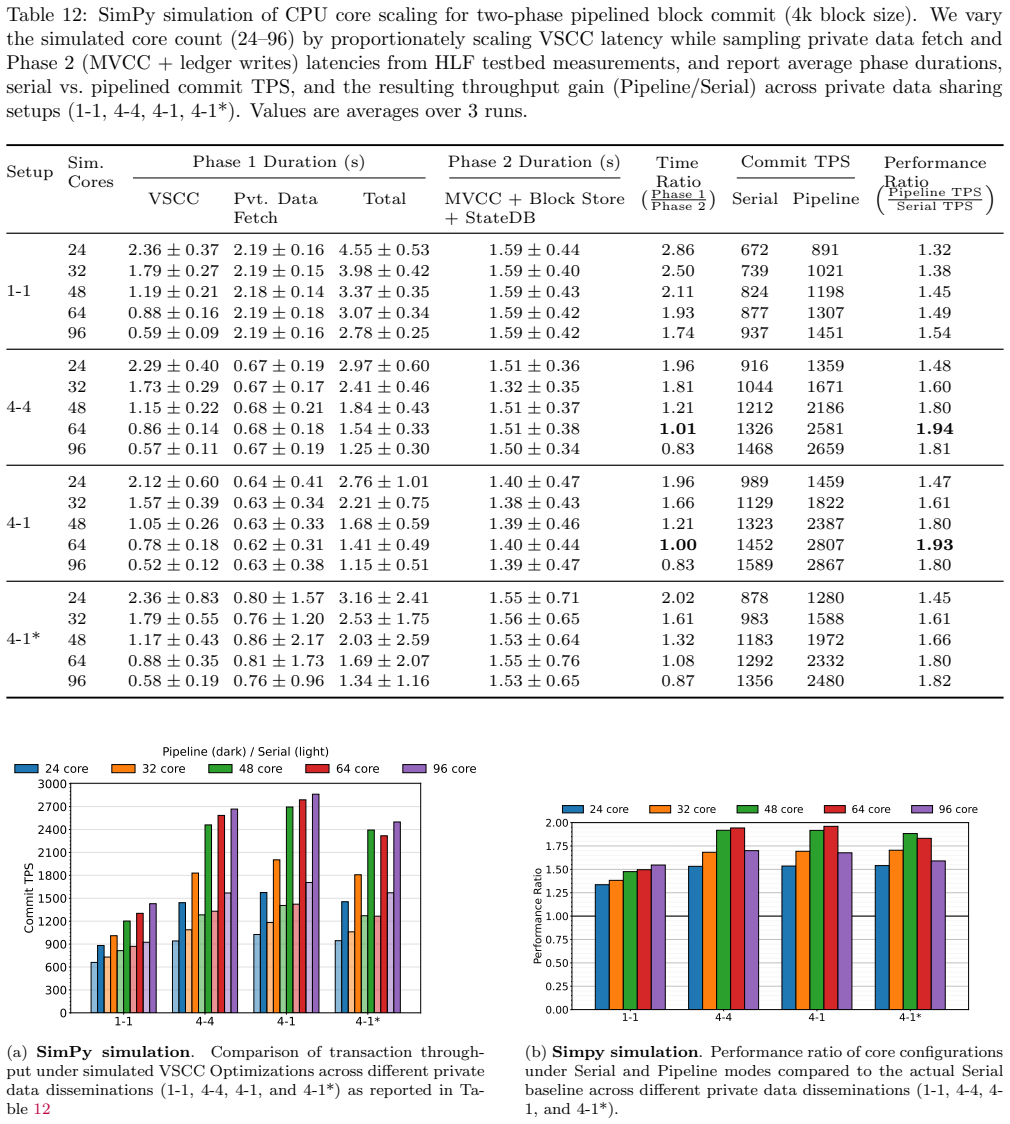
- Throughput gains from pipelined commits over a serial path are largest at moderate rather than maximum levels of VSCC parallelization.
Where Pith is reading between the lines
- The same pipelining and waiting logic could be adapted to other permissioned blockchains that separate endorsement, ordering, and commit phases.
- Calibrating the simulation to production traces suggests the gains are likely to appear in enterprise settings without needing full hardware re-testing for every workload.
- Balancing commit progress across leaders may also improve fairness and reduce tail latency in networks with dozens of peers.
- Further tuning of the moderate-parallelism sweet spot could be tested by varying network size and transaction mix.
Load-bearing premise
The production testbed measurements and SimPy simulations correctly capture the real bottlenecks that appear in enterprise Hyperledger Fabric deployments under representative workloads.
What would settle it
Deploy the pipelined and strategically-waiting commit path on a production-grade Hyperledger Fabric network with heavy transaction loads and measure whether commit throughput reaches or exceeds the reported 1.9x and 1.2x gains relative to the baseline serial commit path.
Figures





read the original abstract
Hyperledger Fabric (HLF) is a modular, permissioned blockchain widely adopted in enterprise settings. Enhancing its throughput and latency remains challenging, as optimization decisions made in one phase of the transaction lifecycle can adversely affect other phases. In this work, we present a systematic, phase-level and end-to-end study of HLF optimizations along three fronts, combining production-grade testbed experiments with calibrated SimPy simulations. First, we introduce two novel optimization techniques that target commit-phase bottlenecks: block-level pipelining and strategic waiting. In pipelining, we overlap validation and private-data acquisition of successive blocks with state-consistency checks and ledger updates improving commit throughput by up to 1.9x. Strategic waiting coordinates commit progress by temporarily pausing fast leaders and boosting laggers to sustain endorsement parallelism, yielding up to a 1.2x higher throughput. Second, we conduct micro-benchmarking of three configuration levers: private-data dissemination, block-size selection, and endorsement peer selection. Our results reveal that: (i) Relaxed quorums for private-data dissemination significantly reduce latency in both endorsement and commit phases; (ii) Under light workloads, smaller blocks yield lower end-to-end latency, whereas, under heavy workloads, larger blocks are necessary to improve throughput and reduce latency; and (iii) Relaxed leader selection dramatically reduces dropped transactions and boosts endorsement throughput, with a modest increase in MVCC invalidations. Finally, we analyze the interplay among private-data dissemination, VSCC parallelization, and pipelined commits. Interestingly, the throughput gains over a serial commit path are maximized at a moderate level of parallelization. Together, our findings provide phase-aware and protocol-level refinements for optimizing HLF.
Editorial analysis
A structured set of objections, weighed in public.
Referee Report
Summary. The paper conducts a systematic phase-level and end-to-end performance study of Hyperledger Fabric using production-grade testbed experiments combined with calibrated SimPy simulations. It introduces two novel commit-phase optimizations—block-level pipelining (overlapping validation and private-data acquisition of successive blocks with state-consistency checks and ledger updates) and strategic waiting (temporarily pausing fast leaders to boost laggers and sustain endorsement parallelism)—claiming up to 1.9× and 1.2× throughput gains. It further reports micro-benchmark results on private-data dissemination quorums, block-size selection under light vs. heavy workloads, and relaxed leader selection, plus an analysis of interactions among private-data dissemination, VSCC parallelization, and pipelined commits.
Significance. If the empirical results hold, the work delivers actionable, phase-aware refinements for a widely deployed enterprise blockchain platform. The combination of concrete throughput multipliers from testbed runs, micro-benchmark insights on configuration levers, and simulation-based interplay analysis provides a useful reference for practitioners tuning Hyperledger Fabric deployments.
major comments (1)
- The central throughput claims (up to 1.9× for block-level pipelining and 1.2× for strategic waiting) are presented without error bars, standard deviations, number of experimental runs, or statistical significance tests. This detail is load-bearing for assessing the reliability of the reported gains, especially given the variability inherent in distributed ledger workloads and the reliance on both testbed and simulation data.
minor comments (2)
- The abstract and results sections would benefit from explicit statements of the baseline configuration against which the multipliers are measured (e.g., default HLF commit path without pipelining).
- Workload definitions (transaction rates, block sizes, private-data sizes) and hardware specifications for the 'production-grade testbed' should be tabulated for reproducibility.
Simulated Author's Rebuttal
We thank the referee for the constructive feedback and the recommendation of minor revision. We address the single major comment below.
read point-by-point responses
-
Referee: The central throughput claims (up to 1.9× for block-level pipelining and 1.2× for strategic waiting) are presented without error bars, standard deviations, number of experimental runs, or statistical significance tests. This detail is load-bearing for assessing the reliability of the reported gains, especially given the variability inherent in distributed ledger workloads and the reliance on both testbed and simulation data.
Authors: We agree that statistical details are necessary to substantiate the reported gains given the inherent variability in distributed systems. In the revised manuscript we will add the number of runs performed (five independent testbed runs and 100 simulation runs per configuration), standard deviations, error bars on all throughput figures, and t-test results confirming statistical significance of the 1.9× and 1.2× improvements. These additions will be made for both the production-grade testbed data and the calibrated SimPy simulations. revision: yes
Circularity Check
Empirical evaluation with no derivation chain
full rationale
The paper reports measured throughput and latency gains from two new techniques (block-level pipelining and strategic waiting) plus micro-benchmarks on configuration parameters. All results come from production-grade testbed runs and calibrated SimPy simulations; no equations, fitted parameters, or self-citations are used to derive or predict the reported speedups. The claimed improvements are therefore direct experimental outcomes rather than quantities that reduce to the inputs by construction.
Axiom & Free-Parameter Ledger
axioms (1)
- domain assumption The chosen testbed workloads and network conditions are representative of typical enterprise Hyperledger Fabric deployments.
Reference graph
Works this paper leans on
-
[1]
Why ’permissioned’ and ’private’ are not blockchains.Available at SSRN 3496468, 2019
Oleksii Konashevych. Why ’permissioned’ and ’private’ are not blockchains.Available at SSRN 3496468, 2019
work page 2019
-
[2]
Bitcoin: A peer-to-peer electronic cash system
Satoshi Nakamoto. Bitcoin: A peer-to-peer electronic cash system. 2008
work page 2008
-
[3]
Ethereum white paper: A next generation smart contract & decentralized application platform
Vitalik Buterin. Ethereum white paper: A next generation smart contract & decentralized application platform. 2013
work page 2013
-
[4]
Filecoin: A decentralized storage network
Protocol Labs et al. Filecoin: A decentralized storage network. Technical report, Protocol Labs, July 2017
work page 2017
-
[5]
Helium: A decentralized wireless network whitepaper, 2019
Helium Inc. Helium: A decentralized wireless network whitepaper, 2019
work page 2019
-
[6]
Ppcoin: Peer-to-peer crypto-currency with proof-of-stake.self-published paper, August, 19(1), 2012
Sunny King and Scott Nadal. Ppcoin: Peer-to-peer crypto-currency with proof-of-stake.self-published paper, August, 19(1), 2012
work page 2012
-
[7]
The Idea of Smart Contracts|Satoshi Nakamoto Institute, October 2025. [Online; accessed 21. Oct. 2025]
work page 2025
-
[8]
Advancing global trade with blockchain
Parm Sangha, Veena Pureswaran, and Smitha Soman. Advancing global trade with blockchain. Whitepaper, IBM, 2025
work page 2025
-
[9]
Blockchain for finance: A survey, 2024
Hanjie Wu, Qian Yao, Zhenguang Liu, Butian Huang, Yuan Zhuang, Huayun Tang, and Erwu Liu. Blockchain for finance: A survey, 2024
work page 2024
- [10]
-
[11]
Abayomi Agbeyangi, Olukayode Oki, and Aphelele Mgidi. Blockchain in healthcare: implementing hyperledger fabric for electronic health records at frere provincial hospital.arXiv preprint arXiv:2407.15876, 2024
-
[12]
In search of an understandable consensus algorithm
Diego Ongaro and John Ousterhout. In search of an understandable consensus algorithm. InProceedings of the 2014 USENIX Conference on USENIX Annual Technical Conference, USENIX ATC’14, page 305–320, USA,
work page 2014
-
[13]
Hyperledger fabric: a distributed operating system for permissioned blockchains
Elli Androulaki, Artem Barger, Vita Bortnikov, Christian Cachin, Konstantinos Christidis, Angelo De Caro, David Enyeart, Christopher Ferris, Gennady Laventman, Yacov Manevich, Srinivasan Muralidharan, Chet Murthy, Binh Nguyen, Manish Sethi, Gari Singh, Keith Smith, Alessandro Sorniotti, Chrysoula Stathakopoulou, Marko Vukoli´ c, Sharon Weed Cocco, and Jas...
work page 2018
-
[14]
Shrey Baheti, Parwat Singh Anjana, Sathya Peri, and Yogesh Simmhan. Dipetrans: A framework for dis- tributed parallel execution of transactions of blocks in blockchains.Concurrency and Computation: Practice and Experience, 34(10):e6804, 2022
work page 2022
-
[15]
Jian Liu, Peilun Li, Raymond Cheng, N Asokan, and Dawn Song. Parallel and asynchronous smart contract execution.IEEE Transactions on Parallel and Distributed Systems, 33(5):1097–1108, 2021
work page 2021
-
[16]
Performance benchmarking of hyperledger fabric networks: Insights for scalability and optimization
Maryam Abbasi, Jose Silva, Paulo Vaz, Adelino Soares, and Pedro Martins. Performance benchmarking of hyperledger fabric networks: Insights for scalability and optimization. In Jos´ e Lu´ ıs Reis, Marc K. Peter, Lu´ ıs Paulo Reis, and Zorica Bogdanovic, editors,Marketing and Smart Technologies, pages 3–15, Singapore,
-
[17]
Springer Nature Singapore. 22
-
[18]
Performance evaluation of dlt systems based on hyper ledger fabric
Mohammed Shuaib, Noor Hafizah Hassan, Sahnius Usman, Shadab Alam, Nur Azaliah Abu Bakar, and Nu- razean Maarop. Performance evaluation of dlt systems based on hyper ledger fabric. In2022 4th International Conference on Smart Sensors and Application (ICSSA), pages 70–75. IEEE, 2022
work page 2022
-
[19]
Carlos Melo, Glauber Gon¸ calves, Francisco A Silva, and Andr´ e Soares. Performance modeling and evaluation of hyperledger fabric: An analysis based on transaction flow and endorsement policies. In2024 IEEE Symposium on Computers and Communications (ISCC), pages 1–6. IEEE, 2024
work page 2024
-
[20]
Performance benchmarking and optimizing hyper- ledger fabric blockchain platform
Parth Thakkar, Senthil Nathan, and Balaji Viswanathan. Performance benchmarking and optimizing hyper- ledger fabric blockchain platform. In2018 IEEE 26th international symposium on modeling, analysis, and simulation of computer and telecommunication systems (MASCOTS), pages 264–276. IEEE, 2018
work page 2018
-
[21]
Performance optimization of high-conflict trans- actions within the hyperledger fabric blockchain
Alexandros Stoltidis, Kostas Choumas, and Thanasis Korakis. Performance optimization of high-conflict trans- actions within the hyperledger fabric blockchain. In2024 6th Conference on Blockchain Research & Applications for Innovative Networks and Services (BRAINS), pages 1–4, 2024
work page 2024
-
[22]
Performance study for improving throughput in hyperledger fabric blockchain platform
Satyanarayana Nanduri and Harish Vemula. Performance study for improving throughput in hyperledger fabric blockchain platform. In2022 IEEE 1st Global Emerging Technology Blockchain Forum: Blockchain & Beyond (iGETblockchain), pages 1–6, 2022
work page 2022
-
[23]
Hyperledger fabric perfor- mance characterization and optimization using goleveldb benchmark
Takuya Nakaike, Qi Zhang, Yohei Ueda, Tatsushi Inagaki, and Moriyoshi Ohara. Hyperledger fabric perfor- mance characterization and optimization using goleveldb benchmark. In2020 IEEE International Conference on Blockchain and Cryptocurrency (ICBC), pages 1–9, 2020
work page 2020
-
[24]
Hyperledger fabric: a distributed operating system for permissioned blockchains
Elli Androulaki, Artem Barger, Vita Bortnikov, Christian Cachin, Konstantinos Christidis, Angelo De Caro, David Enyeart, Christopher Ferris, Gennady Laventman, Yacov Manevich, Srinivasan Muralidharan, Chet Murthy, Binh Nguyen, Manish Sethi, Gari Singh, Keith Smith, Alessandro Sorniotti, Chrysoula Stathakopoulou, Marko Vukoli´ c, Sharon Weed Cocco, and Jas...
work page 2018
-
[25]
Hyperledger fabric: Read-write set semantics
Hyperledger Fabric Documentation. Hyperledger fabric: Read-write set semantics¶. Online, 2025. Accessed: May. 6, 2025
work page 2025
-
[26]
Hyperledger Fabric. Fabric ordering service, 2025. Accessed: June 6, 2025
work page 2025
-
[27]
Optimizing validation phase of hyperledger fabric
Haris Javaid, Chengchen Hu, and Gordon Brebner. Optimizing validation phase of hyperledger fabric. In2019 IEEE 27th International Symposium on Modeling, Analysis, and Simulation of Computer and Telecommuni- cation Systems (MASCOTS), pages 269–275, 2019
work page 2019
-
[28]
Scaling blockchains using pipelined execution and sparse peers
Parth Thakkar and Senthilnathan Natarajan. Scaling blockchains using pipelined execution and sparse peers. InProceedings of the ACM Symposium on Cloud Computing, SoCC ’21, page 489–502, New York, NY, USA,
-
[29]
Association for Computing Machinery
-
[30]
Blurring the lines between blockchains and database systems: the case of hyperledger fabric
Ankur Sharma, Felix Martin Schuhknecht, Divya Agrawal, and Jens Dittrich. Blurring the lines between blockchains and database systems: the case of hyperledger fabric. InProceedings of the 2019 International Conference on Management of Data, SIGMOD ’19, page 105–122, New York, NY, USA, 2019. Association for Computing Machinery
work page 2019
-
[31]
A transactional perspective on execute-order-validate blockchains
Pingcheng Ruan, Dumitrel Loghin, Quang-Trung Ta, Meihui Zhang, Gang Chen, and Beng Chin Ooi. A transactional perspective on execute-order-validate blockchains. InProceedings of the 2020 ACM SIGMOD International Conference on Management of Data, SIGMOD ’20, page 543–557, New York, NY, USA, 2020. Association for Computing Machinery
work page 2020
-
[32]
Slchain: A secure and low-storage pressure sharding blockchain
Junfeng Tian, Hongwei Xu, and Jin Tian. Slchain: A secure and low-storage pressure sharding blockchain. Concurrency and Computation: Practice and Experience, 36(3):e7918, 2024
work page 2024
-
[33]
Iraq Ahmad Reshi and Sahil Sholla. The blockchain conundrum: An in-depth examination of challenges, con- tributing technologies, and alternatives.Concurrency and Computation: Practice and Experience, 36(8):e7987, 2024
work page 2024
-
[34]
Yibin Xu, Yangyu Huang, Jianhua Shao, and George Theodorakopoulos. A flexible n/2 adversary node resistant and halting recoverable blockchain sharding protocol.Concurrency and Computation: Practice and Experience, 32(19):e5773, 2020. 23
work page 2020
-
[35]
Rupali Sachin Vairagade, Priya Parkhi, Yogita Hande, and Bhagyashree Hambarde. Blockchain-powered frame- work for trust enhancement in fintech: A comprehensive trust evaluation approach.Concurrency and Compu- tation: Practice and Experience, 37(3):e8357, 2025
work page 2025
-
[36]
Ziyu Zhou, Na Wang, Jianwei Liu, Junsong Fu, and Lunzhi Deng. The blockchain-based privacy-preserving searchable attribute-based encryption scheme for federated learning model in iomt.Concurrency and Compu- tation: Practice and Experience, 36(24):e8257, 2024
work page 2024
-
[37]
Naga Sravanthi Puppala and R Manoharan. Optimizing pool mining performance: A vikor-based model for identifying reputed miners in blockchain networks.Concurrency and Computation: Practice and Experience, 36(21):e8211, 2024
work page 2024
-
[38]
Sagnik Datta and Suyel Namasudra. Energy-efficient blockchain-based secure model to share medical data using mobile edge computing.Concurrency and Computation: Practice and Experience, 37(9-11):e70087, 2025
work page 2025
-
[39]
Naga Sravanthi Puppala and R Manoharan. Enhancing mining pool performance and security through op- timized cluster-trust consensus mechanism in blockchain networks.Concurrency and Computation: Practice and Experience, 37(9-11):e70077, 2025
work page 2025
-
[40]
Rupali Sachin Vairagade and Brahmananda Savadatti Hanumantha. Secure internet of things network using light-weighted trust and blockchain-powered pow framework.Concurrency and Computation: Practice and Experience, 34(21):e7057, 2022
work page 2022
-
[41]
Performance analysis on block size valuation of hyperledger fabric blockchain
Khin Su Su Wai and Nwe Nwe Myint Thein. Performance analysis on block size valuation of hyperledger fabric blockchain. In2023 IEEE Conference on Computer Applications (ICCA), pages 50–55, 2023
work page 2023
-
[42]
Lei Hang and Do-Hyeun Kim. Optimal blockchain network construction methodology based on analysis of configurable components for enhancing hyperledger fabric performance.Blockchain: Research and Applications, 2(1):100009, 2021
work page 2021
-
[43]
Hyperledger fabric blockchain: Chaincode performance analysis
Luca Foschini, Andrea Gavagna, Giuseppe Martuscelli, and Rebecca Montanari. Hyperledger fabric blockchain: Chaincode performance analysis. InICC 2020 - 2020 IEEE International Conference on Communications (ICC), pages 1–6, 2020
work page 2020
-
[44]
Reem Alhabib and Poonam Yadav. Evaluating the impact of endorsement policies on hyperledger fabric performance for autonomous vehicle data sharing.Cluster Computing, 29(1):8, 2026
work page 2026
-
[45]
Ou Wu, Zhongxing Wang, and Zhongjin Li. Performance modeling of hyperledger fabric 2.0: A queuing theory-based approach.Wireless Communications and Mobile Computing, 2023(1):9957995, 2023
work page 2023
-
[46]
Carlos Melo, Glauber Gon¸ calves, Francisco A Silva, and Andr´ e Soares. A comprehensive hyperledger fabric performance evaluation based on resources capacity planning.Cluster Computing, 27(9):12395–12410, 2024
work page 2024
-
[47]
Harish Sukhwani, Nan Wang, Kishor S. Trivedi, and Andy Rindos. Performance modeling of hyperledger fabric (permissioned blockchain network). In2018 IEEE 17th International Symposium on Network Computing and Applications (NCA), pages 1–8, 2018
work page 2018
-
[48]
Performance modeling and analysis of hyperledger fabric.Cluster Computing, 26(5):2681–2699, 2023
Zuqiang Ke and Nohpill Park. Performance modeling and analysis of hyperledger fabric.Cluster Computing, 26(5):2681–2699, 2023
work page 2023
-
[49]
Lili Jiang, Xiaolin Chang, Yuhang Liu, Jelena Miˇ si´ c, and Vojislav B Miˇ si´ c. Performance analysis of hyperledger fabric platform: A hierarchical model approach.Peer-to-Peer Networking and Applications, 13(3):1014–1025, 2020
work page 2020
-
[50]
Performance perspective on private distributed ledger technologies for industrial networks
Fabien Geyer, Holger Kinkelin, Hendrik Leppelsack, Stefan Liebald, Dominik Scholz, Georg Carle, and Dominic Schupke. Performance perspective on private distributed ledger technologies for industrial networks. In2019 International Conference on Networked Systems (NetSys), pages 1–8. IEEE, 2019
work page 2019
-
[51]
Fabric Gateway — Hyperledger Fabric Docs main documentation, January 2026. [Online; accessed 11. Feb. 2026]. 24
work page 2026
discussion (0)
Sign in with ORCID, Apple, or X to comment. Anyone can read and Pith papers without signing in.