Recognition: unknown
Online Coloring for Graphs of Large Odd Girth
Pith reviewed 2026-05-07 05:48 UTC · model grok-4.3
The pith
For any ε > 0 there exists an odd girth g' such that graphs with odd girth at least g' can be deterministically colored online using O(n^ε) colors.
A machine-rendered reading of the paper's core claim, the machinery that carries it, and where it could break.
Core claim
The paper shows that for every ε > 0 there exists a constant g' in the set of odd positive integers such that any graph with odd girth at least g' admits a deterministic online coloring using at most O(n^ε) colors.
What carries the argument
A deterministic online coloring algorithm that leverages the large odd girth to restrict the possible color conflicts for each new vertex.
If this is right
- Online coloring algorithms can achieve subpolynomial color usage for graphs without short odd cycles.
- The bound on the number of colors can be improved arbitrarily close to constant by increasing the required odd girth.
- Previous O(n^{1/2}) bound is superseded for graphs with sufficiently large odd girth.
- Deterministic online coloring is possible with color counts that are o(n^δ) for any δ>0 when girth condition holds.
Where Pith is reading between the lines
- Short odd cycles may be the primary obstacle to efficient online coloring in general graphs.
- The result might extend to other online problems on graphs, such as list coloring or choosability.
- Computational verification could involve generating graphs with increasing odd girth and testing color usage of simple online heuristics.
Load-bearing premise
That there exists some deterministic rule for assigning colors to arriving vertices that keeps the total number used below O(n^ε) as long as the input graph has no odd cycle shorter than g'.
What would settle it
Exhibiting, for some fixed ε > 0, a sequence of graphs with arbitrarily large odd girth each of which requires more than C n^ε colors no matter which online coloring strategy is used.
Figures
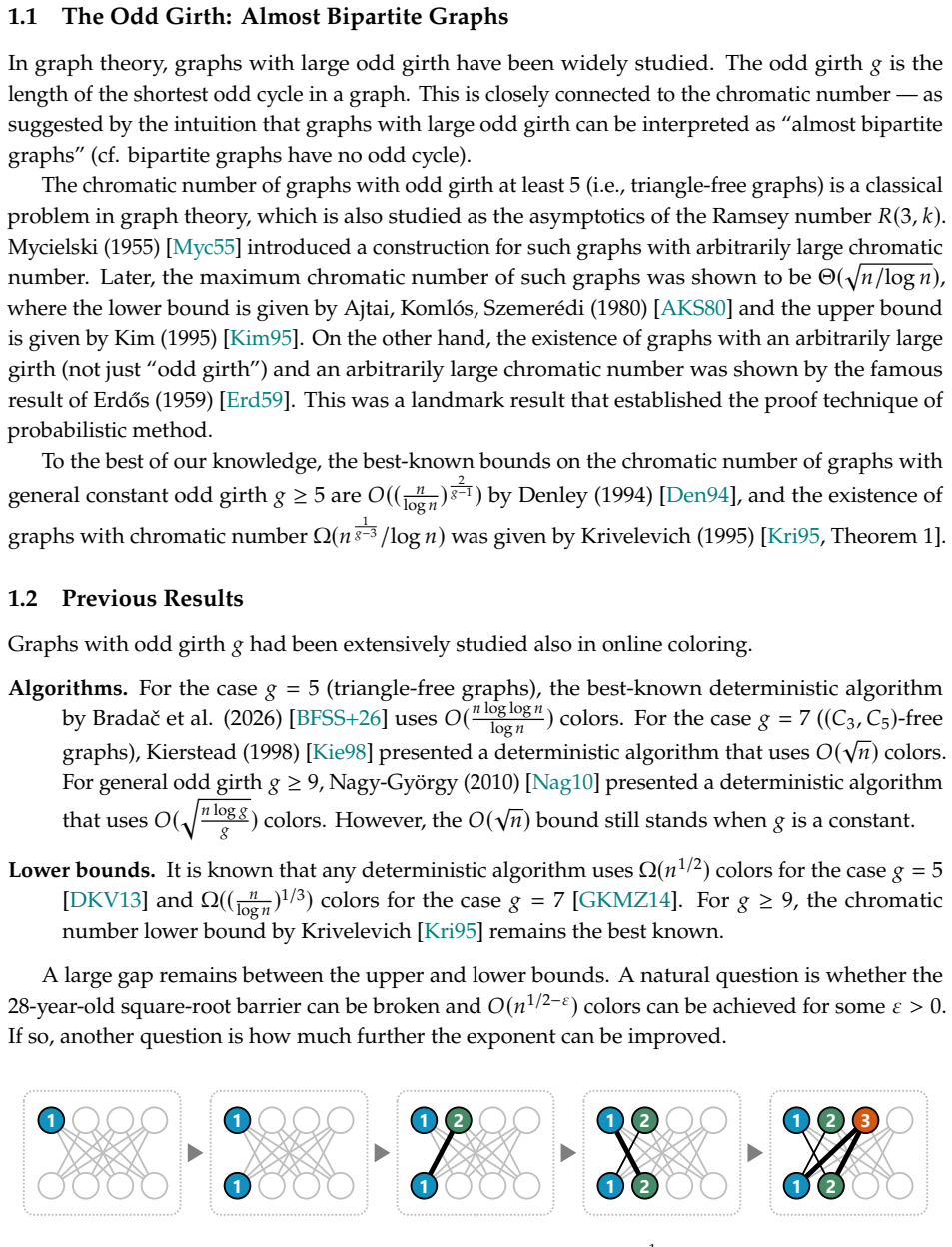


read the original abstract
We study the problem of online coloring for graphs with large odd girth. The best previously known algorithm uses $O(n^{1/2})$ colors, which was discovered by Kierstead in 1998. This algorithm works when the odd girth is 7 or more. In this paper, we provide the following: for every $\varepsilon > 0$, there exists a constant $g' \in \{3, 5, 7, \dots\}$ such that graphs with odd girth at least $g'$ can be deterministically colored online using $O(n^{\varepsilon})$ colors.
Editorial analysis
A structured set of objections, weighed in public.
Referee Report
Summary. The paper claims that for every ε > 0 there exists a constant g' ∈ {3, 5, 7, …} such that every graph with odd girth at least g' admits a deterministic online coloring (in the standard vertex-arrival model) that uses only O(n^ε) colors. This is presented as an improvement over Kierstead’s 1998 O(n^{1/2})-color algorithm that already works for odd girth 7.
Significance. If the claimed existence result holds, it would constitute a meaningful advance in online graph coloring: it shows that the exponent in the color bound can be made arbitrarily small (rather than fixed at 1/2) simply by raising the odd-girth threshold. Such “arbitrarily high girth yields arbitrarily slow-growing color bounds” statements are rare in the online setting and would refine our understanding of how local sparsity constraints affect online chromatic number.
major comments (1)
- The manuscript asserts the existence of a deterministic online algorithm achieving the O(n^ε) bound but supplies neither an explicit algorithm description, a proof sketch, nor any analysis of the construction that would establish the claimed color bound for sufficiently large odd girth. Without these elements the central claim cannot be verified.
Simulated Author's Rebuttal
We thank the referee for the careful reading of our manuscript and for the constructive feedback. We address the major comment below.
read point-by-point responses
-
Referee: The manuscript asserts the existence of a deterministic online algorithm achieving the O(n^ε) bound but supplies neither an explicit algorithm description, a proof sketch, nor any analysis of the construction that would establish the claimed color bound for sufficiently large odd girth. Without these elements the central claim cannot be verified.
Authors: We agree that the current manuscript does not include an explicit description of the algorithm, a proof sketch, or the supporting analysis, which are necessary to fully verify the claim. This omission was unintentional. In the revised version we will supply a complete description of the deterministic online coloring algorithm, a detailed proof sketch, and the full analysis showing that for every ε > 0 there exists g' such that any graph with odd girth at least g' admits an online coloring with O(n^ε) colors. The construction will be presented in a way that makes clear how the larger odd-girth threshold improves upon Kierstead's O(n^{1/2}) bound for girth 7. revision: yes
Circularity Check
No significant circularity detected
full rationale
The paper states an existential result: for every ε > 0 there exists g' such that graphs of odd girth ≥ g' admit a deterministic online coloring with O(n^ε) colors. This improves Kierstead's 1998 O(n^{1/2}) bound for girth ≥ 7 and is presented as a new algorithmic existence proof in the standard online vertex-arrival model. No equations, parameter fits, or self-citations are shown to reduce the central claim to its own inputs by construction. The g'(ε) dependence is the expected form for high-girth asymptotic statements and does not constitute self-definition or renaming of a known result. The derivation chain therefore remains self-contained against external benchmarks.
Axiom & Free-Parameter Ledger
axioms (1)
- domain assumption Vertices arrive one by one; when a vertex arrives, all its edges to previously arrived vertices are revealed, and the algorithm must assign a color immediately without knowledge of future vertices.
Reference graph
Works this paper leans on
-
[1]
Coloring small locally sparse degenerate graphs and related problems
[AKS80] Miklós Ajtai, János Komlós, and Endre Szemerédi. “A note on Ramsey numbers”. In: Journal of Combinatorial Theory, Series A29.3 (1980), pp. 354–360. [AS21] Susanne Albers and Sebastian Schraink. “Tight bounds for online coloring of basic graph classes”. In:Algorithmica83.1 (2021), pp. 337–360. [Bea76] Dwight R Bean. “Effective coloration”. In:The J...
-
[2]
On Moore graphs with diameters 2 and 3
[HS60] Alan J Hoffman and Robert R Singleton. “On Moore graphs with diameters 2 and 3”. In:IBM Journal of Research and Development4.5 (1960), pp. 497–504. [HS94] MagnúsMHalldórssonandMarioSzegedy.“Lowerboundsforon-linegraphcoloring”. In:Theoretical Computer Science130.1 (1994), pp. 163–174. [Ira94] Sandy Irani. “Coloring inductive graphs on-line”. In:Algo...
1960
-
[3]
Online Graph Coloring for $k$-Colorable Graphs
[Kie05] Hal A Kierstead. “Coloring graphs on-line”. In:Online algorithms: the state of the art. Springer, 2005, pp. 281–305. [Kie98] HalAKierstead.“On-linecoloring 𝑘-colorablegraphs”.In:IsraelJournalofMathematics 105 (1998), pp. 93–104. [Kim95] Jeong Han Kim. “The Ramsey number𝑅(3, 𝑡)has order of magnitude𝑡2/log𝑡”. In: Random Structures & Algorithms7.3 (1...
work page internal anchor Pith review Pith/arXiv arXiv 2005
discussion (0)
Sign in with ORCID, Apple, or X to comment. Anyone can read and Pith papers without signing in.