An adaptive Deep Ritz framework for second-order fully nonlinear partial differential equations
Pith reviewed 2026-05-07 06:47 UTC · model grok-4.3
The pith
Splitting algorithm decouples nonlinear PDEs for Deep Ritz neural network solutions
A machine-rendered reading of the paper's core claim, the machinery that carries it, and where it could break.
Core claim
A least-squares splitting method decouples the nonlinearities from the variational features of fully nonlinear PDEs, enabling iterative solution of local nonlinear problems alongside linear variational problems solved via a Deep Ritz neural network, with adaptive sampling of collocation points to maintain accuracy while increasing efficiency; this is demonstrated for the Monge-Ampère Dirichlet problem and the optimal transport variant.
What carries the argument
The least-squares splitting algorithm that separates local nonlinear problems from linear variational subproblems solved by Deep Ritz neural networks with adaptive collocation point selection.
If this is right
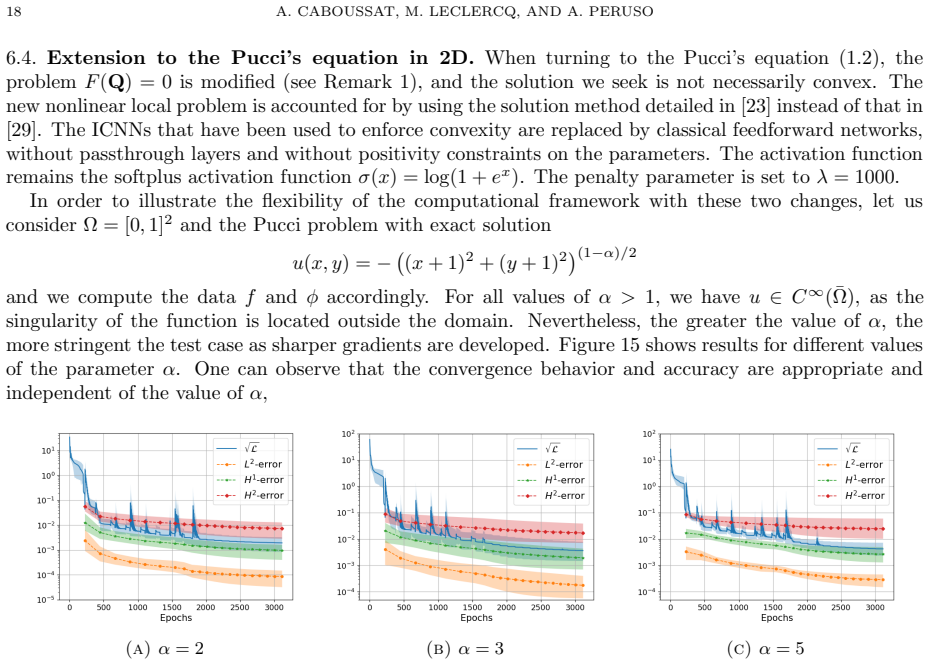
- The framework applies to multiple fully nonlinear equations by reusing existing nonlinear solvers for the local steps.
- Adaptive sampling reduces the number of collocation points needed without sacrificing solution accuracy.
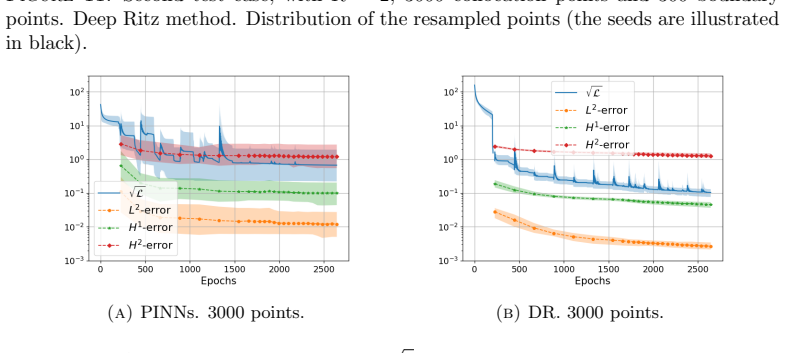
- Direct comparisons show the variational Deep Ritz component can outperform or complement full PINN training on the same problems.
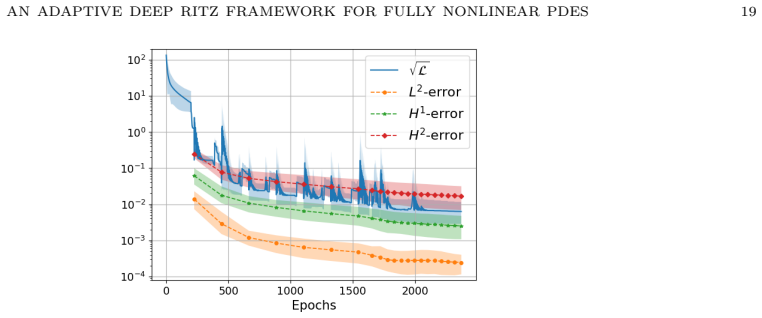
- The method extends naturally to optimal transport formulations with adjusted boundary conditions.
Where Pith is reading between the lines
- Hybrid traditional-numerical plus neural solvers may scale better for problems where nonlinearities dominate in isolated regions.
- The splitting idea could be tested on other variational PDE solvers to reduce overall training cost.
- Adaptive point selection might combine with error estimators from finite element theory for further gains.
Load-bearing premise
That the splitting preserves the variational structure so the Deep Ritz network can accurately solve the resulting linear subproblems without introducing significant errors.
What would settle it
If the iterative method fails to converge to a known exact solution for the Monge-Ampère equation under standard Dirichlet conditions while a full PINN approach succeeds, the decoupling benefit would be invalidated.
Figures






read the original abstract
As an alternative to PINNs, a Deep Ritz framework is proposed to solve fully nonlinear PDEs. A least-squares algorithm is advocated to decouple the nonlinearities from the variational features of several fully nonlinear PDEs. A splitting method allows to iteratively solve local nonlinear problems and linear variational problems at each iteration. While existing nonlinear solvers are applied to solve for nonlinearities, we propose a novel coupling with a Deep Ritz neural network approach that is well-suited to the variational flavor of the linear variational problems. An adaptive sampling strategy for the selection of collocation points is incorporated to increase the efficiency of the algorithm without sacrificing its accuracy. Numerical experiments are presented to solve the Dirichlet problem for several fully nonlinear equations, starting with the prototypical Monge-Amp\`ere equation, showing the flexibility of the approach. Numerical results are compared with results obtained using a full PINNs approach. Finally, numerical experiments are extended to address the optimal transport Monge-Amp\`ere problem with transport boundary conditions.
Editorial analysis
A structured set of objections, weighed in public.
Referee Report
Summary. The manuscript proposes an adaptive Deep Ritz framework as an alternative to PINNs for second-order fully nonlinear PDEs. A least-squares formulation decouples the nonlinearities, enabling a splitting iteration that alternates between local nonlinear solves (via standard solvers) and linear variational subproblems (discretized by a Deep Ritz neural network). An adaptive collocation strategy selects points for the variational problems. Numerical experiments solve Dirichlet problems for the Monge-Ampère equation and extend to the optimal transport problem with transport boundary conditions, with direct comparisons to a full PINN approach.
Significance. If validated, the approach could offer a more variationally natural and potentially efficient alternative to PINNs for fully nonlinear equations by exploiting the Deep Ritz method on the linear subproblems and incorporating adaptivity. The numerical demonstrations on Monge-Ampère and optimal transport problems illustrate flexibility across boundary conditions. However, the complete absence of convergence analysis or error estimates for the coupled splitting-plus-NN iteration substantially limits the work's significance in numerical analysis, where such guarantees are standard for iterative schemes applied to nonlinear PDEs.
major comments (2)
- [Section 2] Section 2 (algorithm description): No convergence analysis, contraction argument, or error propagation bound is given for the splitting iteration when the linear variational subproblems are replaced by Deep Ritz neural-network approximations. It is therefore unclear whether the iterates converge to a solution of the original fully nonlinear PDE (e.g., Monge-Ampère) in the presence of NN approximation error and adaptive point selection bias. This is load-bearing for the central claim that the framework reliably solves second-order fully nonlinear equations.
- [Section 3] Section 3 (numerical experiments): The comparisons with PINNs are presented only through selected plots and qualitative statements; no quantitative error tables, convergence rates with respect to network width/depth or number of collocation points, or ablation studies isolating the effect of the adaptive sampler appear. Without these data it is impossible to substantiate the claim that adaptive sampling increases efficiency without sacrificing accuracy.
minor comments (3)
- [Section 2.1] The least-squares functional used for decoupling should be written explicitly with all terms (including any regularization) so that readers can verify it is indeed parameter-free and equivalent to the original PDE.
- Figure captions and legends in the numerical section should explicitly state the network architecture, optimizer, and number of adaptive iterations used for each example to improve reproducibility.
- A short pseudocode box summarizing the overall splitting loop (nonlinear solve + Deep Ritz solve + adaptive resampling) would clarify the coupling between the components.
Simulated Author's Rebuttal
We thank the referee for their thorough review and valuable feedback on our manuscript. We appreciate the recognition of the potential of the adaptive Deep Ritz framework as an alternative to PINNs for fully nonlinear PDEs. We address the major comments below and will make revisions to improve the manuscript, particularly by enhancing the quantitative aspects of the numerical experiments and adding discussion on the convergence properties.
read point-by-point responses
-
Referee: Section 2 (algorithm description): No convergence analysis, contraction argument, or error propagation bound is given for the splitting iteration when the linear variational subproblems are replaced by Deep Ritz neural-network approximations. It is therefore unclear whether the iterates converge to a solution of the original fully nonlinear PDE (e.g., Monge-Ampère) in the presence of NN approximation error and adaptive point selection bias. This is load-bearing for the central claim that the framework reliably solves second-order fully nonlinear equations.
Authors: We agree that the lack of a rigorous convergence analysis for the splitting iteration in the presence of neural network approximations and adaptive sampling is a significant point. The manuscript is primarily focused on developing and demonstrating the algorithmic framework numerically. In the revised version, we will add a discussion in Section 2 on the theoretical foundations, including references to convergence results for the Deep Ritz method and for splitting schemes in nonlinear problems. We will also provide heuristic arguments on why the combined errors are controlled in practice, supported by the numerical results. A full mathematical proof of convergence for the coupled system is beyond the current scope and would constitute a separate theoretical paper; we note this limitation explicitly in the revision. revision: partial
-
Referee: Section 3 (numerical experiments): The comparisons with PINNs are presented only through selected plots and qualitative statements; no quantitative error tables, convergence rates with respect to network width/depth or number of collocation points, or ablation studies isolating the effect of the adaptive sampler appear. Without these data it is impossible to substantiate the claim that adaptive sampling increases efficiency without sacrificing accuracy.
Authors: We acknowledge that the numerical comparisons could be strengthened with more quantitative information. We will revise Section 3 to include tables with quantitative error metrics (such as relative L^2 errors and maximum pointwise errors) for the Monge-Ampère equation and the optimal transport problem, comparing our adaptive Deep Ritz method to the PINN approach. Additionally, we will present convergence studies with respect to the number of collocation points and network architecture parameters. An ablation study isolating the adaptive sampling strategy versus uniform sampling will be added to demonstrate its benefits in terms of efficiency and accuracy. revision: yes
- Full rigorous convergence analysis of the splitting iteration incorporating Deep Ritz approximations and adaptive collocation
Circularity Check
No significant circularity; algorithmic extension of standard variational and Deep Ritz methods
full rationale
The paper describes a numerical framework that applies least-squares decoupling and iterative splitting to separate nonlinear local solves from linear variational subproblems, which are then discretized via an existing Deep Ritz neural network plus adaptive collocation. No derivation chain is presented that reduces a claimed prediction or first-principles result to a quantity defined in terms of the method's own fitted parameters or outputs. The approach rests on well-established variational principles for the linear subproblems and prior Deep Ritz literature for the network approximation; numerical experiments on the Monge-Ampère equation and optimal transport variants serve as independent validation rather than self-referential confirmation. No self-definitional steps, fitted-input-as-prediction reductions, or load-bearing self-citations that collapse the central construction are identifiable from the abstract or method outline.
Axiom & Free-Parameter Ledger
axioms (2)
- domain assumption Deep Ritz neural networks can accurately solve the linear variational problems that remain after least-squares splitting of the nonlinear PDE.
- domain assumption Adaptive selection of collocation points increases efficiency without loss of accuracy for the target class of fully nonlinear equations.
Reference graph
Works this paper leans on
-
[1]
L. A. Caffarelli and X. Cabr´ e.Fully Nonlinear Elliptic Equations. American Mathematical Society, 1995
work page 1995
-
[2]
C. Villani.Optimal transport, volume 338 ofGrundlehren der mathematischen Wissenschaften [Fundamental Principles of Mathematical Sciences]. Springer-Verlag, Berlin, 2009. AN ADAPTIVE DEEP RITZ FRAMEWORK FOR FULLY NONLINEAR PDES 25
work page 2009
-
[3]
G. De Philippis and A. Figalli. The Monge-Amp` ere equation and its link to optimal transportation.Bull. Amer. Math. Soc. (N.S.), 51(4):527–580, 2014
work page 2014
-
[4]
B. Hamfeldt and A. Oberman. Convergent finite difference solvers for viscosity solutions of the elliptic Monge-Amp` ere equation in dimensions two and higher.SIAM J. Numerical Analysis, 49:1692–1714, 01 2011
work page 2011
-
[5]
X. Feng, R. Glowinski, and M. Neilan. Recent developments in numerical methods for fully nonlinear second order partial differential equations.SIAM Review, 55(2):205–267, 2013
work page 2013
-
[6]
Susanne C. Brenner, Thirupathi Gudi, Michael Neilan, and Li-yeng Sung.C 0 penalty methods for the fully nonlinear Monge-Amp` ere equation.Math. Comp., 80(276):1979–1995, 2011
work page 1979
-
[7]
O. Lakkis and T. Pryer. A finite element method for nonlinear elliptic problems.SIAM Journal on Scientific Computing, 35(4):A2025–A2045, 2013
work page 2013
-
[8]
N. S. Trudinger and X.-J. Wang. The Monge-Amp` ere equation and its geometric applications.Handbook of geometric analysis, 1:467–524, 2008
work page 2008
- [9]
-
[10]
A. Caboussat, R. Glowinski, and D. C. Sorensen. A least-squares method for the numerical solution of the Dirichlet problem for the elliptic Monge-Amp` ere equation in dimension two.ESAIM Control Optim. Calc. Var., 19(3):780–810, 2013
work page 2013
- [11]
-
[12]
G. E. Karniadakis, I. G. Kevrekidis, L. Lu, P. Perdikaris, S. Wang, and L. Yang. Physics-informed machine learning. Nature Reviews Physics, 3(6):422–440, 2021
work page 2021
-
[13]
E. Kharazmi, Z. Zhang, and G. E. Karniadakis. Variational physics-informed neural networks for solving partial differ- ential equations, 2019
work page 2019
-
[14]
W. E and B. Yu. The deep Ritz method: a deep learning-based numerical algorithm for solving variational problems. Commun. Math. Stat., 6(1):1–12, 2018
work page 2018
-
[15]
Error estimates for the deep Ritz method with boundary penalty
Johannes M¨ uller and Marius Zeinhofer. Error estimates for the deep Ritz method with boundary penalty. InMathematical and Scientific Machine Learning, pages 215–230. PMLR, 2022
work page 2022
-
[16]
An iterative deep Ritz method for monotone elliptic problems.J
Tianhao Hu, Bangti Jin, and Fengru Wang. An iterative deep Ritz method for monotone elliptic problems.J. Comput. Phys., 527:Paper No. 113791, 28, 2025
work page 2025
-
[17]
A. Caboussat and A. Peruso. Convex physics-informed neural networks for the Monge–Amp` ere optimal transport prob- lem.Engineering Computations, pages 1–20, 2025
work page 2025
-
[18]
K. Nystr¨ om and M. Vestberg. Solving the Dirichlet problem for the Monge–Amp` ere equation using neural networks. Journal of Computational Mathematics and Data Science, 8:100080, 2023
work page 2023
-
[19]
Roel Hacking, Lisa Kusch, Koondanibha Mitra, Martijn Anthonissen, and Wilbert IJzerman. A neural network approach for solving the monge–amp` ere equation with transport boundary condition.Journal of Computational Mathematics and Data Science, 15:100119, 2025
work page 2025
-
[20]
B. Amos, L. Xu, and J. Z. Kolter. Input convex neural networks. In Doina Precup and Yee Whye Teh, editors,Proceedings of the 34th International Conference on Machine Learning, volume 70 ofProceedings of Machine Learning Research, pages 146–155. PMLR, 2017
work page 2017
-
[21]
Aditi Krishnapriyan, Amir Gholami, Shandian Zhe, Robert Kirby, and Michael W Mahoney. Characterizing possible failure modes in physics-informed neural networks.Advances in neural information processing systems, 34:26548–26560, 2021
work page 2021
-
[22]
H. Liu, S. Leung, and J. Qian. Operator-splitting/finite element methods for the Minkowski problem.SIAM J. Sci. Comput., 46(5):A3230–A3257, 2024
work page 2024
- [23]
-
[24]
C. R. Prins, R. Beltman, J. H. M. ten Thije Boonkkamp, W. L. Ijzerman, and T. W. Tukker. A least-squares method for optimal transport using the Monge-Amp` ere equation.SIAM J. Sci. Comput., 37(6):B937–B961, 2015
work page 2015
-
[25]
A. Caboussat, R. Glowinski, and D. Gourzoulidis. A least-squares/relaxation method for the numerical solution of the three-dimensional elliptic Monge-Amp` ere equation.J. Sci. Comput., 77(1):53–78, 2018
work page 2018
-
[26]
A. Caboussat, R. Glowinski, and D. Gourzoulidis. A least-squares method for the solution of the non-smooth prescribed Jacobian equation.J. Sci. Comput., 93(1), 2022
work page 2022
-
[27]
Convergence of a least-squares splitting method for the Monge-Amp` ere equation
Anna Peruso and Massimo Sorella. Convergence of a least-squares splitting method for the Monge-Amp` ere equation. 2026
work page 2026
-
[28]
A. Caboussat, A. Peruso, and M. Picasso. Error estimates and adaptivity for a least-squares method applied to the Monge-Amp` ere equation.arXiv preprint arXiv:2507.17569, 2025. 26 A. CABOUSSAT, M. LECLERCQ, AND A. PERUSO
-
[29]
D. C. Sorensen and R. Glowinski. A quadratically constrained minimization problem arising from PDE of Monge-Amp` ere type.Numer. Algorithms, 53(1):53–66, 2010
work page 2010
-
[30]
G. Monge. M´ emoire sur la th´ eorie des d´ eblais et des remblais.Histoire de l’Acad´ emie royale des sciences avec les m´ emoires de math´ ematique et de physique tir´ es des registres de cette Acad´ emie, pages 666–705, 1781
-
[31]
Polar factorization and monotone rearrangement of vector-valued functions.Comm
Yann Brenier. Polar factorization and monotone rearrangement of vector-valued functions.Comm. Pure Appl. Math., 44(4):375–417, 1991
work page 1991
-
[32]
Y. Chen, Y. Shi, and B. Zhang. Optimal control via neural networks: A convex approach.arXiv: Optimization and Control, 2018
work page 2018
-
[33]
A natural deep Ritz method for essential boundary value problems.J
Haijun Yu and Shuo Zhang. A natural deep Ritz method for essential boundary value problems.J. Comput. Phys., 537:Paper No. 114133, 15, 2025
work page 2025
-
[34]
M. A. Nabian, R. J. Gladstone, and H. Meidani. Efficient training of physics-informed neural networks via importance sampling.Computer-Aided Civil and Infrastructure Engineering, 36(8):962–977, 2021
work page 2021
-
[35]
P. Rathore, W. Lei, Z. Frangella, L. Lu, and M. Udell. Challenges in training PINNs: a loss landscape perspective. Proceedings of the 41st International Conference on Machine Learning, 2024. Geneva School of Business Administration (HEG-Gen`eve), University of Applied Sciences and Arts Western Switzerland (HES-SO), 1227 Carouge, Switzerland, Email:alexand...
work page 2024
discussion (0)
Sign in with ORCID, Apple, or X to comment. Anyone can read and Pith papers without signing in.