Leveraging natural fluctuations for matrix-based aberration correction in photoacoustic imaging
Pith reviewed 2026-05-07 07:43 UTC · model grok-4.3
The pith
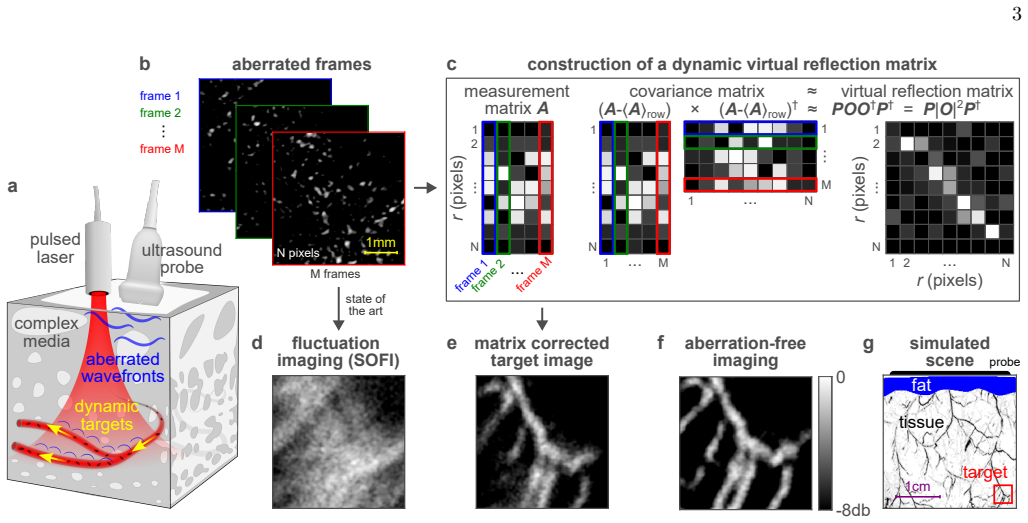
Covariance analysis of photoacoustic frames from dynamic targets yields a virtual reflection matrix for aberration correction
A machine-rendered reading of the paper's core claim, the machinery that carries it, and where it could break.
Core claim
The central claim is that a covariance matrix analysis of a conventional set of photoacoustic frames of dynamic targets yields a virtual reflection-matrix that is mathematically analogous to a pulse-echo reflection-matrix, and lends itself to direct processing by conventional reflection-matrix based scattering-compensation algorithms.
What carries the argument
Covariance matrix of photoacoustic frames from dynamic targets, which produces a virtual reflection-matrix equivalent to a pulse-echo reflection-matrix for direct use in scattering-compensation algorithms
Load-bearing premise
The fluctuations produced by dynamic targets are sufficiently uncorrelated and spatially distributed to generate a virtual reflection matrix whose singular-value structure and distortion properties match those of a true pulse-echo reflection matrix.
What would settle it
If the virtual matrix from flowing absorbers, when processed by a reflection-matrix correction algorithm, produces no measurable improvement in image resolution or reduction in artifacts compared with the uncorrected frames in a setup with known speed-of-sound heterogeneities, the claimed equivalence would be disproven.
Figures


read the original abstract
Photoacoustic imaging is the leading technique for deep tissue optical imaging, allowing single-shot imaging at depths. However, its resolution may be limited by acoustic aberrations, caused by natural unknown heterogeneities in the tissue speed of sound. In recent years, reflection-matrix based scattering-compensation techniques have been successfully employed in ultrasound, optics, and seismology, to computationally correct such distortions. However, they have not been adapted to photoacoustic imaging since they rely on multiple acquisitions under different controlled excitations, such as input plane-wave illuminations, which do not result in signal changes in photoacoustics. Here, we introduce a framework that enables the direct application of the state-of-the-art reflection-matrix based aberration correction techniques to photoacoustic imaging of dynamic targets. Specifically, we show that a covariance matrix analysis of a conventional set of photoacoustic frames of dynamic targets, such as flowing red blood cells in blood vessels, yields a virtual reflection-matrix that is mathematically analogous to a pulse-echo reflection-matrix, and lends itself to direct processing by conventional reflection-matrix based scattering-compensation algorithms. We validate and demonstrate the approach for photoacoustic aberration correction of vessel-mimicking targets containing flowing absorbers in both simulations and experiments.
Editorial analysis
A structured set of objections, weighed in public.
Referee Report
Summary. The manuscript presents a novel approach to aberration correction in photoacoustic imaging by leveraging natural fluctuations from dynamic targets to construct a virtual reflection matrix from the covariance of photoacoustic signals. This virtual matrix is purported to be equivalent to a conventional pulse-echo reflection matrix, allowing the application of established matrix-based scattering compensation techniques without the need for controlled multiple illuminations. The method is demonstrated in both numerical simulations and experimental setups using vessel-mimicking phantoms with flowing absorbers.
Significance. This work has the potential to be significant for the field of photoacoustic imaging, as it provides a way to correct for acoustic aberrations using standard imaging sequences of moving targets, which are common in vascular imaging. If the analogy holds and the method proves robust, it could lead to improved image quality in deep tissues without additional experimental complexity. The approach cleverly uses the physics of fluctuating sources to mimic the conditions needed for reflection matrix methods.
major comments (2)
- [Theory] Theory section (derivation of virtual matrix): The covariance matrix is reduced to a form equivalent to G G^H under the assumption of uncorrelated absorbers, encoding only one-way receive propagation. Standard reflection-matrix algorithms (distortion-matrix or SVD-based) are derived for two-way operators of the form R = G_out S G_in^H. The manuscript must explicitly show, with equations, how phase corrections extracted from this one-way Gram matrix recover the actual one-way aberrations present in the photoacoustic data and whether the algorithms require any modification for direct application.
- [Results] Results and validation sections: While simulations and experiments on vessel-mimicking targets are presented, no quantitative metrics are reported (e.g., resolution improvement via FWHM, residual phase error, or success rate across multiple realizations with error bars). This makes it difficult to assess whether the correction performance matches the central claim of effective aberration compensation, particularly given the one-way versus two-way structural difference.
minor comments (2)
- [Abstract] The abstract claims validation in simulations and experiments but provides no numerical performance indicators or key parameters (e.g., number of frames used for covariance estimation), which would improve immediate readability.
- [Figures and Methods] Figure captions and methods descriptions would benefit from additional detail on experimental parameters such as flow speed, absorber concentration, and the exact number of PA frames averaged to form the covariance matrix.
Simulated Author's Rebuttal
We thank the referee for the insightful comments and the positive evaluation of our work's potential impact. We provide point-by-point responses to the major comments below and plan to revise the manuscript to address them.
read point-by-point responses
-
Referee: [Theory] Theory section (derivation of virtual matrix): The covariance matrix is reduced to a form equivalent to G G^H under the assumption of uncorrelated absorbers, encoding only one-way receive propagation. Standard reflection-matrix algorithms (distortion-matrix or SVD-based) are derived for two-way operators of the form R = G_out S G_in^H. The manuscript must explicitly show, with equations, how phase corrections extracted from this one-way Gram matrix recover the actual one-way aberrations present in the photoacoustic data and whether the algorithms require any modification for direct application.
Authors: We thank the referee for highlighting this key theoretical aspect. In our derivation, the virtual matrix V = <p p^H> reduces to G G^H (up to scaling) for uncorrelated fluctuating absorbers, where G represents the one-way Green's function from the target plane to the transducer array. Since photoacoustic signals involve only receive propagation, the aberrations are one-way. The standard algorithms, such as the distortion matrix method, operate by constructing a matrix that isolates the aberration phases. For the one-way case, V = A G_0 G_0^H A^H, where A is the diagonal aberration matrix. Applying the distortion matrix D = V ./ (reference phases) and performing SVD or phase retrieval directly yields the phases in A, which can then be used to correct the original photoacoustic data by applying the conjugate phases to the receive signals. No fundamental modification to the algorithm is required; it is applied identically to the virtual matrix, and the resulting correction is valid for the one-way operator. We will add a new subsection in the Theory section with these explicit equations and a step-by-step explanation of the phase recovery process to clarify this equivalence. revision: yes
-
Referee: [Results] Results and validation sections: While simulations and experiments on vessel-mimicking targets are presented, no quantitative metrics are reported (e.g., resolution improvement via FWHM, residual phase error, or success rate across multiple realizations with error bars). This makes it difficult to assess whether the correction performance matches the central claim of effective aberration compensation, particularly given the one-way versus two-way structural difference.
Authors: We agree that quantitative metrics would strengthen the validation of our claims. In the revised manuscript, we will include additional analysis in the Results section: (i) FWHM measurements of the vessel cross-sections before and after correction, averaged over multiple vessels with standard deviations; (ii) in simulations, the residual phase error computed as the standard deviation of the difference between estimated and ground-truth aberration phases; (iii) success rates across 50 independent realizations with error bars, where success is defined as achieving at least 20% improvement in image contrast or resolution. These metrics will be presented in tables and figures for both simulated and experimental data, allowing direct comparison to the performance expected from two-way methods. This addition will better demonstrate the effectiveness despite the one-way propagation. revision: yes
Circularity Check
No significant circularity; derivation is self-contained via physical modeling and external validation
full rationale
The paper starts from the standard photoacoustic forward model p = G s (one-way propagation from dynamic absorbers) and computes the data covariance C = <p p^H> = G <s s^H> G^H. Under the explicit assumption that flowing absorbers produce uncorrelated sources (<s s^H> ≈ I), this reduces to the Gram matrix G G^H, which the authors then label a 'virtual reflection-matrix' and feed into pre-existing distortion-matrix or SVD-based correction routines. This construction is derived directly from wave-propagation physics and the statistical properties of the targets; it is not obtained by fitting a parameter to the target result, by renaming a known empirical pattern, or by invoking a uniqueness theorem from the authors' own prior work. The claim of mathematical analogy to pulse-echo reflection matrices (R = G_out S G_in^H) is presented as an observation to be tested, not as an identity by definition, and is supported by separate simulation and experimental demonstrations rather than by self-referential equations or load-bearing self-citations. No step in the chain reduces to its own inputs by construction.
Axiom & Free-Parameter Ledger
axioms (1)
- domain assumption The covariance matrix computed from time-varying photoacoustic signals of moving point-like absorbers is mathematically equivalent to the reflection matrix obtained from multiple controlled pulse-echo illuminations.
Reference graph
Works this paper leans on
-
[1]
Photoacoustic tomography: In vivo imaging from organelles to organs,
1L. V. Wang and S. Hu, “Photoacoustic tomography: In vivo imaging from organelles to organs,” Science335, 1458–1462 (2012). 2S. Manohar and D. Razansky, “Photoacoustics: a historical re- view,” Advances in Optics and Photonics8, 586 (2016). 3V. Perrot, M. Polichetti, F. Varray, and D. Garcia, “So you think you can das? a viewpoint on delay-and-sum beamfor...
-
[2]
Pixel reassignment in image scanning microscopy: a re-evaluation,
Koho, G. Vicidomini, and A. Diaspro, “Pixel reassignment in image scanning microscopy: a re-evaluation,” J. Opt. Soc. Am. A37, 154–162 (2020). 53T. I. Sommer and O. Katz, “Pixel-reassignment in ultrasound imaging,” Applied Physics Letters119, 123701 (2021). 54H.-C. Shin, R. Prager, H. Gomersall, N. Kingsbury, G. Treece, and A. Gee, “Estimation of average ...
work page 2020
discussion (0)
Sign in with ORCID, Apple, or X to comment. Anyone can read and Pith papers without signing in.