Succinct Graph Representations and Algorithmic Applications
Pith reviewed 2026-05-07 04:54 UTC · model grok-4.3
The pith
Dual clique cover representations let graph algorithms run in time proportional to the compact representation size instead of the number of edges.
A machine-rendered reading of the paper's core claim, the machinery that carries it, and where it could break.
Core claim
A dual clique cover (DCC) representation of an undirected graph G is the pair (C, L), where C is a collection of cliques covering the edges of G and L is the incidence dual of C. Succinct DCC representations are those that are both compact and constructible in polynomial time. Graph primitives such as connected components, BFS forests, DFS forests, and maximal matchings can be computed in time proportional to the size of any DCC representation. When the representation is succinct, the combined time and space bounds match or improve upon those obtained from standard edge-list representations.
What carries the argument
The dual clique cover (DCC) representation: a clique edge cover C paired with its incidence dual L, which lets algorithms traverse cliques and vertex-clique incidences rather than individual edges.
If this is right
- Connected components, BFS forests, DFS forests, and maximal matchings are all computable in time linear in the size of the DCC representation.
- For any graph admitting a succinct DCC, the new algorithms achieve time and space bounds that are at least as good as, and sometimes strictly better than, their adjacency-list counterparts.
- Construction algorithms for succinct DCC representations run in polynomial time and come with explicit efficiency guarantees.
- Empirical memory savings reach 35x and total-time speedups reach 35x on tested instances when the representation is succinct.
Where Pith is reading between the lines
- The same representation-aware approach could be adapted to other primitives such as shortest paths or spanning trees whenever those problems can be solved by traversing cliques and incidences.
- Graphs arising from social or biological networks, which often contain dense communities, are natural candidates for large practical speedups.
- If succinct DCCs can be maintained under edge insertions or deletions, the framework would extend directly to dynamic graph algorithms.
Load-bearing premise
Many graphs possess dense local clique structure that permits a compact dual clique cover to be found in polynomial time and to be substantially smaller than the edge set.
What would settle it
Constructing a DCC representation on a large collection of graphs and finding that its size is not appreciably smaller than the number of edges, or that construction time exceeds the subsequent algorithmic savings, would show the claimed improvements do not materialize.
Figures




read the original abstract
We propose new graph representations that exploit dense local structure to improve time and space simultaneously. Given an undirected graph $G$, we define a dual clique cover (DCC) representation of $G$ to be the pair $(C, L)$, where $C$ is a collection of cliques that covers the edges of $G$ and $L$ is the incidence dual of $C$. We identify classes of polynomial-time constructible DCC representations that are compact and call them succinct DCC representations. We then develop representation-aware algorithms for several fundamental graph problems. We show that graph primitives such as connected components, breadth-first search forests, depth-first search forests, and maximal matchings can be computed in time proportional to the size of a DCC representation rather than the number of edges. Combined with our succinct DCC representations, these results give a class of algorithms that either match or improve the time and space bounds of their counterparts on standard graph representations. Furthermore, we design several algorithms for constructing succinct DCC representations and establish provable guarantees on their efficiency. We evaluate several graph algorithms on DCC representations against adjacency-list-based implementations on a large collection of real-world and synthetic graphs. All evaluated applications show substantial execution memory savings and total-time speedups; for example, the connected components algorithm achieves about $9\times$ execution memory savings on average, with a maximum of $35\times$, and about $6.5\times$ total-time speedups on average, with a maximum of $35\times$. We also evaluate several DCC construction algorithms and find that the succinctness property plays a key role in making DCC representations effective for algorithmic applications.
Editorial analysis
A structured set of objections, weighed in public.
Referee Report
Summary. The paper proposes succinct dual clique cover (DCC) representations for undirected graphs, defined as the pair (C, L) where C is an edge-covering collection of cliques and L is the incidence dual. It identifies classes of graphs admitting succinct DCC representations that are compact and constructible in polynomial time. Representation-aware algorithms are developed for connected components, BFS forests, DFS forests, and maximal matchings that run in time proportional to the DCC size rather than the number of edges. The paper also gives construction algorithms with provable efficiency guarantees and reports experimental results on real-world and synthetic graphs showing average 9x memory savings and 6.5x time speedups (with maxima of 35x) for connected components.
Significance. If the claims hold, the work provides a new approach to exploiting dense local structure for simultaneous improvements in time and space for fundamental graph primitives. Strengths include the explicit polynomial-time constructions for specific classes, the direct operation on the incidence structure for the primitives, and the combination of theoretical bounds with empirical validation on real graphs. This could influence algorithm design for graphs with community or clique-like substructures and offers a concrete alternative to standard adjacency-list representations when the succinctness property applies.
major comments (2)
- [§4.1] §4.1, Theorem 4.1: The connected-components algorithm is claimed to run in time linear in the DCC size using union-find over cliques; however, the analysis does not explicitly bound the cost when vertices participate in many cliques (i.e., high degree in L), which could introduce an extra factor linear in the maximum number of cliques per vertex and undermine the 'proportional to representation size' claim.
- [§3.3] §3.3, Construction for chordal graphs: The polynomial-time claim for building a succinct DCC relies on a linear-time clique enumeration step, but the paper does not address how the incidence dual L is materialized without an extra O(log n) factor per incidence when using standard data structures; this detail is load-bearing for the 'polynomial-time constructible' guarantee.
minor comments (3)
- [Figure 2] Figure 2: The illustration of the incidence dual L would benefit from explicit vertex and clique labels to make the traversal for BFS/DFS clearer.
- [§6] §6: The experimental section reports averages over 'a large collection' but does not list the exact number of graphs or the selection criteria; adding this would improve reproducibility.
- [Abstract] Abstract and §1: The phrase 'time proportional to the size of a DCC representation' is used without an initial formal definition of representation size; a short parenthetical (e.g., |C| + |L|) would help readers.
Simulated Author's Rebuttal
We appreciate the referee's detailed comments, which have helped us improve the clarity of our presentation. Below we respond to each major comment and indicate the revisions made to the manuscript.
read point-by-point responses
-
Referee: [§4.1] §4.1, Theorem 4.1: The connected-components algorithm is claimed to run in time linear in the DCC size using union-find over cliques; however, the analysis does not explicitly bound the cost when vertices participate in many cliques (i.e., high degree in L), which could introduce an extra factor linear in the maximum number of cliques per vertex and undermine the 'proportional to representation size' claim.
Authors: The representation size of the DCC is |C| + |L|, with |L| denoting the total number of incidences between vertices and cliques. The connected-components procedure examines each clique and, for each vertex in the clique, performs a union operation. Since each incidence appears exactly once in L, the algorithm performs a constant amount of work per element of L (amortized, via the union-find structure). Thus the running time is O(|L| α(n)), which is linear in the size of the representation. The multiplicity of cliques per vertex is already reflected in the magnitude of |L| and does not introduce an additional multiplicative factor. We have inserted a clarifying sentence immediately after the statement of Theorem 4.1 to make this accounting explicit. revision: yes
-
Referee: [§3.3] §3.3, Construction for chordal graphs: The polynomial-time claim for building a succinct DCC relies on a linear-time clique enumeration step, but the paper does not address how the incidence dual L is materialized without an extra O(log n) factor per incidence when using standard data structures; this detail is load-bearing for the 'polynomial-time constructible' guarantee.
Authors: The linear-time clique enumeration for chordal graphs outputs each clique as an explicit list of its vertices. To assemble the incidence dual L we allocate an array of n dynamic lists and, for every vertex belonging to a clique, append the clique identifier to the corresponding list. When dynamic arrays are employed, each append costs amortized constant time; consequently the materialization of L requires only O(|L|) time in total and introduces no logarithmic factor per incidence. The overall construction therefore remains linear in the combined size of the output representation. We have added a paragraph in §3.3 describing the data structures used for this step. revision: yes
Circularity Check
No significant circularity detected in derivation chain
full rationale
The paper introduces a new DCC representation defined as the pair (C, L) where C is an edge-covering clique collection and L its incidence dual. It then explicitly identifies specific graph classes admitting polynomial-time constructible compact DCCs, supplies concrete construction algorithms with proven efficiency bounds, and derives representation-aware algorithms for connectivity, BFS/DFS forests, and maximal matchings whose running times are proven linear in |DCC| via direct operations on the incidence structure. All steps rest on independent definitions, standard graph-theoretic arguments, and explicit constructions rather than any reduction to fitted parameters, self-referential equations, or load-bearing self-citations. The experimental section reports measured speedups on real graphs when the succinctness property holds, but these are empirical observations, not part of the claimed derivation. The central claims therefore remain self-contained against external benchmarks and do not collapse by construction to their inputs.
Axiom & Free-Parameter Ledger
axioms (2)
- standard math Undirected graphs admit clique edge covers
- domain assumption Polynomial-time constructible succinct DCCs exist for graphs with dense local structure
invented entities (1)
-
Dual clique cover (DCC) representation
no independent evidence
Reference graph
Works this paper leans on
-
[1]
Statistical mechanics of complex networks.Reviews of Modern Physics, 74(1):47, 2002
Réka Albert and Albert-László Barabási. Statistical mechanics of complex networks.Reviews of Modern Physics, 74(1):47, 2002
2002
-
[2]
MaciejBestaandTorstenHoefler. Surveyandtaxonomyoflosslessgraphcompressionandspace-efficient graph representations.arXiv preprint arXiv:1806.01799, 2018
-
[3]
TheWebGraphframeworkI:compressiontechniques
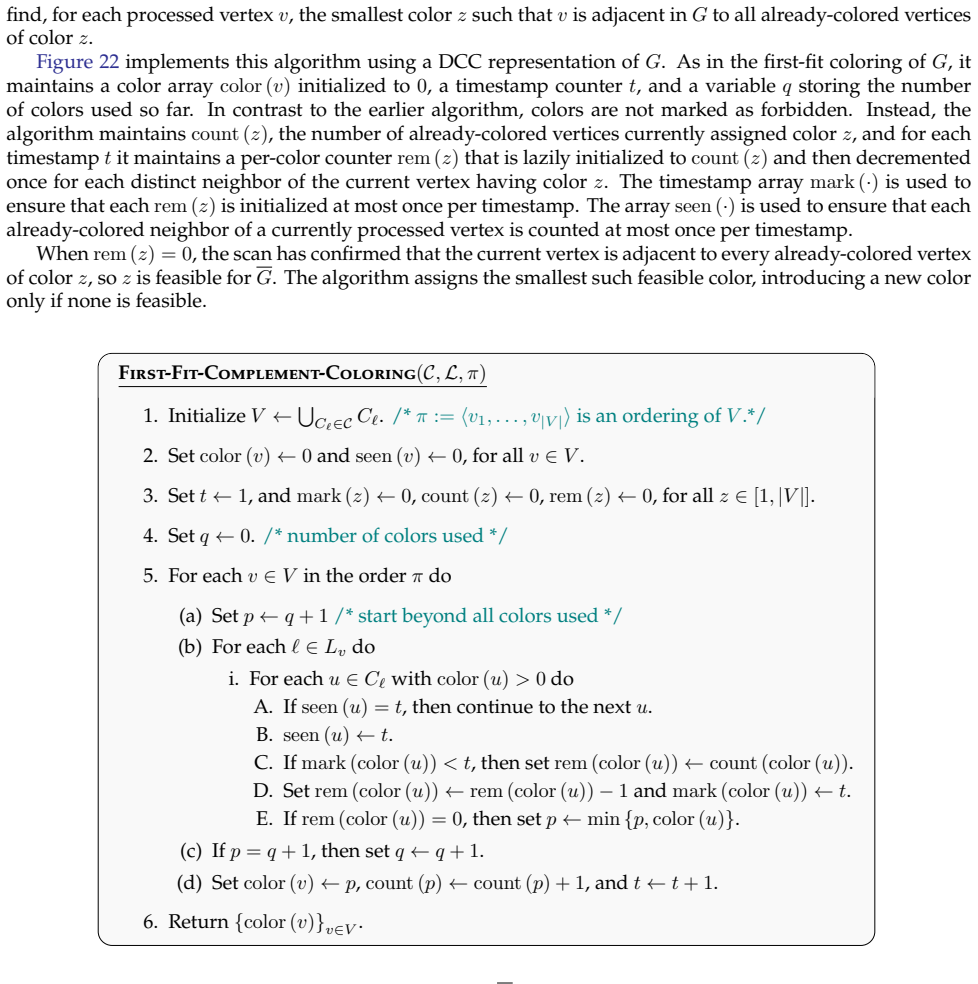
PaoloBoldiandSebastianoVigna. TheWebGraphframeworkI:compressiontechniques. InProceedingsof the 13th International Conference on World Wide Web, pages 595–602, 2004
2004
-
[4]
Cliques in random graphs.Mathematical Proceedings of the Cambridge Philosophical Society, 80(3):419–427, 1976
Béla Bollobás and Paul Erdős. Cliques in random graphs.Mathematical Proceedings of the Cambridge Philosophical Society, 80(3):419–427, 1976
1976
-
[5]
A scalable pattern mining approach to web graph compression with communities
Gregory Buehrer and Kumar Chellapilla. A scalable pattern mining approach to web graph compression with communities. InProceedings of the 2008 international conference on web search and data mining, pages 95–106, 2008. 29
2008
-
[6]
On the tree-degree of graphs
Maw-Shang Chang and Haiko Müller. On the tree-degree of graphs. InInternational Workshop on Graph- Theoretic Concepts in Computer Science, pages 44–54. Springer, 2001
2001
-
[7]
AksharChavan,SanazRabinia,DanielGrosu,andMarcoBrocanelli.Acliquepartitioning-basedalgorithm for graph compression.arXiv preprint arXiv:2502.02477, 2025
work page internal anchor Pith review Pith/arXiv arXiv 2025
-
[8]
Arboricity and subgraph listing algorithms.SIAM Journal on computing, 14(1):210–223, 1985
Norishige Chiba and Takao Nishizeki. Arboricity and subgraph listing algorithms.SIAM Journal on computing, 14(1):210–223, 1985
1985
-
[9]
Large-scale clique cover of real-world networks
Alessio Conte, Roberto Grossi, and Andrea Marino. Large-scale clique cover of real-world networks. Information and Computation, 270:104464, 2020
2020
-
[10]
MIT press, 2022
Thomas H Cormen, Charles E Leiserson, Ronald L Rivest, and Clifford Stein.Introduction to Algorithms. MIT press, 2022
2022
-
[11]
The University of Florida sparse matrix collection.ACM Transactions on Mathematical Software (TOMS), 38(1):1–25, 2011
Timothy A Davis and Yifan Hu. The University of Florida sparse matrix collection.ACM Transactions on Mathematical Software (TOMS), 38(1):1–25, 2011
2011
-
[12]
Assignment-minimum clique coverings.Journal of Experimental Algorithmics (JEA), 17:1–1, 2012
John M Ennis, Charles M Fayle, and Daniel M Ennis. Assignment-minimum clique coverings.Journal of Experimental Algorithmics (JEA), 17:1–1, 2012
2012
-
[13]
The representation of a graph by set intersections
Paul Erdős, Adolph W Goodman, and Louis Pósa. The representation of a graph by set intersections. Canadian Journal of Mathematics, 18:106–112, 1966
1966
-
[14]
On the evolution of random graphs.Publ
Paul Erdős and Alfréd Rényi. On the evolution of random graphs.Publ. Math. Inst. Hung. Acad. Sci., 5:17–60, 1960
1960
-
[15]
Clique partitions, graph compression and speeding-up algorithms
Tomás Feder and Rajeev Motwani. Clique partitions, graph compression and speeding-up algorithms. Journal of Computer and System Sciences, 51(2):261–272, 1995.doi:10.1006/jcss.1995.1065
-
[16]
Graphdistances in the data-stream model.SIAM Journal on Computing, 38(5):1709–1727, 2009
JoanFeigenbaum,SampathKannan,AndrewMcGregor,SiddharthSuri,andJianZhang. Graphdistances in the data-stream model.SIAM Journal on Computing, 38(5):1709–1727, 2009
2009
-
[17]
Edge clique partition and cover beyond independence
Fedor V Fomin, Petr A Golovach, Danil Sagunov, and Kirill Simonov. Edge clique partition and cover beyond independence. In33rd Annual European Symposium on Algorithms (ESA 2025), pages 43:1–43:16. Schloss Dagstuhl–Leibniz-Zentrum für Informatik, 2025
2025
-
[18]
Data reduction, exact, and heuristic algo- rithmsforcliquecover
Jens Gramm, Jiong Guo, Falk Hüffner, and Rolf Niedermeier. Data reduction, exact, and heuristic algo- rithmsforcliquecover. InProceedingsoftheMeetingonAlgorithmEngineering&Expermiments,pages86–94. Society for Industrial and Applied Mathematics, 2006
2006
-
[19]
Constructing an indeterminate string from its associated graph.Theoretical Computer Science, 710:88–96, 2018
Joel Helling, PJ Ryan, WF Smyth, and Michael Soltys. Constructing an indeterminate string from its associated graph.Theoretical Computer Science, 710:88–96, 2018
2018
-
[20]
Schloss Dagstuhl–Leibniz-Zentrum für Informatik, 2023
Anthony Hevia, Benjamin Kallus, Summer McClintic, Samantha Reisner, Darren Strash, and Johnathan Wilson.Solvingedgecliquecoverexactlyviasynergisticdatareduction.In31stAnnualEuropeanSymposium on Algorithms (ESA 2023), pages 61:1–61:19. Schloss Dagstuhl–Leibniz-Zentrum für Informatik, 2023
2023
-
[21]
Complexity of graph covering problems for graphs of low degree.Journal of Combina- torial Mathematics and Combinatorial Computing, 11:187–208, 1992
Douglas N Hoover. Complexity of graph covering problems for graphs of low degree.Journal of Combina- torial Mathematics and Combinatorial Computing, 11:187–208, 1992
1992
-
[22]
Space lower bounds for approximating maximum matching in the edge arrival model
Michael Kapralov. Space lower bounds for approximating maximum matching in the edge arrival model. InProceedings of the 2021 ACM-SIAM Symposium on Discrete Algorithms (SODA), pages 1874–1893. SIAM, 2021
2021
-
[23]
Speeding up algorithms on compressed web graphs
Chinmay Karande, Kumar Chellapilla, and Reid Andersen. Speeding up algorithms on compressed web graphs. InProceedings of the Second ACM International Conference on Web Search and Data Mining, pages 272–281, 2009
2009
-
[24]
Determination of keyword conflict.IBM Technical Disclosure Bulletin, 16(2):544–546, 1973
Eduardo Kellerman. Determination of keyword conflict.IBM Technical Disclosure Bulletin, 16(2):544–546, 1973. 30
1973
-
[25]
Kou, Larry J
Lawrence T. Kou, Larry J. Stockmeyer, and Chak-Kuen Wong. Covering edges by cliques with regard to keyword conflicts and intersection graphs.Communications of the ACM, 21(2):135–139, 1978
1978
-
[26]
On covering of graphs
László Lovász. On covering of graphs. InTheory of Graphs (Proc. Colloq., Tihany, 1966), pages 231–236. Academic Press New York, 1968
1966
-
[27]
Onthehardnessofapproximatingminimizationproblems.Journal of the ACM (JACM), 41(5):960–981, 1994
CarstenLundandMihalisYannakakis. Onthehardnessofapproximatingminimizationproblems.Journal of the ACM (JACM), 41(5):960–981, 1994
1994
-
[28]
Clique covering of chordal graphs.Utilitas Mathematica, 36:151–152, 1989
Shaohan Ma, Walter D Wallis, and Julin Wu. Clique covering of chordal graphs.Utilitas Mathematica, 36:151–152, 1989
1989
-
[29]
Neuro-causal factor analysis.arXiv preprint arXiv:2305.19802, 2023
Alex Markham, Mingyu Liu, Bryon Aragam, and Liam Solus. Neuro-causal factor analysis.arXiv preprint arXiv:2305.19802, 2023
-
[30]
Smallest-lastorderingandclusteringandgraphcoloringalgorithms
DavidWMatulaandLelandLBeck. Smallest-lastorderingandclusteringandgraphcoloringalgorithms. Journal of the ACM (JACM), 30(3):417–427, 1983
1983
-
[31]
Empoweringfaculty: Acampuscyberinfrastructure strategy for research communities.Educause Review, 2014
GerryMcCartney, ThomasHacker, andBaijianYang. Empoweringfaculty: Acampuscyberinfrastructure strategy for research communities.Educause Review, 2014
2014
-
[32]
SIAM, 1999
Terry A McKee and Fred R McMorris.Topics in intersection graph theory. SIAM, 1999
1999
-
[33]
Contentment in graph theory: covering graphs with cliques
James Orlin. Contentment in graph theory: covering graphs with cliques. InIndagationes Mathematicae (Proceedings), volume 80, pages 406–424. Elsevier, 1977
1977
-
[34]
Totalvariationerrorboundsforgeometricapproximation
ErolAPeköz,AdrianRöllinn,andNathanRoss. Totalvariationerrorboundsforgeometricapproximation. Bernoulli, 19(2):610–632, 2013
2013
-
[35]
An algorithm for a letter-based representation of all-pairwise comparisons.Journal of Computational and Graphical Statistics, 13(2):456–466, 2004
Hans-Peter Piepho. An algorithm for a letter-based representation of all-pairwise comparisons.Journal of Computational and Graphical Statistics, 13(2):456–466, 2004
2004
-
[36]
Clique covering and clique partition in generalizations of line graphs.Discrete applied mathematics, 56(1):93–98, 1995
Erich Prisner. Clique covering and clique partition in generalizations of line graphs.Discrete applied mathematics, 56(1):93–98, 1995
1995
-
[37]
Clique coverings of graphs—a survey
Norman J Pullman. Clique coverings of graphs—a survey. InCombinatorial Mathematics X: Proceedings of the Conference held in Adelaide, Australia, August 23–27, 1982, pages 72–85. Springer, 2006
1982
-
[38]
Fred S. Roberts. Applications of edge coverings by cliques.Discret. Appl. Math., 10(1):93–109, 1985. doi:10.1016/0166-218X(85)90061-7
-
[39]
Rossi and Nesreen K
Ryan A. Rossi and Nesreen K. Ahmed. The network data repository with interactive graph analytics and visualization. InAAAI, 2015. URL:https://networkrepository.com
2015
-
[40]
Clique cover of graphs with bounded degeneracy.CoRR, abs/2108.09851, 2021
Ahammed Ullah. Clique cover of graphs with bounded degeneracy.CoRR, abs/2108.09851, 2021
-
[41]
Computing clique cover with structural parameterization.arXiv preprint arXiv:2208.12438, 2022
Ahammed Ullah. Computing clique cover with structural parameterization.arXiv preprint arXiv:2208.12438, 2022
-
[42]
Weighted matching in a poly-streaming model
Ahammed Ullah, SM Ferdous, and Alex Pothen. Weighted matching in a poly-streaming model. In 33rd Annual European Symposium on Algorithms (ESA 2025), pages 17:1–17:18. Schloss Dagstuhl–Leibniz- Zentrum für Informatik, 2025
2025
-
[43]
Weihuang Wen and Tianshu Yu. W2SAT: Learning to generate SAT instances from weighted literal incidence graphs.arXiv preprint arXiv:2302.00272, 2023
-
[44]
HyperPLR: Hypergraph generation through projection, learning, and reconstruction
Weihuang Wen and Tianshu Yu. HyperPLR: Hypergraph generation through projection, learning, and reconstruction. InThe Thirteenth International Conference on Learning Representations, 2025
2025
-
[45]
A fixed-parameter tractable algorithm for combinatorial filter reduction
Yulin Zhang and Dylan A Shell. A fixed-parameter tractable algorithm for combinatorial filter reduction. arXiv preprint arXiv:2309.06664, 2023. 31 A Deferred Details: Representation Design and Construction A.1 Minimality Landscape: Partial Order Details Composition-minimal=⇒Inclusion-minimal.If no pair of cliquesC i, Cj ∈ Cwithi̸=jcan be merged into a sin...
-
[46]
InitializeS←∅, andV← S Cℓ∈C Cℓ
-
[47]
SetI v ←0, for allv∈V
-
[48]
(b) For eachk∈L v do i
For eachv∈VwithI v = 0do (a) SetS←S∪ {v}. (b) For eachk∈L v do i. SetI u ←1, for allu∈C k
-
[49]
Figure 18: Maximal independent set (MIS) using a DCC representation
ReturnS. Figure 18: Maximal independent set (MIS) using a DCC representation. Fixavertexx̸∈S. Whentheouterloopreachesx,wehaveI x = 1,otherwiseStep3(a)wouldhaveincluded xinS. The variableI x can become1only in Step 3(b)(i), so there exists a previously selected vertexv∈Sand k∈L v such thatx∈C k and Step 3(b)(i) setIx ←1while processingC k. Since{v, x} ⊆C k...
-
[51]
Setcolor (v)←0, for allv∈V
-
[52]
Sett←1, andmark (z)←0, for allz∈[1,|V|]
-
[54]
For eachu∈C ℓ withcolor (u)>0domark (color (u))←t
For eachv∈Vin the orderπdo (a) For eachℓ∈L v do i. For eachu∈C ℓ withcolor (u)>0domark (color (u))←t. (b) Setp←1/* smallest color */ (c) Whilep≤qandmark (p) =tdop←p+ 1. (d) Ifp > q, then setq←q+ 1. (e) Setcolor (v)←pandt←t+ 1
-
[55]
Figure 19: First-fit greedy coloring using a DCC representation
Return{color (v)} v∈V. Figure 19: First-fit greedy coloring using a DCC representation. Proof.Consider any edge{x, y} ∈E. WLOG, assumexappears earlier thanyin the orderπ. When the algorithm processesy, the vertexxis already colored. SinceCcovers all edges, there exists a cliqueCℓ⋆ ∈ C with{x, y} ⊆C ℓ⋆; equivalently,ℓ⋆ ∈L y andx∈C ℓ⋆. Therefore, while scan...
-
[56]
InitializeV← S Cℓ∈C Cℓ
-
[57]
Setκ(v)←0,I v ←1,deg c (v)←0, andseen (v)←0, for allv∈V
-
[58]
(b) For eachℓ∈L v do i
For eachv∈Vdo (a) Sett←t+ 1. (b) For eachℓ∈L v do i. For eachu∈C ℓ \ {v}withseen (u)̸=tdo setseen (u)←tand incrementdeg c (v)by1
-
[59]
Insert each vertexv∈Vinto a degree bucket keyed bydegc (v)
-
[60]
(b) Setκ(v)←deg c (v),I v ←0, andt←t+ 1
Fori= 1to|V|do (a) ExtractavertexvwithI v = 1andminimumcurrentvaluedeg c (v). (b) Setκ(v)←deg c (v),I v ←0, andt←t+ 1. (c) For eachℓ∈L v do i. For eachu∈C ℓ \ {v}withI u = 1do A. Ifseen (u) =t, continue to the nextu. B. Setseen (u)←t. C. Ifdeg c (u)>deg c (v), then decrementdeg c (u)by1and moveutothedegreebucketkeyedbytheupdateddeg c (u)
-
[61]
Figure 20:k-Core decomposition using a DCC representation
Return{κ(v)} v∈V. Figure 20:k-Core decomposition using a DCC representation. Lemma B.7.LetR G = (C,L)be a DCC representation of a graphGwith clique numberω. Algorithmk-Core- Decompositionreturns the coreness of every vertex ofGusingO(ω·size(RG))time andO(size(R G))space. Proof.For eachv∈V, letf (v)denote the value assigned toκ(v)whenvis peeled by Algorith...
-
[62]
InitializeS←arg max Cℓ∈C {|Cℓ|}
-
[63]
Select a vertexx∈S, and setA← S ℓ∈Lx Cℓ \S
-
[64]
For eachv∈Sdo (a) SetA← {u∈A|L u ∩L v ̸=∅}
-
[65]
(b) SetA← {u∈A|L u ∩L v ̸=∅}
WhileAis nonempty do (a) Selectavertexv∈A,andsetA←A\{v},S←S∪{v}. (b) SetA← {u∈A|L u ∩L v ̸=∅}
-
[66]
Figure 21: Maximal clique using a DCC representation
ReturnS. Figure 21: Maximal clique using a DCC representation. LemmaB.12.LetR G = (C,L)beaDCCrepresentationofagraphGwithcliquenumberω. AlgorithmMaximal-Clique returns a maximal clique ofGinO(ω·size(R G))time usingO(size(R G))space. Proof.The algorithm starts with a cliqueS∈ C. By construction,A=N(x)\Sfor some vertexx∈S. After Step3,thesetA⊆ T v∈S N(v) \S....
-
[67]
/*π:=⟨v 1,
InitializeV← S Cℓ∈C Cℓ. /*π:=⟨v 1, . . . , v|V| ⟩is an ordering ofV.*/
-
[68]
Setcolor (v)←0andseen (v)←0, for allv∈V
-
[69]
Sett←1, andmark (z)←0,count (z)←0,rem (z)←0, for allz∈[1,|V|]
-
[70]
/* number of colors used */
Setq←0. /* number of colors used */
-
[71]
For eachu∈C ℓ withcolor (u)>0do A
For eachv∈Vin the orderπdo (a) Setp←q+ 1/* start beyond all colors used */ (b) For eachℓ∈L v do i. For eachu∈C ℓ withcolor (u)>0do A. Ifseen (u) =t, then continue to the nextu. B.seen (u)←t. C. Ifmark (color (u))< t, then setrem (color (u))←count (color (u)). D. Setrem (color (u))←rem (color (u))−1andmark (color (u))←t. E. Ifrem (color (u)) = 0, then setp...
-
[72]
Figure 22: First-fit greedy coloring ofGusing a DCC representation ofG
Return{color (v)} v∈V. Figure 22: First-fit greedy coloring ofGusing a DCC representation ofG. Lemma B.13.LetR G = (C,L)be a DCC representation of a graphG= (V, E)with clique numberω, and letπbe an ordering ofV. AlgorithmFirst-Fit-Complement-Coloringreturns the first-fit coloring ofGwith respect toπusing O(ω·size(R G))time andO(size(R G))space. Proof.Cons...
2009
-
[73]
They also improved the size bound, but the resulting covers remain support-minimal
analyzed the construction of [24] together with the post-processing of [25] and improved the runtime. They also improved the size bound, but the resulting covers remain support-minimal. [9] studied several construction algorithms under a common framework that repeatedly selects an uncovered edge and grows a clique around it. Their constructions ensure tha...
-
[74]
proposed a construction that starts with a single clique containing all vertices and processes the non- edges sequentially. For each non-edge{u, v}, every current clique containing bothuandvis replaced by two copies, one withuremoved and the other withvremoved, followed by the deletion of absorbed cliques. This produces composition-minimal covers. On the ...
-
[75]
Since each label induces a clique, obtaining clique covers from the label sets is straightforward
constructs a vertex-label assignment in which adjacent vertices share a label and non-adjacent vertices do not. Since each label induces a clique, obtaining clique covers from the label sets is straightforward. Their algorithm works by exploring maximal cliques and assigning the same label to all vertices in such a clique. Consequently, the resulting cove...
-
[76]
However, the limitations of sequential streaming settings persistinthisintegrationaswell
show that streaming support can be integrated into parallel computation, combining the benefits of small-space computation with parallel speedups. However, the limitations of sequential streaming settings persistinthisintegrationaswell. DCC-baseddesignmayhelpaddresssomeoftheselimitationsforcomputation on static graphs. Hence, designing a new class of repr...
discussion (0)
Sign in with ORCID, Apple, or X to comment. Anyone can read and Pith papers without signing in.