The Fourth Geometry II: From Angle Axioms to Metric Foundations
Pith reviewed 2026-05-16 12:41 UTC · model grok-4.3
The pith
Difference angles arise as the linear degeneration of logarithmic cross ratios in the parabolic limit of the absolute conic.
A machine-rendered reading of the paper's core claim, the machinery that carries it, and where it could break.
Core claim
By interpreting the parabolic power as an inner product, a difference-angle version of the parallelogram theorem is derived via polarization identity, defining the difference-angle inner product as a pseudo-inner product. Parabolic trigonometric functions are defined that satisfy the first and second cosine laws. In the parabolic limit of the absolute conic, the difference angle and difference-angle norm arise as the linear degeneration of the logarithmic cross ratio, while the Cayley-Klein angle satisfies the introduced angle axioms.
What carries the argument
the difference-angle inner product defined via polarization identity from the parabolic power interpreted as a pseudo-inner product
If this is right
- Parabolas admit a constructive focus defined as the zero set of the difference-angle focal function.
- The difference-angle inner product yields a version of the parallelogram theorem and permits derivation of Stewart's theorem.
- Parabolic trigonometric functions cosp and sinp satisfy identities matching the first and second cosine laws.
- The existing Cayley-Klein angle is compatible with the axiomatic system for angles.
Where Pith is reading between the lines
- The degeneration mechanism may offer a uniform way to pass between angle measures in different geometries by varying the absolute conic.
- Applications involving parabolic trajectories or optics could use the pseudo-inner product for direct computations without coordinates.
- The framework might extend to derive other classical theorems solely from difference-angle operations.
Load-bearing premise
The axiomatic system for angles from the prior paper is consistent and provides a sufficient basis for all subsequent definitions and derivations.
What would settle it
Direct computation of the limit of the logarithmic cross ratio as the absolute conic approaches parabolic form to check if it equals the difference angle, or explicit verification that the Cayley-Klein angle violates one of the angle axioms.
Figures




read the original abstract
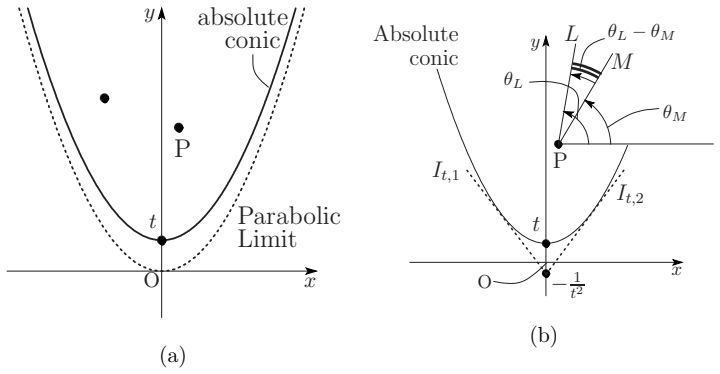
This paper is a sequel to arXiv:2511.01024 (Base 1), where an axiomatic framework for angles and the foundations of difference-angle geometry were introduced. In difference-angle geometry, where the difference of slopes of lines is treated as a primary angular quantity (the difference angle), we reconstruct the focal structure of parabolas from a difference-angle-theoretic viewpoint and develop the associated algebraic and analytic structures. First, we introduce the difference-angle focal function and define the focus of a parabola constructively as its zero set. This approach yields a formulation of the parabolic power that differs from that presented in Base 1. Next, by interpreting the power as a classical representation of an inner product, we derive a difference-angle version of the parallelogram theorem via a polarization identity, and thereby define the difference-angle inner product as a pseudo-inner product. The robustness of this structure is substantiated by deriving a difference-angle version of Stewart's theorem based solely on computations involving the difference-angle inner product. Furthermore, we define the parabolic trigonometric functions cosp(theta) and sinp(theta) (together with related functions) associated with a difference angle (theta), and show that they satisfy identities corresponding to the first and second cosine laws in Euclidean geometry. Finally, we reexamine the Cayley-Klein angle and distance derived from Laguerre's formula, and in particular verify that the existing Cayley-Klein angle satisfies the axiomatic system for angles introduced in Base 1. We then show that, in the parabolic limit of the absolute conic, the difference angle and the difference-angle norm arise naturally as the linear degeneration of the logarithmic cross ratio.
Editorial analysis
A structured set of objections, weighed in public.
Referee Report
Summary. This paper is a sequel to arXiv:2511.01024 (Base 1). It introduces the difference-angle focal function whose zero set defines the focus of a parabola, yielding a new formulation of parabolic power. Interpreting this power as a pseudo-inner product via polarization produces a difference-angle parallelogram theorem and a version of Stewart's theorem. Parabolic trigonometric functions cosp(θ) and sinp(θ) are defined and shown to satisfy identities analogous to the Euclidean cosine laws. The manuscript also verifies that the Cayley-Klein angle satisfies the angle axioms of Base 1 and demonstrates that the difference angle and its norm arise as the linear degeneration of the logarithmic cross ratio in the parabolic limit of the absolute conic.
Significance. If the angle axioms of the prior paper are consistent, the work supplies a coherent algebraic and analytic framework for difference-angle geometry, recovering classical metric theorems (Stewart, cosine laws) from a pseudo-inner-product structure. The constructive definition of the focal function and the explicit degeneration argument from the cross ratio are positive features that could interest researchers in projective and non-Euclidean geometry. The primary limitation is the heavy dependence on unverified prior axioms, which prevents the manuscript from standing alone.
major comments (3)
- [Section on the difference-angle inner product and Stewart's theorem] The polarization identity that converts parabolic power into the difference-angle inner product (and thereby into Stewart's theorem) is asserted to follow from the angle axioms of arXiv:2511.01024, yet the manuscript contains no explicit check that those axioms guarantee the required algebraic properties (additivity, homogeneity, or the parallelogram identity) in the present setting.
- [Section defining parabolic trigonometric functions] The definitions of cosp(θ) and sinp(θ) and the claimed first- and second-cosine-law identities rest on the same axiomatic base; without a self-contained derivation or a reference to the precise axioms used for each step, it is impossible to confirm that the identities hold independently of the prior paper.
- [Section reexamining the Cayley-Klein angle and parabolic limit] The verification that the Cayley-Klein angle satisfies the axiomatic system of Base 1 is stated without an axiom-by-axiom mapping or explicit computation showing that the difference-angle operations are recovered; this verification is load-bearing for the claim that the difference angle is a natural degeneration of the cross ratio.
minor comments (2)
- [Introduction and all sections invoking Base 1 axioms] Cross-references to specific equations or axioms from arXiv:2511.01024 are missing in the introduction and in the sections that invoke the angle axioms.
- [Section on parabolic trigonometric functions] The notation for the parabolic trigonometric functions (cosp, sinp) and the difference-angle norm should be introduced with a brief reminder of their relation to the ordinary trigonometric functions in the Euclidean limit.
Simulated Author's Rebuttal
We thank the referee for the thorough review and for identifying areas where the connection to the prior work (arXiv:2511.01024) can be made more explicit. We agree that the manuscript, as a sequel, benefits from clearer self-contained checks of the axiomatic implications. We will revise accordingly to address each major comment while preserving the focus on the new geometric constructions.
read point-by-point responses
-
Referee: The polarization identity that converts parabolic power into the difference-angle inner product (and thereby into Stewart's theorem) is asserted to follow from the angle axioms of arXiv:2511.01024, yet the manuscript contains no explicit check that those axioms guarantee the required algebraic properties (additivity, homogeneity, or the parallelogram identity) in the present setting.
Authors: We accept this observation. The polarization step relies on the algebraic consequences of the angle axioms established in Base 1, but the current text does not spell out the verification for additivity, homogeneity, and the parallelogram identity in the parabolic-power setting. In the revised manuscript we will insert a short subsection that recalls the relevant axioms from Base 1 and carries out the explicit algebraic verification for the difference-angle inner product. revision: yes
-
Referee: The definitions of cosp(θ) and sinp(θ) and the claimed first- and second-cosine-law identities rest on the same axiomatic base; without a self-contained derivation or a reference to the precise axioms used for each step, it is impossible to confirm that the identities hold independently of the prior paper.
Authors: We will revise the trigonometric-functions section to supply a self-contained derivation. Each definition and each step of the cosine-law proofs will be accompanied by an explicit reference to the precise axiom or theorem from Base 1 that justifies it, together with the intermediate algebraic manipulations. This will allow the identities to be checked without requiring the reader to reconstruct the full prior development. revision: yes
-
Referee: The verification that the Cayley-Klein angle satisfies the axiomatic system of Base 1 is stated without an axiom-by-axiom mapping or explicit computation showing that the difference-angle operations are recovered; this verification is load-bearing for the claim that the difference angle is a natural degeneration of the cross ratio.
Authors: We agree that an explicit mapping is needed. The revised version will contain a dedicated paragraph (or table) that lists each axiom of Base 1 and shows, by direct computation, how the Cayley-Klein angle satisfies it. We will also include the explicit limiting calculation that recovers the difference-angle norm from the logarithmic cross ratio under the parabolic degeneration of the absolute conic. revision: yes
Circularity Check
Metric constructions and parabolic identities reduce to angle axioms from self-cited prior paper (Base 1)
specific steps
-
self citation load bearing
[Abstract, paragraph 1]
"This paper is a sequel to arXiv:2511.01024 (Base 1), where an axiomatic framework for angles and the foundations of difference-angle geometry were introduced. In difference-angle geometry, where the difference of slopes of lines is treated as a primary angular quantity (the difference angle), we reconstruct the focal structure of parabolas from a difference-angle-theoretic viewpoint and develop the associated algebraic and analytic structures."
The difference-angle focal function, focus as zero set, parabolic power, polarization identity for the inner product, Stewart's theorem, and parabolic trigonometric functions are all introduced and derived using the axiomatic system and difference-angle operations fixed in the self-cited Base 1 paper; the derivations therefore reduce to algebraic consequences of those prior definitions.
-
self citation load bearing
[Abstract, final paragraph]
"Finally, we reexamine the Cayley-Klein angle and distance derived from Laguerre's formula, and in particular verify that the existing Cayley-Klein angle satisfies the axiomatic system for angles introduced in Base 1. We then show that, in the parabolic limit of the absolute conic, the difference angle and the difference-angle norm arise naturally as the linear degeneration of the logarithmic cross ratio."
The verification that Cayley-Klein satisfies the Base 1 axioms and the claim that the difference angle 'arises naturally' as the linear degeneration both presuppose the consistency and sufficiency of the self-cited axiomatic system; without an independent check, the 'natural' emergence is an algebraic restatement of the imported axioms rather than a new derivation.
full rationale
The paper is explicitly a sequel that imports the full axiomatic system for angles and difference-angle operations from arXiv:2511.01024. All subsequent objects (difference-angle focal function, parabolic power as pseudo-inner product, polarization identity, Stewart's theorem, cosp/sinp functions, and the claimed natural emergence of the difference angle in the parabolic limit) are defined and derived directly from those imported axioms. The only new content is the verification that the Cayley-Klein angle satisfies the Base 1 axioms and the algebraic re-expression of known limits; no independent consistency proof or self-contained re-derivation of the axioms appears. This matches the self-citation-load-bearing pattern: the central claims are algebraic consequences of quantities fixed by the earlier self-citation.
Axiom & Free-Parameter Ledger
axioms (1)
- domain assumption The axiomatic system for angles introduced in Base 1 (arXiv:2511.01024)
invented entities (3)
-
difference-angle focal function
no independent evidence
-
difference-angle inner product
no independent evidence
-
parabolic trigonometric functions cosp(theta) and sinp(theta)
no independent evidence
Lean theorems connected to this paper
-
IndisputableMonolith/Cost/FunctionalEquation.leanwashburn_uniqueness_aczel unclear?
unclearRelation between the paper passage and the cited Recognition theorem.
We introduce the difference–angle focal function and define the focus of a parabola constructively as its zero set... parabolic power... polarization identity... parabolic trigonometric functions cospθ and sinpθ
-
IndisputableMonolith/Foundation/AlexanderDuality.leanalexander_duality_circle_linking unclear?
unclearRelation between the paper passage and the cited Recognition theorem.
in the parabolic limit of the absolute conic, the difference angle and the difference-angle norm arise naturally as the linear degeneration of the logarithmic cross ratio
-
IndisputableMonolith/Foundation/AbsoluteFloorClosure.leanabsolute_floor_iff_bare_distinguishability unclear?
unclearRelation between the paper passage and the cited Recognition theorem.
Axiom A1–A5 (opposite angles, additivity, vanishing, scaling invariance, continuous bisection)
What do these tags mean?
- matches
- The paper's claim is directly supported by a theorem in the formal canon.
- supports
- The theorem supports part of the paper's argument, but the paper may add assumptions or extra steps.
- extends
- The paper goes beyond the formal theorem; the theorem is a base layer rather than the whole result.
- uses
- The paper appears to rely on the theorem as machinery.
- contradicts
- The paper's claim conflicts with a theorem or certificate in the canon.
- unclear
- Pith found a possible connection, but the passage is too broad, indirect, or ambiguous to say the theorem truly supports the claim.
Reference graph
Works this paper leans on
-
[1]
\"U ber die sogenannte nicht- E uklidische geometrie
Felix Klein. \"U ber die sogenannte nicht- E uklidische geometrie. Mathematische Annalen , 4:573--625, 1871
-
[2]
A comparative review of recent researches in geometry
Felix Klein. A comparative review of recent researches in geometry. Bulletin of the New York Mathematical Society , 2:215--249, 1893. English translation of the Erlangen Program (1872)
-
[3]
The fourth geometry i: Difference--angle geometry beyond euclid, hyperbolic, and elliptic
Masanori Nakazato. The fourth geometry i: Difference--angle geometry beyond euclid, hyperbolic, and elliptic. arXiv , 2511.01024, 2025
-
[4]
Miquel's theorem and its elementary geometric relatives
Gunter Weiss and Boris Odehnal. Miquel's theorem and its elementary geometric relatives. KoG , 28(2):11--24, 2024
work page 2024
- [5]
- [6]
- [7]
- [8]
- [9]
-
[10]
Mathematische Annalen , volume =
Klein, Felix , title =. Mathematische Annalen , volume =. 1871 , doi =
- [11]
-
[12]
Bulletin of the New York Mathematical Society , volume =
Klein, Felix , title =. Bulletin of the New York Mathematical Society , volume =. 1893 , note =
-
[13]
Expositiones Mathematicae , volume =
A'Campo, Norbert and Papadopoulos, Athanase , title =. Expositiones Mathematicae , volume =. 2010 , doi =
work page 2010
-
[14]
Duval, C. and Burdet, G. and K. Bargmann structures and Newton--Cartan theory , journal =. 1985 , doi =
work page 1985
-
[15]
Conformal Carroll groups and BMS symmetry
Duval, C. and Gibbons, G.W. and Horvathy, P.A. , title =. Classical and Quantum Gravity , volume =. 2014 , doi =. 1402.5894 , archivePrefix =
work page internal anchor Pith review Pith/arXiv arXiv 2014
- [16]
-
[17]
Embedding Galilean and Carrollian geometries I. Gravitational waves,
Morand, Kevin , title =. 1811.12681 , archivePrefix =
-
[18]
Affine Geometry and Relativity , eprint =
Jovanovi. Affine Geometry and Relativity , eprint =
-
[19]
Weiss, Gunter and Odehnal, Boris , title =. KoG , volume =. 2024 , doi =
work page 2024
discussion (0)
Sign in with ORCID, Apple, or X to comment. Anyone can read and Pith papers without signing in.