The Dual Canonical Basis in the Spin Representation via the Temperley-Lieb Algebra
Pith reviewed 2026-05-10 19:28 UTC · model grok-4.3
The pith
The Temperley-Lieb algebra supplies explicit formulas for the full dual canonical basis of the spin representation.
A machine-rendered reading of the paper's core claim, the machinery that carries it, and where it could break.
Core claim
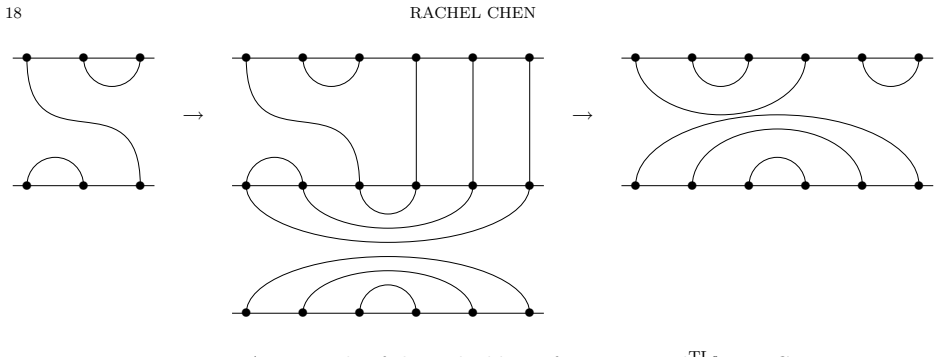
The full dual canonical basis of (C^2)^⊗n is realized through the standard diagrammatic action of the Temperley-Lieb algebra. This action produces explicit formulas for each basis element and, as a byproduct, for the canonical basis of the spherical module. The Hecke algebra then reproves that the two bases are dual, giving corresponding results for the dual spaces of the spherical and aspherical modules, while an alternative definition of the canonical basis is stated in purely diagrammatic terms.
What carries the argument
The diagrammatic action of the Temperley-Lieb algebra on the spin representation, which encodes basis vectors through its generators, relations, and idempotents.
Load-bearing premise
The known relations of the Temperley-Lieb algebra together with its duality to the Hecke algebra let the diagrammatic action produce the complete dual canonical basis for every n without gaps or extra obstructions.
What would settle it
For n=3 compute the vectors given by the explicit formulas and check whether they match the standard dual canonical basis elements defined by Lusztig.
Figures





read the original abstract
The spin representation $(\mathbb C^2)^{\otimes n}$ has a dual canonical basis introduced by Lusztig that is important in many areas of algebra, geometry, and physics. Khovanov observed that a portion of the dual canonical basis can be viewed diagrammatically through the Temperley-Lieb algebra. We provide a simpler construction that we generalize to the entire dual canonical basis, and write explicit formulas to compute the dual canonical basis, and thus the canonical basis of the spherical module, as a byproduct. We reprove some of Khovanov's results using our new perspective. Furthermore, we use the Hecke algebra to reprove the fact that the canonical basis is indeed dual to the dual canonical basis, leading to similar results about the canonical basis in $\mathcal M^*$ and $\mathcal N^*$, the dual spaces to the spherical and aspherical modules, as a byproduct. Finally, we present an alternative axiomatic definition of the canonical basis using diagrams.
Editorial analysis
A structured set of objections, weighed in public.
Referee Report
Summary. The manuscript constructs the dual canonical basis of the spin representation (ℂ²)⊗n using a diagrammatic approach based on the Temperley-Lieb algebra. It generalizes Khovanov's partial construction to the full basis, provides explicit formulas for the basis elements (and thus the canonical basis of the spherical module as a byproduct), reproves some of Khovanov's results, uses the Hecke algebra to reprove duality between the canonical and dual canonical bases, and presents an alternative axiomatic definition of the canonical basis via diagrams. This yields analogous results for the dual spaces to the spherical and aspherical modules.
Significance. If the constructions and explicit formulas are correct, the work is significant for representation theory of quantum groups. It supplies a simpler, more explicit and computable diagrammatic route to the dual canonical basis, an object central to categorification, knot invariants, and applications in geometry and physics. The Temperley-Lieb perspective, Hecke-algebra reproof of duality, and alternative axiomatic definition could facilitate calculations and reveal new structural connections, building directly on standard relations and known duality results in the literature.
major comments (1)
- The generalization of the diagrammatic construction to the entire dual canonical basis (central to the abstract claim) relies on the standard Temperley-Lieb action extending without obstruction for arbitrary n. The manuscript should explicitly verify in the relevant construction section that the bar-involution invariance and triangularity properties hold for the newly constructed elements beyond Khovanov's range, as this is load-bearing for the explicit formulas and full-basis claim.
minor comments (1)
- The abstract and introduction would benefit from a brief comparison table or statement clarifying precisely which of Khovanov's results are reproved and which are new.
Simulated Author's Rebuttal
We thank the referee for their positive evaluation of the manuscript's significance and for the constructive major comment. We address it point by point below and will revise the manuscript accordingly.
read point-by-point responses
-
Referee: The generalization of the diagrammatic construction to the entire dual canonical basis (central to the abstract claim) relies on the standard Temperley-Lieb action extending without obstruction for arbitrary n. The manuscript should explicitly verify in the relevant construction section that the bar-involution invariance and triangularity properties hold for the newly constructed elements beyond Khovanov's range, as this is load-bearing for the explicit formulas and full-basis claim.
Authors: We agree that an explicit verification of these properties for arbitrary n strengthens the central claim. In the revised manuscript we will add a dedicated paragraph (immediately after the recursive definition of the diagrammatic elements in the construction section) that proves, by induction on n, that the newly defined basis vectors remain invariant under the bar involution and satisfy the required triangularity with respect to the standard basis. The inductive step relies only on the fact that the Temperley-Lieb generators act via the same diagrammatic rules for all n and that the relations are independent of n; the base cases recover Khovanov's range. This verification directly supports the explicit formulas and the full-basis statement without altering any existing arguments. revision: yes
Circularity Check
No significant circularity in the derivation chain
full rationale
The paper constructs the dual canonical basis of the spin representation by generalizing Khovanov's diagrammatic Temperley-Lieb action to the full basis, providing explicit formulas and reproving duality via the Hecke algebra. All load-bearing steps rely on standard, externally established relations and duality results from the literature (Lusztig, Khovanov, and Hecke algebra theory), without any self-definitional reductions, fitted inputs renamed as predictions, or load-bearing self-citations. The central claims remain independent of the paper's own outputs.
Axiom & Free-Parameter Ledger
axioms (2)
- domain assumption The Temperley-Lieb algebra acts on the spin representation via the standard diagrammatic generators satisfying the usual quadratic and braid relations.
- standard math The Hecke algebra provides a duality pairing between the canonical and dual canonical bases.
Lean theorems connected to this paper
-
IndisputableMonolith/Cost/FunctionalEquation.leanwashburn_uniqueness_aczel unclear?
unclearRelation between the paper passage and the cited Recognition theorem.
We provide a simpler construction that we generalize to the entire dual canonical basis, and write explicit formulas to compute the dual canonical basis... via the Temperley-Lieb algebra... isomorphism L 0≤k≤n Ind TLn TLk ⊗ TL n−k Ctriv ≅ (C²)⊗n identifying diagrammatic basis with dual canonical basis
What do these tags mean?
- matches
- The paper's claim is directly supported by a theorem in the formal canon.
- supports
- The theorem supports part of the paper's argument, but the paper may add assumptions or extra steps.
- extends
- The paper goes beyond the formal theorem; the theorem is a base layer rather than the whole result.
- uses
- The paper appears to rely on the theorem as machinery.
- contradicts
- The paper's claim conflicts with a theorem or certificate in the canon.
- unclear
- Pith found a possible connection, but the passage is too broad, indirect, or ambiguous to say the theorem truly supports the claim.
Reference graph
Works this paper leans on
-
[1]
Arkady Berenstein and Andrei Zelevinsky. Tensor product multiplicities, canonical bases and totally positive varieties.arXiv preprint math/9912012, 1999
-
[2]
Roman Bezrukavnikov. Cohomology of tilting modules over quantum groups and t-structures on derived cate- gories of coherent sheaves.Inventiones Mathematicae, 166(2):327–357, 2006
work page 2006
-
[3]
Roman Bezrukavnikov, Victor Kac, and Vasily Krylov. Subregular nilpotent orbits and explicit character formulas for modules over affine lie algebras.Pure and Applied Mathematics Quarterly, 20, 2024
work page 2024
-
[4]
Roman Bezrukavnikov and Ivan Mirkovi´ c. Representations of semisimple lie algebras in prime characteristic and the noncommutative springer resolution.Annals of Mathematics, pages 835–919, 2013
work page 2013
-
[5]
´Elie Cartan. Les groupes projectifs qui ne laissent invariante aucune multiplicit´ e plane.Bulletin de la Soci´ et´ e Math´ ematique de France, 41:53–96, 1913
work page 1913
-
[6]
Webs and quantum skew howe duality.Mathematische Annalen, 360(1–2):351–390, April 2014
Sabin Cautis, Joel Kamnitzer, and Scott Morrison. Webs and quantum skew howe duality.Mathematische Annalen, 360(1–2):351–390, April 2014
work page 2014
-
[7]
Jim de Groot. An introduction to the representation theory of Temperley–Lieb algebras.Korteweg-de Vries Instituut voor Wiskunde, Universiteit van Amsterdam, 2015
work page 2015
-
[8]
Vinay V. Deodhar. On some geometric aspects of bruhat orderings II. the parabolic analogue of Kazhdan–Lusztig polynomials.Journal of Algebra, 111(2):483–506, 1987
work page 1987
-
[9]
The quantum theory of the electron
Paul Adrien Maurice Dirac. The quantum theory of the electron. part II.Proceedings of the Royal Society of London. Series A, Containing Papers of a Mathematical and Physical Character, 118(779):351–361, 1928
work page 1928
-
[10]
Galyna Dobrovolska, Vinoth Nandakumar, and David Yang. Modular representations in type A with a two-row nilpotent central character.Journal of Algebra, 643:311–339, 2024
work page 2024
-
[11]
C. K. Fan and Richard M. Green. Monomials and Temperley–Lieb algebras.Journal of Algebra, 190(2):498–517, 1997
work page 1997
-
[12]
Igor B. Frenkel, Mikhail G. Khovanov, and Jr. Kirillov, Alexandre A. Kazhdan–Lusztig polynomials and canonical basis.Transformation Groups, 3(4):321–336, 1998
work page 1998
-
[13]
Michio Jimbo. A q-difference analogue of U(g) and the Yang–Baxter equation.Letters in Mathematical Physics, 10(1):63–69, 1985
work page 1985
-
[14]
Masaki Kashiwara. On crystal bases of the q-analogue of universal enveloping algebras.Duke Mathematical Journal, 63(2):465–516, 1991
work page 1991
-
[15]
Kazhdan–Lusztig conjecture for symmetrizable Kac–Moody lie alge- bra
Masaki Kashiwara and Toshiyuki Tanisaki. Kazhdan–Lusztig conjecture for symmetrizable Kac–Moody lie alge- bra. II. intersection cohomologies of schubert varieties. InOperator Algebras, Unitary Representations, Envelop- ing Algebras, and Invariant Theory, volume 92 ofProgress in Mathematics, pages 159–195. Birkh¨ auser Boston, Boston, MA, 1990
work page 1990
-
[16]
Springer Science & Business Media, 2012
Christian Kassel.Quantum Groups, volume 155. Springer Science & Business Media, 2012
work page 2012
-
[17]
Representations of coxeter groups and hecke algebras.Inventiones Mathe- maticae, 53(2):165–184, 1979
David Kazhdan and George Lusztig. Representations of coxeter groups and hecke algebras.Inventiones Mathe- maticae, 53(2):165–184, 1979
work page 1979
-
[18]
PhD thesis, Yale Univer- sity, May 1997
Mikhail Khovanov.Graphical Calculus, Canonical Bases and Kazhdan–Lusztig Theory. PhD thesis, Yale Univer- sity, May 1997
work page 1997
-
[19]
Hecke algebras and Kazhdan–Lusztig basis
Ivan Losev. Hecke algebras and Kazhdan–Lusztig basis. Lecture notes, available on the author’s website
-
[20]
George Lusztig. Canonical bases arising from quantized enveloping algebras.Journal of the American Mathe- matical Society, 3(2):447–498, 1990
work page 1990
-
[21]
George Lusztig. Quivers, perverse sheaves, and quantized enveloping algebras.Journal of the American Mathe- matical Society, 4(2):365–421, 1991
work page 1991
-
[22]
American Mathematical Society, 2003
George Lusztig.Hecke Algebras with Unequal Parameters, volume 18. American Mathematical Society, 2003
work page 2003
-
[23]
Cluster algebras and their bases
Fan Qin. Cluster algebras and their bases. InRepresentations of Algebras and Related Structures, EMS Series of Congress Reports, pages 335–369. EMS Press, Berlin, 2023. 24 RACHEL CHEN
work page 2023
-
[24]
H. N. V. Temperley and Elliott H. Lieb. Relations between the “percolation” and “colouring” problem and other graph-theoretical problems associated with regular planar lattices: Some exact results for the “perco- lation” problem.Proceedings of the Royal Society of London. Series A, Mathematical and Physical Sciences, 322(1549):251–280, April 1971
work page 1971
-
[25]
Canonical bases and higher representation theory.Compositio Mathematica, 151(1):121–166, 2015
Ben Webster. Canonical bases and higher representation theory.Compositio Mathematica, 151(1):121–166, 2015
work page 2015
- [26]
discussion (0)
Sign in with ORCID, Apple, or X to comment. Anyone can read and Pith papers without signing in.