Quantized Collective Fluctuations in Correlated Fermion Systems
Pith reviewed 2026-05-09 19:44 UTC · model grok-4.3
The pith
A quantum extension of the fluctuating local field method lets researchers selectively quantize bosonic Matsubara modes to measure their individual effects on fermion observables.
A machine-rendered reading of the paper's core claim, the machinery that carries it, and where it could break.
Core claim
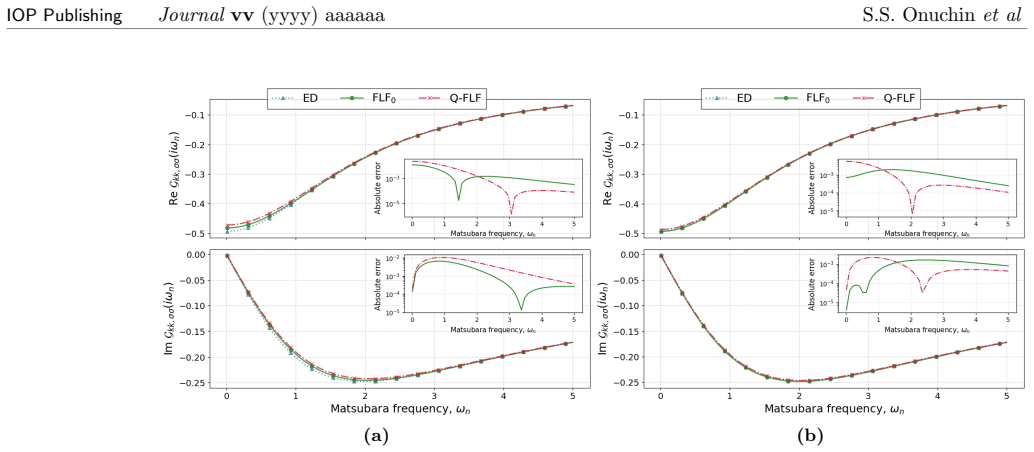
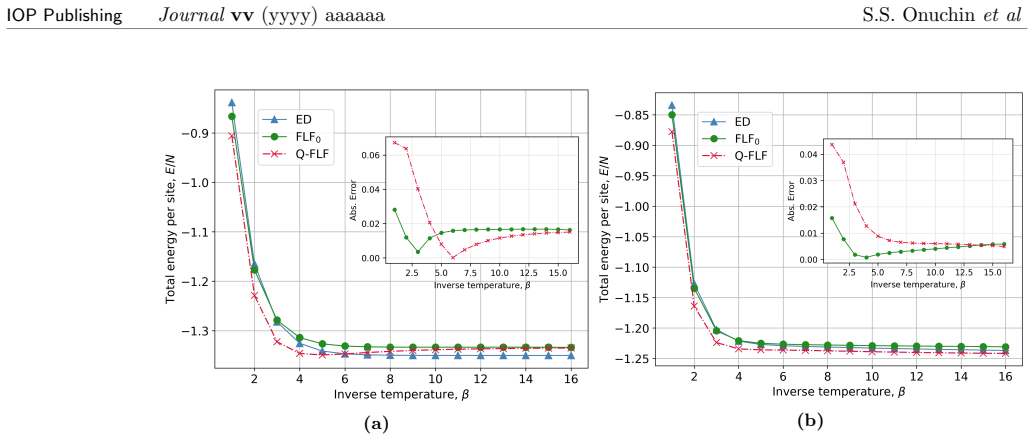
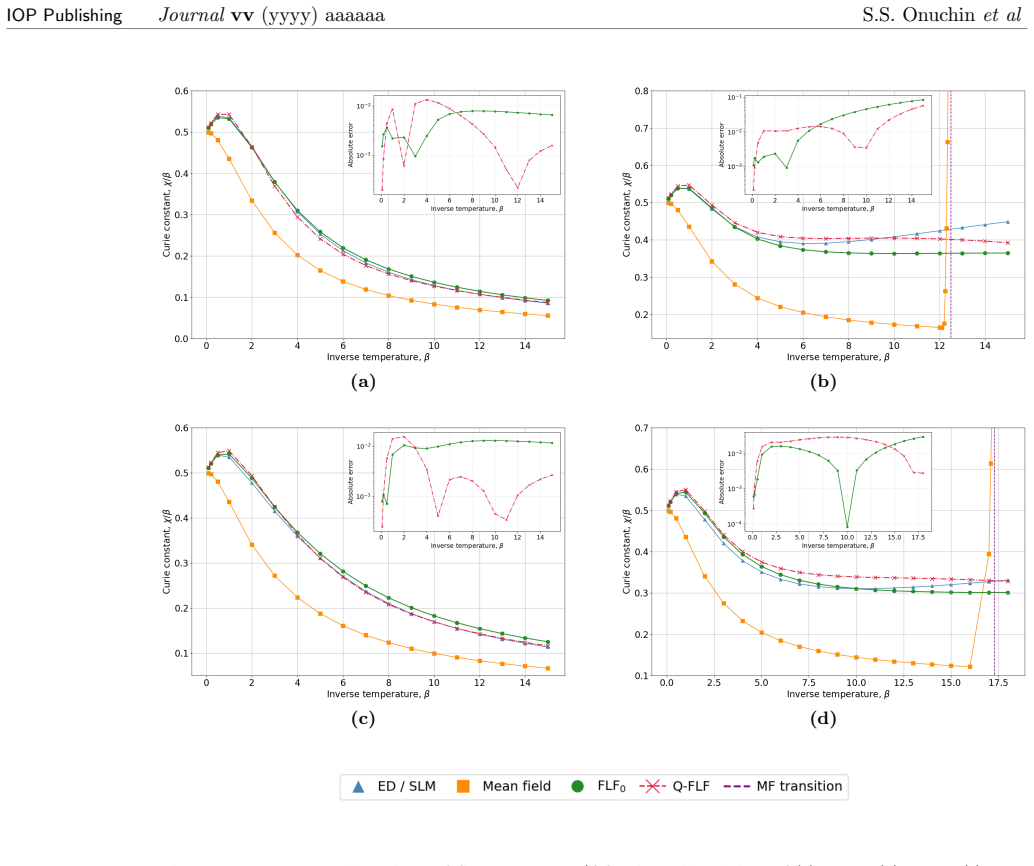
The Quantum FLF method systematically extends the fluctuating local field approach by quantizing selected bosonic Matsubara modes in the auxiliary field, allowing efficient quantification of their individual contributions to observables such as the Green's function, total energy, and antiferromagnetic susceptibility in the half-filled one-dimensional Hubbard chain.
What carries the argument
Selective quantization of bosonic Matsubara modes inside the auxiliary field of the Fluctuating Local Field method, which isolates mode-specific quantum corrections to collective fluctuations.
If this is right
- Low Matsubara frequencies produce quantitative changes in integrated observables such as total energy and antiferromagnetic susceptibility.
- Single-particle properties require higher-frequency bosonic modes for accurate results.
- The Q-FLF scheme permits efficient, mode-by-mode characterization of bosonic contributions without full field quantization.
- The method applies directly to the half-filled one-dimensional Hubbard chain for Green's functions, energies, and susceptibilities.
Where Pith is reading between the lines
- The frequency-dependent separation of effects could guide adaptive truncations in simulations of two-dimensional systems where full quantum treatment remains expensive.
- Similar selective-mode ideas might transfer to other auxiliary-field or fluctuation-based approaches used for quantum critical behavior.
- Testing the same low-versus-high frequency split on doped or frustrated lattices would check whether the observed pattern generalizes beyond the half-filled chain.
Load-bearing premise
That quantizing only a chosen subset of bosonic Matsubara modes is sufficient to capture the main quantum corrections to collective fluctuations without extra terms or full quantization of the field.
What would settle it
Exact diagonalization or full quantum Monte Carlo data for the half-filled one-dimensional Hubbard chain that shows whether energy and antiferromagnetic susceptibility converge with only low Matsubara frequencies included while the Green's function continues to change until higher frequencies are added.
Figures
read the original abstract
Collective excitations in fermionic systems play a crucial role in determining their physical properties. An important challenge is to develop efficient theoretical approaches for describing these excitations and their coupling to fermionic degrees of freedom. In this work, we revisit the problem of quantifying the contributions of individual bosonic modes of collective fluctuations to observable properties of correlated fermion systems within the framework of the Fluctuating Local Field (FLF) method. Whereas the auxiliary field in this method was previously considered only classically, we formulate its systematic extension termed Quantum FLF (Q-FLF) that incorporates selected bosonic Matsubara modes, thus tailoring it to description of quantum collective fluctuations. As a testbed, we apply the approach to a half-filled one-dimensional Hubbard chain and compute the Green's function, the total energy, and the antiferromagnetic susceptibility. Our results demonstrate that the proposed scheme enables an efficient and selective characterization of the contributions of individual bosonic modes. In particular, low Matsubara frequencies are found to have a quantitative impact on integrated observables such as total energy and antiferromagnetic susceptibility. At the same time, an accurate description of single-particle properties requires inclusion of higher-frequency bosonic modes.
Editorial analysis
A structured set of objections, weighed in public.
Referee Report
Summary. The manuscript introduces the Quantum Fluctuating Local Field (Q-FLF) method as a systematic extension of the classical Fluctuating Local Field (FLF) framework. In Q-FLF, selected bosonic Matsubara frequencies are quantized within the auxiliary field while the remainder is treated classically. The approach is tested on the half-filled one-dimensional Hubbard chain, where the Green's function, total energy, and antiferromagnetic susceptibility are computed to demonstrate selective characterization of individual bosonic mode contributions, with low frequencies shown to quantitatively affect integrated observables and higher frequencies required for single-particle properties.
Significance. If the technical implementation and validation details are provided, the work offers a useful extension of the existing FLF method for efficiently isolating contributions from specific collective fluctuation modes in correlated fermion systems. The test on an exactly solvable model system provides a clear benchmark, and the selective quantization strategy could enable computational savings while highlighting differential impacts of Matsubara modes on observables.
major comments (3)
- [Method formulation and 1D Hubbard application] The central claim that selective quantization of chosen Matsubara modes suffices to capture essential quantum corrections (without additional inter-mode coupling terms) is load-bearing for the reported mode impacts on energy, susceptibility, and Green's function, yet the manuscript provides no explicit derivation or numerical test demonstrating that cross terms between quantized and classical modes remain negligible or are absorbed by the FLF saddle point.
- [Results and discussion sections] Implementation details, convergence checks with respect to the number of quantized modes, Matsubara frequency cutoff, and error analysis (including comparisons to full quantization or exact Bethe-ansatz results for the 1D Hubbard chain) are absent; these are required to support the efficiency and quantitative impact statements in the abstract.
- [Green's function results] The statement that accurate single-particle properties require higher-frequency modes is presented without supporting data on how truncation affects the fluctuation-dissipation relation or Green's function self-consistency, which directly bears on the selective characterization claim.
minor comments (2)
- [Method] Notation for the auxiliary field quantization and the distinction between classical and quantum modes should be clarified with explicit equations to avoid ambiguity in the extension from FLF.
- [Figures] Figure captions and axis labels for the susceptibility and energy plots would benefit from explicit indication of which modes are included in each curve.
Simulated Author's Rebuttal
We thank the referee for the constructive and detailed report, which highlights both the potential of the Q-FLF extension and areas where additional clarification will strengthen the manuscript. We address each major comment below and will revise the paper to incorporate the requested details and supporting material.
read point-by-point responses
-
Referee: The central claim that selective quantization of chosen Matsubara modes suffices to capture essential quantum corrections (without additional inter-mode coupling terms) is load-bearing for the reported mode impacts on energy, susceptibility, and Green's function, yet the manuscript provides no explicit derivation or numerical test demonstrating that cross terms between quantized and classical modes remain negligible or are absorbed by the FLF saddle point.
Authors: We appreciate the referee's identification of this foundational aspect. In the Q-FLF formulation the auxiliary field is decomposed in the Matsubara basis, where the frequency modes are orthogonal; the FLF saddle-point condition then absorbs the leading mean-field coupling between the quantized and classical components. To make this transparent we will insert a concise derivation in the Methods section showing that inter-mode cross terms appear only at higher order and are accounted for by the self-consistent saddle point. We have also performed additional numerical checks by systematically varying the set of quantized modes and verified that the reported observables remain stable without explicit cross-term corrections. revision: yes
-
Referee: Implementation details, convergence checks with respect to the number of quantized modes, Matsubara frequency cutoff, and error analysis (including comparisons to full quantization or exact Bethe-ansatz results for the 1D Hubbard chain) are absent; these are required to support the efficiency and quantitative impact statements in the abstract.
Authors: We agree that the original manuscript would benefit from expanded technical documentation. In the revised version we will add a new subsection that specifies the numerical implementation, the Matsubara cutoff procedure, the algorithm for selecting which modes to quantize, and systematic convergence tests with respect to the number of quantized modes. We will also include error estimates and direct comparisons to the exact Bethe-ansatz solution for the half-filled 1D Hubbard chain, thereby quantifying the accuracy of the selective-quantization strategy. revision: yes
-
Referee: The statement that accurate single-particle properties require higher-frequency modes is presented without supporting data on how truncation affects the fluctuation-dissipation relation or Green's function self-consistency, which directly bears on the selective characterization claim.
Authors: The manuscript already illustrates the Green's-function dependence on the number of included modes, but we acknowledge that explicit checks on the fluctuation-dissipation relation and self-consistency are missing. We will augment the Results section with additional figures and tables that quantify the deviation from the fluctuation-dissipation theorem and the change in Green's-function self-consistency as a function of the highest quantized frequency, thereby providing direct support for the claim that higher-frequency modes are required for single-particle quantities. revision: yes
Circularity Check
No significant circularity; Q-FLF extension yields independent computations on testbed
full rationale
The paper defines the Quantum FLF (Q-FLF) as a direct extension of the classical FLF auxiliary-field framework by selectively quantizing chosen bosonic Matsubara frequencies while leaving others classical. Results for the Green's function, total energy, and antiferromagnetic susceptibility on the half-filled 1D Hubbard chain are obtained by explicit numerical evaluation with varying subsets of quantized modes. No equation reduces any reported mode contribution to a parameter fitted inside the same calculation, nor does any central claim collapse to a self-citation, ansatz smuggled via citation, or renaming of a known result. The testbed calculations remain independent of the method definition and are not forced by construction.
Axiom & Free-Parameter Ledger
axioms (1)
- domain assumption The Fluctuating Local Field method and Matsubara formalism provide a valid starting point for describing collective fluctuations in the Hubbard model.
Reference graph
Works this paper leans on
-
[1]
M. R. Norman. High-temperature superconductivity in cuprates: What we know and what we don’t.Reports on Progress in Physics, 86(8):084501, 2023
work page 2023
-
[2]
H. Hu, L. Chen, and Q. Si. Quantum critical metals and loss of quasiparticles. Nat. Phys., 20:1863–1873, 2024
work page 2024
-
[3]
A. Milloch, M. Fabrizio, and C. Giannetti. Mott materials: unsuccessful metals with a bright future.npj Spintronics, 2:49, 2024
work page 2024
- [4]
-
[5]
J. Dukelsky and S. Pittel. Extended rpa equations with a correlated ground state: A review.Rev. Mod. Phys., 76(3):643–662, 2004
work page 2004
-
[6]
G. et al Rohringer. Diagrammatic routes to nonlocal correlations beyond dynamical mean field theory.Reviews of Modern Physics, 90(2):025003, 2018
work page 2018
-
[7]
A.N. Rubtsov, M.I. Katsnelson, and A.I. Lichtenstein. Dual boson approach to collective excitations in correlated fermionic systems.Annals of Physics, 327(5):1320–1335, 2012
work page 2012
-
[8]
Patel, Peter Lunts, and Subir Sachdev
Aavishkar A. Patel, Peter Lunts, and Subir Sachdev. Localization of overdamped bosonic modes and transport in strange metals.Proceedings of the National Academy of Sciences, 121(14):e2402052121, 2024
work page 2024
-
[9]
P. Chalupa, T. Sch¨ afer, M. Reitner, D. Springer, S. Andergassen, and A. Toschi. Fingerprints of the local moment formation and its kondo screening in the generalized susceptibilities of many-electron problems. Phys. Rev. Lett., 126:056403, Feb 2021
work page 2021
-
[10]
Severino Adler, Friedrich Krien, Patrick Chalupa-Gantner, Giorgio Sangiovanni, and Alessandro Toschi. Non-perturbative intertwining between spin and charge correlations: A “smoking gun” single-boson-exchange result.SciPost Phys., 16:054, 2024
work page 2024
-
[11]
Weilun Jiang, Yuzhi Liu, Avraham Klein, Yuxuan Wang, Kai Sun, Andrey V. Chubukov, and Zi Yang Meng. Monte carlo study of the pseudogap and superconductivity emerging from quantum magnetic fluctuations.Nature Communications, 13:2655, 2022
work page 2022
-
[12]
Fluctuating local field method probed for a description of small classical correlated lattices.Phys
Alexey N Rubtsov. Fluctuating local field method probed for a description of small classical correlated lattices.Phys. Rev. E, 97:052120, May 2018
work page 2018
-
[13]
Collective magnetic fluctuations in hubbard plaquettes captured by fluctuating local field method
Alexey N Rubtsov, Evgeny A Stepanov, and Alexander I Lichtenstein. Collective magnetic fluctuations in hubbard plaquettes captured by fluctuating local field method. Physical Review B, 102(22):224423, 2020
work page 2020
-
[14]
Yana S. Lyakhova and Alexey N. Rubtsov. Fluctuating local field approach to the description of lattice models in the strong coupling regime.J Supercond Nov Magn, 35:2169–2173, 2022
work page 2022
-
[15]
Ya. S. Lyakhova, S. D. Semenov, A. I. Lichtenstein, and A. N. Rubtsov. Fluctuating field series: Towards calculations of correlated systems with high accuracy.Phys. Rev. B, 110:245134, Dec 2024
work page 2024
-
[16]
E. Linn´ er, A. I. Lichtenstein, S. Biermann, and E. A. Stepanov. Multichannel fluctuating field approach to competing instabilities in interacting electronic systems.Phys. Rev. B, 108:035143, Jul 2023
work page 2023
-
[17]
E. Linn´ er, C. Dutreix, S. Biermann, and E. A. Stepanov. Coexistence of s-wave superconductivity and phase separation in the half-filled extended hubbard model with attractive interactions.Physical Review B, 108(3):035143, 2023
work page 2023
-
[18]
Yana S Lyakhova, Evgeny A Stepanov, and Alexey N Rubtsov. Fluctuating local field approach to free energy of one-dimensional molecules with strong collective electronic fluctuations.Physical Review B, 105(3):035118, 2022
work page 2022
-
[19]
T. Schauerte and P. G. J. van Dongen. Symmetry breaking in the hubbard model at weak coupling.Phys. Rev. B, 65:081105, Feb 2002
work page 2002
-
[20]
Zhi-Xun Shen Jonathan A. Sobota, Yu He. Angle-resolved photoemission studies of quantum materials.Reviews of Modern Physics, 93(2):025006, 2021
work page 2021
-
[21]
C. Lanczos. An iteration method for the solution of the eigenvalue problem of linear differential and integral operators.Journal of Research of the National Bureau of Standards, 45(4):255, 1950
work page 1950
-
[22]
Alexander Altland and Ben D. Simons. Condensed Matter Field Theory. Cambridge University Press, Cambridge, UK, 2nd edition, 2010. 12
work page 2010
discussion (0)
Sign in with ORCID, Apple, or X to comment. Anyone can read and Pith papers without signing in.