Recognition: unknown
Ultra-deep imaging of nearby dwarf irregular galaxies: stellar haloes and disk structure
Pith reviewed 2026-05-09 19:27 UTC · model grok-4.3
The pith
Dwarf irregular galaxies show pure exponential stellar disks extending to 32.3 V mag per square arcsecond with no detectable stellar halos.
A machine-rendered reading of the paper's core claim, the machinery that carries it, and where it could break.
Core claim
Fitting ellipses to ultra-deep V images of ten dwarf irregular galaxies reveals that star-formation patches skew the isophotes. A stack of seven galaxies produces a pure exponential profile to a V surface brightness of 32.3 mag/arcsec² at a stellar surface density of 0.0013 ± 0.0011 M⊙ pc⁻². This extended component is interpreted as a disk structure built by internal evolutionary processes rather than external accretion, with UBVI colors consistent with ages of 1–6 Gyr in the outer disk.
What carries the argument
The stacked radial surface brightness profile derived from ellipse fits on the combined ultra-deep V images of seven dwarf galaxies.
If this is right
- Low-mass galaxies can sustain extended stellar disks to extremely low surface densities through internal processes alone.
- Irregularities in individual galaxy shapes at faint levels are driven by ongoing star formation rather than accreted material.
- Outer-disk colors indicate intermediate-age populations, not ancient halo stars.
- Models of dwarf galaxy assembly must account for in-situ disk growth without requiring major accretion events.
Where Pith is reading between the lines
- Similar deep imaging of additional dwarfs could show whether the pure exponential form is common across the low-mass population.
- If internal processes dominate, the expected frequency of stellar halos around dwarfs should be lower than predicted by merger-dominated formation models.
- Future surveys reaching comparable depths may use this result to calibrate the contribution of in-situ growth versus accretion in low-mass systems.
Load-bearing premise
That stacking profiles from seven galaxies yields a representative average free of selection biases and that observed irregularities come only from star formation rather than hidden halo components.
What would settle it
A clear break from exponential form or the appearance of a distinct outer halo component in deeper images or a larger sample of similar dwarf galaxies would falsify the interpretation.
Figures




read the original abstract
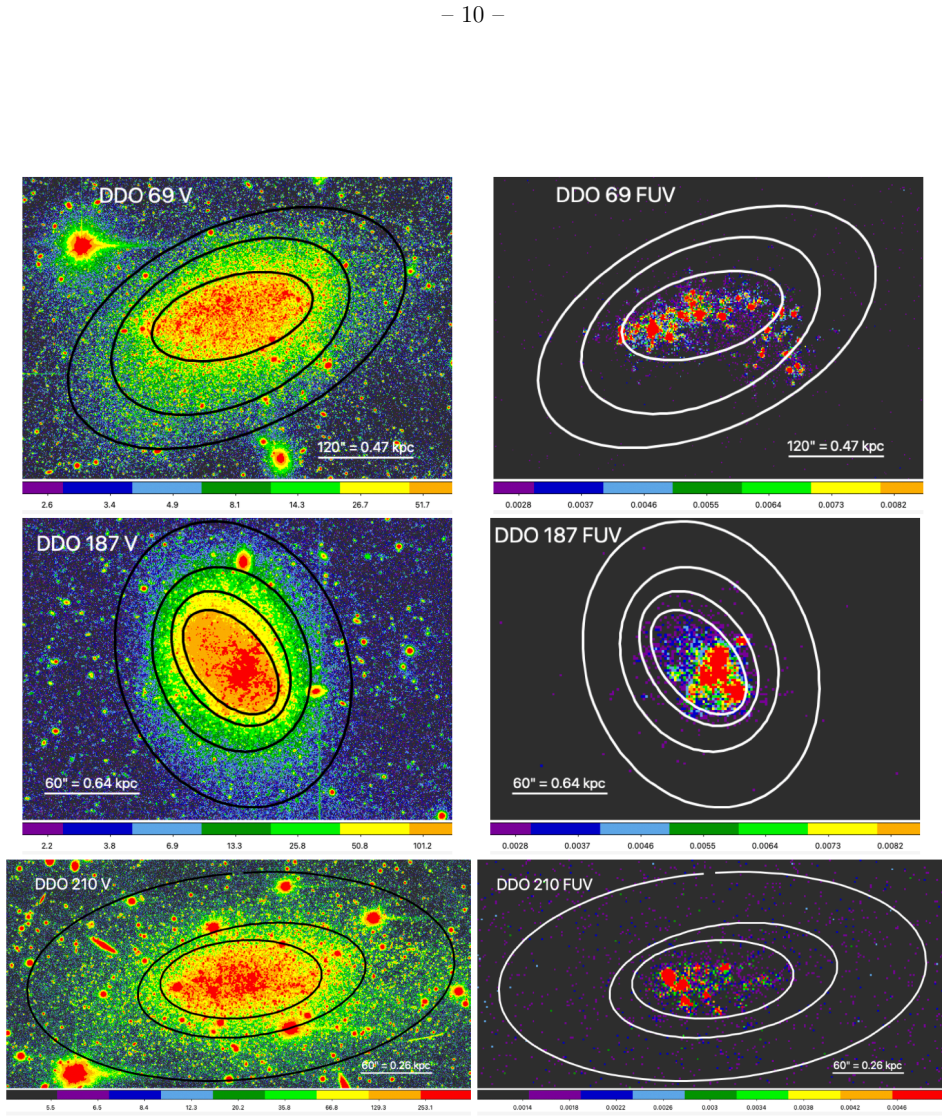
We have examined the stellar structure of 10 nearby, low stellar mass (10^6 to 6 x 10^7 Msolar) dwarf irregular galaxies by fitting ellipses as a function of surface brightness on ultra-deep V images. These are compared to far ultraviolet images as tracers of the star formation. We find that the often asymmetrical distribution of large patches of star formation activity in dwarfs, even out to low disk surface brightness levels, skews the broad-band optical isophotes in these galaxies. We also looked for evidence of the presence of a stellar halo. Possible hints of such are found in several galaxies from irregularities in the ellipses, but a stack of seven of the galaxies shows a pure exponential out to a V surface brightness of 32.3 mag/arcsec^2 where the stellar surface density is 0.0013 +/- 0.0011 Msolar/pc^2. The extended stellar component, most likely a disk structure, is probably due to internal evolutionary processes rather than external accretion. The UBVI colors of the annuli are consistent with ages of 1-6 Gyr for the far outer stellar disk.
Editorial analysis
A structured set of objections, weighed in public.
Referee Report
Summary. The paper reports ultra-deep V-band imaging and ellipse fitting on 10 nearby dwarf irregular galaxies (stellar masses 10^6 to 6x10^7 M⊙). Asymmetries from star-forming patches are found to skew isophotes even at low surface brightness. A stack of seven galaxies yields a pure exponential profile to V=32.3 mag arcsec^{-2} (stellar surface density 0.0013 ± 0.0011 M⊙ pc^{-2}), interpreted as an extended disk from internal evolution rather than a stellar halo; UBVI colors imply outer-disk ages of 1-6 Gyr.
Significance. If the stacked profile is robust, the result supplies direct evidence that low-mass dwarf irregulars lack detectable stellar halos at these depths and that their outermost stellar components arise from internal processes. This constrains hierarchical assembly models in the dwarf regime and provides a reference for the faintest observable stellar disks.
major comments (1)
- [Results (stacked profile)] Results section on the 7-galaxy stack: the headline claim of a pure exponential to 32.3 mag arcsec^{-2} (0.0013 ± 0.0011 M⊙ pc^{-2}) is load-bearing for the no-halo conclusion. The quoted uncertainty is already ~85% of the central value, yet no jackknife, bootstrap, or per-galaxy variance tests are described for alignment, scaling, or background subtraction. Small residuals in any of these steps could produce or remove an artificial exponential wing at these depths.
minor comments (2)
- Clarify in the text how many of the ten individual galaxies show ellipse irregularities and whether those are quantitatively distinguished from the stacked exponential behavior.
- The FUV comparison is used to argue that star-formation patches skew the optical isophotes; a brief quantitative measure of the offset between FUV and optical centroids or position angles would strengthen this point.
Simulated Author's Rebuttal
We thank the referee for their thoughtful review and for highlighting the importance of demonstrating the robustness of our stacked profile. We address the major comment below and will incorporate additional tests in the revised manuscript.
read point-by-point responses
-
Referee: Results section on the 7-galaxy stack: the headline claim of a pure exponential to 32.3 mag arcsec^{-2} (0.0013 ± 0.0011 M⊙ pc^{-2}) is load-bearing for the no-halo conclusion. The quoted uncertainty is already ~85% of the central value, yet no jackknife, bootstrap, or per-galaxy variance tests are described for alignment, scaling, or background subtraction. Small residuals in any of these steps could produce or remove an artificial exponential wing at these depths.
Authors: We agree that the robustness of the stacked profile requires explicit quantification. In the revised manuscript we will expand the description of the stacking procedure, including the alignment, scaling, and background-subtraction steps applied to the seven galaxies. We will also add jackknife resampling (leaving out one galaxy at a time) and report the resulting variance in the stacked surface-brightness profile. These tests will demonstrate that the exponential form persists and that no statistically significant upturn indicative of a halo appears at the faintest levels. The quoted uncertainty of ±0.0011 M⊙ pc^{-2} already incorporates the low signal-to-noise at 32.3 mag arcsec^{-2}; the jackknife analysis will further show that this uncertainty is not dominated by systematic residuals in alignment or background subtraction. revision: yes
Circularity Check
No circularity: empirical profile from direct imaging and stacking.
full rationale
The paper reports ellipse fits to ultra-deep V images of 10 dwarf irregular galaxies, notes asymmetries from star-forming patches, and presents a stacked profile of seven galaxies as a pure exponential reaching 32.3 mag arcsec^{-2}. This is an observational measurement and data reduction result, not a derivation in which a fitted parameter or ansatz is used to predict a closely related quantity that loops back to the input. No equations, model predictions, self-citations for uniqueness theorems, or renamings of known results appear in the provided text. The interpretation favoring internal processes over accretion is qualitative and does not reduce the central claim to its own inputs by construction.
Axiom & Free-Parameter Ledger
axioms (2)
- domain assumption The V-band light traces the stellar mass distribution accurately enough for structural analysis.
- domain assumption The far outer stellar component can be distinguished as disk or halo based on the exponential profile shape and lack of irregularities in the stack.
Reference graph
Works this paper leans on
-
[1]
2000, AJ, 119, 177
Aparicio, A., Tikhonov, N., & Karachentsev, I. 2000, AJ, 119, 177
2000
-
[2]
E., Elmegreen, B
Ashley, T., Simpson, C. E., Elmegreen, B. G., Johnson, M., & Pokhrel, N. R. 2017, AJ, 153, 132
2017
-
[3]
2014, Astronomy and Astrophysics, 566, A44
Bellazzini, M., Beccari, G., Fraternali, F., et al. 2014, Astronomy and Astrophysics, 566, A44
2014
-
[4]
Benavides, J. A., Sales, L. V., Wetzel, A., et al. 2025, submitted to MNRAS, arXiv:2508.00991
-
[5]
C., & Sellwood, J
Berrier, J. C., & Sellwood, J. A. 2016, ApJ, 831, 65
2016
-
[6]
2003, MNRAS, 344, 1000
Bruzual, G., & Charlot, S. 2003, MNRAS, 344, 1000
2003
-
[7]
S., & Johnston, K
Bullock, J. S., & Johnston, K. V. 2005, ApJ, 635, 931
2005
-
[8]
1984, ApJS, 54, 33
Burstein, D., & Heiles, C. 1984, ApJS, 54, 33
1984
-
[9]
J., Williams, B
Dalcanton, J. J., Williams, B. F., Seth, A. C., et al. 2009, ApJS, 183, 67
2009
-
[10]
J., Wetzel, A
Deason, A. J., Wetzel, A. R., Garrison-Kimmel, S., & Belokurov, V. 2015, MNRAS, 453, 3568
2015
-
[11]
E., Saha, A., Claver, J., et al
Dolphin, A. E., Saha, A., Claver, J., et al. 2002, AJ, 123, 3154
2002
-
[12]
2016, ApJ, 820, 131
El-Badry, K., Wetzel, A., Geha, M., Hopkins, P., Kereš, D., Chan, T., & Faucher-Giguère, C.-A. 2016, ApJ, 820, 131
2016
-
[13]
E., Sand, D
Fielder, C. E., Sand, D. J., Jones, M. G., et al. 2025, ApJL, 982, L41
2025
-
[14]
2012, MNRAS, 422, 1231
Governato, F., Zolotov, A., Pontzen, A., et al. 2012, MNRAS, 422, 1231
2012
-
[15]
A., Hunter, D
Herrmann, K. A., Hunter, D. A., & Elmegreen, B. G. 2013, AJ, 146, 104
2013
-
[16]
A., Hunter, D
Herrmann, K. A., Hunter, D. A., Zhang, H.-X., & Elmegreen, B. G. 2016, AJ, 152, 177
2016
-
[17]
L., Marín-Franch, A., & Aparicio, A
Hidalgo, S. L., Marín-Franch, A., & Aparicio, A. 2003, AJ, 2003
2003
-
[18]
A., & Elmegreen, B
Hunter, D. A., & Elmegreen, B. G. 2006, ApJS, 162, 49
2006
-
[19]
A., Elmegreen, B
Hunter, D. A., Elmegreen, B. G., Oh, S.-H., Anderson, E., Nordgren, T. E., et al. 2011, AJ, 142, 121 – 34 –
2011
-
[20]
A., Ficut-Vicas, D., Ashley, T., Brinks, E., Cigan, P., et al
Hunter, D. A., Ficut-Vicas, D., Ashley, T., Brinks, E., Cigan, P., et al. 2012, AJ, 144, 134
2012
-
[21]
A., Gallardo, S., Zhang, H.-X., Adamo, A., Cook, D
Hunter, D. A., Gallardo, S., Zhang, H.-X., Adamo, A., Cook, D. O., et al. 2018, ApJ, 855, 7
2018
-
[22]
A., Zhang, H.-X., Elmegreen, B
Hunter, D. A., Zhang, H.-X., Elmegreen, B. G., Castelloe, E. R., Ledford, H. M., Nisley, I., & Hatano, R. 2025, AJ, in press
2025
-
[23]
S., de Jong, R
Jang, I. S., de Jong, R. S., Minchev, I., et al. 2020, Astronomy & Astrophysics, 640, L19
2020
-
[24]
Jedrzejewski, R. I. 1987, MNRAS, 226,747
1987
-
[25]
E., Huang, S., et al
Kado-Fong, E., Green, J. E., Huang, S., et al. 2020, ApJ, 900, 163
2020
-
[26]
D., Dolphin, A
Karachentsev, I. D., Dolphin, A. E., Geisler, D., et al. 2002, Astronomy and Astrophysics, 383, 125
2002
-
[27]
D., Dolphin, A., Tully, R
Karachentsev, I. D., Dolphin, A., Tully, R. B., et al. 2006, AJ, 131, 1361
2006
-
[28]
D., Karachentseva, V., E., Huchtmeier, W
Karachentsev, I. D., Karachentseva, V., E., Huchtmeier, W. K., & Makarov, D. I. 2004, AJ, 127, 2031
2004
-
[29]
D., Makarov, D
Karachentsev, I. D., Makarov, D. I., Sharina, M. E., et al. 2003, Astronomy and Astrophysics, 398, 479
2003
-
[30]
Y., Brosch, N., Hoffman, G
Kniazev, A. Y., Brosch, N., Hoffman, G. L., et al. 2009, MNRAS, 400, 2054
2009
-
[31]
Martin, D. C., Fanson, J., Schiminovich, D., Morrissey, P., Friedman, P. G., et al. 2005, ApJ, 619, L1, DOI: 10.1086/426387
-
[32]
2009, ApJ, 137, 3619
Meschin, I., Gallart, C., Aparicio, A., Cassisi, S., & Rosenberg, A. 2009, ApJ, 137, 3619
2009
-
[33]
W., Dolphin, A
Miller, B. W., Dolphin, A. E., Lee, M. O., Kim, S. C., & Hodge, P. 2001, ApJ, 562, 713
2001
-
[34]
Minniti, D., Zijlstra, A. A. 1997, AJ, 114, 147
1997
-
[35]
A., & Alonso, M
Minniti, D., Zijlstra, A. A., & Alonso, M. V. 1998, MNRAS, 300, 705
1998
-
[36]
The Astrophysical Journal Supplement Series , author =
Morrissey, P., Conrow, T., Barlow, T. A., et al. 2007, ApJS, 173, 682, DOI: 10.1086/520512
-
[37]
A., Brinks, E., Elmegreen, B
Oh, S.-H., Hunter, D. A., Brinks, E., Elmegreen, B. G., Schruba, A., et al. 2015, AJ, 149, 180
2015
-
[38]
L., Willman, B., Strader, J., Sand, D
Pucha, R., Carlin, J. L., Willman, B., Strader, J., Sand, D. J., et al. 2019, ApJ, 880, 104
2019
-
[39]
W., Brondel, B., et al
Saha, A., Olszewski, E. W., Brondel, B., et al. 2010, AJ, 140, 1719 – 35 –
2010
-
[40]
Spitzer, L., Jr., & Shapiro, S. L. 1972, ApJ, 173, 529
1972
-
[41]
S., Dalcanton, J
Stinson, G. S., Dalcanton, J. J., Quinn, T., et al. 2009, MNRAS, 395, 1455 Stonkutė , R., Čeponis, M., Leščinskaitė, A., Naujalis, R., & Vansevičius, V. 2018, Astron- omy and Astrophysics, 614, A144
2009
-
[42]
A., Vivas, A
Tau, E. A., Vivas, A. K., and Martínez-Vázquez, C. E. 2024, AJ, 167, 57 Vansevičius, V., Ariimoto, N., Hasegawa, T., et al. 2004, ApJ, 611, L93
2024
-
[43]
Wu, J., Struck, C., D’Onghia, E., & Elmegreen, B. G. 2020, MNRAS, 499, 2672
2020
-
[44]
A., Elmegreen, B
Zhang, H.-X., Hunter, D. A., Elmegreen, B. G., Gao, Y., & Schruba, A. 2012, AJ, 143, 47
2012
-
[45]
A., Heckman, T
Zheng, Z., Thilker, D. A., Heckman, T. M., et al. 2015, ApJ, 800, 120 This preprint was prepared with the AAS L ATEX macros v5.2
2015
discussion (0)
Sign in with ORCID, Apple, or X to comment. Anyone can read and Pith papers without signing in.