Recognition: unknown
Deep-Picard Iteration for Space-time Fractional Diffusion PDEs
Pith reviewed 2026-05-09 19:03 UTC · model grok-4.3
The pith
Deep-Picard iteration solves high-dimensional nonlinear space-time fractional diffusion equations by Monte Carlo simulation of fractional paths followed by neural network regression on each update.
A machine-rendered reading of the paper's core claim, the machinery that carries it, and where it could break.
Core claim
The nonlinear space-time fractional diffusion equation admits a fixed-point formulation via the fractional Feynman-Kac representation. Picard iterates are realized by Monte Carlo generation of training labels from discretized beta-stable subordinators coupled to walk-on-spheres simulations of rotationally symmetric alpha-stable Levy processes, followed by supervised neural-network regression that produces the next approximant without explicit computation of fractional differential operators.
What carries the argument
The Deep-Picard iteration: a nonlinear fractional Feynman-Kac fixed-point map whose updates are realized by Monte Carlo label generation from coupled stable processes and supervised neural-network regression.
If this is right
- The method extends solvable regimes for nonlinear fractional diffusion to dimensions where traditional discretizations of the fractional Laplacian become prohibitive.
- Picard updates remain stable without requiring residual minimization that incorporates fractional operators.
- Accurate solutions are obtained for example problems with reported tests reaching dimension 100.
- The framework separates the simulation of fractional dynamics from the regression step, allowing independent refinement of either component.
Where Pith is reading between the lines
- Adapting the underlying stable-process simulators could allow the same iteration structure to handle other nonlocal or memory-dependent PDEs.
- Variance-reduction or importance-sampling techniques for the Monte Carlo trajectories would likely reduce the sample size needed for a given accuracy.
- The separation of path simulation from network training suggests straightforward parallelization across independent trajectory batches.
Load-bearing premise
Monte Carlo simulation of the coupled beta-stable subordinator and alpha-stable Levy process produces unbiased labels that allow the neural network regression to converge to the true solution without systematic bias from sampling or discretization error.
What would settle it
On a low-dimensional test problem whose exact solution is known analytically, compute the sup-norm error of the Deep-Picard approximant as the number of Monte Carlo samples and network width both increase to large values; persistent growth or failure to stabilize would refute unbiased convergence.
Figures


read the original abstract
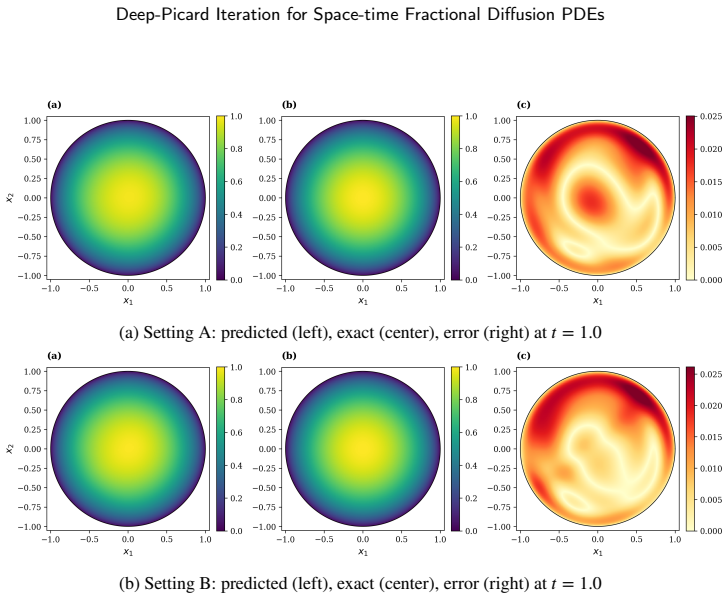
We propose a Deep-Picard iteration framework for high-dimensional nonlinear space-time fractional diffusion equations.The method is based on a nonlinear fractional Feynman--Kac fixed-point formulation, which replaces direct discretization of the Caputo memory term and the nonlocal fractional Laplacian by Monte Carlo simulation of the associated fractional dynamics. Each Picard update is approximated by stochastic label generation and realized through supervised neural-network regression, thereby avoiding residual minimization involving fractional differential operators. The fractional trajectories are generated by coupling a discretized beta-stable subordinator with a walk-on-spheres-type simulation of the rotationally symmetric alpha-stable L\'evy process. Numerical experiments on two-dimensional and high-dimensional test problems ddemonstrate stable Picard convergence and accurate approximation, with tests reported up to dimension d=100.
Editorial analysis
A structured set of objections, weighed in public.
Referee Report
Summary. The manuscript proposes a Deep-Picard iteration framework for high-dimensional nonlinear space-time fractional diffusion PDEs. It reformulates the problem via a nonlinear fractional Feynman-Kac fixed-point equation, replaces direct discretization of the Caputo and fractional Laplacian terms by Monte Carlo simulation of coupled beta-stable subordinators and rotationally symmetric alpha-stable Lévy processes (via walk-on-spheres), and realizes each Picard update through supervised neural-network regression.
Significance. If the Monte Carlo labels remain unbiased at the reported scales, the method offers a scalable route to high-dimensional fractional PDEs (tested to d=100) where grid-based schemes are intractable. The combination of stochastic process simulation with deep learning for fixed-point iteration is a concrete contribution to numerical analysis of nonlocal problems.
major comments (2)
- [Numerical Experiments] Numerical Experiments section: the abstract and reported tests claim 'stable Picard convergence and accurate approximation' up to d=100, yet no quantitative error tables (e.g., L² or max-norm errors versus sample size, network width, or time-step), convergence rates, or baseline comparisons appear. Without these metrics it is impossible to verify that the observed stability reflects convergence to the true PDE solution rather than to a biased surrogate.
- [§3] §3 (Monte Carlo label generation): the discretization of the beta-stable subordinator and the walk-on-spheres truncation for the α-stable process are presented without error bounds or bias analysis. In high dimensions the variance of Lévy increments grows; residual truncation bias could systematically shift the regression target away from the true fractional Feynman-Kac fixed point, undermining the central claim that the procedure recovers the PDE solution.
minor comments (1)
- [Abstract] Abstract: 'ddemonstrate' is a typographical error.
Simulated Author's Rebuttal
We thank the referee for the thorough review and valuable suggestions. Below we respond to each major comment in detail.
read point-by-point responses
-
Referee: [Numerical Experiments] Numerical Experiments section: the abstract and reported tests claim 'stable Picard convergence and accurate approximation' up to d=100, yet no quantitative error tables (e.g., L² or max-norm errors versus sample size, network width, or time-step), convergence rates, or baseline comparisons appear. Without these metrics it is impossible to verify that the observed stability reflects convergence to the true PDE solution rather than to a biased surrogate.
Authors: We agree that the numerical experiments would benefit from more quantitative validation. In the revised version, we will incorporate tables with L² and max-norm errors as functions of sample size, network width, and time-step size. We will also report observed convergence rates for the Picard iteration and provide baseline comparisons for the 2D cases using alternative numerical methods. This will allow readers to assess that the approximations are converging to the true PDE solution. revision: yes
-
Referee: [§3] §3 (Monte Carlo label generation): the discretization of the beta-stable subordinator and the walk-on-spheres truncation for the α-stable process are presented without error bounds or bias analysis. In high dimensions the variance of Lévy increments grows; residual truncation bias could systematically shift the regression target away from the true fractional Feynman-Kac fixed point, undermining the central claim that the procedure recovers the PDE solution.
Authors: The discretization methods are based on established techniques for stable Lévy processes. Nevertheless, we recognize that explicit error bounds and bias analysis were not included. In the revision, we will add a dedicated paragraph or subsection providing error estimates for the beta-stable subordinator discretization and the truncation error in the walk-on-spheres algorithm, drawing on existing convergence theory for these processes. We will also analyze the impact of variance growth in high dimensions and demonstrate through additional experiments that the regression step keeps the overall bias small, preserving the recovery of the PDE solution. revision: yes
Circularity Check
No circularity: external Monte Carlo labels drive independent NN regression
full rationale
The derivation chain begins with the standard nonlinear fractional Feynman-Kac fixed-point representation of the space-time fractional PDE, then generates labels by Monte Carlo simulation of the coupled beta-stable subordinator and alpha-stable Levy process (via discretization and walk-on-spheres), and finally performs supervised neural-network regression on those externally generated labels for each Picard iterate. No equation or step equates a claimed prediction to a fitted parameter by construction, nor does any load-bearing premise reduce to a self-citation or self-defined ansatz. The numerical experiments up to d=100 serve as validation of the simulation-plus-regression procedure rather than tautological re-derivation of the inputs. The framework remains self-contained against external stochastic benchmarks.
Axiom & Free-Parameter Ledger
free parameters (2)
- time discretization step for beta-stable subordinator
- neural network hyperparameters
axioms (2)
- domain assumption The fractional Feynman-Kac formula holds for the space-time fractional diffusion operator
- standard math Alpha-stable Levy processes and beta-stable subordinators correctly generate the required fractional dynamics
Reference graph
Works this paper leans on
-
[1]
A fractional Laplace equation: Regularity of solutions and finite element approximations
Acosta, G., Borthagaray, J.P., 2017. A fractional Laplace equation: Regularity of solutions and finite element approximations. SIAM Journal on Numerical Analysis 55, 472–495. doi:10.1137/15M1033952
-
[2]
Stochastic solutions for fractional Cauchy problems
Baeumer, B., Meerschaert, M.M., 2001. Stochastic solutions for fractional Cauchy problems. Fractional Calculus and Applied Analysis 4, 481–500
2001
-
[3]
Benson, D.A., Wheatcraft, S.W., Meerschaert, M.M., 2000. Application of a fractional advection-dispersion equation. Water Resources Research 36, 1403–1412. doi:10.1029/2000WR900031
-
[4]
Sharp heat kernel estimates for relativistic stable processes in open sets
Chen, Z.Q., Kim, P., Song, R., 2012. Sharp heat kernel estimates for relativistic stable processes in open sets. Annals of Probability 40, 213–244
2012
-
[5]
Numerical method for space–time fractional diffusion: A stochastic approach
Cui, X., Sheng, C., Su, B., Zhou, T., 2025. Numerical method for space–time fractional diffusion: A stochastic approach. arXiv preprint arXiv:2508.20361
-
[6]
Fractional models for the migration of biological cells in complex spatial domains
Cusimano, N., Burrage, K., Burrage, P., 2013. Fractional models for the migration of biological cells in complex spatial domains. ANZIAM Journal 54, C250–C270. doi:10.21914/anziamj.v54i0.6283
-
[7]
Fractional diffusion in plasma turbulence
del-Castillo-Negrete, D., Carreras, B.A., Lynch, V.E., 2004. Fractional diffusion in plasma turbulence. Physics of Plasmas 11, 3854–3864. doi:10.1063/1.1767097
-
[8]
ThefractionalLaplacianoperatoronboundeddomainsasaspecialcaseofthenonlocaldiffusionoperator
D’Elia,M.,Gunzburger,M.,2013. ThefractionalLaplacianoperatoronboundeddomainsasaspecialcaseofthenonlocaldiffusionoperator. Computers & Mathematics with Applications 66, 1245–1260. doi:10.1016/j.camwa.2013.07.022
-
[9]
E, W., Han, J., Jentzen, A., 2017. Deep learning-based numerical methods for high-dimensional parabolic partial differential equations and backwardstochasticdifferentialequations. CommunicationsinMathematicsandStatistics5,349–380. doi:10.1007/s40304-017-0117-6
-
[10]
Multilevel picard iterations for solving smooth semilinear parabolic heat equations
E, W., Hutzenthaler, M., Jentzen, A., Kruse, T., 2021. Multilevel picard iterations for solving smooth semilinear parabolic heat equations. Partial Differential Equations and Applications 2, 1–40. doi:10.1007/s42985-021-00089-5
-
[11]
First passage times for symmetric stable processes in space
Getoor, R.K., 1961. First passage times for symmetric stable processes in space. Transactions of the American Mathematical Society 101, 75–90
1961
-
[12]
Multilevel monte carlo path simulation
Giles, M.B., 2008. Multilevel monte carlo path simulation. Operations Research 56, 607–617. doi:10.1287/opre.1070.0496
-
[13]
Some recent advances in theory and simulation of fractional diffusion processes
Gorenflo, R., Mainardi, F., Moretti, D., Pagnini, G., Paradisi, P., 2009. Some recent advances in theory and simulation of fractional diffusion processes. Journal of Computational and Applied Mathematics 229, 400–415. doi:10.1016/j.cam.2008.04.019
-
[14]
Deep picard iteration for high-dimensional nonlinear PDEs
Han, J., Hu, W., Long, J., Zhao, Y., 2024. Deep picard iteration for high-dimensional nonlinear PDEs. arXiv preprintarXiv:2409.08526
-
[15]
Solving high-dimensional partial differential equations using deep learning
Han, J., Jentzen, A., E, W., 2018. Solving high-dimensional partial differential equations using deep learning. Proceedings of the National Academy of Sciences 115, 8505–8510. doi:10.1073/pnas.1718942115
-
[16]
Numerical methods for the fractional Laplacian: A finite difference–quadrature approach
Huang, Y., Oberman, A.M., 2014. Numerical methods for the fractional Laplacian: A finite difference–quadrature approach. SIAM Journal on Numerical Analysis 52, 3056–3084. doi:10.1137/140954040
-
[17]
Numerical methods for time-fractional evolution equations with nonsmooth data: A concise overview
Jin, B., Lazarov, R., Zhou, Z., 2019. Numerical methods for time-fractional evolution equations with nonsmooth data: A concise overview. Computer Methods in Applied Mechanics and Engineering 346, 332–358. doi:10.1016/j.cma.2018.12.011
-
[18]
Numerical treatment and analysis of time-fractional evolution equations
Jin, B., Zhou, Z., 2023. Numerical treatment and analysis of time-fractional evolution equations. volume 214. Springer
2023
-
[19]
Fractional differential equations
Jin, B., et al., 2021. Fractional differential equations. volume 206. Springer
2021
-
[20]
Decay estimates for time-fractional and other non-local in time subdiffusion equations inℝ𝑑
Kemppainen, J., Siljander, J., Vergara, V., Zacher, R., 2016. Decay estimates for time-fractional and other non-local in time subdiffusion equations inℝ𝑑. Mathematische Annalen 366, 941–979
2016
-
[21]
Ten equivalent definitions of the fractional laplace operator
Kwaśnicki, M., 2017. Ten equivalent definitions of the fractional laplace operator. Fractional Calculus and Applied Analysis 20, 7–51. doi:10.1515/fca-2017-0002
-
[22]
Unbiased‘walk-on-spheres’montecarlomethodsforthefractionalLaplacian
Kyprianou,A.E.,Osojnik,A.,Shardlow,T.,2018. Unbiased‘walk-on-spheres’montecarlomethodsforthefractionalLaplacian. IMAJournal of Numerical Analysis 38, 1550–1578. doi:10.1093/imanum/drx042
-
[23]
Fractional Pearson diffusions
Leonenko, N.N., Meerschaert, M.M., Sikorskii, A., 2013. Fractional Pearson diffusions. Journal of Mathematical Analysis and Applications 403, 532–546
2013
-
[24]
What is the fractional Laplacian? a comparative review with new results
Lischke, A., Pang, G., Gulian, M., Song, F., Glusa, C., Zheng, X., Mao, Z., Cai, W., Meerschaert, M.M., Ainsworth, M., Karniadakis, G.E., 2020. What is the fractional Laplacian? a comparative review with new results. Journal of Computational Physics 404, 109009. doi:10.1016/j.jcp.2019.109009
-
[25]
Discretized fractional calculus
Lubich, C., 1986. Discretized fractional calculus. SIAM Journal on Mathematical Analysis 17, 704–719. doi:10.1137/0517050. Zeng et al.:Preprint submitted to ElsevierPage 21 of 22 Deep-Picard Iteration for Space-time Fractional Diffusion PDEs
-
[26]
doi:10.1103/PhysRevE.65.041103
Meerschaert,M.M.,Benson,D.A.,Scheffler,H.P.,Baeumer,B.,2002.Stochasticsolutionofspace-timefractionaldiffusionequations.Physical Review E 65, 041103. doi:10.1103/PhysRevE.65.041103
-
[27]
Meerschaert,M.M.,Nane,E.,Vellaisamy,P.,2009.FractionalCauchyproblemsonboundeddomains.TheAnnalsofProbability37,979–1007. doi:10.1214/08-AOP426
-
[28]
Minden, V., Ying, L., 2020. A simple solver for the fractional Laplacian in multiple dimensions. SIAM Journal on Scientific Computing 42, A878–A900. doi:10.1137/18M1170406
-
[29]
fPINNs:Fractionalphysics-informedneuralnetworks
Pang,G.,Lu,L.,Karniadakis,G.E.,2019. fPINNs:Fractionalphysics-informedneuralnetworks. SIAMJournalonScientificComputing41, A2603–A2626. doi:10.1137/18M1229845
-
[30]
Raissi, M., Perdikaris, P., Karniadakis, G.E., 2019. Physics-informed neural networks: A deep learning framework for solving forward and inverse problems involving nonlinear partial differential equations. Journal of Computational Physics 378, 686–707. doi:10.1016/j.jcp. 2018.10.045
-
[31]
The Dirichlet problem for the fractional Laplacian: regularity up to the boundary
Ros-Oton, X., Serra, J., 2014. The Dirichlet problem for the fractional Laplacian: regularity up to the boundary. Journal de Mathématiques Pures et Appliquées 101, 275–302
2014
-
[32]
Fast and oblivious convolution quadrature
Schädle, A., López-Fernández, M., Lubich, C., 2006. Fast and oblivious convolution quadrature. SIAM Journal on Scientific Computing 28, 421–438. doi:10.1137/050623139
-
[33]
A walk outside spheres for the fractional Laplacian: Fields and first eigenvalue
Shardlow, T., 2019. A walk outside spheres for the fractional Laplacian: Fields and first eigenvalue. Mathematics of Computation 88, 2767–2792. doi:10.1090/mcom/3422
-
[34]
Efficient monte carlo method for integral fractional Laplacian in multiple dimensions
Sheng, C., Su, B., Xu, C., 2023. Efficient monte carlo method for integral fractional Laplacian in multiple dimensions. SIAM Journal on Numerical Analysis 61, 1738–1763. doi:10.1137/22M1504706
-
[35]
DGM: A deep learning algorithm for solving partial differential equations , volume=
Sirignano, J., Spiliopoulos, K., 2018. DGM: A deep learning algorithm for solving partial differential equations. Journal of Computational Physics 375, 1339–1364. doi:10.1016/j.jcp.2018.08.029
-
[36]
Stynes, M., O’Riordan, E., Gracia, J.L., 2017. Error analysis of a finite difference method on graded meshes for a time-fractional diffusion equation. SIAM Journal on Numerical Analysis 55, 1057–1079. doi:10.1137/16M1082329
-
[37]
SIAM Journal on Scientific Computing 33, 1159–1180
Yang,Q.,Turner,I.,Liu,F.,Ilić,M.,2011.Novelnumericalmethodsforsolvingthetime-spacefractionaldiffusionequationintwodimensions. SIAM Journal on Scientific Computing 33, 1159–1180. doi:10.1137/100800634
-
[38]
Weak solutions of abstract evolutionary integro-differential equations in Hilbert spaces
Zacher, R., 2009. Weak solutions of abstract evolutionary integro-differential equations in Hilbert spaces. Funkcialaj Ekvacioj 52, 1–18. Zeng et al.:Preprint submitted to ElsevierPage 22 of 22
2009
discussion (0)
Sign in with ORCID, Apple, or X to comment. Anyone can read and Pith papers without signing in.