High-Dimensional Multivariate VAR Estimation with Spatio-Temporal Structure
Pith reviewed 2026-05-09 18:46 UTC · model grok-4.3
The pith
Decomposing VAR transition matrices into cross-variable and spatial parts, then weighting regularization by a pre-specified spatial graph, enables consistent estimation of high-dimensional spatio-temporal models.
A machine-rendered reading of the paper's core claim, the machinery that carries it, and where it could break.
Core claim
Under stability and restricted-eigenvalue-type conditions for high-dimensional VAR processes, the proposed estimator converges to a blockwise stationary point in the subgradient sense and provides high-probability estimation error bounds for both components, while simulation studies demonstrate accurate recovery of sparse transition structures and improvement over existing two-step L1-regularized methods.
What carries the argument
Decomposition of each block transition matrix into a cross-variable dependence coefficient and a spatial transition matrix constrained by a pre-specified spatial graph, formulated as a weighted L1-regularized least-squares problem solved by alternating convex search with ADMM.
Load-bearing premise
The spatial transition matrices can be meaningfully constrained through a pre-specified spatial graph, and the high-dimensional VAR process satisfies stability and restricted-eigenvalue conditions.
What would settle it
A simulation where the true sparse structure violates the pre-specified spatial graph or the stability conditions, in which the estimator fails to achieve the predicted support recovery or exceeds the derived error bounds.
Figures


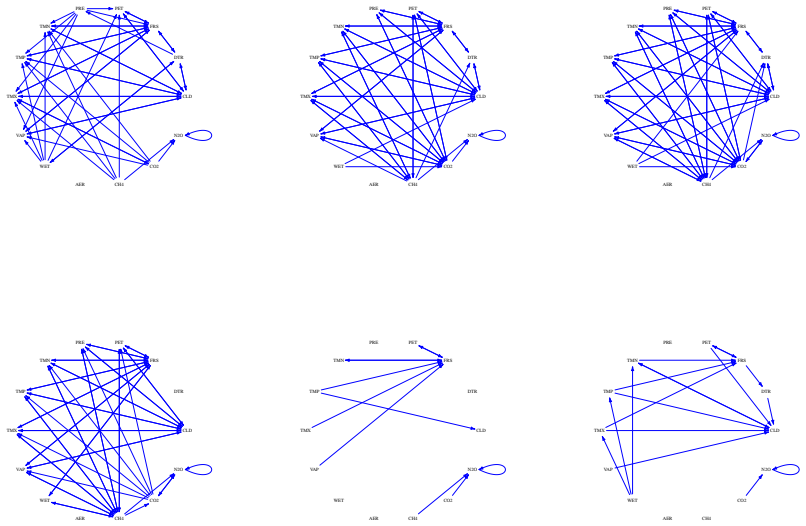

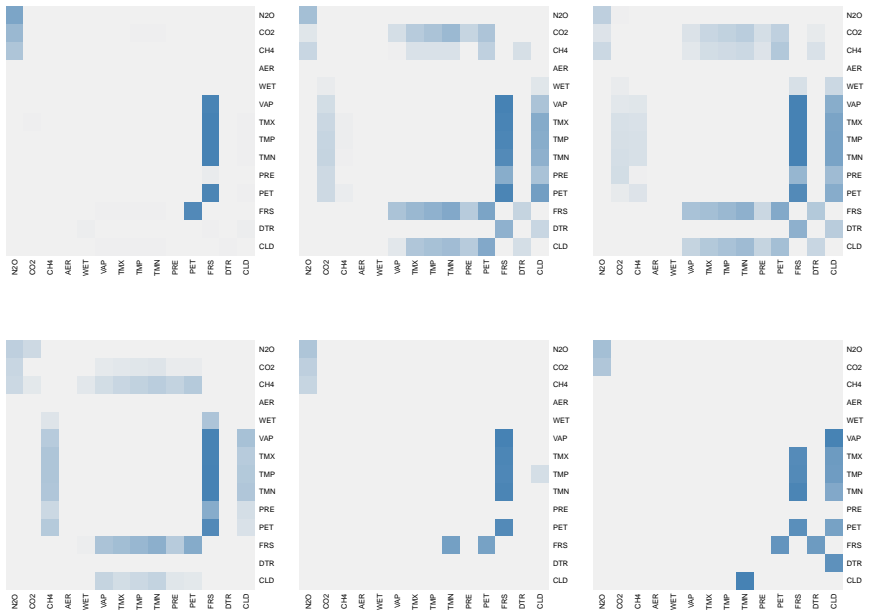


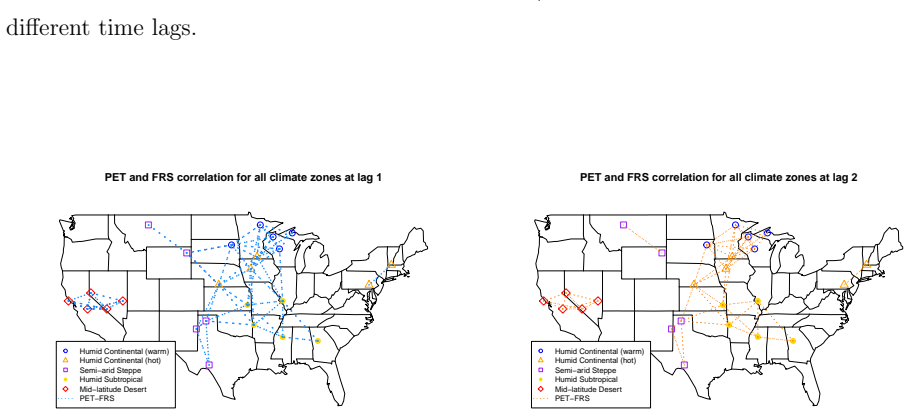

read the original abstract
High-dimensional vector autoregressive (VAR) models provide a flexible framework for characterizing dynamic dependence in multivariate spatio-temporal systems, but their unrestricted estimation becomes infeasible when multiple variables are observed over many spatial locations. This paper develops a structured estimation procedure for high-dimensional multivariate VAR processes that explicitly incorporates spatial information. We decompose each block transition matrix into a cross-variable dependence coefficient and a spatial transition matrix, and constrain the spatial transition matrices through a pre-specified spatial graph. The resulting estimator is formulated as a weighted $\ell_1$-regularized least-squares problem, where the weights encode spatial proximity or topological similarity and induce stronger shrinkage on spatially implausible interactions. Since the objective function is bi-convex, we estimate the cross-variable dependence matrix and the spatial transition matrices through an alternating convex-search algorithm implemented with ADMM. Under stability and restricted-eigenvalue-type conditions for high-dimensional VAR processes, we establish convergence to a blockwise stationary point in the subgradient sense and derive high-probability estimation error bounds for both components of the model. Simulation studies demonstrate that the proposed estimator accurately recovers sparse transition structures and improves over existing two-step $\ell_1$-regularized methods in support recovery and estimation accuracy. An application to North American climate data illustrates that the method recovers interpretable variable-dependence networks and spatial interaction patterns across different climate regions.
Editorial analysis
A structured set of objections, weighed in public.
Referee Report
Summary. The manuscript develops a structured estimator for high-dimensional multivariate VAR processes that incorporates spatial information. Each block transition matrix is decomposed into a cross-variable dependence coefficient and a spatial transition matrix constrained via a pre-specified spatial graph. The resulting weighted ℓ1-regularized least-squares objective is minimized by an alternating convex-search algorithm implemented with ADMM. Under stability and restricted-eigenvalue-type conditions, the paper establishes convergence to a blockwise stationary point in the subgradient sense together with high-probability error bounds. Simulations generated from the model show improved support recovery and estimation accuracy relative to two-step ℓ1 baselines; an application to North American climate data is also presented.
Significance. If the stated assumptions hold in practice, the work provides a computationally tractable way to exploit spatial proximity or topological similarity when estimating high-dimensional spatio-temporal VAR models. The bi-convex formulation and ADMM solver are practical strengths, and the explicit error bounds supply theoretical support for the claimed recovery improvements. This could be useful in domains such as climate science where spatial graphs are often available a priori. The reliance on a user-supplied graph and standard high-dimensional conditions is acknowledged in the paper but limits the scope of the guarantees.
major comments (2)
- § on theoretical analysis (error bounds): The high-probability bounds and convergence result are load-bearing for the central claim, yet they rest on stability and restricted-eigenvalue conditions whose verification for the spatio-temporal model is not discussed. A concrete illustration or sufficient condition showing when the RE constant remains bounded away from zero under the graph-constrained structure would strengthen the result.
- § on model decomposition: The decomposition of each block transition matrix into a cross-variable coefficient matrix and a spatial transition matrix is central to the regularization scheme. The paper should explicitly state the identifiability or normalization condition that makes this decomposition unique, as any scaling ambiguity would propagate into the weighted ℓ1 penalty and the derived error bounds.
minor comments (3)
- Abstract: The phrase 'blockwise stationary point in the subgradient sense' is used without a brief definition or pointer to the precise stationarity condition; adding one sentence would aid readers outside nonsmooth optimization.
- Simulation section: The reported improvements are quantified via support recovery and estimation error, but the exact definitions of the two-step ℓ1 baselines (e.g., separate lasso on each equation versus joint) and the precise metrics (precision-recall or Hamming distance) should be stated in the text or table captions.
- Application section: The recovered climate networks are described as interpretable, yet no quantitative comparison to established climate teleconnection patterns or cross-validation against held-out periods is provided; a small table of edge overlap with known indices would be helpful.
Simulated Author's Rebuttal
We thank the referee for the careful and constructive review. The comments highlight important aspects of the theoretical analysis and model identifiability that we address below. We plan to revise the manuscript accordingly to strengthen these sections.
read point-by-point responses
-
Referee: § on theoretical analysis (error bounds): The high-probability bounds and convergence result are load-bearing for the central claim, yet they rest on stability and restricted-eigenvalue conditions whose verification for the spatio-temporal model is not discussed. A concrete illustration or sufficient condition showing when the RE constant remains bounded away from zero under the graph-constrained structure would strengthen the result.
Authors: We agree that the paper would benefit from explicit discussion of the restricted eigenvalue (RE) condition under the proposed spatio-temporal structure. In the revised manuscript we will add a dedicated remark in the theoretical section providing sufficient conditions under which the RE constant remains bounded away from zero. Specifically, when the pre-specified spatial graph is connected with bounded degree and the cross-variable dependence coefficients obey a uniform row-sparsity pattern, standard concentration arguments for the Gram matrix of the lagged covariates (combined with the graph-induced weighting) yield a positive lower bound on the RE constant with high probability. We will also note that the stability assumption is the standard one for VAR processes and can be verified empirically via the spectral radius of the estimated transition operator. revision: yes
-
Referee: § on model decomposition: The decomposition of each block transition matrix into a cross-variable coefficient matrix and a spatial transition matrix is central to the regularization scheme. The paper should explicitly state the identifiability or normalization condition that makes this decomposition unique, as any scaling ambiguity would propagate into the weighted ℓ1 penalty and the derived error bounds.
Authors: We appreciate the referee drawing attention to the identifiability issue. The decomposition is indeed subject to scaling ambiguity, which would affect both the weighted penalty and the error bounds. In the revised manuscript we will explicitly introduce a normalization condition in the model formulation (Section 2): each spatial transition matrix is constrained to have unit Frobenius norm. This removes the scaling freedom while preserving the product structure, ensures the weighted ℓ1 penalty is well-defined, and allows the high-probability bounds to be stated without additional scaling factors. The alternating optimization algorithm remains unchanged under this constraint. revision: yes
Circularity Check
No significant circularity detected
full rationale
The derivation relies on explicitly stated assumptions (stability, restricted-eigenvalue conditions, and a pre-specified spatial graph) that are external to the fitted quantities. The estimator is formulated as a weighted ℓ1-regularized least-squares problem solved by alternating ADMM on a bi-convex objective; convergence to a blockwise stationary point and high-probability error bounds are derived directly from these assumptions and standard high-dimensional concentration arguments. No step reduces a claimed prediction or bound to a quantity defined by the estimator itself, no self-citation chain is load-bearing, and no ansatz is smuggled in. Simulations are generated from the model but serve only as illustration, not as the source of the theoretical claims. The procedure is therefore self-contained against external benchmarks.
Axiom & Free-Parameter Ledger
free parameters (2)
- spatial graph
- regularization weights
axioms (1)
- domain assumption Stability and restricted-eigenvalue-type conditions for high-dimensional VAR processes
Reference graph
Works this paper leans on
-
[1]
Journal of Economic perspectives , volume=
Vector autoregressions , author=. Journal of Economic perspectives , volume=
-
[2]
Econometrica: journal of the Econometric Society , pages=
Macroeconomics and reality , author=. Econometrica: journal of the Econometric Society , pages=. 1980 , publisher=
work page 1980
- [3]
-
[4]
Journal of Neuroscience , volume=
Granger causality analysis in neuroscience and neuroimaging , author=. Journal of Neuroscience , volume=. 2015 , publisher=
work page 2015
-
[5]
Journal of machine learning research , volume=
Regularized estimation and testing for high-dimensional multi-block vector-autoregressive models , author=. Journal of machine learning research , volume=
-
[6]
International Conference on Machine Learning , pages=
Estimating structured vector autoregressive models , author=. International Conference on Machine Learning , pages=. 2016 , organization=
work page 2016
-
[7]
International journal of epidemiology , volume=
A monitoring system to detect changes in public health surveillance data , author=. International journal of epidemiology , volume=. 1994 , publisher=
work page 1994
-
[8]
A case-crossover analysis of out-of-hospital cardiac arrest and air pollution , author=. Circulation , volume=. 2013 , publisher=
work page 2013
-
[9]
Quantifying effects of abiotic and biotic drivers on community dynamics with multivariate autoregressive (MAR) models , author=. Ecology , volume=. 2013 , publisher=
work page 2013
-
[10]
Journal of Computational and Graphical Statistics , volume=
Sparse vector autoregressive modeling , author=. Journal of Computational and Graphical Statistics , volume=. 2016 , publisher=
work page 2016
-
[11]
IEEE Transactions on Signal Processing , volume=
Low rank and structured modeling of high-dimensional vector autoregressions , author=. IEEE Transactions on Signal Processing , volume=. 2019 , publisher=
work page 2019
-
[12]
arXiv preprint arXiv:2012.10030 , year=
Regularized Estimation in High-Dimensional Vector Auto-Regressive Models using Spatio-Temporal Information , author=. arXiv preprint arXiv:2012.10030 , year=
-
[13]
Traffic-related air pollution and lung cancer: A meta-analysis , author=. Thoracic cancer , volume=. 2015 , publisher=
work page 2015
-
[14]
The Annals of Statistics , volume=
Regularized estimation in sparse high-dimensional time series models , author=. The Annals of Statistics , volume=. 2015 , publisher=
work page 2015
-
[15]
Climate change 2013: the physical science basis , author=. Contribution of Working Group I to the Fifth Assessment Report of the Intergovernmental Panel on Climate Change (eds TF Stocker et al.) , pages=
work page 2013
-
[16]
Statistical learning with sparsity: the lasso and generalizations , author=. 2015 , publisher=
work page 2015
-
[17]
Distributed optimization and statistical learning via the alternating direction method of multipliers , author=. 2011 , publisher=
work page 2011
-
[18]
Introduction to multiple time series analysis , author=. 2013 , publisher=
work page 2013
-
[19]
Journal of Computational and Graphical Statistics , volume=
High-dimensional multivariate time series with additional structure , author=. Journal of Computational and Graphical Statistics , volume=. 2017 , publisher=
work page 2017
-
[20]
Bulletin of the American Meteorological Society , volume=
Space and time scales in ambient ozone data , author=. Bulletin of the American Meteorological Society , volume=. 1997 , publisher=
work page 1997
-
[21]
The relationship of cloud cover to near-surface temperature and humidity: Comparison of GCM simulations with empirical data , author=. Journal of Climate , volume=
-
[22]
Nature Climate Change , volume=
Causal feedbacks in climate change , author=. Nature Climate Change , volume=. 2015 , publisher=
work page 2015
-
[23]
Ecosystem Health and Sustainability , volume=
Global methane and nitrous oxide emissions from terrestrial ecosystems due to multiple environmental changes , author=. Ecosystem Health and Sustainability , volume=. 2015 , publisher=
work page 2015
-
[24]
International Conference on Environmental, Biomedical and Biotechnology
Potential Evapotranspiration Prediction from other climatic variables , author=. International Conference on Environmental, Biomedical and Biotechnology. IPCBEE , volume=
-
[25]
Mathematical methods of operations research , volume=
Biconvex sets and optimization with biconvex functions: a survey and extensions , author=. Mathematical methods of operations research , volume=. 2007 , publisher=
work page 2007
-
[26]
The Annals of Statistics , volume=
High-dimensional regression with noisy and missing data: Provable guarantees with nonconvexity , author=. The Annals of Statistics , volume=. 2012 , publisher=
work page 2012
discussion (0)
Sign in with ORCID, Apple, or X to comment. Anyone can read and Pith papers without signing in.