What Makes an AI Writing Companion a Good Fit? A Personality-Informed Co-Design Study
Pith reviewed 2026-05-09 18:30 UTC · model grok-4.3
The pith
Personality traits shape writers' preferences for how AI companions should function, interact, and appear.
A machine-rendered reading of the paper's core claim, the machinery that carries it, and where it could break.
Core claim
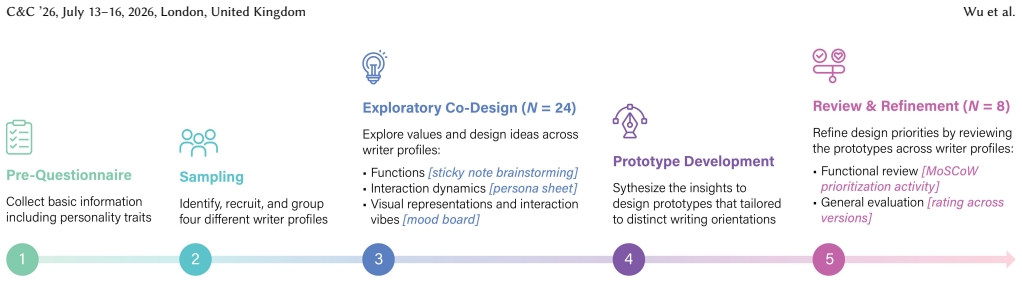
Through exploratory co-design workshops with writers representing different personality profiles, we elicited values and design ideas for AI writing companions spanning functionality, interaction dynamics, and visual representation. These insights informed two contrasting prototypes used as design provocations in review-and-refinement workshops, revealing both shared foundational needs across writers and meaningful personality-driven preferences that influence how writers engage with AI.
What carries the argument
Personality-informed co-design, in which workshops elicit and refine AI companion ideas according to participants' personality profiles to reveal fit with writing practices.
If this is right
- Writers share basic requirements for AI companions such as goal awareness and relevant suggestions.
- Preferences for proactive versus reserved AI behavior vary meaningfully by personality.
- Aligning AI companions with individual cognitive and interpersonal needs improves engagement and perceived collaboration effectiveness.
- Team matching between human writers and AI systems matters for productive outcomes.
- Design considerations should cover functionality, interaction dynamics, and visual representation together.
Where Pith is reading between the lines
- One-size-fits-all AI writing tools are likely to leave some personality types less satisfied.
- Quick personality screening at onboarding could let AI systems adapt their default behavior.
- The same matching logic may apply to other creative AI tools beyond writing.
Load-bearing premise
That a small group of participants in workshop settings can reliably surface stable personality influences on real AI usage preferences rather than workshop-specific or hypothetical ideas.
What would settle it
A follow-up study with a larger and more diverse writer sample that finds no reliable correlation between measured personality traits and preferences for specific AI interaction or visual features would undermine the claim.
Figures


read the original abstract
The growing popularity of AI writing assistants creates exciting opportunities to support diverse writers. This study examines how personality shapes expectations for AI writing companions and how personality-informed design can enhance human-AI teaming in writing. Through exploratory co-design workshops with 24 writers representing different personality profiles, we elicited values and design ideas for AI writing companions spanning functionality, interaction dynamics, and visual representation. These insights informed two contrasting prototypes reflecting distinct writing orientations, used as design provocations in review-and-refinement workshops with eight participants to prompt reflection on fit, priorities, and writing practices. Our findings reveal both shared foundational needs across writers and meaningful personality-driven preferences that influence how writers engage with AI. This work underscores the importance of team matching in human-AI collaboration and demonstrates how aligning AI companions with individual cognitive and interpersonal needs can improve engagement and perceived collaboration effectiveness.
Editorial analysis
A structured set of objections, weighed in public.
Referee Report
Summary. The paper reports results from a two-phase qualitative co-design study: exploratory workshops with 24 writers of varied personality profiles to elicit values and design ideas for AI writing companions (covering functionality, interaction dynamics, and visual representation), followed by prototype review-and-refinement sessions with 8 participants using two contrasting prototypes as provocations. The central claim is that writers share foundational needs but also exhibit meaningful personality-driven preferences that affect how they would engage with AI writing tools, supporting the value of personality-informed design for better human-AI teaming.
Significance. If the interpretive findings hold, the work supplies concrete, participant-grounded design insights that could guide personalization strategies in creative AI tools, an area of growing interest in HCI. It usefully demonstrates co-design as a method for surfacing both common and differentiated needs. The exploratory nature and small sample mean the primary contribution is hypothesis generation rather than generalizable conclusions; stronger validation would be needed to elevate impact.
major comments (3)
- [Methods] Methods (workshop and analysis description): the manuscript provides participant counts and phases but omits inter-rater reliability metrics, detailed coding procedures, exclusion criteria, and how personality profiles were systematically linked to themes; without these, the trustworthiness of the reported personality-driven preferences cannot be fully evaluated.
- [Results] Results and central claim: the assertion of 'meaningful personality-driven preferences that influence how writers engage with AI' rests on self-reported hypothetical scenarios from workshops without behavioral measures, longitudinal follow-up, or controls for confounds such as prior AI exposure and writing genre; this makes it difficult to establish that the observed differences are stable traits rather than session artifacts.
- [Prototype Review] Prototype review phase (n=8): the small size of the second phase limits the ability to validate or refine personality-linked insights across profiles, yet the manuscript uses these sessions to support conclusions about 'fit' and 'collaboration effectiveness'; a clearer discussion of this constraint is needed.
minor comments (2)
- [Abstract] Abstract: the personality assessment instrument or framework (e.g., specific traits or inventory) is not named, which would help readers interpret the 'personality profiles' referenced.
- Presentation: if participant demographics or theme summaries are not already tabulated, adding a concise table would improve traceability between raw data and claims.
Simulated Author's Rebuttal
We thank the referee for their detailed and constructive comments, which highlight important aspects of transparency and scope in our qualitative study. We address each major comment below, indicating where revisions will strengthen the manuscript while preserving the exploratory nature of the work.
read point-by-point responses
-
Referee: [Methods] Methods (workshop and analysis description): the manuscript provides participant counts and phases but omits inter-rater reliability metrics, detailed coding procedures, exclusion criteria, and how personality profiles were systematically linked to themes; without these, the trustworthiness of the reported personality-driven preferences cannot be fully evaluated.
Authors: We agree that greater methodological transparency is warranted. The analysis followed reflexive thematic analysis (Braun & Clarke), with the full research team iteratively developing and refining codes through collaborative discussion sessions rather than independent parallel coding; inter-rater reliability metrics are therefore not applicable and were not computed, consistent with standard practice in HCI qualitative work. We will add a new subsection detailing the coding process, including how personality profiles (from pre-workshop Big Five inventories) were linked to themes via direct participant quotes and cross-case comparison. Exclusion criteria were limited to ensuring English proficiency for writing tasks and will be explicitly stated. These additions will improve evaluability without altering the interpretive approach. revision: partial
-
Referee: [Results] Results and central claim: the assertion of 'meaningful personality-driven preferences that influence how writers engage with AI' rests on self-reported hypothetical scenarios from workshops without behavioral measures, longitudinal follow-up, or controls for confounds such as prior AI exposure and writing genre; this makes it difficult to establish that the observed differences are stable traits rather than session artifacts.
Authors: The referee accurately identifies that findings derive from self-reported preferences elicited in co-design workshops. This is inherent to the exploratory method chosen to surface design values and ideas. We will revise the results and discussion sections to frame the personality-linked preferences explicitly as hypotheses generated for future testing, rather than as demonstrated stable traits. A new limitations paragraph will address potential confounds, noting that prior AI exposure was captured via pre-session questionnaires and that writing genre was recorded but not controlled; we acknowledge the absence of behavioral or longitudinal data and will not overstate generalizability. The co-design approach remains appropriate for its goal of informing personality-informed design. revision: yes
-
Referee: [Prototype Review] Prototype review phase (n=8): the small size of the second phase limits the ability to validate or refine personality-linked insights across profiles, yet the manuscript uses these sessions to support conclusions about 'fit' and 'collaboration effectiveness'; a clearer discussion of this constraint is needed.
Authors: We concur that the prototype review phase (n=8) is small and primarily served to provoke deeper reflection using contrasting designs rather than to validate findings. We will expand the discussion and limitations sections to explicitly state this constraint, clarifying that insights on 'fit' and collaboration draw from the integrated two-phase data with the second phase providing illustrative examples rather than standalone evidence. This will temper claims accordingly while retaining the value of the provocation sessions for surfacing nuanced participant reactions. revision: yes
Circularity Check
No significant circularity: empirical qualitative study with no derivations or self-referential reductions
full rationale
This paper is a qualitative HCI study relying on co-design workshops, participant interviews, and prototype feedback from 32 writers. The central claims about shared needs and personality-driven preferences are grounded directly in the collected data and thematic analysis rather than any equations, fitted parameters, or predictions that reduce to inputs by construction. No self-citation chains, uniqueness theorems, or ansatzes are invoked to justify core results. The derivation chain is self-contained against external participant evidence.
Axiom & Free-Parameter Ledger
axioms (2)
- domain assumption Co-design workshops reliably elicit authentic user values and design preferences for AI systems.
- domain assumption Personality profiles are stable traits that predictably shape interaction preferences with AI writing tools.
Reference graph
Works this paper leans on
-
[1]
Philip Achimugu, Ali Selamat, Roliana Ibrahim, and Mohd Naz’ri Mahrin. 2014. A systematic literature review of software requirements prioritization research. Information and software technology56, 6 (2014), 568–585
work page 2014
-
[2]
Alaa Alslaity, Gerry Chan, and Rita Orji. 2023. A panoramic view of person- alization based on individual differences in persuasive and behavior change interventions.Frontiers in Artificial Intelligence6 (2023), 1125191
work page 2023
-
[3]
Robert W Andrews, J Mason Lilly, Divya Srivastava, and Karen M Feigh. 2023. The role of shared mental models in human-AI teams: a theoretical review.Theoretical Issues in Ergonomics Science24, 2 (2023), 129–175
work page 2023
-
[4]
Tita Alissa Bach, Amna Khan, Harry Hallock, Gabriela Beltrão, and Sonia Sousa
-
[5]
A systematic literature review of user trust in AI-enabled systems: An HCI perspective.International Journal of Human–Computer Interaction40, 5 (2024), 1251–1266
work page 2024
-
[6]
Hassan Banaruee, Hooshang Khoshsima, and Afsane Askari. 2017. Corrective Feedback and Personality Type: A Case Study of Iranian L2 Learners.Global Journal of Educational Studies3, 2 (2017), 14–21
work page 2017
-
[7]
Murray R. Barrick, Greg L. Stewart, Mitchell J. Neubert, and Michael K. Mount
-
[8]
doi:10.1037/ 0021-9010.83.3.377
Relating member ability and personality to work-team processes and team effectiveness.Journal of Applied Psychology83, 3 (1998), 377–391. doi:10.1037/ 0021-9010.83.3.377
work page 1998
-
[9]
Amna Batool and Waqar Hussain. 2025. Evaluating the Usability and Ethical Implications of Graphical User Interfaces in Generative AI Systems.Computers 14, 10 (2025), 418
work page 2025
-
[10]
Russell W Belk. 1988. Possessions and the extended self.Journal of consumer research15, 2 (1988), 139–168
work page 1988
- [11]
-
[12]
Oloff C Biermann, Ning F Ma, and Dongwook Yoon. 2022. From tool to compan- ion: Storywriters want AI writers to respect their personal values and writing strategies. InProceedings of the 2022 ACM Designing Interactive Systems Conference. 1209–1227
work page 2022
-
[13]
Kirsten Boehner, Janet Vertesi, Phoebe Sengers, and Paul Dourish. 2007. How HCI interprets the probes. InProceedings of the SIGCHI conference on Human factors in computing systems. 1077–1086
work page 2007
-
[14]
Virginia Braun and Victoria Clarke. 2024. Thematic analysis. InEncyclopedia of quality of life and well-being research. Springer, 7187–7193
work page 2024
-
[15]
Roger Bruning, Michael Dempsey, Douglas F Kauffman, Courtney McKim, and Sharon Zumbrunn. 2013. Examining dimensions of self-efficacy for writing. Journal of educational psychology105, 1 (2013), 25
work page 2013
-
[16]
Roger Bruning and Christy Horn. 2000. Developing motivation to write.Educa- tional psychologist35, 1 (2000), 25–37
work page 2000
-
[17]
Elizabeth Clark, Anne Spencer Ross, Chenhao Tan, Yangfeng Ji, and Noah A Smith. 2018. Creative writing with a machine in the loop: Case studies on slogans and stories. InProceedings of the 23rd International Conference on Intelligent User Interfaces. 329–340
work page 2018
-
[18]
Hai Dang, Karim Benharrak, Florian Lehmann, and Daniel Buschek. 2022. Beyond text generation: Supporting writers with continuous automatic text summaries. InProceedings of the 35th Annual ACM Symposium on User Interface Software and Technology. 1–13
work page 2022
-
[19]
Boele De Raad. 2000.The big five personality factors: the psycholexical approach to personality.Hogrefe & Huber Publishers
work page 2000
-
[20]
Fernando Delgado, Stephen Yang, Michael Madaio, and Qian Yang. 2023. The participatory turn in ai design: Theoretical foundations and the current state of practice. InProceedings of the 3rd ACM Conference on Equity and Access in Algorithms, Mechanisms, and Optimization. 1–23
work page 2023
- [21]
-
[22]
Helga Dittmar. 1991. Meanings of material possessions as reflections of identity: Gender and social-marterial position in society.Journal of Social Behavior and Personality6, 6 (1991), 165
work page 1991
-
[23]
Ann Hill Duin, Isabel Pedersen, Jim Hall, Dan Card, and Lee-Ann Kastman Breuch
-
[24]
In2023 IEEE International Professional Communication Conference (ProComm)
Co-AI Technical Writing: Documentation, Experimentation, User Testing, & Ethical Design. In2023 IEEE International Professional Communication Conference (ProComm). IEEE, 41–43
-
[25]
Aidan Z Fitzsimons. 2024. Overcoming challenges to personal narrative co- writing with AI: A participatory design approach for under-resourced high school students and those that support them. InProceedings of the 16th Conference on Creativity & Cognition. 17–20
work page 2024
-
[26]
Linda Flower and John R Hayes. 1981. A cognitive process theory of writing. College Composition & Communication32, 4 (1981), 365–387
work page 1981
-
[27]
David C Funder. 2012. Accurate personality judgment.Current Directions in Psychological Science21, 3 (2012), 177–182
work page 2012
-
[28]
Lita Furby. 1978. Possession in humans: An exploratory study of its meaning and motivation.Social Behavior and Personality: an international journal6, 1 (1978), 49–65
work page 1978
-
[29]
Richard P Gabriel, Jilin Chen, and Jeffrey Nichols. 2015. InkWell: A Creative Writer’s Creative Assistant. InProceedings of the 2015 ACM SIGCHI Conference on Creativity and Cognition. 93–102
work page 2015
-
[30]
Jianfeng Gao, Michel Galley, and Lihong Li. 2018. Neural approaches to con- versational AI. InThe 41st international ACM SIGIR conference on research & development in information retrieval. 1371–1374
work page 2018
-
[31]
John Maurice Gayed, May Kristine Jonson Carlon, Angelu Mari Oriola, and Jeffrey S Cross. 2022. Exploring an AI-based writing Assistant’s impact on English language learners.Computers and Education: Artificial Intelligence3 (2022), 100055
work page 2022
-
[32]
Katy Ilonka Gero and Lydia B Chilton. 2019. Metaphoria: An algorithmic com- panion for metaphor creation. InProceedings of the 2019 CHI conference on human factors in computing systems. 1–12
work page 2019
-
[33]
Katy Ilonka Gero, Vivian Liu, and Lydia Chilton. 2022. Sparks: Inspiration for science writing using language models. InProceedings of the 2022 ACM Designing Interactive Systems Conference. 1002–1019
work page 2022
-
[34]
Connor Graham and Mark Rouncefield. 2008. Probes and participation. InProceed- ings of the Tenth Anniversary Conference on Participatory Design 2008. 194–197
work page 2008
-
[35]
Patrick Hemmer, Max Schemmer, Niklas Kühl, Michael Vössing, and Gerhard Satzger. 2025. Complementarity in human-AI collaboration: Concept, sources, and evidence.European Journal of Information Systems34, 6 (2025), 979–1002
work page 2025
- [36]
-
[37]
Michael Ivanov and Paul D Werner. 2010. Behavioral communication: Individual differences in communication style.Personality and Individual Differences49, 1 (2010), 19–23
work page 2010
-
[38]
Maurice Jakesch, Advait Bhat, Daniel Buschek, Lior Zalmanson, and Mor Naaman
-
[39]
In Proceedings of the 2023 CHI conference on human factors in computing systems
Co-writing with opinionated language models affects users’ views. In Proceedings of the 2023 CHI conference on human factors in computing systems. C&C ’26, July 13–16, 2026, London, United Kingdom Wu et al. 1–15
work page 2023
-
[40]
George H Jensen and John K DiTiberio. 1984. Personality and individual writing processes.College Composition & Communication35, 3 (1984), 285–300
work page 1984
-
[41]
Melissa A Kacena, Lilian I Plotkin, and Jill C Fehrenbacher. 2024. The use of artificial intelligence in writing scientific review articles.Current Osteoporosis Reports22, 1 (2024), 115–121
work page 2024
-
[42]
Arja Kangasharju, Liisa Ilomäki, Minna Lakkala, and Auli Toom. 2022. Lower secondary students’ poetry writing with the AI-based poetry machine.Computers and Education: Artificial Intelligence3 (2022), 100048
work page 2022
-
[43]
Robert B Kaplan. 1966. Cultural thought patterns in inter-cultural education. Language learning16, 1 (1966)
work page 1966
-
[44]
Ronit Kark and Abraham Carmeli. 2009. Alive and creating: The mediating role of vitality and aliveness in the relationship between psychological safety and creative work involvement.Journal of Organizational Behavior: The International Journal of Industrial, Occupational and Organizational Psychology and Behavior 30, 6 (2009), 785–804
work page 2009
-
[45]
Scott Barry Kaufman, Lena C Quilty, Rachael G Grazioplene, Jacob B Hirsh, Jeremy R Gray, Jordan B Peterson, and Colin G DeYoung. 2016. Openness to experience and intellect differentially predict creative achievement in the arts and sciences.Journal of personality84, 2 (2016), 248–258
work page 2016
-
[46]
Dongwhan Kim and Joonhwan Lee. 2019. Designing an algorithm-driven text generation system for personalized and interactive news reading.International Journal of Human–Computer Interaction35, 2 (2019), 109–122
work page 2019
-
[47]
Jinhee Kim, Hyunkyung Lee, and Young Hoan Cho. 2022. Learning design to support student-AI collaboration: Perspectives of leading teachers for AI in education.Education and Information Technologies27, 5 (2022), 6069–6104
work page 2022
-
[48]
Tatiana Kravchenko, Tatiana Bogdanova, and Timofey Shevgunov. 2022. Ranking requirements using MoSCoW methodology in practice. InComputer Science On-line Conference. Springer, 188–199
work page 2022
-
[49]
Sandra Krebs Hirsh and Jean M Kummerow. 1998. Introduction to type in organizations.Edmonton, AB: CPP(1998)
work page 1998
-
[50]
Albrecht CP Küfner, Mitja D Back, Steffen Nestler, and Boris Egloff. 2010. Tell me a story and I will tell you who you are! Lens model analyses of personality and creative writing.Journal of Research in Personality44, 4 (2010), 427–435
work page 2010
-
[51]
1993.People types & tiger stripes
Gordon D Lawrence. 1993.People types & tiger stripes. ERIC
work page 1993
-
[52]
2013.The science of writing: Theories, methods, individual differences and applications
C Michael Levy and Sarah Ransdell. 2013.The science of writing: Theories, methods, individual differences and applications. Routledge
work page 2013
-
[53]
Claire Liang, Julia Proft, Erik Andersen, and Ross A Knepper. 2019. Implicit communication of actionable information in human-ai teams. InProceedings of the 2019 CHI conference on human factors in computing systems. 1–13
work page 2019
-
[54]
Yihe Liu, Anushk Mittal, Diyi Yang, and Amy Bruckman. 2022. Will AI console me when I lose my pet? Understanding perceptions of AI-mediated email writing. InProceedings of the 2022 CHI conference on human factors in computing systems. 1–13
work page 2022
-
[55]
Andrés Lucero. 2012. Framing, aligning, paradoxing, abstracting, and directing: how design mood boards work. InProceedings of the designing interactive systems conference. 438–447
work page 2012
-
[56]
Fahimeh Marefat. 2006. Student Writing, Personality Type of the Student and the Rater: Any Interrelationship?The Reading Matrix6 (2006), 116–124
work page 2006
-
[57]
Deborah McCutchen. 2000. Knowledge, processing, and working memory: Impli- cations for a theory of writing.Educational psychologist35, 1 (2000), 13–23
work page 2000
-
[58]
Melanie J McGrath, Andreas Duenser, Justine Lacey, and Cecile Paris. 2025. Collab- orative human-AI trust (CHAI-T): A process framework for active management of trust in human-AI collaboration.Computers in Human Behavior: Artificial Humans(2025), 100200
work page 2025
-
[59]
Justin Nicholes. 2017. Measuring ownership of creative versus academic writing: Implications for interdisciplinary praxis.Writing in Practice3 (2017)
work page 2017
-
[60]
Sun Young Park, Pei-Yi Kuo, Andrea Barbarin, Elizabeth Kaziunas, Astrid Chow, Karandeep Singh, Lauren Wilcox, and Walter S Lasecki. 2019. Identifying chal- lenges and opportunities in human-AI collaboration in healthcare. InCompanion Publication of the 2019 Conference on Computer Supported Cooperative Work and Social Computing. 506–510
work page 2019
-
[61]
Miranda A.G. Peeters, Harrie F.J.M. Van Tuijl, Christel G. Rutte, and Isabelle M.M.J. Reymen. 2006. Personality and team performance: A meta-analysis.European Journal of Personality20, 5 (2006), 377–396. doi:10.1002/per.588
-
[62]
James W Pennebaker and Laura A King. 1999. Linguistic styles: language use as an individual difference.Journal of personality and social psychology77, 6 (1999), 1296
work page 1999
-
[63]
Bradley Joseph Perks, Bradley DF Colpitts, and Matthew Michaud. 2021. The role of individual preferences in the efficacy of written corrective feedback in an English for academic purposes writing course.Australian Journal of Teacher Education (Online)46, 10 (2021), 1–20
work page 2021
-
[64]
Kexin Quan, Dina Albassam, Mengke Wu, Zijian Ding, and Jessie Chin. 2026. Towards AI as Colleagues: Multi-Agent System Improves Structured Ideation Pro- cesses. InProceedings of the 2026 CHI Conference on Human Factors in Computing Systems. 1–26
work page 2026
-
[65]
Kexin Quan, Pavithra Ramakrishnan, and Jessie Chin. 2025. Can AI take a joke—or make one? a study of humor generation and recognition in llms. InProceedings of the 2025 Conference on Creativity and Cognition. 431–437
work page 2025
-
[66]
Beatrice Rammstedt and Oliver P John. 2007. Measuring personality in one minute or less: A 10-item short version of the Big Five Inventory in English and German.Journal of research in Personality41, 1 (2007), 203–212
work page 2007
- [67]
-
[68]
Jeba Rezwana and Mary Lou Maher. 2022. Understanding user perceptions, collaborative experience and user engagement in different human-AI interaction designs for co-creative systems. InProceedings of the 14th Conference on Creativity and Cognition. 38–48
work page 2022
-
[69]
Eduardo Salas, Nancy J Cooke, and Michael A Rosen. 2008. On teams, teamwork, and team performance: Discoveries and developments.Human factors50, 3 (2008), 540–547
work page 2008
- [70]
-
[71]
Elizabeth B-N Sanders. 2002. From user-centered to participatory design ap- proaches. InDesign and the social sciences. CRC Press, 18–25
work page 2002
-
[72]
Merve Savaşçı and Seval Kaygisiz. 2019. One hand washes the other and both wash the face: Individuality versus collaboration in L2 writing.Eurasian Journal of Applied Linguistics5, 1 (2019), 131–151
work page 2019
-
[73]
Iulian Serban, Alessandro Sordoni, Ryan Lowe, Laurent Charlin, Joelle Pineau, Aaron Courville, and Yoshua Bengio. 2017. A hierarchical latent variable encoder- decoder model for generating dialogues. InProceedings of the AAAI conference on artificial intelligence, Vol. 31. 3295–3301
work page 2017
- [74]
-
[75]
Tony Silva. 1993. Toward an understanding of the distinct nature of L2 writing: The ESL research and its implications.TESOL quarterly27, 4 (1993), 657–677
work page 1993
-
[76]
Pankaj Singh and Gaurav Agrawal. 2022. Mapping the customer centric weather index insurance service design using quality function deployment.The TQM Journal34, 6 (2022), 1800–1822
work page 2022
-
[77]
Konrad Sowa, Aleksandra Przegalinska, and Leon Ciechanowski. 2021. Cobots in knowledge work: Human–AI collaboration in managerial professions.Journal of Business Research125 (2021), 135–142
work page 2021
-
[78]
Lu Sun, Stone Tao, Junjie Hu, and Steven P Dow. 2024. MetaWriter: Exploring the Potential and Perils of AI Writing Support in Scientific Peer Review.Proceedings of the ACM on Human-Computer Interaction8, CSCW1 (2024), 1–32
work page 2024
- [79]
-
[80]
Nitish Upadhyaya and Matteo M Galizzi. 2023. In bot we trust? Personality traits and reciprocity in human-bot trust games.Frontiers in Behavioral Economics2 (2023), 1164259
work page 2023
discussion (0)
Sign in with ORCID, Apple, or X to comment. Anyone can read and Pith papers without signing in.