AULAs: A Novel Family of Augmented ULAs for Enhanced Localization of Non-Circular Sources with Reduced Mutual Coupling Effects
Pith reviewed 2026-05-09 19:02 UTC · model grok-4.3
The pith
AULAs configure sparse and dense ULAs plus extra elements to perfectly splice holes in sum and difference co-arrays for non-circular source localization.
A machine-rendered reading of the paper's core claim, the machinery that carries it, and where it could break.
Core claim
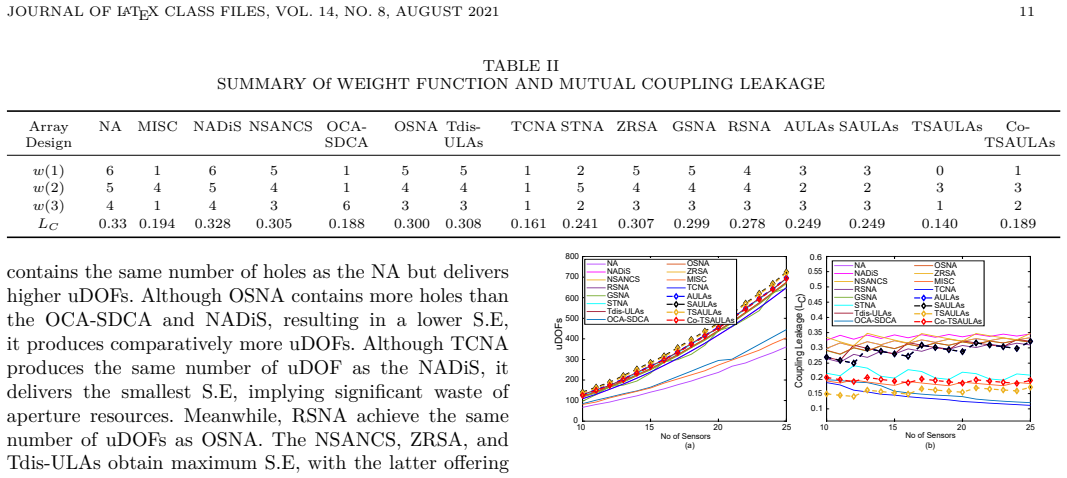
The AULAs configure a single sparse ULA and two dense ULAs alongside two separate elements to achieve a perfect splicing of holes and lags in the difference and sum co-arrays. This results in a larger virtual aperture and increased DOFs for NCS. Building on this structure, shifted AULAs displace the layout to minimize redundancy, transformed SAULAs convert dense segments into sparse ones to reduce mutual coupling, and complementary TSAULAs combine the benefits of both. All variants belong to a single framework that supplies closed-form expressions for element positions, DOFs, and weight functions and permits easy extension to larger apertures.
What carries the argument
The AULA geometry of one sparse ULA, two dense ULAs, and two extra elements that produces hole-free splicing across both the difference co-array and the sum co-array.
If this is right
- The design supplies closed-form expressions for exact element placements, achievable DOFs, and weight functions.
- Shifted AULAs reduce co-array redundancy and thereby raise the number of degrees of freedom.
- Transformed SAULAs lower mutual coupling by replacing dense ULAs with sparse ones.
- Complementary TSAULAs combine the DOF gains of shifted designs with the coupling reduction of transformed designs.
- The unified framework lets a designer switch between configurations and extend the physical array size without redesign.
Where Pith is reading between the lines
- The same splicing principle could be applied to other array geometries or to signals that are only partially non-circular.
- Hardware prototypes would test whether the theoretical DOF increase survives real-world noise, gain/phase mismatches, and finite snapshot counts.
- Because the framework supports incremental aperture growth, it offers a route to scalable arrays for large-scale sensor networks.
Load-bearing premise
The chosen positions of the sparse ULA, dense ULAs, and extra elements produce perfect hole-free splicing in both co-arrays under ideal conditions without calibration errors or non-ideal signal statistics.
What would settle it
If numerical construction of the co-arrays or physical measurements reveal remaining holes or no net gain in the number of resolvable non-circular sources relative to prior designs, the splicing claim fails.
Figures



read the original abstract
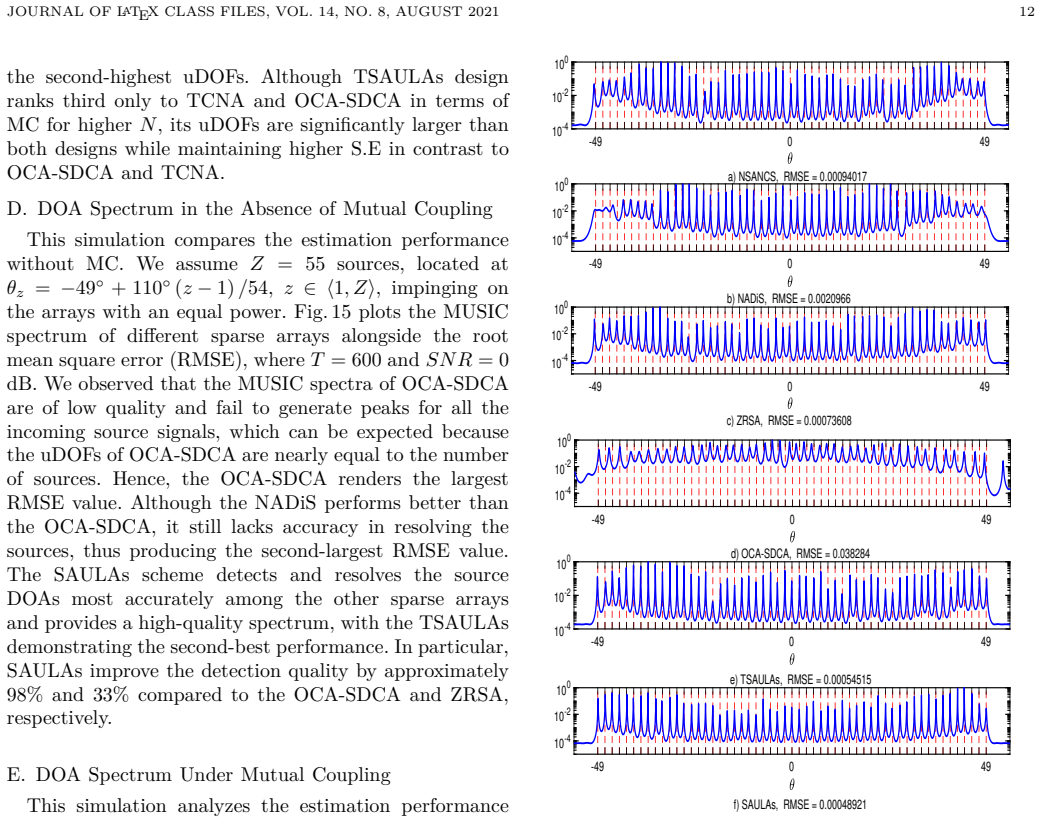
In this paper, we introduce a family of novel sparse array designs called the augmented ULAs (AULAs) for the localization of non-circular signals (NCS). Accurate direction of arrival (DOA) estimation and the ability to resolve multiple targets are critical in modern wireless communication systems. Most existing sparse arrays are optimized solely for the difference co-array, making them less efficient at utilizing the sum co-array resulting from the non-zero pseudo-covariance of NCS. Meanwhile, state-of-the-art designs for joint optimization of the sum and difference co-arrays remain constrained by a three-way performance trade-off. The proposed AULAs configure single sparse and two dense ULAs alongside two separate elements to achieve a perfect splicing of holes and lags in the difference and sum co-array. This results in a larger virtual aperture and increased DOFs for NCS. Building on this structure, other variants of AULAs are developed, each exhibiting distinct characteristics. The shifted AULAs (SAULAs) judiciously displace the AULAs structure to minimize co-array redundancy and further enhance the DOFs. A transformed SAULAs (TSAULAs) design is proposed, which mitigates mutual coupling effects by converting the dense ULAs of SAULAs into sparse ULAs. By reconfiguring the elements of TSAULAs, the complementary TSAULAs (Co-TSAULAs) design inherits the desirable properties of SAULAs and TSAULAs.All these structures belong to a unified design framework, within which one configuration can be adapted into another during the design phase to meet different performance requirements. Meanwhile, they provide in-built physical locations for convenient extension to a larger aperture. Closed-form expressions for precise element placements, DOFs, and weight functions are derived. Simulation results validate the effectiveness of the proposed approach.
Editorial analysis
A structured set of objections, weighed in public.
Referee Report
Summary. The paper proposes a family of augmented uniform linear array (AULA) designs for direction-of-arrival estimation of non-circular signals. A core configuration places one sparse ULA, two dense ULAs, and two additional elements to produce contiguous, hole-free lags in both the difference co-array (p_i - p_j) and sum co-array (p_i + p_j). Variants (SAULAs, TSAULAs, Co-TSAULAs) are obtained by shifting, sparsifying, or reconfiguring the base structure to reduce redundancy or mutual coupling while preserving or increasing virtual aperture and degrees of freedom. Closed-form expressions for sensor positions, achievable DOFs, and weight functions are supplied, together with simulation results that compare the new arrays against existing sparse geometries.
Significance. If the geometric constructions deliver the claimed hole-free joint co-arrays, the work would provide a systematic route to larger effective apertures and higher DOFs for non-circular sources while offering built-in mechanisms for mutual-coupling mitigation and aperture extension. The unified reconfiguration framework and explicit closed-form weight functions constitute concrete, reusable contributions to sparse-array design.
major comments (2)
- [§3] §3 (AULA geometry and co-array analysis): The central claim that the chosen placements of one sparse ULA, two dense ULAs, and two extra elements produce contiguous integer lags with no holes in both the difference and sum co-arrays is asserted via closed-form positions but is not accompanied by an explicit lag enumeration, inductive argument, or exhaustive verification for general array sizes. Because the sum and difference co-arrays obey different symmetry constraints, even a single missing lag would invalidate the stated DOF gain and larger virtual aperture; this verification is therefore load-bearing.
- [§4] §4 (variants and DOF formulas): The DOF expressions for SAULAs, TSAULAs, and Co-TSAULAs are derived from the base AULA co-array; any gap in the base construction propagates directly to these formulas. The manuscript should therefore supply a compact proof or tabulated lag coverage that confirms the joint hole-free property before the DOF formulas can be accepted as general.
minor comments (2)
- [Simulation results] Figure captions and axis labels in the simulation section should explicitly state the number of snapshots, SNR range, and whether the plotted RMSE is averaged over both circular and non-circular sources.
- [§2] Notation for the weight function w(·) is introduced without a clear statement of whether it is normalized or whether it accounts for the pseudo-covariance contribution of non-circular sources.
Simulated Author's Rebuttal
We thank the referee for the careful and constructive review. The comments correctly identify that the co-array hole-free property, while asserted through closed-form positions, requires explicit verification to support the DOF claims for general array sizes. We will revise the manuscript to include the requested proofs and illustrations.
read point-by-point responses
-
Referee: [§3] §3 (AULA geometry and co-array analysis): The central claim that the chosen placements of one sparse ULA, two dense ULAs, and two extra elements produce contiguous integer lags with no holes in both the difference and sum co-arrays is asserted via closed-form positions but is not accompanied by an explicit lag enumeration, inductive argument, or exhaustive verification for general array sizes. Because the sum and difference co-arrays obey different symmetry constraints, even a single missing lag would invalidate the stated DOF gain and larger virtual aperture; this verification is therefore load-bearing.
Authors: We agree that an explicit verification is necessary. In the revised manuscript we will add an inductive proof in Section 3 showing that the proposed sensor positions generate all contiguous integer lags in both the difference co-array (from -L to L) and the sum co-array (from 0 to 2L) for arbitrary array size N. The induction step will exploit the specific sparse-dense splicing structure to demonstrate that no holes arise under the distinct symmetry constraints of the two co-arrays. revision: yes
-
Referee: [§4] §4 (variants and DOF formulas): The DOF expressions for SAULAs, TSAULAs, and Co-TSAULAs are derived from the base AULA co-array; any gap in the base construction propagates directly to these formulas. The manuscript should therefore supply a compact proof or tabulated lag coverage that confirms the joint hole-free property before the DOF formulas can be accepted as general.
Authors: We concur that the DOF formulas for the variants rest on the base AULA construction. The revised manuscript will therefore include both the inductive proof for the base array and a compact tabulated verification of lag coverage for representative small-to-moderate array sizes. These additions will directly validate the closed-form DOF expressions provided for SAULAs, TSAULAs, and Co-TSAULAs. revision: yes
Circularity Check
No circularity: geometric configurations and closed-form DOF expressions are independently derived
full rationale
The paper introduces AULA array geometries via explicit element placements (one sparse ULA, two dense ULAs, plus two separate elements) and states that closed-form expressions for positions, DOFs, and weight functions are derived from this structure. No equations reduce a claimed prediction or DOF count to a fitted parameter or self-citation by construction. The splicing of sum and difference co-arrays is presented as a consequence of the chosen positions rather than presupposed in the definition of the design. No load-bearing self-citation, uniqueness theorem, or ansatz smuggling appears in the abstract or description. The derivation chain remains self-contained against external benchmarks for array geometry.
Axiom & Free-Parameter Ledger
axioms (2)
- domain assumption Non-circular signals possess non-zero pseudo-covariance that can be exploited to form a usable sum co-array.
- domain assumption Antenna elements can be placed at the exact computed positions without violating physical realizability or introducing unmodeled coupling beyond the mitigated case.
invented entities (1)
-
Augmented ULAs (AULAs) and variants
no independent evidence
Reference graph
Works this paper leans on
-
[1]
A real-time super- resolution doa estimation algorithm for automotive radar sen- sor,
Y. Wu, C. Li, Y. T. Hou, and W. Lou, “A real-time super- resolution doa estimation algorithm for automotive radar sen- sor,” IEEE Sensors Journal, vol. 24, no. 22, pp. 37 947–37 961, 2024
2024
-
[2]
Mimo radar for advanced driver-assistance systems and autonomous driving: Advantages and challenges,
S. Sun, A. P. Petropulu, and H. V. Poor, “Mimo radar for advanced driver-assistance systems and autonomous driving: Advantages and challenges,” IEEE Signal Processing Magazine, vol. 37, no. 4, pp. 98–117, 2020
2020
-
[3]
High-resolution imag- ing algorithms for automotive radar: Challenges in real driving scenarios,
S. Yuan, F. Fioranelli, and A. Yarovoy, “High-resolution imag- ing algorithms for automotive radar: Challenges in real driving scenarios,” IEEE Aerospace and Electronic Systems Magazine, vol. 40, no. 7, pp. 30–43, 2025
2025
-
[4]
Automotive radars: A review of signal processing techniques,
S. M. Patole, M. Torlak, D. Wang, and M. Ali, “Automotive radars: A review of signal processing techniques,” IEEE Signal Processing Magazine, vol. 34, no. 2, pp. 22–35, 2017
2017
-
[5]
An overview of enhanced massive mimo with array signal processing techniques,
M. Wang, F. Gao, S. Jin, and H. Lin, “An overview of enhanced massive mimo with array signal processing techniques,” IEEE Journal of Selected Topics in Signal Processing, vol. 13, no. 5, pp. 886–901, 2019
2019
-
[6]
Design of sparse antenna arrays using the physics-aware generative adversarial network,
C. Wang, Y. Zhang, S. Gao, and W. Liu, “Design of sparse antenna arrays using the physics-aware generative adversarial network,” IEEE Transactions on Antennas and Propagation, vol. 73, no. 9, pp. 6311–6325, 2025. JOURNAL OF LATEX CLASS FILES, VOL. 14, NO. 8, AUGUST 2021 15
2025
-
[7]
Sparse array wideband beamforming based on covariance matrix reconstruction and neural network,
S. Zhang, C. Xue, J. Luo, B. Wen, Y. Han, and W. Sheng, “Sparse array wideband beamforming based on covariance matrix reconstruction and neural network,” IEEE Transactions on Vehicular Technology, vol. 75, no. 1, pp. 33–44, 2026
2026
-
[8]
Sparse array enabled near-field communications: Beam pattern analysis and hybrid beamforming design,
C. Zhou, C. You, H. Zhang, L. Chen, and S. Shi, “Sparse array enabled near-field communications: Beam pattern analysis and hybrid beamforming design,” IEEE Transactions on Wireless Communications, vol. 24, no. 12, pp. 10 261–10 277, 2025
2025
-
[9]
Doa estimation using antenna arrays: A universal array designing framework,
A. H. Shaikh, X. Dang, and D. Huang, “Doa estimation using antenna arrays: A universal array designing framework,” IEEE Transactions on Vehicular Technology, vol. 72, no. 11, pp. 15 092–15 097, 2023
2023
-
[10]
An enhanced augmented coprime array with low mutual coupling and high dofs,
L. Han, Y. Zhao, S. Mei, X. Zhao, H. Wang, and B. Zhang, “An enhanced augmented coprime array with low mutual coupling and high dofs,” IEEE Transactions on Vehicular Technology, vol. 74, no. 5, pp. 7676–7687, 2025
2025
-
[11]
Three more decades in array signal processing research: An optimization and structure exploitation perspective,
M. Pesavento, M. Trinh-Hoang, and M. Viberg, “Three more decades in array signal processing research: An optimization and structure exploitation perspective,” IEEE Signal Processing Magazine, vol. 40, no. 4, pp. 92–106, 2023
2023
-
[12]
Nested arrays: A novel approach to array processing with enhanced degrees of freedom,
P. P. and V. P. P., “Nested arrays: A novel approach to array processing with enhanced degrees of freedom,” IEEE Transactions on Signal Processing, vol. 58, no. 8, pp. 4167–4181, 2010
2010
-
[13]
Two novel low mutual coupling sparse array configurations: Combining multiple uniform linear arrays and additional sensors,
X. Wang, Y. Jiang, L. Zhao, and L. Wang, “Two novel low mutual coupling sparse array configurations: Combining multiple uniform linear arrays and additional sensors,” IEEE Transactions on Vehicular Technology, vol. 74, no. 11, pp. 18 208–18 213, 2025
2025
-
[14]
Large minimum redundancy linear arrays: Systematic search of perfect and optimal rulers exploiting parallel processing,
F. Schwartau, Y. Schröder, L. Wolf, and J. Schoebel, “Large minimum redundancy linear arrays: Systematic search of perfect and optimal rulers exploiting parallel processing,” IEEE Open Journal of Antennas and Propagation, vol. 2, pp. 79–85, 2021
2021
-
[15]
A new array extension configuration method based on nesting and minimum redun- dancy,
H. Ma, X. Mao, X. Wang, and Y. Gao, “A new array extension configuration method based on nesting and minimum redun- dancy,” IET Radar, Sonar & Navigation, vol. 17, no. 5, pp. 748–758
-
[16]
Generalized non-redundant sparse array designs,
A. Ahmed and Y. D. Zhang, “Generalized non-redundant sparse array designs,” IEEE Trans. Signal Process, vol. 69, pp. 4580– 4594, 2021
2021
-
[17]
Sparse sensing with coprime samplers and arrays,
P. P. Vaidyanathan and P. Pal, “Sparse sensing with coprime samplers and arrays,” IEEE Trans. Signal Process., vol. 59, pp. 573–586, 2011
2011
-
[18]
Super fragmented coprime arrays for doa estimation,
A. H. Shaikh and X. Liu, “Super fragmented coprime arrays for doa estimation,” IEEE Signal Process. Letters, vol. 32, pp. 1825–1829, 2025
2025
-
[19]
Hole identification and filling in k-times extended co-prime arrays for highly efficient doa estimation,
X. Wang and X. Wang, “Hole identification and filling in k-times extended co-prime arrays for highly efficient doa estimation,” IEEE Transactions on Signal Processing, vol. 67, no. 10, pp. 2693–2706, 2019
2019
-
[20]
Super nested arrays: Linear sparse arrays with reduced mutual coupling-part i: Fundamen- tals,
C. Liu and P. P. Vaidyanathan, “Super nested arrays: Linear sparse arrays with reduced mutual coupling-part i: Fundamen- tals,” IEEE Transactions on Signal Processing, vol. 64, no. 15, pp. 3997–4012, 2016
2016
-
[21]
Sparse nested array with aperture extension for high accuracy angle estimation,
J. He, Z. Zhang, T. Shu, and W. Yu, “Sparse nested array with aperture extension for high accuracy angle estimation,” Signal Processing, vol. 176, p. 107700, 06 2020
2020
-
[22]
Enhanced nested array configuration with hole-free co-array and increasing degrees of freedom for doa estimation,
P. Zhao, G. Hu, Z. Qu, and L. Wang, “Enhanced nested array configuration with hole-free co-array and increasing degrees of freedom for doa estimation,” IEEE Comm. Lett., vol. 23, no. 12, pp. 2224–2228 , 2019
2019
-
[23]
Ts-cpa: A novel family of tri-shifted coprime array,
A. H. Shaikh and X. Liu, “Ts-cpa: A novel family of tri-shifted coprime array,” IEEE Transactions on Vehicular Technology, vol. 75, no. 1, pp. 850–863, 2026
2026
-
[24]
Augmented covariance matrix reconstruction for doa estimation using differ- ence coarray,
Z. Zheng, Y. Huang, W.-Q. Wang, and H. C. So, “Augmented covariance matrix reconstruction for doa estimation using differ- ence coarray,” IEEE Transactions on Signal Processing, vol. 69, pp. 5345–5358, 2021
2021
-
[25]
Fast direction-of-arrival estima- tion via coarray interpolation based on truncated nuclear norm regularization,
S. K. Yadav and N. V. George, “Fast direction-of-arrival estima- tion via coarray interpolation based on truncated nuclear norm regularization,” IEEE Transactions on Circuits and Systems II: Express Briefs, vol. 68, no. 4, pp. 1522–1526, 2021
2021
-
[26]
Coprime sampling and the music algorithm,
P. Pal and P. P. Vaidyanathan, “Coprime sampling and the music algorithm,” in 2011 Digital Signal Processing and Signal Processing Education Meeting (DSP/SPE), 2011, pp. 289–294
2011
-
[27]
Misc array: A new sparse array design achieving increased degrees of freedom and reduced mutual coupling effect,
Z. Zheng, W. Wang, Y. Kong, and Y. D. Zhang, “Misc array: A new sparse array design achieving increased degrees of freedom and reduced mutual coupling effect,” IEEE Transactions on Signal Processing, vol. 67, no. 7, pp. 1728–1741, 2019
2019
-
[28]
A pentad-displaced ulas configuration with hole-free co-array and increased degrees of freedom for direction of arrival estimation,
A. H. Shaikh, X. Dang, and D. Huang, “A pentad-displaced ulas configuration with hole-free co-array and increased degrees of freedom for direction of arrival estimation,” Digital Signal Processing, vol. 118, p. 103243, 2021
2021
-
[29]
A two-dimensional doa estimation method based on virtual extension of sparse array,
G. Wang, P. Zhao, L. Wang, X. Wang, H. Wang, and Z. Zhang, “A two-dimensional doa estimation method based on virtual extension of sparse array,” Journal of Electrical and Computer Engineering, vol. 2021, pp. 1–10, 05 2021
2021
-
[30]
Design and analysis of the sparse array for doa estimation of noncircular signals,
P. Gupta and M. Agrawal, “Design and analysis of the sparse array for doa estimation of noncircular signals,” IEEE Transac- tions on Signal Processing, vol. 67, no. 2, pp. 460–473, 2019
2019
-
[31]
New array designs for doa estimation of non- circular signals with reduced mutual coupling,
N. Mohsen, A. Hawbani, X. Wang, B. Bairrington, L. Zhao, and S. Alsamhi, “New array designs for doa estimation of non- circular signals with reduced mutual coupling,” IEEE Transac- tions on Vehicular Technology, vol. 72, no. 7, pp. 8313–8328, 2023
2023
-
[32]
Underdetermined direction of arrival estimation by sum and difference composite co-array,
S. Iwazaki and K. Ichige, “Underdetermined direction of arrival estimation by sum and difference composite co-array,” in 2018 25th IEEE International Conference on Electronics, Circuits and Systems (ICECS), 2018, pp. 669–672
2018
-
[33]
Gsna: A novel sparse array design achieving enhanced degree of freedom for noncircular sources,
H. Jiang, L. Li, and X. Li, “Gsna: A novel sparse array design achieving enhanced degree of freedom for noncircular sources,” Wireless Communications and Mobile Computing, vol. 2022, pp. 1–9, 04 2022
2022
-
[34]
New sparse array for non-circular sources with increased degrees of freedom,
A. H. Shaikh, X. Dang, I. A. Khoso, and D. Huang, “New sparse array for non-circular sources with increased degrees of freedom,” Electronics Letters, vol. 57, no. 8, pp. 339–342, 2021
2021
-
[35]
Optimized sparse nested arrays for doa estimation of non- circular signals,
N. Mohsen, A. Hawbani, X. Wang, M. Agrawal, and L. Zhao, “Optimized sparse nested arrays for doa estimation of non- circular signals,” Signal Processing, vol. 204, p. 108819, 2023
2023
-
[36]
A novel designed sparse array for noncircular sources with high degree of freedom,
Y.-k. Zhang, H.-y. Xu, D.-m. Wang, and S.-y. Li, “A novel designed sparse array for noncircular sources with high degree of freedom,” Mathematical Problems in Engineering, vol. 2019, pp. 1–10, 01 2019
2019
-
[37]
Zero-redundancy sparse array configuration design based on sum-difference coar- ray,
P. Zhao, Q. Wu, L. Wang, L. Wan, and G. Hu, “Zero-redundancy sparse array configuration design based on sum-difference coar- ray,” IEEE Signal Processing Letters, vol. 31, pp. 436–440, 2024
2024
-
[38]
A super transformed nested array with reduced mutual coupling for direction of arrival estimation of non-circular signals,
F. Mei, H. Xu, W. Cui, C. Jian, and J. Zhang, “A super transformed nested array with reduced mutual coupling for direction of arrival estimation of non-circular signals,” IET Radar, Sonar & Navigation, vol. 16, no. 5, pp. 799–814, 2022
2022
-
[39]
Design of relocating sparse nested arrays for doa estimation of non- circular signals,
L. Zhou, Z. Feng, K. Ye, J. Qi, and S. Hong, “Design of relocating sparse nested arrays for doa estimation of non- circular signals,” AEU - International Journal of Electronics and Communications, vol. 173, p. 154976, 2024
2024
-
[40]
Triad-displaced ulas configuration for non-circular sources with larger continuous virtual aperture and enhanced degrees of freedom,
S. A. Hayee, D. Xiaoyu, and H. Daqing, “Triad-displaced ulas configuration for non-circular sources with larger continuous virtual aperture and enhanced degrees of freedom,” Journal of Systems Engineering and Electronics, pp. 1–13, 2022
2022
-
[41]
A special coprime array configura- tion for increased degrees of freedom,
R. K. Patra and A. S. Dhar, “A special coprime array configura- tion for increased degrees of freedom,” Digital Signal Processing, vol. 122, p. 103369, 2022
2022
-
[42]
Enhanced coprime array configuration for doa estimation of non-circular signals,
N. Mohsen, A. Hawbani, X. Wang, B. Bairrington, L. Zhao, and S. Alsamhi, “Enhanced coprime array configuration for doa estimation of non-circular signals,” in 2023 IEEE Interna- tional Conference on Acoustics, Speech and Signal Processing (ICASSP), 2023, pp. 1–5
2023
-
[43]
A novel coprime nested array with enhanced dofs and reduced mutual coupling for doa estimation of noncircular sources,
Z. Peng, Q. Gong, and H. Xie, “A novel coprime nested array with enhanced dofs and reduced mutual coupling for doa estimation of noncircular sources,” IEEE Transactions on Vehicular Technology, vol. 74, no. 9, pp. 14 012–14 025, 2025
2025
-
[44]
Remarks on the spatial smoothing step in coarray MUSIC,
C.-L. Liu and P. P. Vaidyanathan, “Remarks on the spatial smoothing step in coarray MUSIC,” IEEE Signal Processing Letters, vol. 22, no. 9, pp. 1438–1442, 2015
2015
-
[45]
A new nested array configuration with increased degrees of freedom,
H. Huang, B. Liao, X. Wang, X. Guo, and J. Huang, “A new nested array configuration with increased degrees of freedom,” IEEE Access, vol. 6, pp. 1490–1497, 2018
2018
discussion (0)
Sign in with ORCID, Apple, or X to comment. Anyone can read and Pith papers without signing in.