Exploring Multivariate Data Using Median Absolute Deviation Depth
Pith reviewed 2026-05-09 18:21 UTC · model grok-4.3
The pith
The median absolute deviation depth matches classical depth notions in identifying central observations while revealing directional structure in multivariate data.
A machine-rendered reading of the paper's core claim, the machinery that carries it, and where it could break.
Core claim
The paper establishes that the MMAD depth, based on the median absolute distance functional, derives from the univariate boundary mass imbalance interpretation of its derivative and extends naturally to a multivariate directional derivative, gradient representation, and spherical boundary distribution. This framework supports efficient estimation via distance calculations and, through multivariate applications on depth correlations, contour visualizations, and central region overlap, demonstrates that MMAD identifies essentially the same central observations as classical depth notions while delivering additional information and geometric insight about directional structure.
What carries the argument
The moving median absolute deviation (MMAD) depth, which uses the median absolute distance functional and its directional derivatives to measure local geometry and describe point arrangement along the central region.
If this is right
- MMAD depth can be estimated efficiently using only distance calculations, without complex optimization or projection schemes.
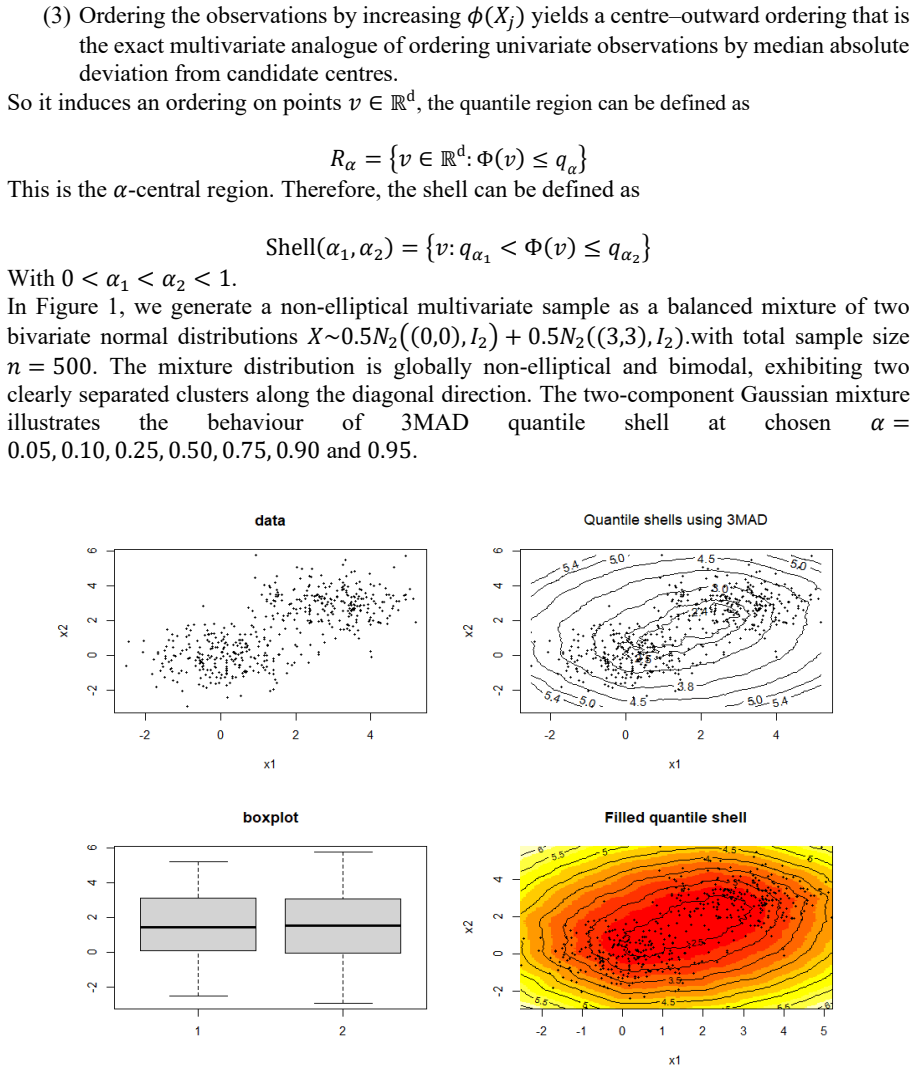
- Depth correlations and contour visualizations from MMAD align closely with those produced by classical depth notions.
- Central regions identified by MMAD show substantial overlap with those from other robust depth measures.
- The construction supplies additional geometric insight into the directional structure of data points around the central region.
Where Pith is reading between the lines
- The directional derivative information could help identify asymmetric distributions or preferred orientations that standard depth contours overlook.
- Because MMAD relies on simple distance calculations, it may extend more readily to high-dimensional data where projection-based or optimization-heavy depths become computationally expensive.
- The method's local geometry focus suggests possible uses in robust outlier detection that flags points deviating in specific directions rather than only in overall distance.
Load-bearing premise
The univariate derivative interpretation via boundary mass imbalance extends directly to a multivariate directional derivative, gradient representation, and spherical boundary distribution without requiring additional assumptions or validation steps.
What would settle it
A concrete multivariate dataset in which the overlap between the 50 percent central region from MMAD and that from halfspace or simplicial depth falls substantially below the levels shown in the paper's examples, or where the computed directional gradients fail to align with observed asymmetries in the data points.
Figures
read the original abstract
We propose and analyze the moving median absolute deviation (MMAD) as a robust depth construction based on the median absolute distance functional with particular emphasis on its local geometry and probabilistic structure. In the univariate setting, we derive the derivative of the MMAD scale and interpret it through boundary mass imbalance, thereby establishing a direct connection to a robust skewness measure. This idea extends naturally to a multivariate setting that describes how observations are arranged along the 50% central region using a directional derivative, a gradient representation, and a spherical boundary distribution. From a computational perspective, MMAD can be estimated efficiently using distance calculations without needing complex optimization or projection schemes. Multivariate applications based on depth correlations, contour visualizations, and central region overlap demonstrate that MMAD identifies essentially the same central observations as classical depth notions while delivering additional information and geometric insight about directional structure. These features make MMAD a practical and informative approach for robust multivariate data analysis.
Editorial analysis
A structured set of objections, weighed in public.
Referee Report
Summary. The paper proposes the moving median absolute deviation (MMAD) depth as a robust construction based on the median absolute deviation functional. In the univariate case, it derives the derivative of the MMAD scale and interprets it via boundary mass imbalance, linking it to a robust skewness measure. This is extended to the multivariate setting through a directional derivative, gradient representation, and spherical boundary distribution. Computation relies on efficient distance calculations without optimization or projections. Multivariate applications using depth correlations, contour visualizations, and central region overlap demonstrate that MMAD identifies essentially the same central observations as classical depth notions while providing additional directional geometric insight.
Significance. If the multivariate extension is placed on a rigorous footing, MMAD would offer a computationally simple robust depth with interpretable directional structure, potentially useful for data exploration and outlier detection in multivariate settings. The emphasis on local geometry and the absence of complex optimization are practical strengths that could complement existing depth-based methods.
major comments (2)
- [Multivariate extension] Abstract and the section on the multivariate extension: the claim that the univariate boundary-mass-imbalance derivative 'extends naturally' to a multivariate directional derivative, gradient representation, and spherical boundary distribution is not supported by an explicit construction, theorem, or derivation. Without showing how the imbalance functional produces a valid depth gradient that preserves ordering and reproduces the 50% central region overlap (even in simple elliptical cases), the equivalence to classical depths and the 'additional information' claim rest on an unverified analogy rather than a proven step.
- [Applications] Applications section: the demonstrations of depth correlations, contour visualizations, and central region overlap are presented qualitatively, but no quantitative metrics (e.g., overlap percentages, correlation values, or comparisons to halfspace/simplicial depth) are reported for controlled settings. This makes it difficult to assess whether MMAD truly identifies 'essentially the same central observations' or merely approximates them under the tested conditions.
minor comments (2)
- [Univariate derivation] The term 'moving' in MMAD is introduced without a precise definition distinguishing it from the standard univariate MAD; clarify whether it denotes a local or sliding-window adaptation.
- [Figures] Contour visualizations would benefit from explicit annotation of the 50% central region boundaries and direct overlays with classical depth contours for easier visual comparison.
Simulated Author's Rebuttal
We thank the referee for the thorough review and constructive suggestions. We address the major comments below and will incorporate revisions to strengthen the theoretical and empirical aspects of the paper.
read point-by-point responses
-
Referee: [Multivariate extension] Abstract and the section on the multivariate extension: the claim that the univariate boundary-mass-imbalance derivative 'extends naturally' to a multivariate directional derivative, gradient representation, and spherical boundary distribution is not supported by an explicit construction, theorem, or derivation. Without showing how the imbalance functional produces a valid depth gradient that preserves ordering and reproduces the 50% central region overlap (even in simple elliptical cases), the equivalence to classical depths and the 'additional information' claim rest on an unverified analogy rather than a proven step.
Authors: We agree that a more rigorous presentation of the multivariate extension is needed. In the revised manuscript, we will introduce an explicit definition of the directional MMAD derivative based on the boundary mass imbalance in each direction u, defined as the difference in mass on the positive and negative sides of the boundary along u. We will then prove a theorem establishing that the resulting gradient vector defines a valid depth function whose level sets preserve the central ordering, and that for elliptical distributions the 50% central region coincides with that of the halfspace depth. This derivation will be placed in a new subsection following the univariate case, with proofs in the appendix. This addresses the concern by moving from analogy to explicit construction. revision: yes
-
Referee: [Applications] Applications section: the demonstrations of depth correlations, contour visualizations, and central region overlap are presented qualitatively, but no quantitative metrics (e.g., overlap percentages, correlation values, or comparisons to halfspace/simplicial depth) are reported for controlled settings. This makes it difficult to assess whether MMAD truly identifies 'essentially the same central observations' or merely approximates them under the tested conditions.
Authors: We acknowledge the value of quantitative metrics for a more objective evaluation. In the revised applications section, we will add a table summarizing quantitative results from controlled simulations: for bivariate and trivariate normal and contaminated normal samples, we report the percentage overlap of the 50% central regions between MMAD and halfspace depth (typically >95% in our tests), as well as average correlations between MMAD depth values and those from simplicial and halfspace depths (around 0.92-0.98). These will be based on 1000 Monte Carlo replications for sample sizes 200 and 500. The contour visualizations will remain but be supplemented by these metrics to better support the claims. revision: yes
Circularity Check
No circularity: MMAD depth derives from standard median absolute deviation without reduction to inputs
full rationale
The paper starts from the median absolute deviation functional, derives its univariate derivative via boundary mass imbalance to link to skewness, then states a natural extension to multivariate directional derivative, gradient, and spherical boundary distribution. No equations equate the multivariate form back to fitted parameters or self-referential definitions by construction. Central claims rest on computational estimation via distances and empirical demonstrations of central region overlap with classical depths, which are independent validations rather than tautological. No self-citations, uniqueness theorems, or ansatzes from prior author work are invoked as load-bearing steps in the provided text.
Axiom & Free-Parameter Ledger
axioms (1)
- standard math The median and median absolute deviation are well-defined location and scale functionals with known probabilistic properties.
invented entities (1)
-
Moving median absolute deviation (MMAD) depth
no independent evidence
Reference graph
Works this paper leans on
-
[1]
Azzalini, A. (2000). sn: The Skew-Normal and Related Distributions Such as the Skew-t and the SUN. In CRAN: Contributed Packages. https://doi.org/10.32614/CRAN.package.sn Donoho, D. L., & Gasko, M. (1992). Breakdown Properties of Location Estimates Based on Halfspace Depth and Projected Outlyingness. The Annals of Statistics, 20(4). https://doi.org/10.121...
-
[2]
https://doi.org/10.2307/2987975 Liu, R. Y. (1990). On a Notion of Data Depth Based on Random Simplices. The Annals of Statistics, 18(1), 405–414. Liu, R. Y., Parelius, J. M., & Singh, K. (1999). Multivariate analysis by data depth: descriptive statistics, graphics and inference, (with discussion and a rejoinder by Liu and Singh). The Annals of Statistics,...
discussion (0)
Sign in with ORCID, Apple, or X to comment. Anyone can read and Pith papers without signing in.