Hybrid Optimal Control of Homogeneous Epidemiological Compartmental Models with Regime Switching
Pith reviewed 2026-05-09 17:37 UTC · model grok-4.3
The pith
Coordinating work-from-home policies with vaccination in a hybrid model improves disease mitigation over single-phase approaches.
A machine-rendered reading of the paper's core claim, the machinery that carries it, and where it could break.
Core claim
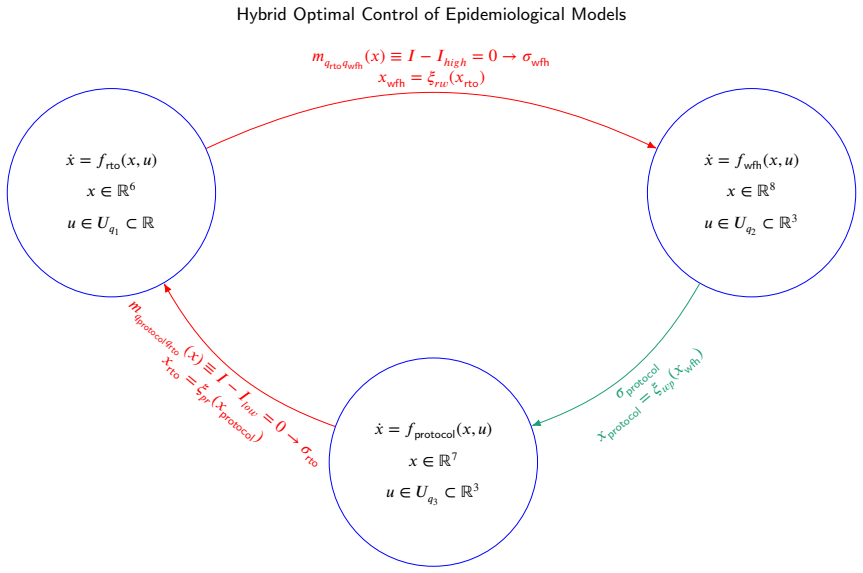
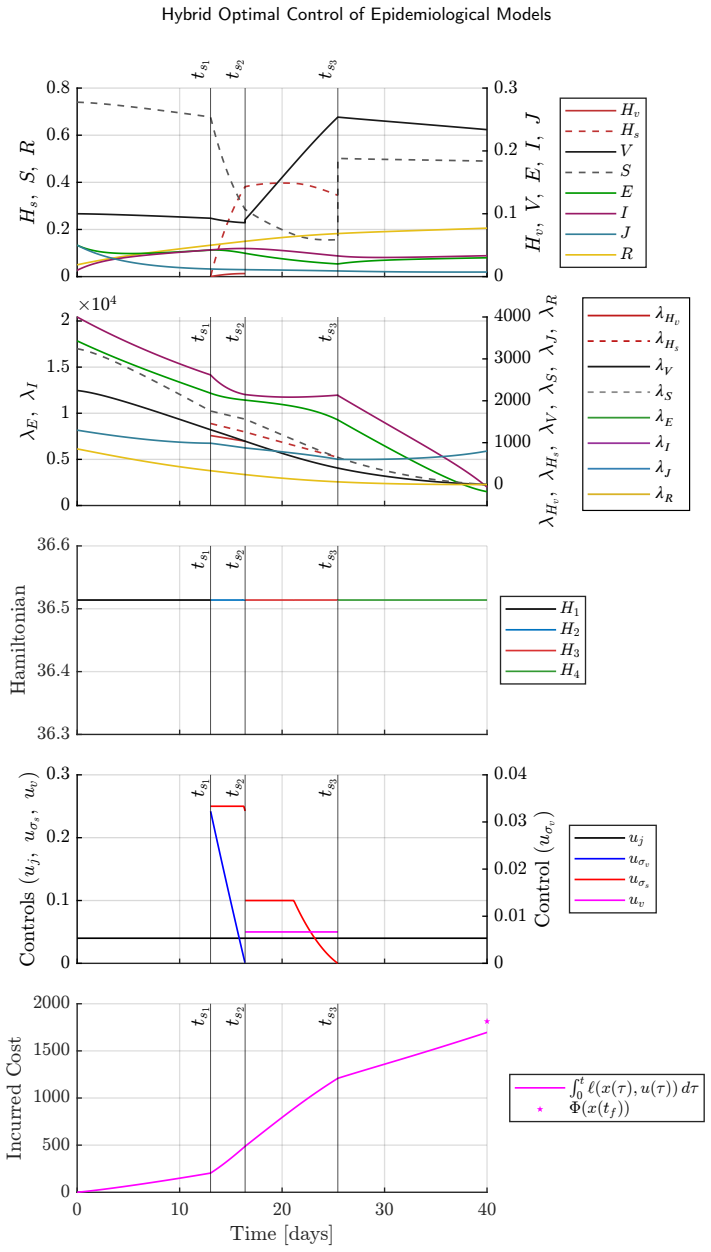
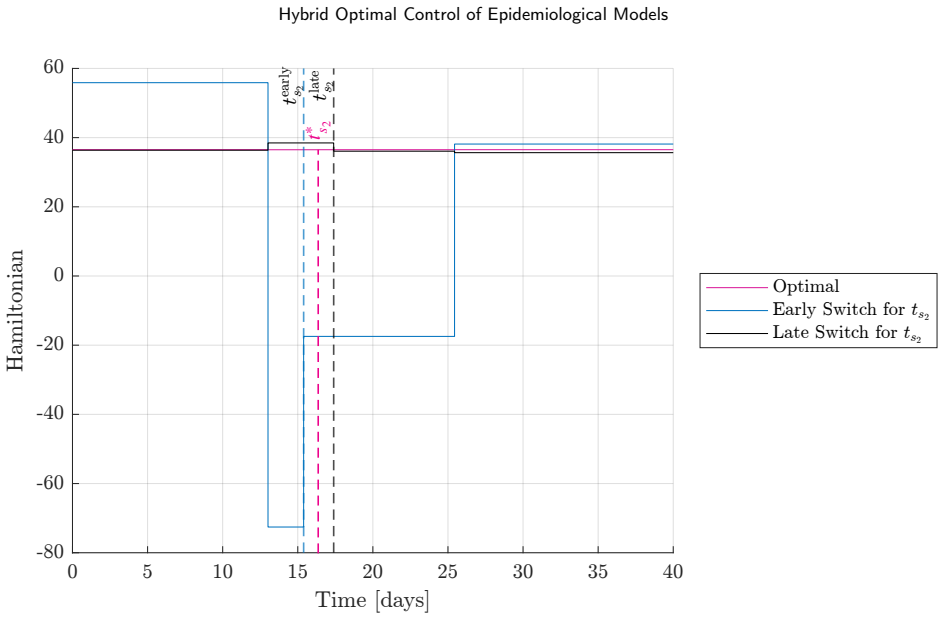
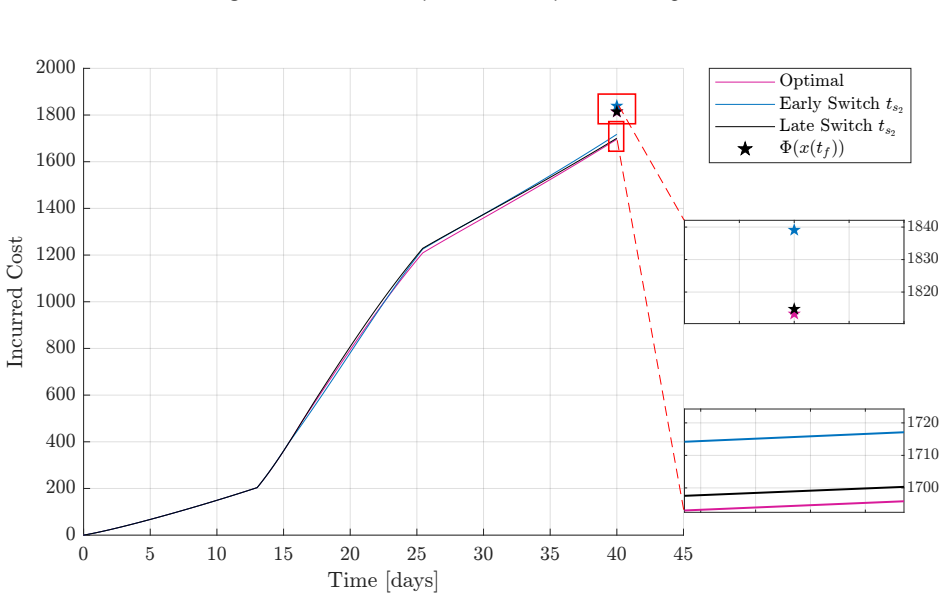
The authors model the epidemiological system as a four-phase hybrid dynamical system with phase-dependent continuous dynamics and running costs that capture different transmission mechanisms and trade-offs, a mix of autonomous and controlled switchings whose times are co-optimized with continuous inputs, and nontrivial state jump maps for transitions between phases with different dimensions. They apply the Hybrid Minimum Principle to obtain the optimal solutions, and numerical results show that coordinating work-from-home policies with vaccination provides improved mitigation compared to single-phase interventions.
What carries the argument
A four-phase hybrid dynamical system featuring phase-specific continuous dynamics and running costs, a mix of autonomous and controlled switchings, and nontrivial state jump maps, with solutions obtained via the Hybrid Minimum Principle.
If this is right
- Switching times between policy phases can be optimized either through state-dependent thresholds or as explicit decision variables.
- Coordinating work-from-home policies and vaccination produces lower overall costs and better disease control than isolated interventions.
- The model accounts for transitions that alter the number of state and control variables across phases.
Where Pith is reading between the lines
- The same hybrid control framework could extend to models with more phases or different policy types for other infectious diseases.
- Implementation in practice would depend on reliable real-time data for state estimation to trigger the autonomous switches.
- Adding uncertainty in transmission rates might require robust optimization extensions to the current deterministic setup.
Load-bearing premise
The real-world disease spread and the effects of policies can be faithfully captured by this specific four-phase hybrid structure with the given dynamics, costs, switchings, and jumps, allowing the Hybrid Minimum Principle to deliver the actual optimum.
What would settle it
Running the numerical optimization with the Hybrid Minimum Principle and finding that the resulting coordinated policy does not achieve lower total cost or fewer infections than single-phase strategies in the simulations.
Figures
read the original abstract
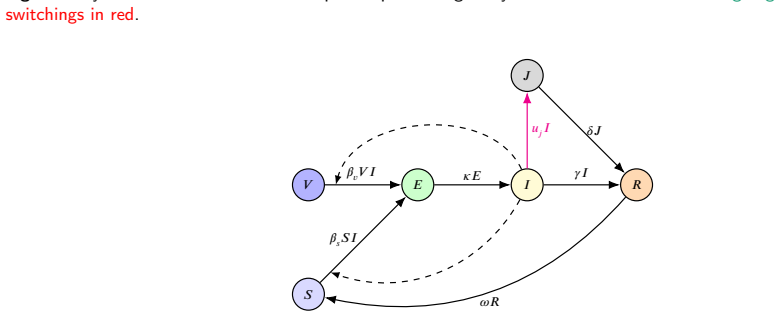
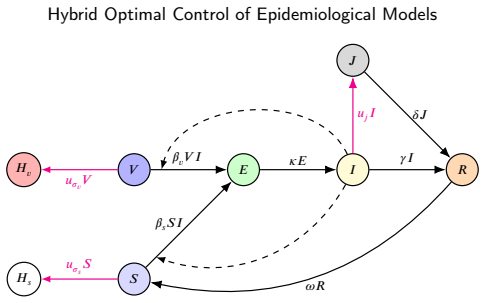
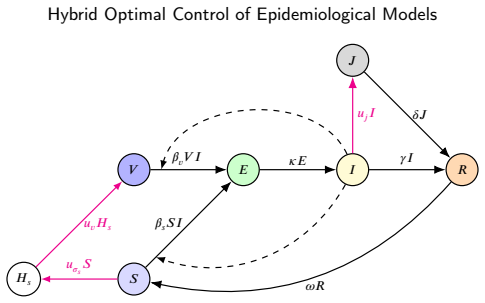
Optimal intervention design is formulated as a hybrid optimal control problem for multiphase homogeneous epidemiological systems. The system extends a foundational compartmental model through intermediate phases that incorporate work-from-home (WFH) policies and a vaccination protocol, yielding a four-phase hybrid system that captures policy escalation and relaxation. Key characteristics of the resulting hybrid system include (i) phase-dependent continuous dynamics and running costs that respectively capture distinct disease transmission mechanisms and shifting public health socioeconomic trade-offs, (ii) a combination of autonomous and controlled switchings for intervention policies, whose times are co-optimized - whether indirectly via state thresholds or directly as decision variables alongside continuous inputs to minimize the overall cost, and (iii) nontrivial state jump maps that govern transitions between phases with differing state and control space dimensions. The Hybrid Minimum Principle (HMP) is invoked to obtain the optimal solutions. Numerical results demonstrate that coordinating WFH policies with vaccination efforts provides improved mitigation of disease spread compared to single-phase policy interventions.
Editorial analysis
A structured set of objections, weighed in public.
Referee Report
Summary. The paper formulates optimal design of interventions (WFH policies and vaccination) for homogeneous epidemiological compartmental models as a four-phase hybrid optimal control problem. The hybrid system features phase-dependent continuous dynamics and running costs, a mix of autonomous and controlled switchings whose times are co-optimized, and nontrivial state jump maps that change the dimension of the state and control spaces. The Hybrid Minimum Principle is invoked to obtain candidate optimal solutions, and numerical experiments are presented to show that coordinating WFH with vaccination yields better mitigation than single-phase policies.
Significance. If the optimality conditions are correctly established for this non-standard hybrid setting, the work supplies a systematic framework for multi-phase policy optimization in epidemic models that accounts for regime-dependent transmission, socioeconomic costs, and dimension-changing transitions. The numerical comparison between coordinated and single-phase strategies offers concrete evidence that joint optimization can improve outcomes, which could inform public-health decision tools once the technical gaps are closed.
major comments (2)
- [Section 3 (Hybrid Minimum Principle application) and the numerical results section] The manuscript invokes the Hybrid Minimum Principle for the four-phase system but does not derive or verify the necessary conditions (adjoint equations, Hamiltonian continuity, and transversality conditions) at switching instants where the state and control dimensions change via the nontrivial jump maps. Standard HMP statements for fixed-dimensional systems or purely controlled switches do not automatically extend to this case; without the case-specific derivation, the numerical trajectories cannot be guaranteed to satisfy the optimality conditions.
- [Numerical experiments and comparison claims] The central claim that coordinated WFH-vaccination policies provide improved mitigation rests on the numerical trajectories being optimal. Because the HMP verification is missing, the reported performance gains relative to single-phase interventions are not yet rigorously supported.
minor comments (3)
- [Abstract and §1] The abstract and introduction should explicitly name the base compartmental model (e.g., SEIR or SEIRS) and list the state variables for each phase.
- [Numerical results section] Parameter values, initial conditions, and the precise form of the running costs and jump maps should be tabulated or given in an appendix so that the numerical results can be reproduced.
- [Figures 1-4] Figure captions should indicate which curves correspond to which phases and whether the plotted controls are the optimal ones obtained from the HMP.
Simulated Author's Rebuttal
We are grateful to the referee for the thorough review and valuable suggestions. We have carefully considered the major comments and will revise the manuscript to address them as detailed in the point-by-point responses below.
read point-by-point responses
-
Referee: [Section 3 (Hybrid Minimum Principle application) and the numerical results section] The manuscript invokes the Hybrid Minimum Principle for the four-phase system but does not derive or verify the necessary conditions (adjoint equations, Hamiltonian continuity, and transversality conditions) at switching instants where the state and control dimensions change via the nontrivial jump maps. Standard HMP statements for fixed-dimensional systems or purely controlled switches do not automatically extend to this case; without the case-specific derivation, the numerical trajectories cannot be guaranteed to satisfy the optimality conditions.
Authors: We acknowledge that the manuscript invokes the Hybrid Minimum Principle without providing an explicit, case-specific derivation of the necessary conditions for the dimension-changing jump maps. While the general HMP framework is applied, we agree that the adjoint equations, Hamiltonian continuity, and transversality conditions must be derived explicitly at the switching instants to rigorously confirm optimality of the numerical solutions. In the revised manuscript, we will add a dedicated derivation in Section 3 tailored to our four-phase system with nontrivial state jumps. revision: yes
-
Referee: [Numerical experiments and comparison claims] The central claim that coordinated WFH-vaccination policies provide improved mitigation rests on the numerical trajectories being optimal. Because the HMP verification is missing, the reported performance gains relative to single-phase interventions are not yet rigorously supported.
Authors: We agree that the reported performance improvements depend on the trajectories satisfying the optimality conditions. Upon incorporating the case-specific HMP derivation, we will verify that the numerical solutions meet these conditions and update the numerical experiments section to include this verification. This will provide rigorous support for the claim that coordinated policies outperform single-phase interventions. revision: yes
Circularity Check
No significant circularity; HMP invoked as external tool on independently formulated hybrid model
full rationale
The paper defines a novel four-phase hybrid system (phase-dependent SEIR-like dynamics, running costs, mixed autonomous/controlled switches, and dimension-altering state jumps) and invokes the Hybrid Minimum Principle from prior literature to compute optimal policies. Numerical results comparing coordinated WFH+vaccination to single-phase interventions are generated outputs from this application, not reductions by construction to fitted inputs or self-referential definitions. No self-citation is load-bearing for the central claim, and the derivation remains self-contained against external benchmarks with independent content in the model setup and numerical evaluation.
Axiom & Free-Parameter Ledger
axioms (1)
- domain assumption The Hybrid Minimum Principle applies to the four-phase hybrid system with phase-dependent dynamics, costs, and nontrivial state jumps.
Reference graph
Works this paper leans on
-
[1]
W. O. Kermack, A. G. McKendrick, A contribution to the mathematical theory of epidemics, Proceedings of the Royal Society of London. Series A 115 (772) (1927) 700–721
work page 1927
-
[2]
H. W. Hethcote, The mathematics of infectious diseases, SIAM Review 42 (4) (2000) 599–653
work page 2000
-
[3]
R. C. Poonia, A. K. J. Saudagar, A. Altameem, M. Alkhathami, M. B. Khan, M. H. A. Hasanat, An enhanced seir model for prediction of covid-19 with vaccination effect, Life 12 (5) (2022). T.Halterman and A. Pakniyat:Preprint submitted to ElsevierPage 13 of 14 Hybrid Optimal Control of Epidemiological Models
work page 2022
-
[4]
A.Safarishahrbijari,T.Lawrence,R.Lomotey,J.Liu,C.Waldner,N.Osgood,Particlefilteringinaseirvsimulationmodelofh1n1influenza, 2015 Winter Simulation Conference (WSC) (2015) 1240–1251
work page 2015
-
[5]
S. Zhao, H. Chen, Modeling the epidemic dynamics and control of covid-19 outbreak in china, Quantitative Biology 8 (1) (2020) 11–19. arXiv:https://onlinelibrary.wiley.com/doi/pdf/10.1007/s40484-020-0199-0
- [6]
-
[7]
M. Surya Prakash, A. D. Mahindrakar, R. Pasumarthy, Reachability analysis and optimal control for epidemic spreading model on multiplex network, in: 2019 Fifth Indian Control Conference (ICC), 2019, pp. 383–388
work page 2019
-
[8]
E.A.Rozan,M.I.Simoy,S.Bouzat,M.N.Kuperman,Modelingepidemicsonmultiplexnetworks:Epidemicthresholdandbasicreproduction number, arXiv preprint arXiv:2510.12614 (2025)
work page internal anchor Pith review arXiv 2025
- [9]
-
[10]
S. Lenhart, J. T. Workman, Optimal Control Applied to Biological Models, Chapman and Hall/CRC, 2007
work page 2007
-
[11]
H. Behncke, Optimal control of deterministic epidemics, Optimal Control Applications and Methods 21 (6) (2000) 269–285
work page 2000
- [12]
-
[13]
M. Della Rossa, L. Freddi, D. Goreac, Optimality of vaccination for an sir epidemic with an icu constraint, Journal of Optimization Theory and Applications 204 (1) (2024) 8.doi:10.1007/s10957-024-02598-w
-
[14]
A. Bensoussan, J. Menaldi, Stochastic Hybrid Control, Mathematical Analysis and Applications 249 (1) (2000) 261–288
work page 2000
-
[15]
M.S.Branicky,V. S.Borkar,S.K.Mitter,A UnifiedFrameworkforHybridControl: ModelandOptimalControlTheory,IEEETransactions on Automatic Control 43 (1) (1998) 31–45
work page 1998
-
[16]
S. Dharmatti, M. Ramaswamy, Hybrid Control Systems and Viscosity Solutions, SIAM Journal on Control and Optimization 44 (4) (2005) 1259–1288
work page 2005
-
[17]
H. J. Sussmann, Maximum Principle for Hybrid Optimal Control Problems, in: Proceedings of the 38th IEEE Conference on Decision and Control, CDC, 1999, pp. 425–430
work page 1999
-
[18]
M. Garavello, B. Piccoli, Hybrid Necessary Principle, SIAM Journal on Control and Optimization 43 (5) (2005) 1867–1887
work page 2005
-
[19]
M. S. Shaikh, P. E. Caines, On the hybrid optimal control problem: theory and algorithms, IEEE Transactions on Automatic Control 52 (9) (2007) 1587–1603
work page 2007
-
[20]
F. Taringoo, P. E. Caines, On the Optimal Control of Impulsive Hybrid Systems on Riemannian Manifolds, SIAM Journal on Control and Optimization 51 (4) (2013) 3127–3153
work page 2013
-
[21]
A. Pakniyat, P. E. Caines, On the Minimum Principle and Dynamic Programming for Hybrid Systems, IFAC Proceedings Volumes 47 (3) (2014) 9629–9634
work page 2014
-
[22]
A. Pakniyat, P. E. Caines, On the Relation between the Minimum Principle and Dynamic Programming for Classical and Hybrid Control Systems, IEEE Transactions on Automatic Control 62 (9) (2017b) 4347–4362
-
[23]
R. G. Sanfelice, B. Altın, Model predictive control of hybrid dynamical systems, IEEE Transactions on Automatic Control (2026) 1–16
work page 2026
-
[24]
A. Pakniyat, P. E. Caines, Hybrid Optimal Control of an Electric Vehicle with a Dual-Planetary Transmission, Nonlinear Analysis: Hybrid Systems 25 (2017) 263–282
work page 2017
- [25]
- [26]
-
[27]
D. Firoozi, A. Pakniyat, P. E. Caines, A Mean Field Game - Hybrid Systems Approach to Optimal Execution Problems in Finance with Stopping Times, in: Proceedings of the 56th IEEE Conference on Decision and Control, Melbourne, Australia, 2017, pp. 3144 – 3151
work page 2017
-
[28]
L. Bolzoni, E. Bonacini, R. Della Marca, M. Groppi, Optimal control of epidemic size and duration with limited resources, Mathematical Biosciences 315 (2019) 108232
work page 2019
-
[29]
M. Kantner, T. Koprucki, Beyond just “flattening the curve”: Optimal control of epidemics with purely non-pharmaceutical interventions, Journal of Mathematics in Industry 10 (1) (2020) 23
work page 2020
-
[30]
K. Tran, G. Yin, Optimal control and numerical methods for hybrid stochastic sis models, Nonlinear Analysis: Hybrid Systems 41 (2021) 101051.doi:10.1016/j.nahs.2021.101051
-
[31]
S.Dharmatti,N.Krishnan,Mathematicalmodellingandoptimalcontrolanalysisofpandemicdynamicsasahybridsystem,EuropeanJournal of Control 74 (2023) 100942.doi:10.1016/j.ejcon.2023.100942
-
[32]
A. Pakniyat, P. E. Caines, On the Hybrid Minimum Principle: The Hamiltonian and Adjoint Boundary Conditions, IEEE Transactions on Automatic Control 66 (3) (2021) 1246–1253
work page 2021
-
[33]
A. Pakniyat, P. E. Caines, The Minimum Principle of Hybrid Optimal Control Theory, Mathematics of Control, Signals, and Systems (2023) 1–50
work page 2023
-
[34]
R. M. Neilan, S. Lenhart, An introduction to optimal control with an application in disease modeling, Journal of Biological Dynamics 4 (6) (2010) 627–663
work page 2010
-
[35]
H. Liu, X. Tian, Data-driven optimal control of a seir model for covid-19, Communications on Pure and Applied AnalysisAvailable online (2023)
work page 2023
-
[36]
M.A.Patterson,A.V.Rao,GPOPS-II:AMATLABsoftwareforsolvingmultiple-phaseoptimalcontrolproblemsusinghp-adaptivegaussian quadrature collocation methods and sparse nonlinear programming, ACM Transactions on Mathematical Software 41 (1) (2014) 1:1–1:37. T.Halterman and A. Pakniyat:Preprint submitted to ElsevierPage 14 of 14
work page 2014
discussion (0)
Sign in with ORCID, Apple, or X to comment. Anyone can read and Pith papers without signing in.