Error analysis of a divergence-preserving mixed finite element scheme for the incompressible Hall--magnetohydrodynamic equations
Pith reviewed 2026-05-09 17:07 UTC · model grok-4.3
The pith
A mixed finite element scheme for Hall-MHD equations enforces exact divergence-free magnetic fields and yields optimal error estimates via Voigt regularization.
A machine-rendered reading of the paper's core claim, the machinery that carries it, and where it could break.
Core claim
The authors propose, analyse, and implement a structure-preserving, linear, fully discrete finite element method for the Voigt-regularised Hall-MHD system. Using finite element exterior calculus and a mixed formulation, the spatial discretisation enforces the divergence-free condition on the magnetic field exactly, while a skew-symmetric, linearly implicit time discretisation yields unconditional energy stability. Optimal convergence rates are established for the Voigt-regularised problem, and error estimates are additionally derived for the unregularised Hall-MHD system, with the Voigt regularisation playing a crucial role in the non-resistive regime.
What carries the argument
The mixed finite element discretization based on finite element exterior calculus that exactly enforces the divergence-free constraint on the magnetic field for the Voigt-regularised Hall-MHD system.
If this is right
- The scheme maintains the solenoidal condition on the magnetic field exactly at the discrete level for any mesh size and time step.
- Unconditional energy stability removes the need for CFL-type restrictions on the time step.
- Optimal convergence rates hold in standard norms for the regularised equations.
- Error bounds extend to the original Hall-MHD system when magnetic resistivity is small or zero.
Where Pith is reading between the lines
- The same divergence-preserving construction may apply directly to other incompressible flow models with similar curl-type nonlinearities.
- Voigt regularization could serve as a practical computational device for obtaining stable long-time simulations even when the theoretical limit is not taken.
- The linear implicit time discretization opens the possibility of efficient coupling to additional transport or reaction terms in multi-physics plasma models.
Load-bearing premise
The Voigt-regularised Hall-MHD system is a physically consistent, well-posed regularisation whose solutions allow error estimates to transfer to the original unregularised model in the non-resistive regime.
What would settle it
Numerical results on successively refined meshes in which the computed magnetic-field error fails to decrease at the predicted optimal rate for the regularised system, or in which the discrete divergence of B exceeds machine precision.
Figures


read the original abstract
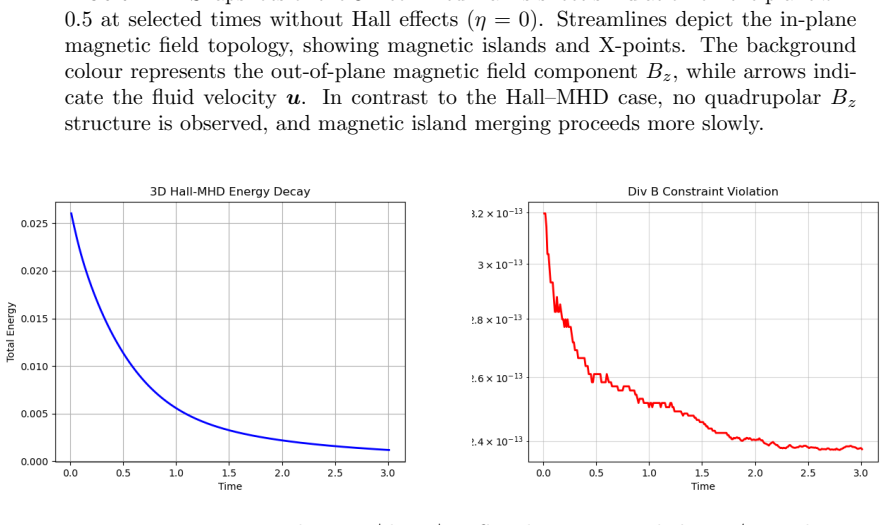
The incompressible Hall-magnetohydrodynamics (Hall--MHD) system presents substantial analytical and computational challenges due to its stiff, highly nonlinear Hall term and the strict requirement that the magnetic field remains solenoidal. In this paper, we study a Voigt-regularised Hall--MHD system, which is of independent analytical interest and provides a physically consistent, well-posed regularisation of the original model. We propose, analyse, and implement a structure-preserving, linear, fully discrete finite element method for this regularised problem. Using finite element exterior calculus and a mixed formulation, the spatial discretisation enforces the divergence-free condition on the magnetic field exactly, while a skew-symmetric, linearly implicit time discretisation yields unconditional energy stability. We establish optimal convergence rates for the Voigt-regularised problem and, additionally, derive error estimates for the unregularised Hall--MHD system, with the Voigt regularisation playing a crucial role in the non-resistive regime. Finally, numerical simulations in both 2.5D and 3D corroborate the theoretical results and demonstrate the physical fidelity of the scheme.
Editorial analysis
A structured set of objections, weighed in public.
Referee Report
Summary. The manuscript presents a divergence-preserving mixed finite element method for the Voigt-regularized incompressible Hall-MHD equations. The scheme is linear and fully discrete, employing finite element exterior calculus to enforce the divergence-free condition on the magnetic field exactly and a skew-symmetric linearly implicit time discretization to achieve unconditional energy stability. Optimal convergence rates are established for the regularized problem, and error estimates are derived for the unregularized Hall-MHD system, with particular emphasis on the non-resistive regime where the Voigt regularization is essential. Numerical simulations in 2.5D and 3D are provided to validate the theoretical findings.
Significance. This work addresses a challenging problem in computational plasma physics by providing a structure-preserving discretization with rigorous error analysis. The exact preservation of the divergence-free constraint via FEEC and the unconditional energy stability are notable strengths. If the error estimates for the unregularized system hold with controlled dependence on the regularization parameter, the results would offer a reliable numerical tool for simulating Hall-MHD systems in regimes where resistivity vanishes.
major comments (1)
- The abstract states that error estimates for the unregularised Hall-MHD system are derived, with the Voigt regularisation playing a crucial role in the non-resistive regime (η=0). The analysis must demonstrate that the constants in the final error bounds for the unregularised case remain independent of the Voigt parameter α (or at worst grow in a controlled manner that still permits α→0). If the estimates require α ≳ h^k for some k or contain factors of 1/α, the claim of approximation to the target unregularised model does not hold uniformly. Please identify the precise theorem for the unregularised estimates and state the α-dependence explicitly.
Simulated Author's Rebuttal
We thank the referee for their careful reading of the manuscript and for the constructive comment on the α-dependence of the error estimates. We address the point below and have revised the manuscript to improve clarity on this matter.
read point-by-point responses
-
Referee: The abstract states that error estimates for the unregularised Hall-MHD system are derived, with the Voigt regularisation playing a crucial role in the non-resistive regime (η=0). The analysis must demonstrate that the constants in the final error bounds for the unregularised case remain independent of the Voigt parameter α (or at worst grow in a controlled manner that still permits α→0). If the estimates require α ≳ h^k for some k or contain factors of 1/α, the claim of approximation to the target unregularised model does not hold uniformly. Please identify the precise theorem for the unregularised estimates and state the α-dependence explicitly.
Authors: We thank the referee for this important observation. The error estimates for the unregularized Hall-MHD system (including the non-resistive case η=0) are stated in Theorem 5.2. Upon review, the constants appearing in these bounds depend on α; specifically, they contain factors of order α^{-1/2} arising from the Voigt term in the energy estimates when η=0. These estimates hold for any fixed α>0 as the mesh size h and time step τ tend to zero, with optimal rates in the appropriate norms. The dependence is not uniform as α→0, which is consistent with the fact that the Voigt regularization is essential for well-posedness and stability analysis in the non-resistive regime. We have revised the manuscript to (i) explicitly display the α-dependence in the statement of Theorem 5.2, (ii) add a remark immediately after the theorem explaining the controlled nature of the dependence for fixed α and its implications for approximating the unregularized model, and (iii) update the abstract slightly for precision. This does not alter the validity of the claims but makes the limitations transparent. revision: yes
Circularity Check
No circularity: standard regularization and energy analysis
full rationale
The derivation proceeds by first analyzing the Voigt-regularized system with a mixed FEEC spatial discretization that exactly preserves div B=0 and a skew-symmetric time scheme for unconditional stability, then obtaining optimal error rates via standard energy estimates. Error bounds for the unregularized system are subsequently derived from the regularized estimates. No step reduces by construction to a fitted parameter renamed as prediction, a self-definition, or a load-bearing self-citation whose content is unverified; the chain relies on independent a priori estimates and approximation theory for the regularized model. This is the normal, non-circular structure for regularization-based error analysis.
Axiom & Free-Parameter Ledger
axioms (1)
- domain assumption The Voigt-regularised Hall-MHD system is a physically consistent, well-posed regularisation of the original model.
Reference graph
Works this paper leans on
-
[1]
D. N. Arnold, R. S. Falk, and R. Winther , Finite element exterior calculus, homological techniques, and applications , Acta Numer., 15 (2006), pp. 1--155
work page 2006
- [2]
-
[3]
L. Beir\ ao da Veiga, K. Hu, and L. Mascotto , Error estimates for a helicity-preserving finite element discretisation of an incompressible magnetohydrodynamics system , ESAIM Math. Model. Numer. Anal., 59 (2025), pp. 1075--1094
work page 2025
-
[4]
Biskamp , Nonlinear magnetohydrodynamics , vol
D. Biskamp , Nonlinear magnetohydrodynamics , vol. 1 of Cambridge Monographs on Plasma Physics, Cambridge University Press, Cambridge, 1993
work page 1993
-
[5]
Biskamp , Magnetic reconnection in plasmas , Astrophysics and Space Science, 242 (1996), pp
D. Biskamp , Magnetic reconnection in plasmas , Astrophysics and Space Science, 242 (1996), pp. 165--207
work page 1996
-
[6]
J. U. Brackbill and D. C. Barnes , The effect of nonzero B \ on the numerical solution of the magnetohydrodynamic equations , J. Comput. Phys., 35 (1980), pp. 426--430
work page 1980
-
[7]
Z. Brze \'z niak, A. Larios, and I. Safarik , Fractional V oigt-regularization of the 3d N avier- S tokes and E uler equations: global well-posedness and limiting behavior , J. Math. Fluid Mech., 27 (2025), pp. Paper No. 45, 23
work page 2025
-
[8]
Chac\'on , A scalable multidimensional fully implicit solver for H all magnetohydrodynamics , J
L. Chac\'on , A scalable multidimensional fully implicit solver for H all magnetohydrodynamics , J. Comput. Phys., 526 (2025), pp. Paper No. 113789, 20
work page 2025
-
[9]
P. Constantin and F. Pasqualotto , Magnetic relaxation of a V oigt- MHD system , Comm. Math. Phys., 402 (2023), pp. 1931--1952
work page 2023
- [10]
- [11]
-
[12]
J. F. Drake, M. A. Shay, and M. Swisdak , The H all fields and fast magnetic reconnection , Physics of Plasmas, 15 (2008), p. 042306
work page 2008
-
[13]
A. Ern and J.-L. Guermond , Finite element quasi-interpolation and best approximation , ESAIM Math. Model. Numer. Anal., 51 (2017), pp. 1367--1385
work page 2017
-
[14]
A. Ern and J.-L. Guermond , Analysis of the edge finite element approximation of the M axwell equations with low regularity solutions , Comput. Math. Appl., 75 (2018), pp. 918--932
work page 2018
-
[15]
T. G. Forbes , Magnetic reconnection in solar flares , Geophysical & Astrophysical Fluid Dynamics, 62 (1991), pp. 15--36
work page 1991
- [16]
-
[17]
S. Guo, L. Mei, and W. Yan , A linearly implicit spectral scheme for the three-dimensional H all- MHD system , SIAM J. Sci. Comput., 46 (2024), pp. B752--B783
work page 2024
-
[18]
S. Guo, W. Yan, and L. Mei , I MEX H ermite- G alerkin spectral method for incompressible H all-magnetohydrodynamic flow with variable density , SIAM J. Sci. Comput., 47 (2025), pp. B505--B532
work page 2025
-
[19]
J. He, K. Hu, and J. Xu , Generalized G affney inequality and discrete compactness for discrete differential forms , Numer. Math., 143 (2019), pp. 781--795
work page 2019
-
[20]
X. He, A. Mao, S. Apatenkov, Z. Zhang, Z. Wang, M. Sun, J. Zou, and X. Wang , Numerical analysis of three-dimensional magnetopause-like reconnection properties by H all MHD simulation for SPERF-AREX , Physics of Plasmas, 31 (2024), p. 072107
work page 2024
- [21]
- [22]
-
[23]
J. D. Huba , Hall Magnetohydrodynamics - A Tutorial , Springer Berlin Heidelberg, Berlin, Heidelberg, 2003, pp. 166--192
work page 2003
-
[24]
K. Iwasaki and K. Tomida , Comparative analysis of H all effect implementations in H all magnetohydrodynamics , The Astrophysical Journal, 984 (2025), p. 50
work page 2025
-
[25]
John , Finite element methods for incompressible flow problems , vol
V. John , Finite element methods for incompressible flow problems , vol. 51 of Springer Series in Computational Mathematics, Springer, Cham, 2016
work page 2016
-
[26]
P. Kuberry, A. Larios, L. G. Rebholz, and N. E. Wilson , Numerical approximation of the V oigt regularization for incompressible N avier- S tokes and magnetohydrodynamic flows , Comput. Math. Appl., 64 (2012), pp. 2647--2662
work page 2012
-
[27]
F. Laakmann, K. Hu, and P. E. Farrell , Structure-preserving and helicity-conserving finite element approximations and preconditioning for the H all MHD equations , J. Comput. Phys., 492 (2023), pp. Paper No. 112410, 25
work page 2023
-
[28]
A. Larios and E. S. Titi , Higher-order global regularity of an inviscid V oigt-regularization of the three-dimensional inviscid resistive magnetohydrodynamic equations , J. Math. Fluid Mech., 16 (2014), pp. 59--76
work page 2014
-
[29]
M. J. Lighthill , Studies on magneto-hydrodynamic waves and other anisotropic wave motions , Philos. Trans. Roy. Soc. London Ser. A, 252 (1960), pp. 397--430
work page 1960
-
[30]
A. J. Majda and A. L. Bertozzi , Vorticity and incompressible flow , vol. 27 of Cambridge Texts in Applied Mathematics, Cambridge University Press, Cambridge, 2002
work page 2002
-
[31]
L. F. M\'orales, S. Dasso, and D. O. Gomez , Hall effect in incompressible magnetic reconnection , Journal of Geophysical Research: Space Physics, 110 (2005)
work page 2005
- [32]
-
[33]
X. Yang, P. Huang, and Y. He , A V oigt regularization of the thermally coupled magnetohydrodynamic flow , Z. Angew. Math. Phys., 75 (2024), pp. Paper No. 115, 20
work page 2024
discussion (0)
Sign in with ORCID, Apple, or X to comment. Anyone can read and Pith papers without signing in.