Numerical Construction of Elliptic Lower-Dimensional Quasi-Periodic Solutions with a Priori Bound
Pith reviewed 2026-05-09 16:34 UTC · model grok-4.3
The pith
Alternating numerical scheme extends to elliptic lower-dimensional quasi-periodic solutions while controlling inverses via resolvent identity.
A machine-rendered reading of the paper's core claim, the machinery that carries it, and where it could break.
Core claim
The authors establish that the alternating scheme extends to elliptic lower-dimensional quasi-periodic solutions by using the resolvent identity to represent the global inverse of the perturbation operator as a linear gluing of local inverses. This yields a regime-dependent interaction structure—weak at short range, strong at long range—that preserves Gevrey decay uniformly, even for real-valued perturbations lacking Hankel structure. With the Melnikov conditions eliminating small divisors, the method delivers numerical constructions with a priori bounds, as verified on the Hénon-Heiles and FPU models.
What carries the argument
The resolvent identity applied in multi-scale analysis, which linearly combines local inverses into a global one whose Gevrey decay stays controlled through short-range weak and long-range strong interactions.
If this is right
- The scheme applies to general real-valued perturbations, not only polynomials.
- Numerical solutions are obtained for the Hénon-Heiles model and the Fermi-Pasta-Ulam model with demonstrated effectiveness.
- Gevrey decay of the inverse remains uniformly controlled despite the lack of Hankel structure.
- Small divisors are eliminated once the first and second Melnikov conditions are met.
Where Pith is reading between the lines
- The linear gluing representation may simplify similar inversion problems in other KAM constructions for non-polynomial perturbations.
- The approach could be tested on additional nearly integrable systems with known lower-dimensional tori to check uniformity of the decay control.
- Practical use in problems like the restricted three-body problem becomes feasible if the Melnikov conditions can be verified numerically.
Load-bearing premise
The frequencies must satisfy the first and second Melnikov conditions and the perturbation operator must exhibit Gevrey decay for the uniform control of the inverse to hold.
What would settle it
A long-time numerical integration of the constructed Hénon-Heiles solution that shows secular drift or violation of the a priori bound would falsify the claim that the scheme produces valid elliptic lower-dimensional quasi-periodic solutions.
Figures



read the original abstract
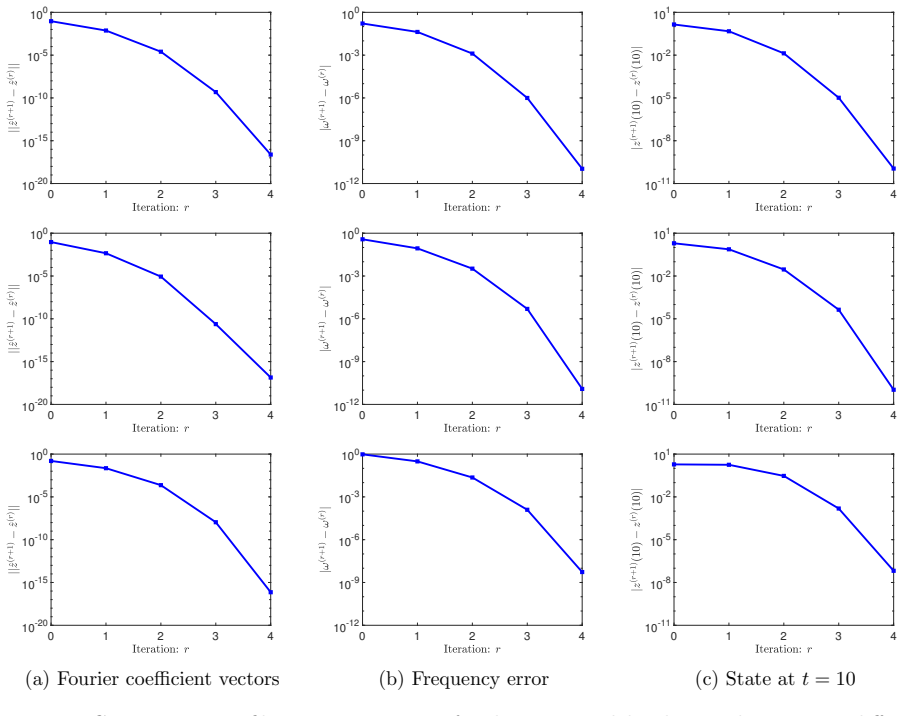
A numerical framework for constructing full-dimensional quasi-periodic solutions in nearly integrable systems was recently developed by Fu and Shi[2026]. Based on an alternating scheme, this approach effectively overcomes the secular drift in angle variables, a fundamental limitation of symplectic integrators. However, in many applications, such as the restricted three-body problem, lower-dimensional quasi-periodic solutions hold greater significance. The construction of these solutions is considerably more challenging due to the presence of normal frequencies, leading to intricate resonance phenomena. Beyond the subspace resonance, one must also account for the first and second Melnikov conditions to eliminate small divisors. In this study, we extend the proposed alternating numerical scheme to compute the elliptic lower-dimensional quasi-periodic solutions. Numerical experiments are presented for the H\'{e}non-Heiles model and the Fermi--Pasta--Ulam (FPU) model, demonstrating the effectiveness of the proposed method. Furthermore, we emphasize that the perturbation is not merely a polynomial with real coefficients but is a real-valued function. As a result, the associated perturbation operator exhibits Gevrey decay without possessing a Hankel structure. Meanwhile, we further simplify the multi-scale analysis by exploiting the resolvent identity, showing that the global inverse can be expressed linearly in terms of local inverses via the gluing procedure. This representation reveals a regime-dependent interaction structure: weak interactions dominate at short range, while strong interactions emerge at long range. This balance ensures that the Gevrey decay of the inverse remains uniformly controlled. Moreover, within this linear representation, the inversion conditions provide a clearer characterization of the localization properties.
Editorial analysis
A structured set of objections, weighed in public.
Referee Report
Summary. The paper extends the alternating numerical scheme introduced by Fu and Shi (2026) for full-dimensional quasi-periodic solutions to the elliptic lower-dimensional case in nearly integrable Hamiltonian systems. It incorporates the first and second Melnikov conditions to handle normal frequencies and small divisors, presents numerical experiments on the Hénon-Heiles and Fermi-Pasta-Ulam models, and analyzes the perturbation operator for real-valued (non-polynomial) functions exhibiting Gevrey decay without Hankel structure. The multi-scale analysis is simplified via the resolvent identity and a gluing procedure that expresses the global inverse linearly in terms of local inverses, revealing regime-dependent weak-to-strong interactions that preserve uniform Gevrey decay.
Significance. If the numerical effectiveness and a priori bound hold, the work provides a practical extension of KAM-type numerical methods to lower-dimensional tori, which are central in applications such as the restricted three-body problem. The emphasis on real-valued perturbations and the resolvent-based gluing for controlling inverses without Hankel structure offers a technical advance over prior polynomial-focused schemes; reproducible code or explicit bounds would strengthen its utility for the field.
major comments (2)
- The abstract and title claim an 'a priori bound' and 'effectiveness' for the extended scheme, yet no explicit derivation, theorem statement, or quantitative error measures (e.g., residual norms, convergence rates, or comparison to the bound) are referenced; this is load-bearing for the central numerical claim and requires a dedicated section or theorem to verify uniform control of the Gevrey decay under the gluing procedure.
- The weakest assumption—that the perturbation is a general real-valued function with Gevrey decay (no Hankel structure) and that Melnikov conditions hold—is stated but not verified numerically or analytically for the chosen models; § on numerical experiments should include a check that the first and second Melnikov conditions are satisfied for the computed solutions to support the small-divisor elimination.
minor comments (2)
- The abstract contains a minor formatting inconsistency in 'Hénon-Heiles' (appears with escaped LaTeX in one place); ensure consistent rendering throughout.
- The description of 'regime-dependent interaction structure' (weak at short range, strong at long range) is conceptually useful but would benefit from a brief equation or diagram illustrating the linear representation of the inverse via gluing.
Simulated Author's Rebuttal
We thank the referee for the careful reading and constructive feedback on our manuscript extending the alternating numerical scheme to elliptic lower-dimensional quasi-periodic solutions. We address the major comments point by point below and will revise the manuscript to strengthen the presentation of the a priori bounds and numerical validations.
read point-by-point responses
-
Referee: The abstract and title claim an 'a priori bound' and 'effectiveness' for the extended scheme, yet no explicit derivation, theorem statement, or quantitative error measures (e.g., residual norms, convergence rates, or comparison to the bound) are referenced; this is load-bearing for the central numerical claim and requires a dedicated section or theorem to verify uniform control of the Gevrey decay under the gluing procedure.
Authors: We agree that an explicit theorem statement would improve clarity. The multi-scale analysis in the theoretical sections derives the a priori bound on the Gevrey decay of the inverse operator via the resolvent identity and gluing procedure, establishing uniform control through the regime-dependent weak-to-strong interactions. However, this is not condensed into a standalone theorem, and the numerical experiments lack explicit quantitative measures such as residual norms or convergence rates. In the revision, we will add a dedicated theorem summarizing the bound and include quantitative error analysis (e.g., residual norms and comparison to the predicted decay) in the numerical experiments section. revision: yes
-
Referee: The weakest assumption—that the perturbation is a general real-valued function with Gevrey decay (no Hankel structure) and that Melnikov conditions hold—is stated but not verified numerically or analytically for the chosen models; § on numerical experiments should include a check that the first and second Melnikov conditions are satisfied for the computed solutions to support the small-divisor elimination.
Authors: The first and second Melnikov conditions are assumed as part of the standard setup for elliptic lower-dimensional tori to eliminate small divisors, consistent with the KAM framework, and the models are selected with frequencies in the perturbative regime where these are expected to hold. Explicit numerical verification was not included in the current experiments section. We will add a check in the revised numerical experiments (e.g., computing minimal distances to resonances for the obtained solutions) to support the small-divisor control. revision: yes
Circularity Check
No significant circularity in derivation chain
full rationale
The paper extends the authors' prior alternating numerical scheme from the 2026 reference but introduces independent analytical steps: simplification of multi-scale analysis via the resolvent identity, a gluing procedure expressing the global inverse linearly in terms of local inverses, and control of Gevrey decay for real-valued (non-polynomial) perturbations lacking Hankel structure. These elements, along with invocation of first and second Melnikov conditions and numerical validation on the Hénon-Heiles and FPU models, do not reduce any claimed result to a fitted parameter, self-definition, or unverified self-citation chain. The derivation remains self-contained with externally demonstrable components.
Axiom & Free-Parameter Ledger
axioms (2)
- domain assumption The Hamiltonian system is nearly integrable with a perturbation that is a real-valued function exhibiting Gevrey decay without Hankel structure.
- domain assumption The first and second Melnikov conditions hold to eliminate small divisors arising from normal frequencies.
Reference graph
Works this paper leans on
- [1]
-
[2]
Construction of quasi-periodic solutions for
Bourgain, Jean , journal=. Construction of quasi-periodic solutions for
-
[3]
Bourgain, Jean , journal=. Quasi-periodic solutions of. 1998 , publisher=
work page 1998
- [4]
-
[5]
Ruth, R. D. , title =. IEEE Transactions on Nuclear Science , volume =
- [6]
- [7]
-
[8]
Numerische Mathematik , volume=
Volume-preserving algorithms for source-free dynamical systems , author=. Numerische Mathematik , volume=. 1995 , publisher=
work page 1995
-
[9]
Proceedings of the International Congress of Mathematicians: Rio de Janeiro 2018 , pages=
Dynamics, numerical analysis, and some geometry , author=. Proceedings of the International Congress of Mathematicians: Rio de Janeiro 2018 , pages=. 2018 , organization=
work page 2018
-
[10]
Calvo, M. P. and Sanz-Serna, J. M. , title =. Numerical Analysis 1991 , series =
work page 1991
- [11]
-
[12]
Numerische Mathematik , volume=
The life-span of backward error analysis for numerical integrators , author=. Numerische Mathematik , volume=. 1997 , publisher=
work page 1997
-
[13]
Geometric numerical integration illustrated by the
Hairer, Ernst and Lubich, Christian and Wanner, Gerhard , journal=. Geometric numerical integration illustrated by the. 2003 , publisher=
work page 2003
-
[14]
Numerische Mathematik , volume=
Symmetric multistep methods over long times , author=. Numerische Mathematik , volume=. 2004 , publisher=
work page 2004
-
[15]
The SMAI Journal of computational mathematics , volume=
Symmetric multistep methods for charged-particle dynamics , author=. The SMAI Journal of computational mathematics , volume=
- [16]
- [17]
-
[18]
Mathematical methods of classical mechanics , author=. 2013 , publisher=
work page 2013
-
[19]
K. Feng , title =. Proceedings of the International Conference on Scientific Computation , year =
-
[20]
H. Yoshida , title =. Celestial Mechanics and Dynamical Astronomy , year =
- [21]
-
[22]
Ernst Hairer and Gerhard Wanner , title =
-
[23]
SIAM journal on numerical analysis , volume=
Long-time energy conservation of numerical methods for oscillatory differential equations , author=. SIAM journal on numerical analysis , volume=. 2000 , publisher=
work page 2000
-
[24]
V. I. Arnold , title =. Russian Mathematical Surveys , year =
-
[25]
Nachrichten der Akademie der Wissenschaften in G\"
On invariant curves of area-preserving mapping of an annulus , author=. Nachrichten der Akademie der Wissenschaften in G\". 1962 , pages =
work page 1962
-
[26]
Nash, John , journal=. The imbedding problem for. 1956 , publisher=
work page 1956
-
[27]
Annali della Scuola Normale Superiore di Pisa
Moser, Jürgen , title =. Annali della Scuola Normale Superiore di Pisa. Classe di Scienze , volume =
-
[28]
Communications in Mathematical Physics , volume =
Chemin, Jean-Yves and Zhang, Ping , title =. Communications in Mathematical Physics , volume =
-
[29]
1987, Geophysical Fluid Dynamics (New York: Springer), doi: 10.1007/978-1-4612-4650-3
Pedlosky, Joseph , title =. 1987 , edition =. doi:10.1007/978-1-4612-4650-3 , pages =
- [30]
-
[31]
Melnikov, V. K. , title =. Doklady Akademii Nauk SSSR , volume =
-
[32]
Arnold, Vladimir I. and Kozlov, Valery V. and Neishtadt, Anatoly I. , title =. 2006 , volume =
work page 2006
-
[33]
Green's Function Estimates for Lattice
Jean Bourgain , publisher =. Green's Function Estimates for Lattice
- [34]
-
[35]
Yuan, Xiaoping , journal=. Lagrange stability for. 2000 , publisher=
work page 2000
-
[36]
Approaches to the qualitative theory of ordinary differential equations: dynamical systems and nonlinear oscillations , author=. 2007 , publisher=
work page 2007
-
[37]
The applicability of the third integral of motion: some numerical experiments , journal =
H. The applicability of the third integral of motion: some numerical experiments , journal =
-
[38]
Channell, Paul J and Scovel, Clint , journal=. Symplectic integration of. 1990 , publisher=
work page 1990
- [39]
- [40]
- [41]
- [42]
-
[43]
Liu, Jianjun and Yuan, Xiaoping , journal=. A. 2011 , publisher=
work page 2011
- [44]
- [46]
-
[47]
Fermi, Enrico and Pasta, John and Ulam, Stanislaw , booktitle =. Studies of nonlinear problems. 1965 , note =
work page 1965
-
[48]
Geometric Numerical Integration: Structure-Preserving Algorithms for Ordinary Differential Equations , author=. 2006 , publisher=
work page 2006
-
[49]
On certain cases of conservation of almost periodic motions with a small change of the
Melnikov, Viktor Kuz'mich , booktitle=. On certain cases of conservation of almost periodic motions with a small change of the. 1965 , organization=
work page 1965
-
[50]
Perturbations of stable invariant tori for
Eliasson, L H. Perturbations of stable invariant tori for. Annali della Scuola Normale Superiore di Pisa-Classe di Scienze , volume=
-
[51]
On elliptic lower dimensional tori in
P. On elliptic lower dimensional tori in. Mathematische Zeitschrift , volume=. 1989 , publisher=
work page 1989
-
[52]
KAM theory without action-angle variables , author=. Nonlinearity , volume=
-
[53]
The parameterization method for invariant manifolds: from rigorous results to effective computations , author=. 2016 , publisher=
work page 2016
-
[54]
Discrete and Continuous Dynamical Systems , volume=
Computation of whiskered invariant tori and their associated manifolds: New fast algorithms , author=. Discrete and Continuous Dynamical Systems , volume=. 2012 , publisher=
work page 2012
-
[55]
A parametrization algorithm to compute lower dimensional elliptic tori in
Caracciolo, Chiara and Figueras, Jordi-Llu. A parametrization algorithm to compute lower dimensional elliptic tori in. Nonlinearity , volume=. 2025 , publisher=
work page 2025
-
[56]
Kolmogorov, A. N. , journal=. On the preservation of conditionally periodic motions under a small change of the. 1954 , note=
work page 1954
-
[57]
Arnold, V. I. , journal=. Proof of a theorem of
-
[58]
Bourgain, Jean , journal=. On. 1997 , publisher=
work page 1997
-
[59]
On the theory of quasiperiodic motions , author=. SIAM Review , volume=. 1966 , publisher=
work page 1966
-
[60]
Mathematische Annalen , volume=
Convergent series expansions for quasi-periodic motions , author=. Mathematische Annalen , volume=. 1967 , publisher=
work page 1967
-
[61]
Instability of dynamical systems with several degrees of freedom , author=. Soviet Mathematics , volume=
-
[62]
P. A Lecture on the Classical. Proceedings of Symposia in Pure Mathematics , volume=. 2001 , publisher=
work page 2001
- [63]
-
[64]
Quasi-periodic solutions of nonlinear Schr
Yuan, Xiaoping , journal=. Quasi-periodic solutions of nonlinear Schr. 2003 , publisher=
work page 2003
-
[65]
Physica D: Nonlinear Phenomena , volume=
Breathers in nonlinear lattices: Existence, linear stability and quantization , author=. Physica D: Nonlinear Phenomena , volume=. 1997 , publisher=
work page 1997
-
[66]
Communications in Mathematical Physics , volume =
Yuan, Xiaoping , title =. Communications in Mathematical Physics , volume =. 2002 , publisher =
work page 2002
- [67]
-
[68]
V. I. Arnold. Proof of a theorem of A . N . K olmogorov on the invariance of quasi-periodic motions under small perturbations of the H amiltonian. Russian Mathematical Surveys, 18 0 (5): 0 9--36, 1963
work page 1963
-
[69]
V. I. Arnold. Instability of dynamical systems with several degrees of freedom. Soviet Mathematics, 5: 0 581--585, 1964
work page 1964
-
[70]
V. I. Arnold. Mathematical methods of classical mechanics, volume 60. Springer Science & Business Media, 2013
work page 2013
-
[71]
S. Aubry. Breathers in nonlinear lattices: Existence, linear stability and quantization. Physica D: Nonlinear Phenomena, 103 0 (1-4): 0 201--250, 1997
work page 1997
- [72]
- [73]
-
[74]
L. H. Eliasson. Perturbations of stable invariant tori for H amiltonian systems. Annali della Scuola Normale Superiore di Pisa-Classe di Scienze, 15 0 (1): 0 115--147, 1988
work page 1988
-
[75]
K. Feng. Collected Works of Feng Kang, volume II. Science Press, Beijing, 1995. Edited by Institute of Computational Mathematics and Scientific/Engineering Computing, Academy of Mathematics and Systems Science, Chinese Academy of Sciences; Proofread by Liqun, Cao and Yifa, Tang
work page 1995
- [76]
- [77]
-
[78]
L. Gauckler, E. Hairer, and C. Lubich. Dynamics, numerical analysis, and some geometry. In Proceedings of the International Congress of Mathematicians: Rio de Janeiro 2018, pages 453--485. World Scientific, 2018
work page 2018
- [79]
-
[80]
M. H \'e non and C. Heiles. The applicability of the third integral of motion: some numerical experiments. Astronomical Journal, 69: 0 73--79, 1964
work page 1964
-
[81]
T. Kappeler and J. P\" o schel. KdV & KAM. Ergebnisse der Mathematik und ihrer Grenzgebiete. 3. Folge / A Series of Modern Surveys in Mathematics. Springer Berlin, Heidelberg, 1 edition, 2003
work page 2003
discussion (0)
Sign in with ORCID, Apple, or X to comment. Anyone can read and Pith papers without signing in.