Waveform Design for 6G ISAC Systems Under Full-Duplex Residual Self-Interference
Pith reviewed 2026-05-08 19:31 UTC · model grok-4.3
The pith
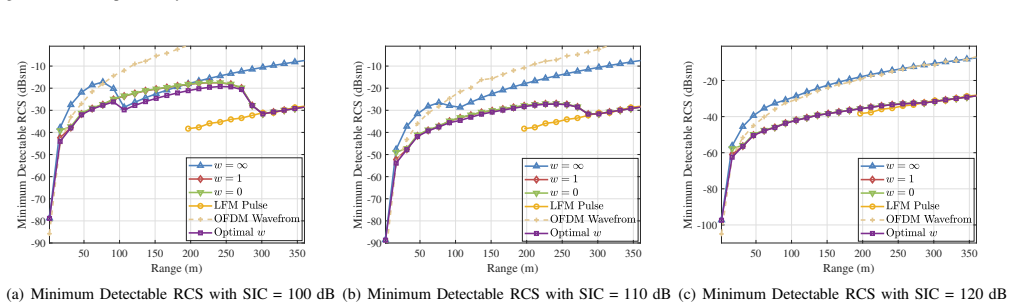
Dual-power phase-coded pulse enables long-range ISAC sensing despite full-duplex residual interference
A machine-rendered reading of the paper's core claim, the machinery that carries it, and where it could break.
Core claim
We propose a novel time-division ISAC waveform that integrates a dual-power phase-coded pulse for sensing into the communication frame under full-duplex RSI. The dual-power sensing pulse consists of a high-power sequence followed by a low-power sequence, effectively exploiting imperfect full-duplex operations to achieve reliable long-range sensing while eliminating the detection blind range inherent to conventional half-duplex pulse radars. Furthermore, a complementary and inverse-phase sequence group is designed to ensure perfect autocorrelation and robust cross-correlation sidelobe suppression, so as to enhance multi-target detection capability.
What carries the argument
dual-power phase-coded pulse consisting of a high-power sequence followed by a low-power sequence with complementary and inverse-phase sequences for perfect autocorrelation
If this is right
- Improves maximum detection range compared to OFDM and LFM baselines
- Enhances multi-target detection through robust sidelobe suppression
- Eliminates the detection blind range for small RCS targets
- Effectively exploits imperfect full-duplex RSI for reliable sensing
Where Pith is reading between the lines
- This approach may facilitate the integration of sensing capabilities into low-altitude wireless networks more seamlessly than current methods.
- Validation on actual hardware could reveal additional optimizations needed for the mismatched filter under real RSI conditions.
- The hierarchical CFAR-CA detector design might inspire similar adaptive detection schemes in other interference-limited sensing scenarios.
Load-bearing premise
That a dual-power phase-coded pulse with complementary inverse-phase sequences achieves perfect autocorrelation and robust sidelobe suppression while exploiting imperfect full-duplex RSI in real hardware conditions.
What would settle it
An experiment in a real full-duplex radio setup where the measured autocorrelation of the proposed pulse shows significant sidelobes or fails to suppress interference effectively, reducing detection performance.
Figures




read the original abstract
In this paper, the waveform design for 6G integrated sensing and communication (ISAC) systems is investigated, with a particular focus on the practical limitations imposed by imperfect full-duplex radios. Under such imperfections, continuous communication waveforms, such as OFDM, suffer from severe full-duplex residual self-interference (RSI) for radar sensing, which significantly restricts the long-range sensing capabilities required by emerging low-altitude wireless networks (LAWN). To address this challenge, we propose a novel time-division ISAC waveform that integrates a specially developed dual-power phase-coded pulse for sensing into the communication frame under full-duplex RSI. Specifically, the dual-power sensing pulse consists of a high-power sequence followed by a low-power sequence, effectively exploiting imperfect full-duplex operations to achieve reliable long-range sensing while eliminating the detection blind range inherent to conventional half-duplex pulse radars. Furthermore, a complementary and inverse-phase sequence group is designed to ensure perfect autocorrelation and robust cross-correlation sidelobe suppression, so as to enhance multi-target detection capability. As for sensing signal processing, a parameterized mismatched filter is developed and optimized to maximize the detection performance, tailored to the proposed pulse structure. In addition, we design a hierarchical one-dimensional CFAR-CA detector that can exploit the perfect range-domain autocorrelation characteristics of the proposed waveform to further improve the detection performance. Extensive simulations demonstrate that the proposed design significantly improves the maximum detection range and multi-target detection capability compared to existing OFDM and LFM pulse baselines, while effectively covering the blind range for targets with small RCS.
Editorial analysis
A structured set of objections, weighed in public.
Referee Report
Summary. The paper proposes a time-division ISAC waveform for 6G systems under imperfect full-duplex radios. It integrates a dual-power phase-coded sensing pulse (high-power sequence followed by low-power sequence) with a complementary inverse-phase sequence group into the communication frame. The design claims to achieve perfect range-domain autocorrelation, robust sidelobe suppression, elimination of the detection blind range, and improved maximum detection range plus multi-target capability versus OFDM and LFM baselines. Supporting elements include a parameterized mismatched filter and a hierarchical 1D CFAR-CA detector, with performance asserted via extensive simulations.
Significance. If the autocorrelation and sidelobe claims hold under realistic RSI and power disparity, the work would offer a practical advance for ISAC in full-duplex deployments, particularly for long-range sensing in low-altitude networks where continuous waveforms are otherwise limited by self-interference. The explicit exploitation of imperfect full-duplex operation and the hierarchical detector represent targeted engineering contributions, though their impact hinges on verification of the core waveform properties.
major comments (2)
- [§3 (Waveform Design)] §3 (Waveform Design): The assertion that complementary inverse-phase sequences deliver 'perfect autocorrelation' for the dual-power pulse is not supported. The autocorrelation is necessarily the weighted sum A² R_high(τ) + B² R_low(τ) with A ≫ B; even if the individual sequences are complementary, the unequal weights leave residual sidelobes of order (A² - B²) times the uncancelled terms. No analytical bound or closed-form expression is supplied showing these residuals fall below the CFAR threshold under the modeled RSI.
- [§5 (Numerical Results)] §5 (Numerical Results): Performance claims of significantly extended detection range and improved multi-target detection rest on simulations whose methods are insufficiently specified. The section does not report Monte Carlo trial counts, exact baseline parameters (OFDM subcarrier spacing and power, LFM chirp rate and duration), statistical error bars, or the RCS threshold and range criteria used to declare 'blind range coverage.' Without these, the quantitative gains cannot be reproduced or compared.
minor comments (2)
- [Abstract] Abstract: The phrase 'parameterized mismatched filter' is introduced without indicating the optimization objective or the parameters being tuned, which would help readers anticipate the later derivation.
- [Notation and equations] Notation and equations: Define the high-to-low power ratio symbol once and reuse it consistently; several figures would benefit from explicit axis labels for the power ratio and RSI variance.
Simulated Author's Rebuttal
We thank the referee for the constructive and detailed comments on our manuscript. We have carefully reviewed the major points raised and provide point-by-point responses below. The feedback has prompted us to strengthen the analytical support and reproducibility of the results.
read point-by-point responses
-
Referee: [§3 (Waveform Design)] §3 (Waveform Design): The assertion that complementary inverse-phase sequences deliver 'perfect autocorrelation' for the dual-power pulse is not supported. The autocorrelation is necessarily the weighted sum A² R_high(τ) + B² R_low(τ) with A ≫ B; even if the individual sequences are complementary, the unequal weights leave residual sidelobes of order (A² - B²) times the uncancelled terms. No analytical bound or closed-form expression is supplied showing these residuals fall below the CFAR threshold under the modeled RSI.
Authors: We thank the referee for this observation. The complementary inverse-phase sequence group is designed to cancel the primary sidelobe contributions in the range domain, but we acknowledge that the power disparity (A ≫ B) introduces residual terms of order (A² - B²). In the original manuscript, the term 'perfect autocorrelation' was used to describe the ideal cancellation property of the sequence group; however, this requires qualification under unequal weighting. In the revised manuscript, we will add a dedicated subsection deriving the closed-form expression for the residual sidelobe level as a function of the power ratio and sequence length. We will further show analytically and via simulation that, for the RSI levels and power ratios considered in the paper, these residuals remain below the CFAR threshold, thereby preserving the claimed multi-target detection performance. This addition directly addresses the request for an analytical bound. revision: partial
-
Referee: [§5 (Numerical Results)] §5 (Numerical Results): Performance claims of significantly extended detection range and improved multi-target detection rest on simulations whose methods are insufficiently specified. The section does not report Monte Carlo trial counts, exact baseline parameters (OFDM subcarrier spacing and power, LFM chirp rate and duration), statistical error bars, or the RCS threshold and range criteria used to declare 'blind range coverage.' Without these, the quantitative gains cannot be reproduced or compared.
Authors: We agree that the simulation methodology in Section 5 lacks sufficient detail for full reproducibility. In the revised manuscript, we will expand the description of the numerical results to explicitly state: the number of Monte Carlo trials (10,000 independent realizations), the exact OFDM baseline parameters (15 kHz subcarrier spacing, power allocation consistent with the ISAC frame structure), the LFM baseline parameters (chirp rate and duration matched to the proposed dual-power pulse), statistical error bars (standard deviation across trials), and the precise criteria for blind-range coverage (RCS threshold of -10 dBsm together with the range-resolution condition). These additions will enable direct reproduction and comparison of the reported gains in maximum detection range and multi-target capability. revision: yes
Circularity Check
No significant circularity; derivation is self-contained
full rationale
The paper proposes a time-division ISAC waveform using a dual-power phase-coded pulse whose complementary inverse-phase sequence group is constructed to achieve the stated autocorrelation and cross-correlation properties. The parameterized mismatched filter is optimized directly from the pulse structure, and the hierarchical CFAR-CA detector exploits the resulting range-domain characteristics. Performance gains are shown via simulation comparisons to OFDM and LFM baselines rather than any fitted parameter renamed as a prediction or any self-citation chain. No load-bearing step reduces by construction to its own inputs; the central claims rest on the explicit waveform design and external simulation validation.
Axiom & Free-Parameter Ledger
free parameters (1)
- High-to-low power ratio in sensing pulse
axioms (1)
- domain assumption Imperfect full-duplex RSI can be reliably exploited for long-range sensing without introducing new interference issues
Lean theorems connected to this paper
-
Cost.FunctionalEquation (J-cost uniqueness) — not invoked here; optimization is a standard SINR maximization, not a ratio-symmetric costwashburn_uniqueness_aczel unclear?
unclearRelation between the paper passage and the cited Recognition theorem.
a parameterized mismatched filter is developed and optimized to maximize the detection performance ... ∂F(nτ;w)/∂w|_{w=w*} = 0
What do these tags mean?
- matches
- The paper's claim is directly supported by a theorem in the formal canon.
- supports
- The theorem supports part of the paper's argument, but the paper may add assumptions or extra steps.
- extends
- The paper goes beyond the formal theorem; the theorem is a base layer rather than the whole result.
- uses
- The paper appears to rely on the theorem as machinery.
- contradicts
- The paper's claim conflicts with a theorem or certificate in the canon.
- unclear
- Pith found a possible connection, but the passage is too broad, indirect, or ambiguous to say the theorem truly supports the claim.
Reference graph
Works this paper leans on
-
[1]
W. Y uan, Y . Cui, J. Wang et al. , “From ground to sky: Architectures, applications, and challenges shaping low-altitude wirele ss networks,” arXiv preprint arXiv:2506.12308 , 2025
-
[2]
ISAC enabled cooperative detection for cellular-connected UA V network,
Y . Wang, K. Zu, L. Xiang, Q. Zhang, Z. Feng, J. Hu, and K. Y an g, “ISAC enabled cooperative detection for cellular-connected UA V network,” IEEE Trans. Wireless Commun. , vol. 24, no. 2, pp. 1541–1554, 2025
2025
-
[3]
Accessing from the sky: A tut orial on UA V communications for 5G and beyond,
Y . Zeng, Q. Wu, and R. Zhang, “Accessing from the sky: A tut orial on UA V communications for 5G and beyond,” Proc. IEEE, vol. 107, no. 12, pp. 2327–2375, 2019
2019
-
[4]
Integrated sensing and communication with massive mimo: A unified tensor approach for channel and target parameter estimatio n,
R. Zhang, L. Cheng, S. Wang, Y . Lou, Y . Gao, W. Wu, and D. W. K . Ng, “Integrated sensing and communication with massive mimo: A unified tensor approach for channel and target parameter estimatio n,” IEEE Trans. Wireless Commun. , vol. 23, no. 8, pp. 8571–8587, 2024
2024
-
[5]
Integrated sensing and communications: Toward dual-func tional wire- less networks for 6G and beyond,
F. Liu, Y . Cui, C. Masouros, J. Xu, T. X. Han, Y . C. Eldar, an d S. Buzzi, “Integrated sensing and communications: Toward dual-func tional wire- less networks for 6G and beyond,” IEEE J. Sel. Areas Commun. , vol. 40, no. 6, pp. 1728–1767, 2022
2022
-
[6]
I ntegrated sensing and communication (ISAC) transceiver: Hardware ar chitectures, enabling technologies, and emerging trends,
K. Wu, Y . Bigdeli, S. A. Keivaan, J. Deng, and P . Burasa, “I ntegrated sensing and communication (ISAC) transceiver: Hardware ar chitectures, enabling technologies, and emerging trends,” IEEE J. Sel. Top. Electro- magn. Antennas Propag. , pp. 1–29, 2025
2025
-
[7]
Feasibility study on integrated sensing and comm unication,
3GPP , “Feasibility study on integrated sensing and comm unication,” Tech. Rep. TR 22.837 version 19.2.1, Feb. 2024
2024
-
[8]
Integrating sensing an d communi- cations for ubiquitous IoT: Applications, trends, and chal lenges,
Y . Cui, F. Liu, X. Jing, and J. Mu, “Integrating sensing an d communi- cations for ubiquitous IoT: Applications, trends, and chal lenges,” IEEE Network, vol. 35, no. 5, pp. 158–167, 2021
2021
-
[9]
Integrated sensing and communication signals tow ard 5G-A and 6G: A survey,
Z. Wei, H. Qu, Y . Wang, X. Y uan, H. Wu, Y . Du, K. Han, N. Zhang , and Z. Feng, “Integrated sensing and communication signals tow ard 5G-A and 6G: A survey,” IEEE Internet Things J. , vol. 10, no. 13, pp. 11 068– 11 092, 2023
2023
-
[10]
6G internet of things: A comprehens ive survey,
D. C. Nguyen, M. Ding, P . N. Pathirana, A. Seneviratne, J . Li, D. Niyato, O. Dobre, and H. V . Poor, “6G internet of things: A comprehens ive survey,” IEEE Internet Things J. , vol. 9, no. 1, pp. 359–383, 2022
2022
-
[11]
Applications of self-interference cancellation in 5G and beyond,
S. Hong, J. Brand, J. I. Choi, M. Jain, J. Mehlman, S. Katt i, and P . Levis, “Applications of self-interference cancellation in 5G and beyond,” IEEE Commun. Mag. , vol. 52, no. 2, pp. 114–121, 2014
2014
-
[12]
All-digital self-interfer ence cancellation technique for full-duplex systems,
E. Ahmed and A. M. Eltawil, “All-digital self-interfer ence cancellation technique for full-duplex systems,” IEEE Trans. Wireless Commun. , vol. 14, no. 7, pp. 3519–3532, 2015
2015
-
[13]
Balanced RF-circuit based self-in terference cancellation for full duplex communications,
A. Tang and X. Wang, “Balanced RF-circuit based self-in terference cancellation for full duplex communications,” Ad Hoc Netw. , vol. 24, pp. 214–227, 2015
2015
-
[14]
Nonlinear self-interferen ce cancellation in vehicle networks for full-duplex integrated sensing and co mmunication,
Y . He, H. Zhao, and S. Shao, “Nonlinear self-interferen ce cancellation in vehicle networks for full-duplex integrated sensing and co mmunication,” IEEE Trans. V eh. Technol., vol. 73, no. 9, pp. 13 980–13 985, 2024
2024
-
[15]
Interference managem ent for full-duplex ISAC in B5G/6G networks: Architectures, chall enges, and solutions,
A. Tang, X. Wang, and J. A. Zhang, “Interference managem ent for full-duplex ISAC in B5G/6G networks: Architectures, chall enges, and solutions,” IEEE Commun. Mag. , vol. 62, no. 9, pp. 20–26, 2024
2024
-
[16]
5G PRS-based sensing: A sensing referen ce signal approach for joint sensing and communication system ,
Z. Wei, Y . Wang, L. Ma, S. Y ang, Z. Feng, C. Pan, Q. Zhang, Y . Wang, H. Wu, and P . Zhang, “5G PRS-based sensing: A sensing referen ce signal approach for joint sensing and communication system ,” IEEE Trans. V eh. Technol., vol. 72, no. 3, pp. 3250–3263, 2023
2023
-
[17]
SSB-based multi-tar get detection and joint velocity, angle, and range estimation in 5G-NR,
Y . Awad, A. Celik, and A. Eltawil, “SSB-based multi-tar get detection and joint velocity, angle, and range estimation in 5G-NR,” IEEE Com- mun. Lett. , vol. 29, no. 6, pp. 1340–1344, 2025
2025
-
[18]
Reference signal design a nd power optimization for energy-efficient 5G V2X integrated sensin g and com- munications,
Q. Zhao, A. Tang, and X. Wang, “Reference signal design a nd power optimization for energy-efficient 5G V2X integrated sensin g and com- munications,” IEEE Trans. Green Commun. Netw. , vol. 7, no. 1, pp. 379–392, 2023
2023
-
[19]
ISI-resistant refe rence signal design and processing for OFDM integrated communications a nd long- range radar sensing,
A. Tang, Q. Zhao, X. Wang, and W. Qu, “ISI-resistant refe rence signal design and processing for OFDM integrated communications a nd long- range radar sensing,” IEEE Commun. Lett. , vol. 28, no. 6, pp. 1322– 1326, 2024
2024
-
[20]
Improving ISA C system long-range sensing with alternating cyclic prefix and postfi x signals,
Y . Zhou, C. Xu, J. Liu, W. Wang, and F. Gao, “Improving ISA C system long-range sensing with alternating cyclic prefix and postfi x signals,” in Proc. IEEE PIMRC , 2024, pp. 1–6
2024
-
[21]
CP-OFDM achieves the lowest average ranging side lobe under QAM/PSK constellations,
F. Liu, Y . Zhang, Y . Xiong, S. Li, W. Y uan, F. Gao, S. Jin, a nd G. Caire, “CP-OFDM achieves the lowest average ranging side lobe under QAM/PSK constellations,” IEEE Trans. Info. Theory , 2025
2025
-
[22]
Reshaping the ISAC tradeoff under OFDM signaling: A probabilistic con stellation shaping approach,
Z. Du, F. Liu, Y . Xiong, T. X. Han, Y . C. Eldar, and S. Jin, “ Reshaping the ISAC tradeoff under OFDM signaling: A probabilistic con stellation shaping approach,” IEEE Trans. Signal Process., vol. 72, pp. 4782–4797, 2024
2024
-
[23]
Self-interference-resist ant IEEE 802.11 ad-based joint communication and automotive radar design,
A. Tang, S. Li, and X. Wang, “Self-interference-resist ant IEEE 802.11 ad-based joint communication and automotive radar design, ” IEEE J. Sel. Top. Signal Process. , vol. 15, no. 6, pp. 1484–1499, 2021
2021
-
[24]
M. A. Richards et al. , Fundamentals of radar signal processing . Mcgraw-hill New Y ork, 2005, vol. 1
2005
-
[25]
Masked modu la- tion: High-throughput half-duplex ISAC transmission wave form design,
Y . Xiong, J. Mu, S. Li, M. Lops, and J. Zhang, “Masked modu la- tion: High-throughput half-duplex ISAC transmission wave form design,” IEEE J. Sel. Areas Commun. , 2025
2025
-
[26]
Co- ordinated resource allocation for multi-cell isac network s: Interference suppression and blind zone mitigation in UA V detection,
R. Li, D. Ma, Z. Jiang, K. Y u, H. Zhang, J. Hou, and Q. Zhang , “Co- ordinated resource allocation for multi-cell isac network s: Interference suppression and blind zone mitigation in UA V detection,” IEEE Trans. Commun., vol. 74, pp. 5783–5802, 2026
2026
-
[27]
Waveform design and performance an alysis for full-duplex integrated sensing and communication,
Z. Xiao and Y . Zeng, “Waveform design and performance an alysis for full-duplex integrated sensing and communication,” IEEE J. Sel. Areas Commun., vol. 40, no. 6, pp. 1823–1837, 2022
2022
-
[28]
Alabaster, Pulse doppler radar principles: technology, applications
C. Alabaster, Pulse doppler radar principles: technology, applications . SciTech Publishing, 2012
2012
-
[29]
Sequence set design with good correlation properties via majorization-minimizati on,
J. Song, P . Babu, and D. P . Palomar, “Sequence set design with good correlation properties via majorization-minimizati on,” IEEE Trans. Signal Process. , vol. 64, no. 11, pp. 2866–2879, 2016
2016
-
[30]
Complementary sets of sequence s,
C.-C. Tseng and C. Liu, “Complementary sets of sequence s,” IEEE Trans. Inf. Theory , vol. 18, no. 5, pp. 644–652, 1972
1972
-
[31]
Rang e-doppler sidelobe suppression for pulsed radar based on golay comple mentary codes,
Z.-J. Wu, C.-X. Wang, P .-H. Jiang, and Z.-Q. Zhou, “Rang e-doppler sidelobe suppression for pulsed radar based on golay comple mentary codes,” IEEE Signal Process. Lett. , vol. 27, pp. 1205–1209, 2020
2020
-
[32]
Joint d esign of receiving filters and complementary set of sequences for I SAC with sidelobe level suppression,
K. Zhang, J. Wu, F. Dong, S. Lu, X. Li, and W. Y uan, “Joint d esign of receiving filters and complementary set of sequences for I SAC with sidelobe level suppression,” IEEE J. Sel. Areas Sens. , vol. 1, pp. 211– 223, 2024
2024
-
[33]
OFDM-bas ed in- band full-duplex ISAC systems,
W. Cho, K. Chang, W. Shin, Y . Kim, and Y .-J. Ko, “OFDM-bas ed in- band full-duplex ISAC systems,” IEEE Wirel. Commun. Lett. , vol. 14, no. 2, pp. 365–369, 2025
2025
-
[34]
Mitigation of l oopback self- interference in full-duplex MIMO relays,
T. Riihonen, S. Werner, and R. Wichman, “Mitigation of l oopback self- interference in full-duplex MIMO relays,” IEEE Trans. Signal Process. , vol. 59, no. 12, pp. 5983–5993, 2011
2011
-
[35]
F ull-duplex MIMO relaying: Achievable rates under limited dynamic rang e,
B. P . Day, A. R. Margetts, D. W. Bliss, and P . Schniter, “F ull-duplex MIMO relaying: Achievable rates under limited dynamic rang e,” IEEE J. Sel. Areas Commun. , vol. 30, no. 8, pp. 1541–1553, 2012
2012
-
[36]
NR; Physical Channels and Modulation,
3GPP , “NR; Physical Channels and Modulation,” Tech. Re p. TS 38.211 version 18.4.0, Sep. 2024
2024
discussion (0)
Sign in with ORCID, Apple, or X to comment. Anyone can read and Pith papers without signing in.