A Review on Quantum Satellite Communications: Challenges and Future Directions
Pith reviewed 2026-05-08 17:29 UTC · model grok-4.3
The pith
Quantum satellite communication faces atmospheric loss, tracking difficulties, and integration barriers that must be resolved before large-scale secure global networks can emerge.
A machine-rendered reading of the paper's core claim, the machinery that carries it, and where it could break.
Core claim
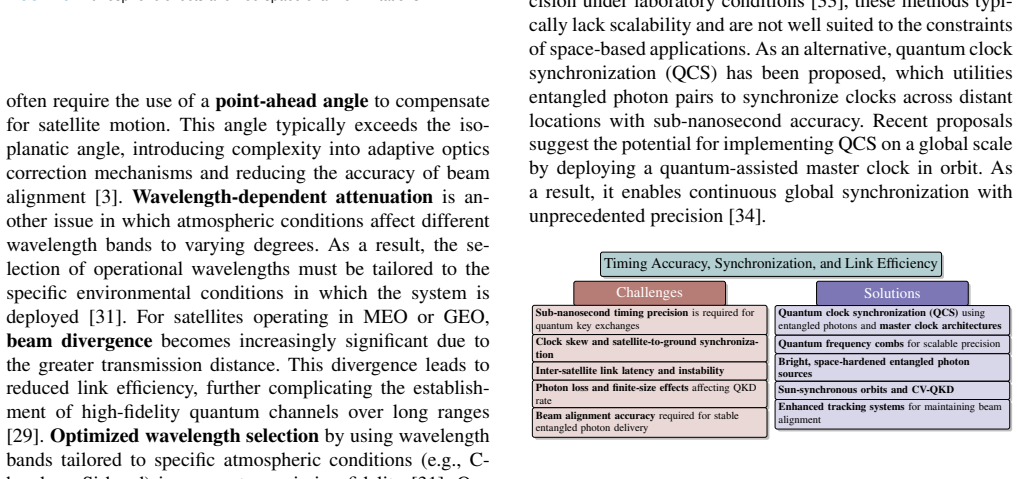
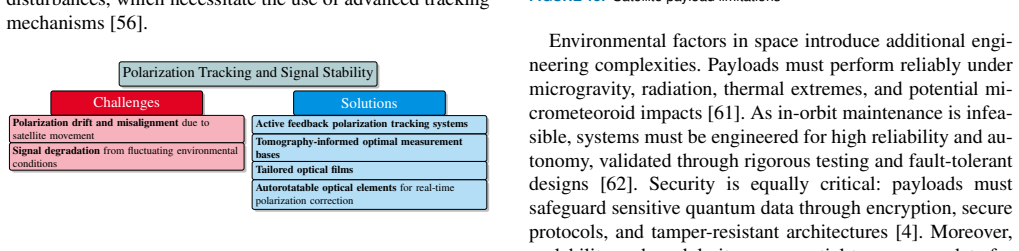
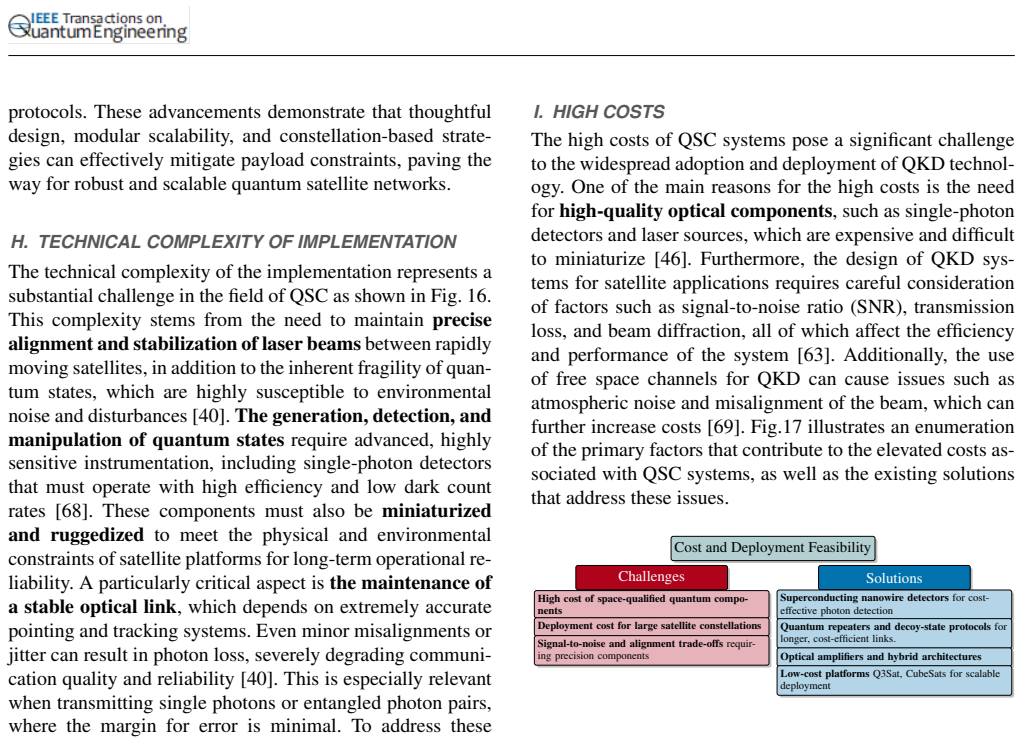
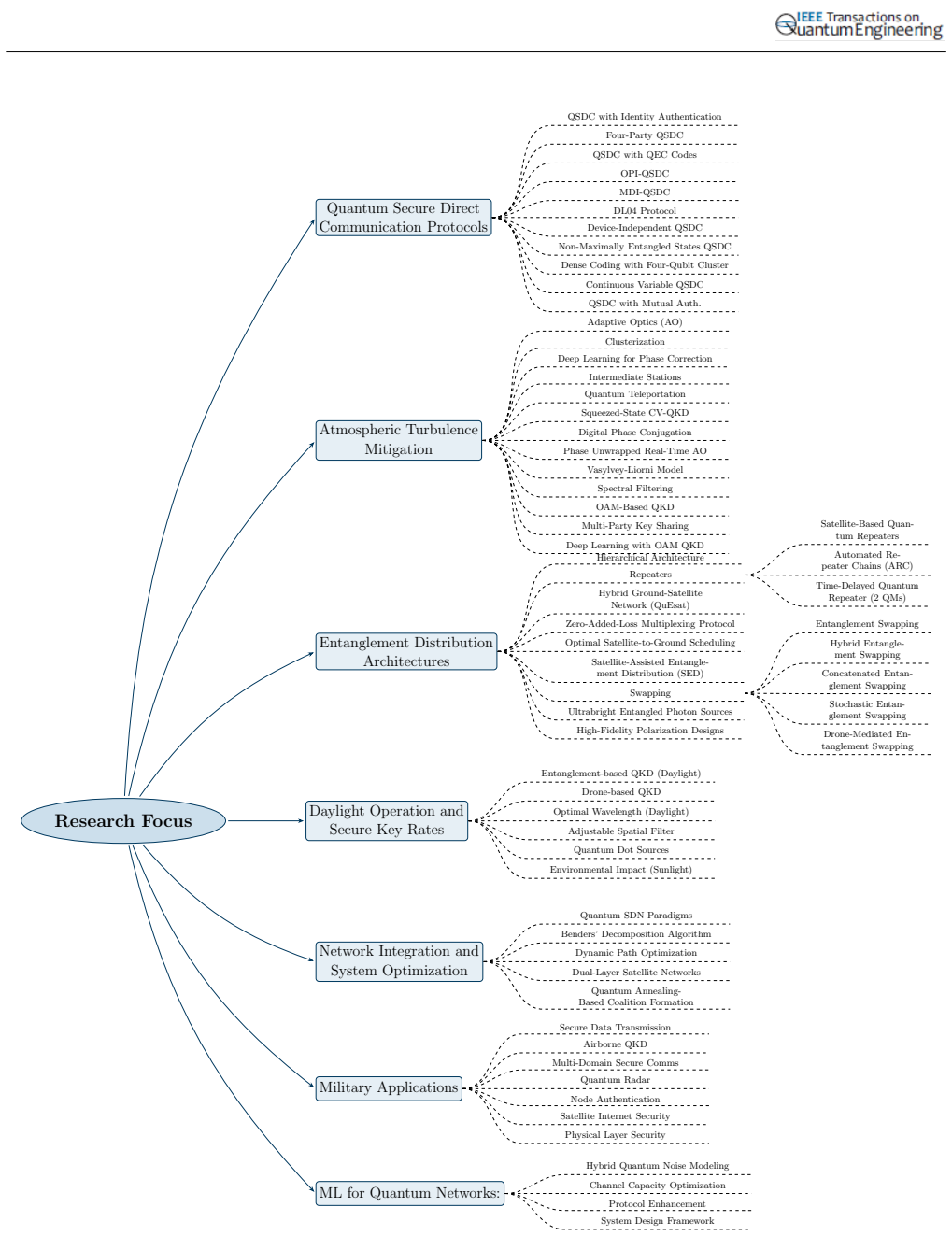
The paper establishes that the main roadblocks to practical quantum satellite communication are atmospheric loss, beam pointing and tracking errors, satellite payload restrictions, synchronization problems, scalability limits, and seamless merging with terrestrial systems. It presents these issues as the central focus, supported by a compact summary of basic concepts, key milestones such as the Micius mission, and current work on protocols, hybrid architectures, turbulence handling, and AI optimization, while pointing to future needs like daylight operation and satellite repeaters.
What carries the argument
The prioritized list of deployment barriers in quantum satellite systems, which organizes the review's discussion of concepts, milestones, advances, and research directions.
If this is right
- Overcoming atmospheric loss and turbulence would make daylight quantum links reliable enough for continuous operation.
- Improved beam pointing and tracking would raise the success rate of satellite-to-ground quantum transmissions.
- Solutions to payload constraints and synchronization would allow more complex quantum protocols on orbiting platforms.
- Progress on scalability and terrestrial integration would enable hybrid networks that extend quantum security beyond single satellites.
- Advances in the listed areas would support satellite-based repeaters and eventual space quantum computing nodes.
Where Pith is reading between the lines
- The emphasis on hybrid architectures suggests that purely space-based quantum networks may remain impractical without ground infrastructure for the foreseeable future.
- Highlighting AI-assisted optimization implies that machine learning could become a standard tool for real-time adaptation in quantum links.
- Future directions such as quantum Internet integration indicate that satellite systems are viewed as one layer in a larger global quantum communication fabric rather than standalone solutions.
- Daylight operation and satellite repeaters point to the need for protocols that tolerate higher noise and longer distances than current lab demonstrations.
Load-bearing premise
The reviewed challenges, protocols, and examples are representative enough of the field to usefully guide future development.
What would settle it
A working large-scale quantum satellite network deployed without measurable improvements in atmospheric loss, beam tracking, payload capacity, synchronization, or terrestrial integration.
Figures





read the original abstract
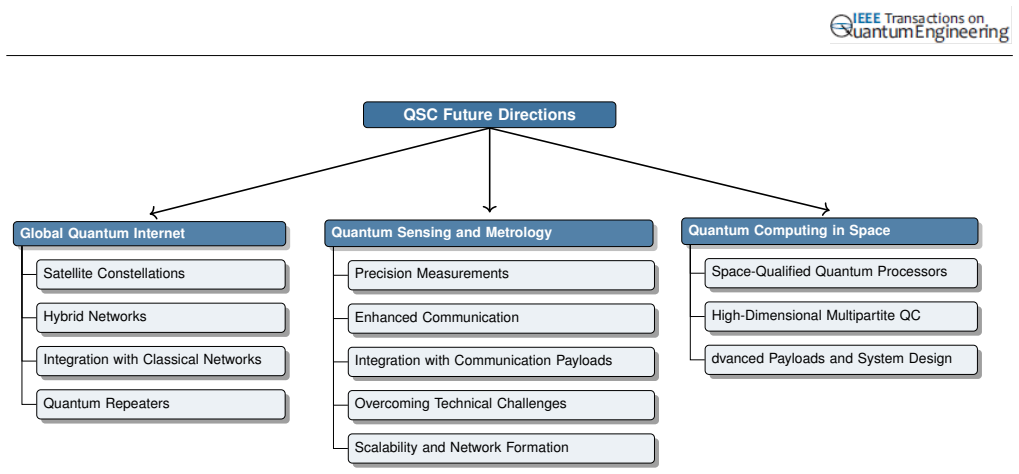
Quantum satellite communication (QSC) is emerging as a strategic technology for secure global networking and long-distance quantum connectivity. This review prioritizes the major challenges that still hinder large-scale deployment, including atmospheric loss, beam pointing and tracking, payload constraints, synchronization, scalability, and integration with terrestrial infrastructure. To contextualize these issues, we provide only a concise overview of the core concepts and enabling technologies behind QSC, together with representative milestones such as the Micius mission. Building on this background, the paper surveys recent advances in protocols, hybrid space--terrestrial architectures, turbulence mitigation, and AI-assisted optimization. It then examines future directions, including quantum Internet integration, daylight operation, satellite-supported repeaters, and space-based quantum computing. By centering the discussion on open technical bottlenecks and emerging research trajectories, this review aims to support researchers and engineers working toward practical and resilient QSC systems.
Editorial analysis
A structured set of objections, weighed in public.
Referee Report
Summary. This review paper on quantum satellite communications (QSC) prioritizes the major challenges hindering large-scale deployment, including atmospheric loss, beam pointing and tracking, payload constraints, synchronization, scalability, and integration with terrestrial infrastructure. It provides a concise overview of core concepts and enabling technologies, references representative milestones such as the Micius mission, surveys recent advances in protocols, hybrid space-terrestrial architectures, turbulence mitigation, and AI-assisted optimization, and examines future directions including quantum Internet integration, daylight operation, satellite-supported repeaters, and space-based quantum computing. The contribution is framed as a focused overview to support researchers and engineers rather than an exhaustive survey.
Significance. If the selected challenges and advances accurately reflect the current state of the field, the review could provide a useful structured resource for identifying bottlenecks and research trajectories in QSC. Its explicit non-exhaustive framing and emphasis on practical deployment issues are strengths for guiding work toward resilient systems, though its value depends on the representativeness and currency of the cited literature.
minor comments (2)
- The abstract states that the review 'prioritizes' the listed challenges; the manuscript should clarify in the introduction or a dedicated section whether this prioritization is based on a systematic literature analysis, citation frequency, or expert judgment, to strengthen the central framing.
- Section on future directions mentions 'satellite-supported repeaters' and 'space-based quantum computing' without citing specific recent proposals or feasibility studies; adding 2-3 key references would improve traceability.
Simulated Author's Rebuttal
We thank the referee for the positive and accurate summary of our review, which correctly captures our focus on deployment challenges in quantum satellite communications and our non-exhaustive framing. The recommendation for minor revision is noted, and we appreciate the recognition of the paper's potential value as a structured resource for the field.
Circularity Check
No significant circularity in this review paper
full rationale
This is a literature survey paper with no mathematical derivations, predictions, fitted parameters, or first-principles results. The central contribution is an overview of challenges (atmospheric loss, beam pointing, etc.) and a survey of existing milestones and advances, without any self-definitional loops, fitted inputs renamed as predictions, or load-bearing self-citations that reduce the claims to the paper's own inputs. All referenced content draws from external literature (e.g., Micius mission), making the paper self-contained as a review with no circularity.
Axiom & Free-Parameter Ledger
Reference graph
Works this paper leans on
-
[1]
A literature review on quantum experiments at space scale—quess satellite,
C. Koushik, S. B. Choubey, A. Choubey, and K. Pachori, “A literature review on quantum experiments at space scale—quess satellite,” Innova- tions in Electronics and Communication Engineering: Proceedings of the 8th ICIECE 2019, pp. 13–25, 2020
2019
-
[2]
Paving the way for satellite quantum communications,
J. C. Chapman and N. A. Peters, “Paving the way for satellite quantum communications,” Physics, vol. 15, p. 172, 2022
2022
-
[3]
Advances in space quantum communications,
J. S. Sidhu, S. K. Joshi, M. Gündo ˘gan, T. Brougham, D. Lowndes, L. Mazzarella, M. Krutzik, S. Mohapatra, D. Dequal, G. Vallone et al., “Advances in space quantum communications,” IET Quantum Commu- nication, vol. 2, no. 4, pp. 182–217, 2021
2021
-
[5]
Appli- cation and development of qkd-based quantum secure communication,
J. Lai, F. Yao, J. Wang, M. Zhang, F. Li, W. Zhao, and H. Zhang, “Appli- cation and development of qkd-based quantum secure communication,” Entropy, vol. 25, no. 4, p. 627, 2023
2023
-
[6]
Quantum key distribution over double-layer quantum satellite net- works,
D. Huang, Y . Zhao, T. Yang, S. Rahman, X. Yu, X. He, and J. Zhang, “Quantum key distribution over double-layer quantum satellite net- works,” IEEE Access, vol. 8, pp. 16 087–16 098, 2020
2020
-
[7]
Integrating quantum and satellites: A new era of connectiv- ity,
S. Sodagari, “Integrating quantum and satellites: A new era of connectiv- ity,” IEEE Access, vol. 11, pp. 145 101–145 110, 2023
2023
-
[8]
Observation of quantum entanglement with top quarks at the atlas detector,
“Observation of quantum entanglement with top quarks at the atlas detector,” Nature, vol. 633, no. 8030, pp. 542–547, 2024
2024
-
[9]
A quick guide to quantum communication,
R. Singh and R. M. Bodile, “A quick guide to quantum communication,” arXiv preprint arXiv:2402.15707, 2024
-
[10]
Satellite-based entangle- ment distribution and quantum teleportation with continuous variables,
T. Gonzalez-Raya, S. Pirandola, and M. Sanz, “Satellite-based entangle- ment distribution and quantum teleportation with continuous variables,” Communications Physics, vol. 7, no. 1, p. 126, 2024
2024
-
[11]
Deterministic quantum state and gate teleportation between distant superconducting chips,
J. Qiu, Y . Liu, L. Hu, Y . Wu, J. Niu, L. Zhang, W. Huang, Y . Chen, J. Li, S. Liu et al., “Deterministic quantum state and gate teleportation between distant superconducting chips,” Science Bulletin, 2024
2024
-
[12]
Ground-to-satellite quantum teleportation,
J.-G. Ren, P. Xu, H.-L. Yong, L. Zhang, S.-K. Liao, J. Yin, W.-Y . Liu, W.- Q. Cai, M. Yang, L. Li et al., “Ground-to-satellite quantum teleportation,” Nature, vol. 549, no. 7670, pp. 70–73, 2017
2017
-
[13]
Satellite- based quantum network: Security and challenges over atmospheric chan- nel,
H.-f. Chou, V . N. Ha, H. Al-Hraishawi, L. M. Garces-Socarras, J. L. Gonzalez-Rios, J. C. Merlano-Duncan, and S. Chatzinotas, “Satellite- based quantum network: Security and challenges over atmospheric chan- nel,” arXiv preprint arXiv:2308.00011, 2023
-
[14]
A guide to global quantum key distribu- tion networks,
J. Wang and B. A. Huberman, “A guide to global quantum key distribu- tion networks,” ArXiv, vol. abs/2012.14396, 2020
-
[15]
Satellite-relayed global quantum communi- cation without quantum memory,
S. Goswami and S. Dhara, “Satellite-relayed global quantum communi- cation without quantum memory,” Physical Review Applied, 2023
2023
-
[16]
Performance assessment of multi-gnss ppp ambiguity resolution with leo-augmentation,
Q. Li, W. Yao, R. Tu, Y . Du, and M. Liu, “Performance assessment of multi-gnss ppp ambiguity resolution with leo-augmentation,” Remote. Sens., vol. 15, p. 2958, 2023
2023
-
[17]
A novel satellite mission concept for upper air water vapour, aerosol and cloud observations using integrated path differential absorption lidar limb sounding,
A. Hoffmann, D. Clifford, J. Aulinas, J. G. Carton, F. Deconinck, B. Esen, J. Hüsing, K. Kern, S. Kox, D. Krejci, T. Krings, S. Lohrey, P. Romano, R. Topham, and C. Weitnauer, “A novel satellite mission concept for upper air water vapour, aerosol and cloud observations using integrated path differential absorption lidar limb sounding,” Remote. Sens., vol....
2012
-
[18]
Satellite constellations for trusted node qkd networks
T. Vergoossen, S. Loarte, R. Bedington, H. Kuiper, and A. Ling, “Satellite constellations for trusted node qkd networks.” arXiv: Quantum Physics, 2019
2019
-
[19]
Micius quantum experiments in space,
C. Lu, Y . Cao, C.-Z. Peng, and J.-W. Pan, “Micius quantum experiments in space,” 2022. 20 VOLUME 4, 2016
2022
-
[20]
Satellite-relayed intercontinental quantum network
S. Liao, W. Cai, J. Handsteiner, B. Liu, J. Yin, L. Zhang, D. Rauch, M. Fink, J.-G. Ren, W. Liu, Y . Li, Q. Shen, Y . Cao, F.-Z. Li, J.-F. Wang, Y . mei Huang, L. Deng, T. Xi, L. Ma, T. Hu, L. Li, N.-L. Liu, F. Koidl, P. Wang, Y .-A. Chen, X.-B. Wang, M. A. Steindorfer, G. Kirchner, C. Lu, R. Shu, R. Ursin, T. Scheidl, C.-Z. Peng, J. Wang, A. Zeilinger, a...
2018
-
[21]
Eurasian-scale experimental satellite-based quantum key distribution with detector efficiency mismatch analysis
A. V . Khmelev, A. V . Duplinsky, R. M. Bakhshaliev, E. I. Ivchenko, L. V . Pismeniuk, V . Mayboroda, I. S. Nesterov, A. N. Chernov, A. S. Trushechkin, E. O. Kiktenko, V . L. Kurochkin, and A. K. Fedorov, “Eurasian-scale experimental satellite-based quantum key distribution with detector efficiency mismatch analysis.” Optics express, vol. 32 7, pp. 11 964...
2023
-
[22]
Towards global time distribution via satellite-based sources of entangled photons,
S. Haldar, I. Agulló, A. J. Brady, A. Lamas-Linares, W. C. Proctor, and J. E. Troupe, “Towards global time distribution via satellite-based sources of entangled photons,” Physical Review A, 2022
2022
-
[23]
Entanglement distribution in satellite-based dynamic quantum networks,
A. Chang, Y . Wan, G. Xue, and A. Sen, “Entanglement distribution in satellite-based dynamic quantum networks,” IEEE Network, vol. 38, pp. 79–86, 2023
2023
-
[24]
Satellite-terrestrial quantum networks and the global quantum internet,
A. Conti, R. Malaney, and M. Z. Win, “Satellite-terrestrial quantum networks and the global quantum internet,” IEEE Communications Mag- azine, vol. 62, pp. 34–39, 2024
2024
-
[25]
Quantum clock syn- chronization for future nasa deep space quantum links and fundamental science,
J. E. Troupe, S. Haldar, I. Agulló, and P. G. Kwiat, “Quantum clock syn- chronization for future nasa deep space quantum links and fundamental science,” 2022
2022
-
[26]
On global quantum communication networking,
I. B. Djordjevic, “On global quantum communication networking,” En- tropy, vol. 22, 2020
2020
-
[27]
Atmospheric attenuation on a satellite quan- tum system at 0.8µm,
Y . Yan, C. Pei, and H. Hu, “Atmospheric attenuation on a satellite quan- tum system at 0.8µm,” Journal of Infrared, Millimeter, and Terahertz Waves, vol. 30, pp. 302–308, 2009
2009
-
[28]
A hybrid noise approach to modelling of free-space satellite quantum communication channel for continuous-variable qkd,
M. Chakraborty, A. Mukherjee, I. Krikidis, A. Nag, and S. Chandra, “A hybrid noise approach to modelling of free-space satellite quantum communication channel for continuous-variable qkd,” IEEE Transactions on Green Communications and Networking, 2024
2024
-
[29]
Towards quan- tum communication from global navigation satellite system,
L. Calderaro, C. Agnesi, D. Dequal, F. Vedovato, M. Schiavon, A. San- tamato, V . Luceri, G. Bianco, G. Vallone, and P. Villoresi, “Towards quan- tum communication from global navigation satellite system,” Quantum Science and Technology, vol. 4, no. 1, p. 015012, 2018
2018
-
[30]
Predicting atmospheric turbulence for secure quan- tum communications in free space,
T. Jaouni, L. Scarfe, F. Bouchard, M. Krenn, K. Heshami, F. Di Colan- drea, and E. Karimi, “Predicting atmospheric turbulence for secure quan- tum communications in free space,” arXiv preprint arXiv:2406.14768, 2024
-
[31]
Cv-qkd with gaussian and non- gaussian entangled states over satellite-based channels,
N. Hosseinidehaj and R. A. Malaney, “Cv-qkd with gaussian and non- gaussian entangled states over satellite-based channels,” 2016 IEEE Global Communications Conference (GLOBECOM), pp. 1–7, 2016
2016
-
[32]
Sub-ns timing accuracy for satellite quantum communications,
C. Agnesi, L. Calderaro, D. Dequal, F. Vedovato, M. Schiavon, A. San- tamato, V . Luceri, G. Bianco, G. Vallone, and P. Villoresi, “Sub-ns timing accuracy for satellite quantum communications,” Journal of the Optical Society of America B, vol. 36, no. 3, pp. B59–B64, 2019
2019
-
[33]
Classical and quantum frequency combs for satellite-based clock synchronization,
R. Gosalia, R. Aguinaldo, J. Green, H. Leopardi, P. Brereton, and R. Malaney, “Classical and quantum frequency combs for satellite-based clock synchronization,” APL Photonics, 2024
2024
-
[34]
A quantum-assisted master clock in the sky: global synchronization from satellites at sub- nanosecond precision,
S. Ducoing, I. Agullo, J. E. Troupe, and S. Haldar, “A quantum-assisted master clock in the sky: global synchronization from satellites at sub- nanosecond precision,” 2023
2023
-
[35]
Clock synchro- nization with correlated photons,
C. Spiess, S. Töpfer, S. Sharma, A. Krži ˇc, M. Cabrejo-Ponce, U. Chan- drashekara, N. Döll, D. Rieländer, and F. Steinlechner, “Clock synchro- nization with correlated photons,” Physical Review Applied, 2021
2021
-
[36]
Timing and synchronisation for high-loss free-space quantum communication with hybrid de bruijn codes,
P. Zhang, D. K. L. Oi, D. Lowndes, and J. G. Rarity, “Timing and synchronisation for high-loss free-space quantum communication with hybrid de bruijn codes,” IET Quantum Commun., vol. 2, pp. 80–89, 2021
2021
-
[37]
Satellite quantum communications: Fundamental bounds and practical security,
S. Pirandola, “Satellite quantum communications: Fundamental bounds and practical security,” Physical Review Research, vol. 3, no. 2, p. 023130, 2021
2021
-
[38]
Reference-frame- independent quantum key distribution,
A. Laing, V . Scarani, J. G. Rarity, and J. L. O’Brien, “Reference-frame- independent quantum key distribution,” Physical Review A—Atomic, Molecular, and Optical Physics, vol. 82, no. 1, p. 012304, 2010
2010
-
[39]
Practical polarization- frame alignment for quantum key distribution with single-photon-level resources,
B. L. Higgins, J.-P. Bourgoin, and T. Jennewein, “Practical polarization- frame alignment for quantum key distribution with single-photon-level resources,” arXiv e-prints, pp. arXiv–1810, 2018
2018
-
[40]
Quantum entanglement and measurement noise: A novel approach to satellite node authentication,
P. Madani and C. McGregor, “Quantum entanglement and measurement noise: A novel approach to satellite node authentication,” in AIAA SCITECH 2025 Forum, 2025, p. 2725
2025
-
[41]
K. M. Kareem, “Cyber threat landscape analysis for starlink assessing risks and mitigation strategies in the global satellite internet infrastruc- ture,” ArXiv, vol. abs/2406.07562, 2024
-
[42]
Broadband non- geostationary satellite communication systems: Research challenges and key opportunities,
H. Al-Hraishawi, S. Chatzinotas, and B. E. Ottersten, “Broadband non- geostationary satellite communication systems: Research challenges and key opportunities,” 2021 IEEE International Conference on Communica- tions Workshops (ICC Workshops), pp. 1–6, 2021
2021
-
[43]
Combined quantum and post-quantum security for earth-satellite channels,
A. Rani, X. Ai, A. Gupta, R. S. Adhikari, and R. Malaney, “Combined quantum and post-quantum security for earth-satellite channels,” 2025
2025
-
[44]
Assessment of practical satellite quantum key distribution architectures for current and near-future missions,
D. Orsucci, P. Kleinpaß, J. Meister, I. De Marco, S. Häusler, T. Strang, N. Walenta, and F. Moll, “Assessment of practical satellite quantum key distribution architectures for current and near-future missions,” Interna- tional Journal of Satellite Communications and Networking, 2024
2024
-
[45]
From connectivity to advanced internet services: A comprehensive re- view of small satellites communications and networks,
S. C. Burleigh, T. de Cola, S. Morosi, S. Jayousi, E. Cianca, and C. Fuchs, “From connectivity to advanced internet services: A comprehensive re- view of small satellites communications and networks,” Wirel. Commun. Mob. Comput., vol. 2019, pp. 6 243 505:1–6 243 505:17, 2019
2019
-
[46]
Vulnerability of satel- lite quantum key distribution to disruption from ground-based lasers,
D. R. Gozzard, S. M. Walsh, and T. J. Weinhold, “Vulnerability of satel- lite quantum key distribution to disruption from ground-based lasers,” Sensors (Basel, Switzerland), vol. 21, 2021
2021
-
[47]
Proposal for space-borne quantum memories for global quantum networking,
M. Gündo ˘gan, J. S. Sidhu, V . Henderson, L. Mazzarella, J. Wolters, D. K. Oi, and M. Krutzik, “Proposal for space-borne quantum memories for global quantum networking,” npj Quantum Information, vol. 7, no. 1, p. 128, 2021
2021
-
[48]
Time-delayed sin- gle satellite quantum repeater node for global quantum communications,
M. Gündo ˇgan, J. S. Sidhu, M. Krutzik, and D. K. Oi, “Time-delayed sin- gle satellite quantum repeater node for global quantum communications,” Optica Quantum, vol. 2, no. 3, pp. 140–147, 2024
2024
-
[49]
Quantum error correction for quantum memories,
B. M. Terhal, “Quantum error correction for quantum memories,” Re- views of Modern Physics, vol. 87, no. 2, pp. 307–346, 2015
2015
-
[50]
High-threshold and low-overhead fault-tolerant quantum memory,
S. Bravyi, A. W. Cross, J. M. Gambetta, D. Maslov, P. Rall, and T. J. Yo- der, “High-threshold and low-overhead fault-tolerant quantum memory,” Nature, vol. 627, no. 8005, pp. 778–782, 2024
2024
-
[51]
Quantum error correction of spin quantum memories in diamond under a zero magnetic field,
T. Nakazato, R. Reyes, N. Imaike, K. Matsuda, K. Tsurumoto, Y . Sekiguchi, and H. Kosaka, “Quantum error correction of spin quantum memories in diamond under a zero magnetic field,” Communications Physics, vol. 5, no. 1, p. 102, 2022
2022
-
[52]
Optical quantum memory and its applications in quantum communication systems,
L. Ma, O. Slattery, and X. Tang, “Optical quantum memory and its applications in quantum communication systems,” Journal of research of the National Institute of Standards and Technology, vol. 125, p. 125002, 2020
2020
-
[53]
Deployment strategies for the global coverage of quantum key distribution network,
J. Wang and B. A. Huberman, “Deployment strategies for the global coverage of quantum key distribution network,” Revista Abierta de Informática Aplicada, 2022
2022
-
[54]
Satellite-based quantum communications,
R. J. Hughes, J. E. Nordholt, K. P. McCabe, R. T. Newell, and C. G. Pe- terson, “Satellite-based quantum communications,” Los Alamos National Laboratory (LANL), Los Alamos, NM (United States), Tech. Rep., 2010
2010
-
[55]
Dynamic beam coverage for satellite communications aided by movable-antenna array,
L. Zhu, X. song Pi, W. Ma, Z. Xiao, and R. Zhang, “Dynamic beam coverage for satellite communications aided by movable-antenna array,” ArXiv, vol. abs/2404.15643, 2024
-
[56]
Polarization tracking for quantum satellite communications,
G. Wang, D. Shen, G. Chen, K. Pham, and E. Blasch, “Polarization tracking for quantum satellite communications,” in Sensors and Systems for Space Applications VII, vol. 9085. SPIE, 2014, pp. 200–207
2014
-
[57]
Polarization-basis tracking scheme in satellite quantum key distribution,
M. Toyoshima, H. Takenaka, Y . Shoji, Y . Takayama, M. Takeoka, M. Fu- jiwara, and M. Sasaki, “Polarization-basis tracking scheme in satellite quantum key distribution,” International Journal of Optics, vol. 2011, pp. 1–8, 2011
2011
-
[58]
Polarization correction towards satellite-based qkd without an active feedback,
S. Chatterjee, K. Goswami, R. Chatterjee, and U. Sinha, “Polarization correction towards satellite-based qkd without an active feedback,” 2022
2022
-
[59]
Design and test of optical payload for polarization encoded qkd for nanosatellites,
J. Sagar, E. Hastings, P. Zhang, M. Stefko, D. Lowndes, D. K. L. Oi, J. G. Rarity, and S. K. Joshi, “Design and test of optical payload for polarization encoded qkd for nanosatellites,” in Photonex, 2022
2022
-
[60]
Optical payload design for downlink quantum key distribution and keyless communication using cubesats,
P. Mendes, G. Teixeira, D. Pinho, R. Rocha, P. Andr’e, M. Niehus, R. Faleiro, D. Rusca, and E. Z. Cruzeiro, “Optical payload design for downlink quantum key distribution and keyless communication using cubesats,” EPJ Quantum Technology, 2023
2023
-
[61]
Leo small satellite qkd downlink perfor- mance: Quantsat-pt case study,
V . Galetsky and M. Niehus, “Leo small satellite qkd downlink perfor- mance: Quantsat-pt case study,” 2022
2022
-
[62]
Microsatellite-based real-time quantum key distribution,
Y . Li, W. Cai, J.-G. Ren, C. Wang, M. Yang, L. Zhang, H.-Y . Wu, L. Chang, J. Wu, B. Jin, H.-J. Xue, X.-J. Li, H. Liu, G.-W. Yu, X. Tao, T. Chen, C. Liu, W. Luo, J. Zhou, H.-L. Yong, Y . Li, F.-Z. Li, C. Jiang, H. Chen, C. Wu, X. Tong, S. Xie, F. Zhou, W. Liu, N.-L. Liu, L. Li, F. Xu, Y . Cao, J. Yin, R. Shu, X. Wang, Q. Zhang, J.-Y . Wang, S. Liao, C. P...
2024
-
[63]
End-to-end demonstration for cubesatellite quantum key distribution,
P. Zhang, J. Sagar, E. Hastings, M. Stefko, S. Joshi, and J. G. Rarity, “End-to-end demonstration for cubesatellite quantum key distribution,” IET Quantum Commun., vol. 5, pp. 291–302, 2023
2023
-
[64]
Design and test of optical payload for polarization encoded qkd for nanosatellites,
J. Sagar, E. Hastings, P. Zhang, M. Stefko, D. Lowndes, D. Oi, J. Rarity, and S. K. Joshi, “Design and test of optical payload for polarization encoded qkd for nanosatellites,” in Quantum Technology: Driving Com- mercialisation of an Enabling Science III, vol. 12335. SPIE, 2023, pp. 64–70
2023
-
[65]
Microsatellite-based real-time quantum key distribution,
Y . Li, W.-Q. Cai, J.-G. Ren, C.-Z. Wang, M. Yang, L. Zhang, H.-Y . Wu, L. Chang, J.-C. Wu, B. Jin et al., “Microsatellite-based real-time quantum key distribution,” Nature, pp. 1–8, 2025
2025
-
[66]
Quarc: Quantum research cubesat—a constellation for quantum communica- tion,
L. Mazzarella, C. Lowe, D. Lowndes, S. K. Joshi, S. Greenland, D. Mc- Neil, C. Mercury, M. Macdonald, J. Rarity, and D. K. L. Oi, “Quarc: Quantum research cubesat—a constellation for quantum communica- tion,” Cryptography, vol. 4, no. 1, p. 7, 2020
2020
-
[67]
Optical payload design for downlink quantum key distribution and keyless communication using cubesats,
P. N. Mendes, G. L. Teixeira, D. Pinho, R. Rocha, P. André, M. Niehus, R. Faleiro, D. Rusca, and E. Z. Cruzeiro, “Optical payload design for downlink quantum key distribution and keyless communication using cubesats,” EPJ Quantum Technology, vol. 11, no. 1, p. 48, 2024
2024
-
[68]
Towards quantum communications with satellites,
T. Jennewein, “Towards quantum communications with satellites,” in 2018 IEEE photonics society summer topical meeting series (SUM). IEEE, 2018, pp. 217–218
2018
-
[69]
Quantum key distribution networks: Challenges and future research issues in security,
C. Tsai, C.-W. Yang, J. Lin, Y .-C. Chang, and R. S. Chang, “Quantum key distribution networks: Challenges and future research issues in security,” Applied Sciences, vol. 11, p. 3767, 2021
2021
-
[70]
Q3sat: quantum communications uplink to a 3u cube- sat—feasibility & design,
S. P. Neumann, S. K. Joshi, M. Fink, T. Scheidl, R. Blach, C. A. Scharlemann, S. Abouagaga, D. Bambery, E. Kerstel, M. Barthélémy, and R. Ursin, “Q3sat: quantum communications uplink to a 3u cube- sat—feasibility & design,” EPJ Quantum Technology, vol. 5, 2017
2017
-
[71]
Measurement- device-independent quantum secure direct communication,
Z. Zhou, Y . Sheng, P. Niu, L. Yin, G. Long, and L. Hanzo, “Measurement- device-independent quantum secure direct communication,” Science China Physics, Mechanics & Astronomy, vol. 63, no. 3, p. 230362, 2020
2020
-
[72]
Measurement-device- independent quantum secure direct communication based on quantum cover channel and multiple degrees of freedom of hyperentanglement,
T.-J. Pan, R.-G. Zhou, and X.-X. Zhang, “Measurement-device- independent quantum secure direct communication based on quantum cover channel and multiple degrees of freedom of hyperentanglement,” Physica Scripta, vol. 100, no. 2, p. 025114, 2025
2025
-
[73]
One- photon-interference quantum secure direct communication,
X.-J. Li, M. Wang, X.-B. Pan, Y .-R. Zhang, and G.-L. Long, “One- photon-interference quantum secure direct communication,” Entropy, vol. 26, no. 9, p. 811, 2024
2024
-
[74]
Quantum secure direct communication based on quantum error correc- tion code,
C.-W. Ding, W.-Y . Wang, W.-D. Zhang, L. Zhou, and Y .-B. Sheng, “Quantum secure direct communication based on quantum error correc- tion code,” Applied Physics Letters, vol. 126, no. 2, 2025
2025
-
[75]
Four-party quantum secure direct communication based on hyperentangled bell states,
R. Guo, R.-G. Zhou, and X.-X. Zhang, “Four-party quantum secure direct communication based on hyperentangled bell states,” Modern Physics Letters B, vol. 38, no. 32, p. 2450311, 2024
2024
-
[76]
Quantum secure direct communication scheme with identity authentication br,
X.-T. Zhou and Y .-H. Jiang, “Quantum secure direct communication scheme with identity authentication br,” Acta Physica Sinica, vol. 72, no. 2, 2023
2023
-
[77]
Free-space quantum secure direct communication: Basics, progress, and outlook,
D. Pan, X.-T. Song, and G.-L. Long, “Free-space quantum secure direct communication: Basics, progress, and outlook,” Advanced Devices & Instrumentation, vol. 4, p. 0004, 2023
2023
-
[78]
Quasi-quantum secure direct communication scheme using non-maximally entangled states,
S. Vijayaraj, S. Balakrishnan, and K. Senthilnathan, “Quasi-quantum secure direct communication scheme using non-maximally entangled states,” ArXiv, vol. abs/1912.03498, 2019
-
[79]
Bidirectional quantum secure direct com- munication using dense coding of four qubit cluster states,
S. Chauhan and N. Gupta, “Bidirectional quantum secure direct com- munication using dense coding of four qubit cluster states,” Journal of Scientific Research, 2022
2022
-
[80]
Continuous variable direct secure quantum communication using gaussian states,
S. Srikara, K. Thapliyal, and A. Pathak, “Continuous variable direct secure quantum communication using gaussian states,” Quantum Infor- mation Processing, vol. 19, 2019
2019
-
[81]
Quan- tum direct communication with mutual authentication,
C.-A. Yen, S.-J. Horng, H.-S. Goan, T.-W. Kao, and Y .-H. Chou, “Quan- tum direct communication with mutual authentication,” Quantum Inf. Comput., vol. 9, pp. 376–394, 2009
2009
discussion (0)
Sign in with ORCID, Apple, or X to comment. Anyone can read and Pith papers without signing in.