Recognition: unknown
Structural MAT: Clean and Scalable Medial Axis Simplification via Explicit Surface Correspondence
Pith reviewed 2026-05-08 02:05 UTC · model grok-4.3
The pith
Explicit tracking of surface correspondences during MAT simplification produces structurally aligned medial axes for triangle meshes.
A machine-rendered reading of the paper's core claim, the machinery that carries it, and where it could break.
Core claim
The central claim is that explicitly tracking the correspondence between MAT vertices and surface regions throughout the progressive simplification process ensures that the resulting MAT triangles accurately reflect the intrinsic symmetries between surface patches. These geometric requirements are translated into priority control strategies that govern the sequencing of edge collapses on an initial 3D Voronoi structure. The outcome is a scalable MAT that remains highly expressive for articulated shapes and CAD models, capturing global structure with only a few hundred vertices while aligning with rolling-ball loci in fillet regions.
What carries the argument
explicit tracking of the correspondence between MAT vertices and surface regions, used to derive priority control strategies that sequence edge collapses in a QEM-like simplification of the Voronoi-initialized MAT
Load-bearing premise
The initial 3D Voronoi diagram of surface samples combined with the proposed priority control strategies will consistently produce MATs that align with rolling-ball loci in fillet regions without introducing topological errors on arbitrary triangle meshes.
What would settle it
Finding a triangle mesh on which the output MAT either fails to align its boundary with the locus of rolling ball centers in a fillet region or introduces a topological error such as incorrect connectivity would falsify the central claim.
Figures




read the original abstract
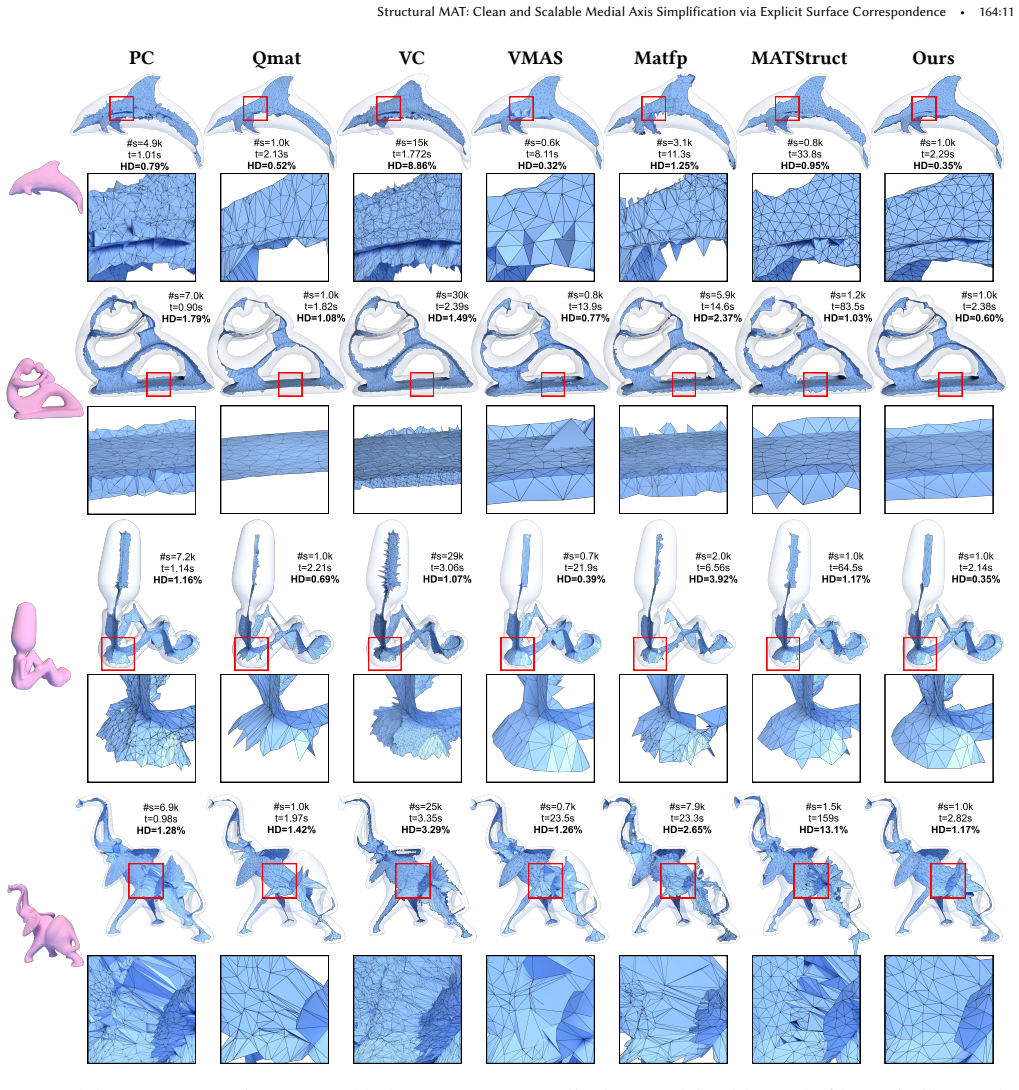
The Medial Axis Transform (MAT) is a complete shape descriptor capable of reconstructing the geometry of the original domain. A high-quality MAT should not only facilitate high-fidelity reconstruction but also capture structural features -- for instance, by aligning the MAT boundary with the locus of rolling ball centers within fillet regions. However, computing such an ideal MAT remains a significant challenge, particularly when the input is a discrete triangle mesh. In this paper, we follow the established technical pipeline of initializing the MAT via a 3D Voronoi diagram of surface samples and subsequently simplifying the Voronoi structure through a QEM-like scheme. Our key insight is to explicitly track the correspondence between MAT vertices and surface regions throughout the progressive simplification process, ensuring that the resulting MAT triangles accurately reflect the intrinsic symmetries between surface patches. We translate these geometric requirements into a suite of priority control strategies that govern the sequencing of edge collapses. Through extensive evaluation against state-of-the-art MAT algorithms, we validate the strong performance of our approach regarding runtime efficiency, structural alignment, boundary regularity, triangle quality, and robustness to noise. Our resulting MATs remain highly expressive for both articulated shapes and CAD models, even under extreme simplification -- effectively capturing the global structure of complex geometries with only a few hundred vertices.
Editorial analysis
A structured set of objections, weighed in public.
Referee Report
Summary. The paper introduces Structural MAT, a method for clean and scalable simplification of the medial axis transform (MAT) from triangle meshes. It builds on the standard pipeline of computing a 3D Voronoi diagram from surface samples and then simplifying it via QEM-like edge collapses. The novel aspect is the explicit tracking of correspondences between MAT vertices and surface regions during simplification, which is used to define priority control strategies. These strategies aim to ensure that the resulting simplified MAT triangles align with intrinsic surface symmetries and the loci of rolling ball centers in fillet regions. Extensive experiments demonstrate advantages in runtime, structural alignment, boundary regularity, triangle quality, and robustness to noise, with the simplified MATs remaining effective for both articulated and CAD models even at high simplification ratios.
Significance. If the central claims hold, this provides a practical method for producing structurally faithful simplified MATs from discrete meshes, which could support downstream tasks in shape analysis, skeleton extraction, and geometric modeling. The explicit use of surface correspondence to guide simplification is a clear strength over purely geometric or heuristic approaches, and the reported evaluations across runtime, alignment, and robustness add concrete evidence of utility. The approach is algorithmic rather than data-driven, with priorities derived from geometric requirements.
major comments (1)
- [§3.2] §3.2 (Initial Voronoi Construction and Correspondence Tracking): The central claim that explicit MAT-to-surface-region correspondence tracking during QEM-style collapses ensures alignment with rolling-ball loci and intrinsic patch symmetries rests on the assumption that the initial 3D Voronoi diagram of surface samples is already topologically close to the true medial axis. The description does not specify a mechanism (e.g., edge insertion, deletion, or reconnection) by which erroneous Voronoi connections between non-adjacent surface regions are corrected rather than merely reordered; if only reordering occurs, topological errors can propagate and undermine the alignment guarantee on non-convex or noisy inputs.
minor comments (4)
- [Abstract] Abstract: The phrase 'extensive evaluation' would benefit from a brief parenthetical note on the number of models and categories tested to set expectations for the results section.
- [§5.1] §5.1 (Evaluation Metrics): The structural alignment metric is presented without an equation or pseudocode definition; adding this would make the quantitative claims easier to reproduce and compare.
- [Figure 4] Figure 4 caption: The color mapping for MAT triangles versus surface patches is not explained in the caption or legend, reducing clarity for readers examining the visual results.
- [References] References: Several foundational works on medial axis extraction from meshes (pre-2020) are cited, but the list would be strengthened by including more recent Voronoi-based simplification papers from 2021-2023.
Simulated Author's Rebuttal
We are grateful to the referee for their constructive feedback and for recognizing the strengths of our approach. We provide a detailed response to the major comment below.
read point-by-point responses
-
Referee: [§3.2] §3.2 (Initial Voronoi Construction and Correspondence Tracking): The central claim that explicit MAT-to-surface-region correspondence tracking during QEM-style collapses ensures alignment with rolling-ball loci and intrinsic patch symmetries rests on the assumption that the initial 3D Voronoi diagram of surface samples is already topologically close to the true medial axis. The description does not specify a mechanism (e.g., edge insertion, deletion, or reconnection) by which erroneous Voronoi connections between non-adjacent surface regions are corrected rather than merely reordered; if only reordering occurs, topological errors can propagate and undermine the alignment guarantee on non-convex or noisy inputs.
Authors: We appreciate the referee pointing out this subtlety in our description. Our approach follows the standard pipeline of computing an initial 3D Voronoi diagram from surface samples, which we assume to be sufficiently dense to approximate the medial axis topology reasonably well. The explicit surface correspondence tracking is introduced to define priority functions for the QEM-style edge collapses, aiming to preserve alignments with surface symmetries and rolling ball loci during simplification. However, as the referee correctly notes, we do not provide mechanisms such as edge insertion, deletion, or reconnection to correct erroneous Voronoi connections between non-adjacent regions. The process primarily reorders the collapses based on our priority strategies. We acknowledge that on inputs with significant topological errors in the initial Voronoi (e.g., highly non-convex or extremely noisy meshes), these errors may persist or affect the final result. To address this, we will revise §3.2 to explicitly articulate the reliance on the quality of the initial Voronoi diagram and include a brief discussion of this limitation, along with suggestions for future work on topology correction. revision: yes
Circularity Check
No circularity: algorithmic pipeline with independent geometric priorities
full rationale
The paper describes an algorithmic procedure: initialize MAT from 3D Voronoi diagram of surface samples, then simplify via QEM-like edge collapses while tracking explicit MAT-to-surface-region correspondences to derive priority strategies. No equations, fitted parameters, or self-referential definitions appear in the provided text; the priorities are stated as translations of geometric requirements (symmetries, rolling-ball loci) rather than outputs of the method itself. The initial Voronoi step is an external input, not derived from the simplification result. No self-citation chains or uniqueness theorems are invoked as load-bearing. The derivation chain remains self-contained against external geometric benchmarks.
Axiom & Free-Parameter Ledger
Reference graph
Works this paper leans on
-
[1]
Patricia S. Abril and Robert Plant. The patent holder's dilemma: Buy, sell, or troll?. Communications of the ACM. 2007. doi:10.1145/1188913.1188915
-
[2]
Deciding equivalances among conjunctive aggregate queries
Sarah Cohen and Werner Nutt and Yehoshua Sagic. Deciding equivalances among conjunctive aggregate queries. doi:10.1145/1219092.1219093
-
[3]
Special issue: Digital Libraries. 1996
1996
-
[4]
Understanding Policy-Based Networking
David Kosiur. Understanding Policy-Based Networking. 2001
2001
-
[7]
The title of book two. 2008. doi:10.1007/3-540-09237-4
-
[8]
Asad Z. Spector. Achieving application requirements. Distributed Systems. 1990. doi:10.1145/90417.90738
-
[9]
Douglass and David Harel and Mark B
Bruce P. Douglass and David Harel and Mark B. Trakhtenbrot. Statecarts in use: structured analysis and object-orientation. Lectures on Embedded Systems. 1998. doi:10.1007/3-540-65193-4_29
-
[10]
Donald E. Knuth. The Art of Computer Programming, Vol. 1: Fundamental Algorithms (3rd. ed.). 1997
1997
-
[11]
Donald E. Knuth. The Art of Computer Programming. 1998
1998
-
[12]
Structured Variational Inference Procedures and their Realizations (as incol)
Dan Geiger and Christopher Meek. Structured Variational Inference Procedures and their Realizations (as incol). Proceedings of Tenth International Workshop on Artificial Intelligence and Statistics, The Barbados
-
[13]
Stan W. Smith. An experiment in bibliographic mark-up: Parsing metadata for XML export. Proceedings of the 3rd. annual workshop on Librarians and Computers. 2010. doi:99.9999/woot07-S422
2010
-
[14]
Catch me, if you can: Evading network signatures with web-based polymorphic worms
Matthew Van Gundy and Davide Balzarotti and Giovanni Vigna. Catch me, if you can: Evading network signatures with web-based polymorphic worms. Proceedings of the first USENIX workshop on Offensive Technologies
-
[15]
Sten Andler. Predicate Path expressions. Proceedings of the 6th. ACM SIGACT-SIGPLAN symposium on Principles of Programming Languages. 1979. doi:10.1145/567752.567774
-
[16]
LOGICS of Programs: AXIOMATICS and DESCRIPTIVE POWER
David Harel. LOGICS of Programs: AXIOMATICS and DESCRIPTIVE POWER. 1978
1978
-
[17]
Anisi , title =
David A. Anisi , title =
-
[18]
Clarkson
Kenneth L. Clarkson. Algorithms for Closest-Point Problems (Computational Geometry). 1985
1985
-
[19]
Introduction to Bayesian Statistics
Harry Thornburg. Introduction to Bayesian Statistics. 2001
2001
-
[20]
CLIFFORD: a Maple 11 Package for Clifford Algebra Computations, version 11
Rafal Ablamowicz and Bertfried Fauser. CLIFFORD: a Maple 11 Package for Clifford Algebra Computations, version 11. 2007
2007
-
[21]
Stats and Analysis
Poker-Edge.Com. Stats and Analysis. 2006
2006
-
[22]
A more perfect union
Barack Obama. A more perfect union. 2008
2008
-
[23]
The fountain of youth
Joseph Scientist. The fountain of youth. 2009
2009
-
[24]
Solder man
Dave Novak. Solder man. ACM SIGGRAPH 2003 Video Review on Animation theater Program: Part I - Vol. 145 (July 27--27, 2003). 2003. doi:99.9999/woot07-S422
2003
-
[25]
Interview with Bill Kinder: January 13, 2005
Newton Lee. Interview with Bill Kinder: January 13, 2005. Comput. Entertain. 2005. doi:10.1145/1057270.1057278
-
[26]
The Enabling of Digital Libraries
Bernard Rous. The Enabling of Digital Libraries. Digital Libraries. 2008
2008
-
[28]
(new) Finding minimum congestion spanning trees , journal =
Werneck, Renato and Setubal, Jo\. (new) Finding minimum congestion spanning trees , journal =. doi:10.1145/351827.384253 , acmid = 384253, publisher =
-
[30]
Conti, Mauro and Di Pietro, Roberto and Mancini, Luigi V. and Mei, Alessandro , title =. Inf. Fusion , volume =. 2009 , issn =. doi:10.1016/j.inffus.2009.01.002 , acmid =
-
[31]
Li, Cheng-Lun and Buyuktur, Ayse G. and Hutchful, David K. and Sant, Natasha B. and Nainwal, Satyendra K. , title =. CHI '08 extended abstracts on Human factors in computing systems , year =. doi:10.1145/1358628.1358946 , acmid =
-
[32]
, title =
Hollis, Billy S. , title =. 1999 , isbn =
1999
-
[33]
Goossens, Michel and Rahtz, S. P. and Moore, Ross and Sutor, Robert S. , title =. 1999 , isbn =
1999
-
[34]
and Rosenberg, Arnold L
Buss, Jonathan F. and Rosenberg, Arnold L. and Knott, Judson D. , title =. 1987 , source =
1987
-
[35]
CHI '08: CHI '08 extended abstracts on Human factors in computing systems , year =
, note =. CHI '08: CHI '08 extended abstracts on Human factors in computing systems , year =
-
[36]
Algorithms for Closest-Point Problems (Computational Geometry) , year =
Clarkson, Kenneth Lee , advisor =. Algorithms for Closest-Point Problems (Computational Geometry) , year =
-
[37]
SIGCOMM Comput. Commun. Rev. , year =
-
[38]
IEEE TCSC Executive Committee , booktitle =. 2004 , isbn =. doi:http://dx.doi.org/10.1109/ICWS.2004.64 , acmid =
-
[39]
Distributed systems (2nd Ed.) , year =
-
[40]
, title =
Petrie, Charles J. , title =. 1986 , source =
1986
-
[41]
Donald E. Knuth. Seminumerical Algorithms. 1981
1981
-
[42]
E-commerce and cultural values , year =
Kong, Wei-Chang , Title =. E-commerce and cultural values , year =
-
[43]
E-commerce and cultural values , year =
Kong, Wei-Chang , type =. E-commerce and cultural values , year =
-
[44]
Chapter 9 , booktitle =
Kong, Wei-Chang , editor =. Chapter 9 , booktitle =. 2002 , address =
2002
-
[45]
E-commerce and cultural values , editor =
Kong, Wei-Chang , title =. E-commerce and cultural values , editor =. 2003 , isbn =
2003
-
[46]
E-commerce and cultural values - (InBook-num-in-chap) , chapter =
Kong, Wei-Chang , editor =. E-commerce and cultural values - (InBook-num-in-chap) , chapter =. 2004 , address =
2004
-
[47]
E-commerce and cultural values (Inbook-text-in-chap) , chapter =
Kong, Wei-Chang , editor =. E-commerce and cultural values (Inbook-text-in-chap) , chapter =. 2005 , address =
2005
-
[48]
E-commerce and cultural values (Inbook-num chap) , chapter =
Kong, Wei-Chang , editor =. E-commerce and cultural values (Inbook-num chap) , chapter =. 2006 , address =
2006
-
[49]
Microelectron
Mehdi Saeedi and Morteza Saheb Zamani and Mehdi Sedighi , title =. Microelectron. J. , volume =. 2010 , pages =
2010
-
[50]
Mehdi Saeedi and Morteza Saheb Zamani and Mehdi Sedighi and Zahra Sasanian , title =. J. Emerg. Technol. Comput. Syst. , volume =
-
[51]
Kirschmer, Markus and Voight, John , title =. SIAM J. Comput. , issue_date =. 2010 , issn =. doi:https://doi.org/10.1137/080734467 , acmid =
-
[52]
Hoare, C. A. R. , title =. Structured programming (incoll) , editor =. 1972 , isbn =
1972
-
[53]
History of programming languages I (incoll) , editor =
Lee, Jan , title =. History of programming languages I (incoll) , editor =. 1981 , isbn =. doi:http://doi.acm.org/10.1145/800025.1198348 , acmid =
-
[54]
, title =
Dijkstra, E. , title =. Classics in software engineering (incoll) , year =
-
[55]
Wenzel, Elizabeth M. , title =. Multimedia interface design (incoll) , year =. doi:10.1145/146022.146089 , acmid =
-
[56]
, title =
Mumford, E. , title =. Critical issues in information systems research (incoll) , year =
-
[57]
and Golden, Donald G
McCracken, Daniel D. and Golden, Donald G. , title =. 1990 , isbn =
1990
-
[58]
The analysis of linear partial differential operators
H. The analysis of linear partial differential operators. 1985 , PAGES =
1985
-
[59]
IEEE", address =
A. Adya and P. Bahl and J. Padhye and A.Wolman and L. Zhou , title =. Proceedings of the IEEE 1st International Conference on Broadnets Networks (BroadNets'04) , publisher = "IEEE", address = "Los Alamitos, CA", year =
-
[60]
I. F. Akyildiz and W. Su and Y. Sankarasubramaniam and E. Cayirci , title =. Comm. ACM , volume = 38, number = "4", year =
-
[61]
I. F. Akyildiz and T. Melodia and K. R. Chowdhury , title =. Computer Netw. , volume = 51, number = "4", year =
-
[62]
ACM", address =
P. Bahl and R. Chancre and J. Dungeon , title =. Proceeding of the 10th International Conference on Mobile Computing and Networking (MobiCom'04) , publisher = "ACM", address = "New York, NY", year =
-
[63]
8 (Special Issue on Sensor Networks)
D. Culler and D. Estrin and M. Srivastava , title =. IEEE Comput. , volume = 37, number = "8 (Special Issue on Sensor Networks)", publisher = "IEEE", address = "Los Alamitos, CA", year =
-
[64]
Natarajan and M
A. Natarajan and M. Motani and B. de Silva and K. Yap and K. C. Chua , title =. Network Architectures , editor =. 960935712
-
[65]
Tzamaloukas and J
A. Tzamaloukas and J. J. Garcia-Luna-Aceves , title =
-
[66]
Zhou and J
G. Zhou and J. Lu and C.-Y. Wan and M. D. Yarvis and J. A. Stankovic , title =
-
[67]
Mapping Powerlists onto Hypercubes
Jacob Kornerup. Mapping Powerlists onto Hypercubes. 1994
1994
-
[68]
Automatic Parallelization for Distributed-Memory Multiprocessing Systems
Michael Gerndt. Automatic Parallelization for Distributed-Memory Multiprocessing Systems
-
[69]
J. E. Archer, Jr. and R. Conway and F. B. Schneider. User recovery and reversal in interactive systems. ACM Trans. Program. Lang. Syst
-
[70]
D. D. Dunlop and V. R. Basili. Generalizing specifications for uniformly implemented loops. ACM Trans. Program. Lang. Syst
-
[71]
Heering and P
J. Heering and P. Klint. Towards monolingual programming environments. ACM Trans. Program. Lang. Syst
-
[72]
Donald E. Knuth. The book
-
[73]
Korach and D
E. Korach and D. Rotem and N. Santoro. Distributed algorithms for finding centers and medians in networks. ACM Trans. Program. Lang. Syst
-
[74]
: A Document Preparation System
Leslie Lamport. : A Document Preparation System
-
[75]
F. Nielson. Program transformations in a denotational setting. ACM Trans. Program. Lang. Syst
-
[76]
Brian K. Reid. A high-level approach to computer document formatting. Proceedings of the 7th Annual Symposium on Principles of Programming Languages
-
[77]
Zhou, Gang and Wu, Yafeng and Yan, Ting and He, Tian and Huang, Chengdu and Stankovic, John A. and Abdelzaher, Tarek F. , title =. ACM Trans. Embed. Comput. Syst. , issue_date =. doi:10.1145/1721695.1721705 , acmid = 1721705, publisher =
-
[78]
Institutional members of the Users Group
-
[79]
Boris Veytsman , title =
-
[80]
Robin Schneider , title =
-
[81]
and Peterson, Larry L
Bowman, Mic and Debray, Saumya K. and Peterson, Larry L. , title =. ACM Trans. Program. Lang. Syst. , volume =. 1993 , doi =
1993
-
[82]
TUGboat , volume =
Braams, Johannes , title =. TUGboat , volume =
-
[83]
Post Congress Tristesse
Malcolm Clark. Post Congress Tristesse. TeX90 Conference Proceedings
-
[84]
ACM Trans
Herlihy, Maurice , title =. ACM Trans. Program. Lang. Syst. , volume =. 1993 , doi =
1993
discussion (0)
Sign in with ORCID, Apple, or X to comment. Anyone can read and Pith papers without signing in.