Risk-Based PV-Rich Distribution System Planning Using Generative AI
Pith reviewed 2026-05-12 01:07 UTC · model grok-4.3
The pith
Risk-based assessment using generative AI raises PV hosting capacity by accepting limited voltage violation risks.
A machine-rendered reading of the paper's core claim, the machinery that carries it, and where it could break.
Core claim
By generating time-correlated load-demand scenarios conditioned on projected growth and then scoring voltage violations with probabilistic intensity-duration-frequency metrics, the method shows that zero-risk, extreme-percentile evaluations treat every violation as equally decisive and therefore underestimate PV hosting capacity; introducing a modest risk tolerance yields measurably higher but still quantified safe limits.
What carries the argument
Generative AI scenario generator that produces realistic, time-correlated load profiles conditioned on energy-growth projections, paired with intensity-duration-frequency metrics that convert raw violation counts into a single risk probability.
If this is right
- Planners can set higher PV targets without immediately triggering network upgrades.
- Risk levels can be chosen explicitly to trade off reliability against renewable integration goals.
- Planning studies become sensitive to violation duration rather than treating every breach as permanent.
- The framework supplies a repeatable numerical basis for updating connection standards under uncertainty.
Where Pith is reading between the lines
- The same scenario-generation step could be reused to evaluate risk for battery storage or electric-vehicle charging.
- Calibration against historical smart-meter data from existing PV-rich areas would provide an immediate test of scenario realism.
- Extending the risk metric to include thermal limits or protection coordination would widen applicability to full feeder design.
Load-bearing premise
The generative AI model must produce load and generation patterns whose joint statistics and time correlations match the real uncertainties that will occur under future growth.
What would settle it
Field measurements from operating feeders that record voltage-violation frequencies and durations differing substantially from the probabilities predicted by the generated scenarios.
Figures




read the original abstract
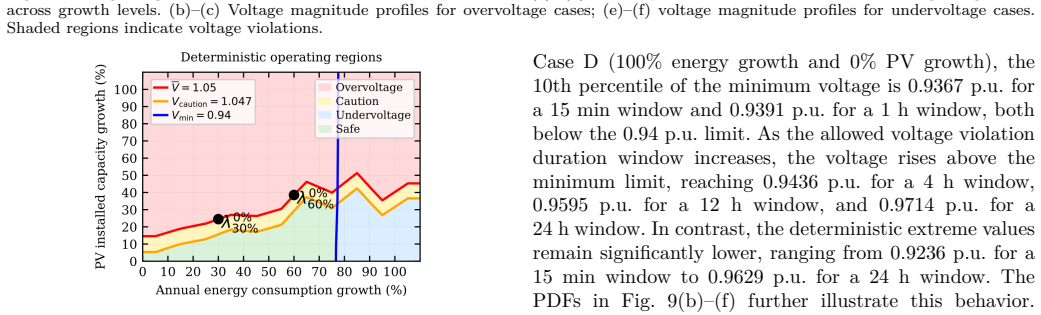
Hosting capacity (HC) assessment plays a critical role in distribution system planning under increasing penetration of distributed energy resources (DERs) and associated uncertainties in load and generation. However, conventional approaches often rely on deterministic worst-case evaluation, leading to overly conservative HC estimates. This paper introduces a risk-based framework for HC assessment that explicitly accounts for the frequency, intensity, and duration of voltage violations under uncertain operating conditions. A generative AI-based approach is employed to generate realistic, time-correlated load demand scenarios conditioned on projected energy consumption growth levels. These scenarios are then used to assess voltage violations and quantify their risk using probabilistic intensity, duration, and frequency (IDF) metrics. The results show that extreme-percentile (zero-risk) approaches significantly underestimate PV-HC by treating all violations equally, regardless of their likelihood or persistence. For instance, allowing a 5% risk level increases HC by approximately 18% for a 15 min violation duration. The proposed approach provides a practical tool for risk-informed distribution system planning under uncertainty.
Editorial analysis
A structured set of objections, weighed in public.
Referee Report
Summary. The paper introduces a risk-based framework for PV hosting capacity (HC) assessment in distribution systems under load and generation uncertainty. It employs a generative AI approach to produce realistic, time-correlated load demand scenarios conditioned on projected energy consumption growth levels. These scenarios feed into probabilistic intensity-duration-frequency (IDF) metrics to quantify voltage violation risk, moving beyond deterministic worst-case evaluations. The central result is that allowing a 5% risk level increases PV HC by approximately 18% for a 15-minute violation duration, positioning the method as a practical tool for risk-informed planning.
Significance. If the generative AI scenarios are validated to match real joint statistics of load and generation, the work would provide a useful advance by enabling higher DER penetration with explicit risk tolerance rather than overly conservative zero-risk assessments. The IDF-based quantification offers a more nuanced view of violation severity and persistence, which could inform utility planning practices as PV adoption increases.
major comments (2)
- [Abstract] Abstract: The reported 18% HC increase at 5% risk is obtained from simulation using the generative AI scenarios, yet the manuscript supplies no architecture details, training procedure, validation against measured load traces, or statistical fidelity tests (marginal distributions, autocorrelation, cross-variable dependence). This is load-bearing for the central claim, as unfaithful scenarios would mis-calibrate the IDF risk metrics and invalidate the uplift relative to deterministic assessment.
- [Results] Results (HC and IDF quantification): No error bars, sensitivity analysis, or conditioning details are provided for the IDF metrics or the 18% figure. The claim that extreme-percentile approaches underestimate HC rests on the unshown realism of the generated ensemble; a concrete test (e.g., comparison of generated vs. historical statistics) is required to support the risk-informed conclusion.
minor comments (3)
- [Abstract] The abstract and introduction should briefly specify the generative AI model type (e.g., GAN, VAE, diffusion) and any conditioning mechanism for growth levels to aid reader understanding.
- [Figures] Ensure figures illustrating generated scenarios include side-by-side comparison with historical data for visual assessment of temporal correlation and variance.
- [Introduction] Add citations to recent literature on generative models for power-system scenario generation and risk-based hosting capacity methods to better position the contribution.
Simulated Author's Rebuttal
We thank the referee for the constructive feedback, which highlights important aspects of validating the generative AI component central to our risk-based framework. We address each major comment below and will revise the manuscript to incorporate the requested details and analyses.
read point-by-point responses
-
Referee: [Abstract] Abstract: The reported 18% HC increase at 5% risk is obtained from simulation using the generative AI scenarios, yet the manuscript supplies no architecture details, training procedure, validation against measured load traces, or statistical fidelity tests (marginal distributions, autocorrelation, cross-variable dependence). This is load-bearing for the central claim, as unfaithful scenarios would mis-calibrate the IDF risk metrics and invalidate the uplift relative to deterministic assessment.
Authors: We agree that the current manuscript lacks explicit details on the generative AI model. In the revised version, we will add a new subsection in the Methods describing the architecture (e.g., conditional GAN or diffusion model specifics), training procedure (including loss functions, hyperparameters, and conditioning on energy growth levels), and comprehensive validation against measured load traces. This will include quantitative statistical fidelity tests for marginal distributions, autocorrelation functions, and cross-variable dependencies between load and generation. These additions will directly support the realism of the scenarios used to derive the IDF metrics and the reported 18% HC increase. revision: yes
-
Referee: [Results] Results (HC and IDF quantification): No error bars, sensitivity analysis, or conditioning details are provided for the IDF metrics or the 18% figure. The claim that extreme-percentile approaches underestimate HC rests on the unshown realism of the generated ensemble; a concrete test (e.g., comparison of generated vs. historical statistics) is required to support the risk-informed conclusion.
Authors: We acknowledge the absence of error bars, sensitivity analyses, and explicit conditioning details in the presented results. The revised manuscript will include error bars on the HC and IDF plots derived from ensemble variability or bootstrap resampling. We will also add sensitivity analysis varying the risk thresholds, violation durations, and conditioning levels. Most importantly, we will insert a dedicated validation figure and table comparing key statistics (marginals, temporal correlations, and joint distributions) between the generated scenarios and historical traces to substantiate the ensemble realism underlying the 18% uplift claim relative to deterministic methods. revision: yes
Circularity Check
No significant circularity; result obtained from simulation
full rationale
The paper applies a generative-AI model to produce load scenarios conditioned on growth projections, then runs power-flow simulations to compute voltage-violation IDF metrics and hosting-capacity values at chosen risk thresholds. The headline quantitative claim (approximately 18 % HC increase at 5 % risk for 15 min violations) is produced by comparing these simulation outputs across risk levels; it is not algebraically forced by any fitted parameter, self-definition, or self-citation chain. No equations or steps in the provided text reduce the reported uplift to the inputs by construction. The framework therefore remains self-contained against external benchmarks.
Axiom & Free-Parameter Ledger
free parameters (1)
- risk tolerance threshold (5%)
axioms (2)
- domain assumption Generative AI produces realistic time-correlated load scenarios conditioned on projected growth
- domain assumption Probabilistic IDF metrics adequately quantify risk for planning decisions
Lean theorems connected to this paper
-
IndisputableMonolith/Cost/FunctionalEquation.leanwashburn_uniqueness_aczel unclear?
unclearRelation between the paper passage and the cited Recognition theorem.
A conditional flow-based deep generative model is used to generate load demand scenarios... IDF framework for voltage violation assessment
-
IndisputableMonolith/Foundation/RealityFromDistinction.leanreality_from_one_distinction unclear?
unclearRelation between the paper passage and the cited Recognition theorem.
allowing a 5% risk level increases HC by approximately 18% for a 15 min violation duration
What do these tags mean?
- matches
- The paper's claim is directly supported by a theorem in the formal canon.
- supports
- The theorem supports part of the paper's argument, but the paper may add assumptions or extra steps.
- extends
- The paper goes beyond the formal theorem; the theorem is a base layer rather than the whole result.
- uses
- The paper appears to rely on the theorem as machinery.
- contradicts
- The paper's claim conflicts with a theorem or certificate in the canon.
- unclear
- Pith found a possible connection, but the passage is too broad, indirect, or ambiguous to say the theorem truly supports the claim.
Reference graph
Works this paper leans on
-
[1]
H. Lee, “Integrating distributed energy resources in power distribution systems: A comprehensive review of impacts, chal- lenges, and opportunities from a distribution system operator’s perspective,” Appl. Energy, vol. 403, p. 127052, 2026
work page 2026
-
[2]
J. A. Dippenaar, B. Bekker, K. Foster, and M. Davies, “A synthesis of distributed energy resource impacts and regulatory responses with a focus on soft law,” Utilities Policy, vol. 98, p. 102104, 2026
work page 2026
-
[3]
Nationaal plan energiesysteem,
Ministry of Economic Affairs and Climate Policy, “Nationaal plan energiesysteem,” 2023. [Online]. A vail- able: https://www.rijksoverheid.nl/documenten/rapporten/ 2023/12/01/nationaal-plan-energiesysteem
work page 2023
-
[4]
A review of methods for assessing der hosting capacity of power distribution systems,
V. de Cillo Moro, R. S. Bonadia, and F. C. L. Trindade, “A review of methods for assessing der hosting capacity of power distribution systems,” IEEE Latin Amer. Trans., vol. 20, no. 10, pp. 2275–2287, 2022
work page 2022
-
[5]
H. H. H. Mousa, K. Mahmoud, and M. Lehtonen, “A com- prehensive review on recent developments of hosting capacity estimation and optimization for active distribution networks,” IEEE Access, vol. 12, pp. 18 545–18 593, 2024
work page 2024
-
[6]
A unified definition of hosting capacity, applications and review,
A. Benzerga, A. Bahmanyar, G. Derval, and D. Ernst, “A unified definition of hosting capacity, applications and review,” IEEE Access, pp. 1–1, 2024
work page 2024
-
[7]
P. P. Vergara, M. Salazar, T. T. Mai, P. H. Nguyen, and H. Slootweg, “A comprehensive assessment of pv inverters operating with droop control for overvoltage mitigation in lv distribution networks,” Renew. Energy, vol. 159, pp. 172–183, 2020
work page 2020
-
[8]
On estimation and sensitivity analysis of distribution circuit’s photovoltaic hosting capacity,
A. Dubey and S. Santoso, “On estimation and sensitivity analysis of distribution circuit’s photovoltaic hosting capacity,” IEEE Trans. Power Syst., vol. 32, no. 4, pp. 2779–2789, 2017
work page 2017
-
[9]
Steady- state analysis of maximum photovoltaic penetration levels on typical distribution feeders,
A. Hoke, R. Butler, J. Hambrick, and B. Kroposki, “Steady- state analysis of maximum photovoltaic penetration levels on typical distribution feeders,” IEEE Trans. Sustain. Energy, vol. 4, pp. 350–357, 2013
work page 2013
-
[10]
Probabilistic hosting capacity for active distribution networks,
H. Al-Saadi, R. Zivanovic, and S. F. Al-Sarawi, “Probabilistic hosting capacity for active distribution networks,” IEEE Trans. Ind. Informat., vol. 13, no. 5, pp. 2519–2532, 2017
work page 2017
-
[11]
Probabilistic assessment of hosting capacity in radial distribution systems,
M. S. S. Abad, J. Ma, D. Zhang, A. S. Ahmadyar, and H. Marzooghi, “Probabilistic assessment of hosting capacity in radial distribution systems,” IEEE Trans. Sustain. Energy, vol. 9, no. 4, pp. 1935–1947, 2018
work page 1935
-
[12]
C. Han, D. Lee, S. Song, and G. Jang, “Probabilistic assessment of pv hosting capacity under coordinated voltage regulation in unbalanced active distribution networks,” IEEE Access, vol. 10, pp. 35 578–35 588, 2022
work page 2022
-
[13]
A. Ali, K. Mahmoud, D. Raisz, and M. Lehtonen, “Probabilistic approach for hosting high pv penetration in distribution systems via optimal oversized inverter with watt-var functions,” IEEE Syst. J., vol. 15, no. 1, pp. 684–693, 2020
work page 2020
-
[14]
H. Ma, G. Li, H. Wang, Z. Yan, and X. Xu, “Probabilistic evaluation of photovoltaic hosting capacity in unbalanced dis- tribution network via polynomial chaos based kriging model,” IEEE Trans. Ind. Appl., vol. 61, no. 1, pp. 1466–1474, 2024
work page 2024
-
[15]
Risk-aware operating regions for pv-rich distribution networks considering irradiance variability,
E. M. S. Duque, J. S. Giraldo, P. P. Vergara, P. H. Nguyen, A. van der Molen, and J. G. Slootweg, “Risk-aware operating regions for pv-rich distribution networks considering irradiance variability,” IEEE Trans. Sustain. Energy, vol. 14, no. 4, pp. 2092–2108, 2023
work page 2092
-
[16]
Risk-based hosting capacity analysis in distribution systems,
A. N. Madavan, N. Dahlin, S. Bose, and L. Tong, “Risk-based hosting capacity analysis in distribution systems,” IEEE Trans. Power Syst., vol. 39, no. 1, pp. 355–365, 2024
work page 2024
-
[17]
Risk-averse storage planning for improving res hosting capacity under uncertain siting choices,
X. Cao, T. Cao, F. Gao, and X. Guan, “Risk-averse storage planning for improving res hosting capacity under uncertain siting choices,” IEEE Trans. Sustain. Energy, vol. 12, no. 4, pp. 1984–1995, 2021
work page 1984
-
[18]
A flow-based model for conditional and probabilistic electricity consumption profile generation,
W. Xia, C. Wang, P. Palensky, and P. P. Vergara, “A flow-based model for conditional and probabilistic electricity consumption profile generation,” Energy AI, vol. 21, p. 100586, 2025
work page 2025
-
[19]
Normalizing flows for probabilistic modeling and inference,
G. Papamakarios, E. Nalisnick, D. Rezende, S. Mohamed, and B. Lakshminarayanan, “Normalizing flows for probabilistic modeling and inference,” J. Mach. Learn. Res., vol. 22, no. 57, pp. 1–64, 2021
work page 2021
-
[20]
A mathemati- cal framework for studying rainfall intensity-duration-frequency relationships,
D. Koutsoyiannis, D. Kozonis, and A. Manetas, “A mathemati- cal framework for studying rainfall intensity-duration-frequency relationships,” J. Hydrol., vol. 206, no. 1, pp. 118–135, 1998
work page 1998
-
[21]
Pseudo multi-scaling model of intensity–duration–frequency (idf) curves,
C. Giudicianni, F. D. Nunno, F. Granata, and E. Creaco, “Pseudo multi-scaling model of intensity–duration–frequency (idf) curves,” J. Hydrol., vol. 664, p. 134370, 2026
work page 2026
discussion (0)
Sign in with ORCID, Apple, or X to comment. Anyone can read and Pith papers without signing in.