Understanding all-dielectric periodically modulated coatings for normal-incidence polarization control
Pith reviewed 2026-05-08 18:09 UTC · model grok-4.3
The pith
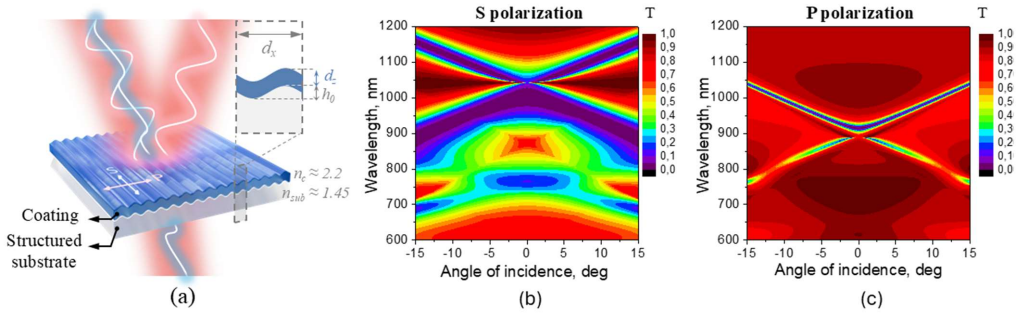
An all-dielectric periodically modulated thin film achieves polarization control at normal incidence by exploiting polarization-dependent Fano resonances.
A machine-rendered reading of the paper's core claim, the machinery that carries it, and where it could break.
Core claim
The central claim is that periodically modulated all-dielectric coatings can be engineered so that Fano resonances occur at different frequencies for orthogonal polarizations, resulting in polarization-selective behavior even at zero degrees angle of incidence. This is supported by analytical modeling, numerical optimization, fabrication, and experimental measurements confirming high contrast and damage thresholds.
What carries the argument
Polarization-dependent Fano resonances in periodically nanostructured dielectric thin films, which shift the resonance condition differently for each polarization to enable selective reflection and transmission at normal incidence.
If this is right
- High-contrast polarizers can be made ultracompact and integrated into normal-incidence optical setups without requiring angled light paths.
- The all-dielectric nature provides superior laser damage resistance compared to metal-based alternatives for high-power applications.
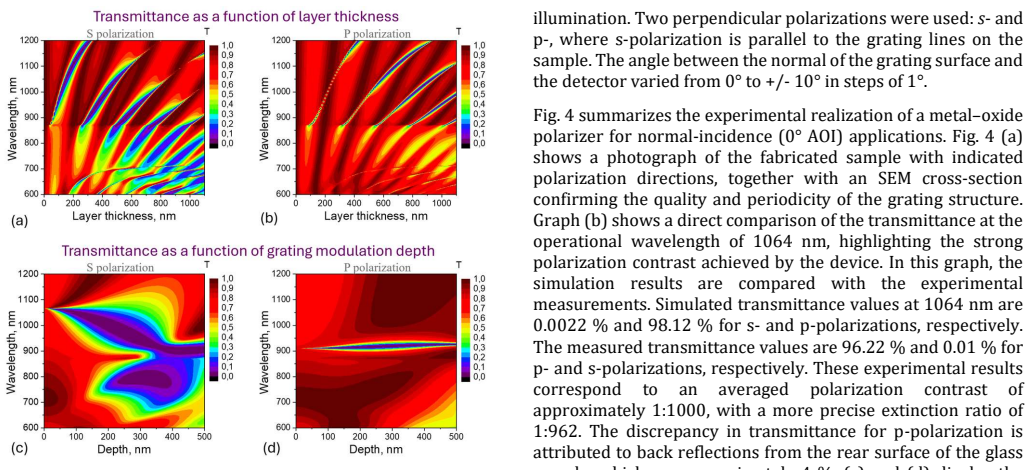
- Analytical and numerical design tools can predict and optimize the polarization selectivity based on the modulation period and film parameters.
- Experimental results show contrast ratios sufficient for practical use in polarization filtering at 0 degrees incidence.
Where Pith is reading between the lines
- These polarizers could be tuned for specific wavelengths by adjusting the nanostructure period, enabling custom applications in lasers or sensors.
- Integration with other thin-film components might allow multifunctional optical coatings for compact systems.
- The high damage threshold suggests suitability for pulsed laser systems where traditional polarizers might fail.
Load-bearing premise
The polarization-dependent Fano resonance frequencies can be precisely engineered to occur exactly at normal incidence without significant shifts from fabrication imperfections or minor angular deviations.
What would settle it
Fabricated samples showing no difference in resonance frequencies between polarizations at zero incidence, or measured contrast ratios falling well below 1:1000.
Figures

read the original abstract
An ultracompact thin-film polarizer for normal-incidence (0{\deg} angle of incidence, AOI) applications is analytically and experimentally investigated. The device is based on Fano resonances in periodically nanostructured dielectric thin films, enabling polarization selective reflection and transmission due to polarization dependent resonance frequencies. The operating principle is analyzed both analytically and numerically, and the optimized structure is fabricated and experimentally characterized. Measurements demonstrate polarization contrast ratios of up to approximately 1:1000 at normal incidence. Laser-induced damage threshold measurements using nanosecond laser pulses further confirm the high damage resistance of the all-dielectric polarizer.
Editorial analysis
A structured set of objections, weighed in public.
Referee Report
Summary. The manuscript presents the analytical, numerical, and experimental investigation of an ultracompact all-dielectric thin-film polarizer based on polarization-dependent Fano resonances in periodically nanostructured dielectric coatings. The device is optimized for normal-incidence operation, fabricated, and characterized, with reported polarization contrast ratios of approximately 1:1000 and high nanosecond-pulse laser damage thresholds.
Significance. If the experimental performance claims hold with adequate validation, the work would be significant for enabling compact, high-power-handling polarizers in laser and photonic systems, offering advantages over metallic alternatives in damage resistance and integration.
major comments (2)
- Experimental characterization section: The central claim of polarization contrast ratios up to 1:1000 at normal incidence lacks reported error bars, sample statistics, baseline comparisons to unpatterned films, or quantitative alignment tolerances, which are required to substantiate the performance given potential fabrication variations and resonance sensitivity.
- Results section: No data or analysis is provided on angular acceptance or sensitivity of the Fano resonances, which is load-bearing for the normal-incidence claim because periodic nanostructures typically exhibit angular dispersion that can detune TE/TM resonances even at milliradian deviations from 0° AOI.
minor comments (1)
- Abstract: The notation '0°' is written with LaTeX markup ('0{°}'); ensure consistent rendering of the degree symbol in the final version.
Simulated Author's Rebuttal
We thank the referee for the constructive and detailed comments, which highlight important areas for strengthening the experimental validation and supporting analysis in our manuscript. We respond to each major comment below and outline the planned revisions.
read point-by-point responses
-
Referee: Experimental characterization section: The central claim of polarization contrast ratios up to 1:1000 at normal incidence lacks reported error bars, sample statistics, baseline comparisons to unpatterned films, or quantitative alignment tolerances, which are required to substantiate the performance given potential fabrication variations and resonance sensitivity.
Authors: We agree that the experimental section would be strengthened by including these details. In the revised manuscript we will add error bars to the reported contrast ratios based on repeated measurements from multiple samples and spatial positions on each sample. We will also report statistics across several independently fabricated devices, include reflection and transmission spectra from unpatterned reference films to establish the baseline performance, and provide quantitative information on the alignment tolerances used in the measurement setup together with a brief assessment of sensitivity to small angular or positional misalignments. These additions will directly address concerns about fabrication variations and resonance sensitivity. revision: yes
-
Referee: Results section: No data or analysis is provided on angular acceptance or sensitivity of the Fano resonances, which is load-bearing for the normal-incidence claim because periodic nanostructures typically exhibit angular dispersion that can detune TE/TM resonances even at milliradian deviations from 0° AOI.
Authors: We acknowledge that angular sensitivity analysis is important for validating the normal-incidence operation. While the manuscript emphasizes performance at exactly 0° AOI, the revised version will include numerical simulations of the angular dependence of both TE and TM Fano resonances. These will show resonance wavelength shifts and contrast degradation versus angle of incidence (up to a few degrees), thereby quantifying the angular acceptance. Experimental angular scans were not performed in the original work owing to constraints of the available measurement apparatus; the added numerical results will nevertheless demonstrate that the resonances remain sufficiently separated near normal incidence. We are prepared to expand this section further if the referee considers additional experimental verification necessary. revision: partial
Circularity Check
No significant circularity; experimental validation stands independent of any derivation
full rationale
The paper analyzes Fano resonances in periodically nanostructured dielectric films both analytically and numerically, then fabricates and measures the device, reporting polarization contrast ratios up to 1:1000 at normal incidence plus laser damage threshold data. No load-bearing derivation step is shown that reduces by construction to fitted inputs, self-defined parameters, or self-citation chains. The operating principle is derived from standard resonance physics and validated externally by fabrication and measurement; the central claims do not rely on renaming known results or smuggling ansatzes via prior self-work. The derivation chain is therefore self-contained against external benchmarks.
Axiom & Free-Parameter Ledger
Lean theorems connected to this paper
-
Cost.FunctionalEquation / Constantswashburn_uniqueness_aczel; phi_golden_ratio unclear?
unclearRelation between the paper passage and the cited Recognition theorem.
λ_res ≈ n·dx / sqrt(1+(m·dx/(2dz))^2) − n²·dx⁴/(4απ·dz³·sqrt(n²−1)) (Eq. 3); resonance widths Δλ_width,s, Δλ_width,p (Eq. 5)
What do these tags mean?
- matches
- The paper's claim is directly supported by a theorem in the formal canon.
- supports
- The theorem supports part of the paper's argument, but the paper may add assumptions or extra steps.
- extends
- The paper goes beyond the formal theorem; the theorem is a base layer rather than the whole result.
- uses
- The paper appears to rely on the theorem as machinery.
- contradicts
- The paper's claim conflicts with a theorem or certificate in the canon.
- unclear
- Pith found a possible connection, but the passage is too broad, indirect, or ambiguous to say the theorem truly supports the claim.
Reference graph
Works this paper leans on
-
[1]
A new optical model for wire grid polarizers
Yeh P. A new optical model for wire grid polarizers. Opt Commun 1978;26:289–92. https://doi.org/10.1016/0030-4018(78)90203-1
-
[2]
Wang C, Chao Y, Liang J, et al. Large-Area Wire Grid Polarizer with High Transverse Magnetic Wave Transmittance and Extinction Ratio for Infrared Imaging System. Adv Photonics Res 2023;4:2200218. https://doi.org/10.1002/ADPR.202200218
-
[3]
Zhao Z, Zhao Z, Ma T, et al. Numerical demonstration of low-reflective wire grid polarizers with a patterned Fe2O3 absorptive layer. Applied Optics, Vol 61, Issue 32, Pp 9708-9715 2022;61:9708–15. https://doi.org/10.1364/AO.472299
-
[4]
Zhu M, Yi K, Fan Z, et al. Theoretical and experimental research on spectral performance and laser induced damage of Brewster’s thin film polarizers. Appl Surf Sci 2011;257:6884–8. https://doi.org/10.1016/J.APSUSC.2011.03.023
-
[5]
Optical anisotropy of glancing angle deposited thin films on nano-patterned substrates
Grineviciute L, Moein T, Han M, et al. Optical anisotropy of glancing angle deposited thin films on nano-patterned substrates. Opt Mater Express 2022;12:1281. https://doi.org/10.1364/ome.451669
-
[6]
Electron-beam– deposited distributed polarization rotator for high- power laser applications
Oliver JB, Kessler TJ, Smith C, et al. Electron-beam– deposited distributed polarization rotator for high- power laser applications. Opt Express 2014;22:23883. https://doi.org/10.1364/oe.22.023883
-
[7]
Glancing-angle– deposited magnesium oxide films for high-fluence applications
Oliver JB, Smith C, Spaulding J, et al. Glancing-angle– deposited magnesium oxide films for high-fluence applications. Opt Mater Express 2016;6:2291. https://doi.org/10.1364/ome.6.002291
-
[8]
(18) Zeghdoudi, T.; Kebci, Z.; Mezeghrane, A.; Belkhir, A.; Baida, F
Mireles M, Hoffman BN, MacNally S, et al. Direct-write laser-assisted patterning of form birefringence in wave plates fabricated by glancing-angle deposition. Optica 2023;10:657. https://doi.org/10.1364/optica.487263
-
[9]
Compact linearly polarized ceramic laser made with anisotropic nanostructured thin films
Doucet A, Beydaghyan G, Ashrit P V., et al. Compact linearly polarized ceramic laser made with anisotropic nanostructured thin films. Applied Optics, Vol 54, Issue 28, Pp 8326-8331 2015;54:8326–31. https://doi.org/10.1364/AO.54.008326
-
[10]
Linear and Circular Polarization Filters Using Sculptured Thin Films
Lakhtakia A, Hodgkinson I, Messier R, et al. Linear and Circular Polarization Filters Using Sculptured Thin Films. Optics and Photonics News, Vol 10, Issue 12, Pp 30-31 1999;10:30–1. https://doi.org/10.1364/OPN.10.12.000030
-
[11]
Highly resistant all-silica polarizing coatings for normal incidence applications
Grineviciute L, Ramalis L, Buzelis R, et al. Highly resistant all-silica polarizing coatings for normal incidence applications. Opt Lett 2021;46:916. https://doi.org/10.1364/ol.414392
-
[12]
Sullo spettro di assorbimento dei gas nobili presso il limite dello spettro d’arco
Fano U. Sullo spettro di assorbimento dei gas nobili presso il limite dello spettro d’arco. Il Nuovo Cimento (1924-1942) 1935 12:3 2008;12:154–61. https://doi.org/10.1007/BF02958288
-
[13]
Effects of Configuration Interaction on Intensities and Phase Shifts
Fano U. Effects of Configuration Interaction on Intensities and Phase Shifts. Physical Review 1961;124:1866. https://doi.org/10.1103/PhysRev.124.1866
-
[14]
Limonov MF, Rybin M V., Poddubny AN, et al. Fano resonances in photonics. Nature Photonics 2017 11:9 2017;11:543–54. https://doi.org/10.1038/nphoton.2017.142
-
[15]
Fano resonances and all- optical switching in a resonantly coupled plasmonic- atomic system
Stern L, Grajower M, Levy U. Fano resonances and all- optical switching in a resonantly coupled plasmonic- atomic system. Nat Commun 2014;5:1–9. https://doi.org/10.1038/NCOMMS5865;TECHMETA
-
[16]
Campione S, De Ceglia D, Guclu C, et al. Fano collective resonance as complex mode in a two-dimensional planar metasurface of plasmonic nanoparticles. Appl Phys Lett 2014;105. https://doi.org/10.1063/1.4901183
-
[17]
Nonlinear Fano- Resonant Dielectric Metasurfaces
Yang Y, Wang W, Boulesbaa A, et al. Nonlinear Fano- Resonant Dielectric Metasurfaces. Nano Lett 2015;15:7388–93. https://doi.org/10.1021/ACS.NANOLETT.5B02802
-
[18]
Collin S. Nanostructure arrays in free-space: Optical properties and applications. Reports on Progress in Physics 2014;77. https://doi.org/10.1088/0034- 4885/77/12/126402
-
[19]
Nonlinear optics in dielectric guided-mode resonant structures and resonant metasurfaces
Raghunathan V, Deka J, Menon S, et al. Nonlinear optics in dielectric guided-mode resonant structures and resonant metasurfaces. Micromachines (Basel) 2020;11. https://doi.org/10.3390/MI11040449
-
[20]
Fano-like resonances in nanostructured thin films for spatial filtering
Grineviciute L, Nikitina J, Babayigit C, et al. Fano-like resonances in nanostructured thin films for spatial filtering. Appl Phys Lett 2021;118. https://doi.org/10.1063/5.0044032
-
[21]
Extremely narrow sharply peaked resonances at the edge of the continuum
Lukosiunas I, Grineviciute L, Nikitina J, et al. Extremely narrow sharply peaked resonances at the edge of the continuum. Phys Rev A (Coll Park) 2023;107. https://doi.org/10.1103/PhysRevA.107.L061501
-
[22]
Lee KJ, Giese J, Ajayi L, et al. Resonant grating polarizers made with silicon nitride, titanium dioxide, and silicon: Design, fabrication, and characterization. Opt Express 2014;22:9271. https://doi.org/10.1364/oe.22.009271
-
[23]
Metamaterial polarizer providing principally unlimited extinction
Hemmati H, Bootpakdeetam P, Magnusson R. Metamaterial polarizer providing principally unlimited extinction. Opt Lett 2019;44:5630. https://doi.org/10.1364/ol.44.005630
-
[24]
Frang Jimin, Wang Bo. Silicon-doped cylindrical arrays for ultra-broadband terahertz absorber with polarization independence. Phys Scr 2021;96. https://doi.org/10.1088/1402-4896/ac0076
-
[25]
Dual-polarization strong nonreciprocal radiation by the 2D GaAs nanograting
Shi X, Wang B. Dual-polarization strong nonreciprocal radiation by the 2D GaAs nanograting. Appl Phys Lett 2024;125:62202. https://doi.org/10.1063/5.0225127/3307378
-
[26]
Li J, Wang B, Wu J. Si/InAs/Ag metamaterial for strong nonreciprocal thermal emitter with dual polarization under a 0.9 T magnetic field. Appl Mater Today 2024;39:102345. https://doi.org/10.1016/J.APMT.2024.102345
-
[27]
I-shaped stack configuration for multi- purpose splitter
Xiong Z, Wang B. I-shaped stack configuration for multi- purpose splitter. Opt Laser Technol 2024;168:109959. https://doi.org/10.1016/J.OPTLASTEC.2023.109959
-
[28]
High-efficiency multi-port beam control device based on periodic nanodisk arrays
Huang Z, Wang B. High-efficiency multi-port beam control device based on periodic nanodisk arrays. Opt Laser Technol 2022;152:108102. https://doi.org/10.1016/J.OPTLASTEC.2022.108102
-
[29]
Guided Mode Resonant Gratings for Broadband Reflection
Xie Y, Chen C, Wang J, et al. Guided Mode Resonant Gratings for Broadband Reflection. Laser Photon Rev
-
[30]
https://doi.org/10.1002/lpor.202501956
-
[31]
Multicoated gratings: a differential formalism applicable in the entire optical region
Chandezon J, Dupuis MT, Cornet G, et al. Multicoated gratings: a differential formalism applicable in the entire optical region. J Opt Soc Am 1982;72
1982
-
[32]
https://mcgrating.com/ (accessed September 19, 2025)
Modal and C Methods Grating Software n.d. https://mcgrating.com/ (accessed September 19, 2025)
2025
-
[33]
Optical Coating Deposition on Submicron-Patterned Surfaces
Grineviciute L, Melnikas S, Nikitina J, et al. Optical Coating Deposition on Submicron-Patterned Surfaces. Coatings 2025;15. https://doi.org/10.3390/coatings15040372
-
[34]
https://www.rp- photonics.com/polarizers.html?utm_source=chatgpt.co m (accessed January 18, 2026)
Polarizers – absorptive, polarizing beam splitters, birefringence, calcite, Glan–Taylor prism, Wollaston prism, thin-film polarizers n.d. https://www.rp- photonics.com/polarizers.html?utm_source=chatgpt.co m (accessed January 18, 2026)
2026
-
[35]
https://www.meetoptics.com/polarization- optics/linear/polymer-linear- polarizer/s/thorlabs/p/LPNIRE050-B (accessed January 18, 2026)
Thorlabs Polymer Linear Polarizer - LPNIRE050-B | MEETOPTICS n.d. https://www.meetoptics.com/polarization- optics/linear/polymer-linear- polarizer/s/thorlabs/p/LPNIRE050-B (accessed January 18, 2026)
2026
-
[36]
Enhancement of brightness in microchip laser with angular filtering mirrors
Plukys M, Grineviciute L, Nikitina J, et al. Enhancement of brightness in microchip laser with angular filtering mirrors. Opt Laser Technol 2025;181. https://doi.org/10.1016/j.optlastec.2024.111904
discussion (0)
Sign in with ORCID, Apple, or X to comment. Anyone can read and Pith papers without signing in.