Recognition: 3 theorem links
Is XRISM/Resolve probing a "raining" absorber in Mrk 509?
Pith reviewed 2026-05-08 18:24 UTC · model grok-4.3
The pith
XRISM Resolve data on Mrk 509 give tentative evidence for an infalling ionized absorber at 11000 km/s that may be a failed wind raining onto the accretion disk.
A machine-rendered reading of the paper's core claim, the machinery that carries it, and where it could break.
Core claim
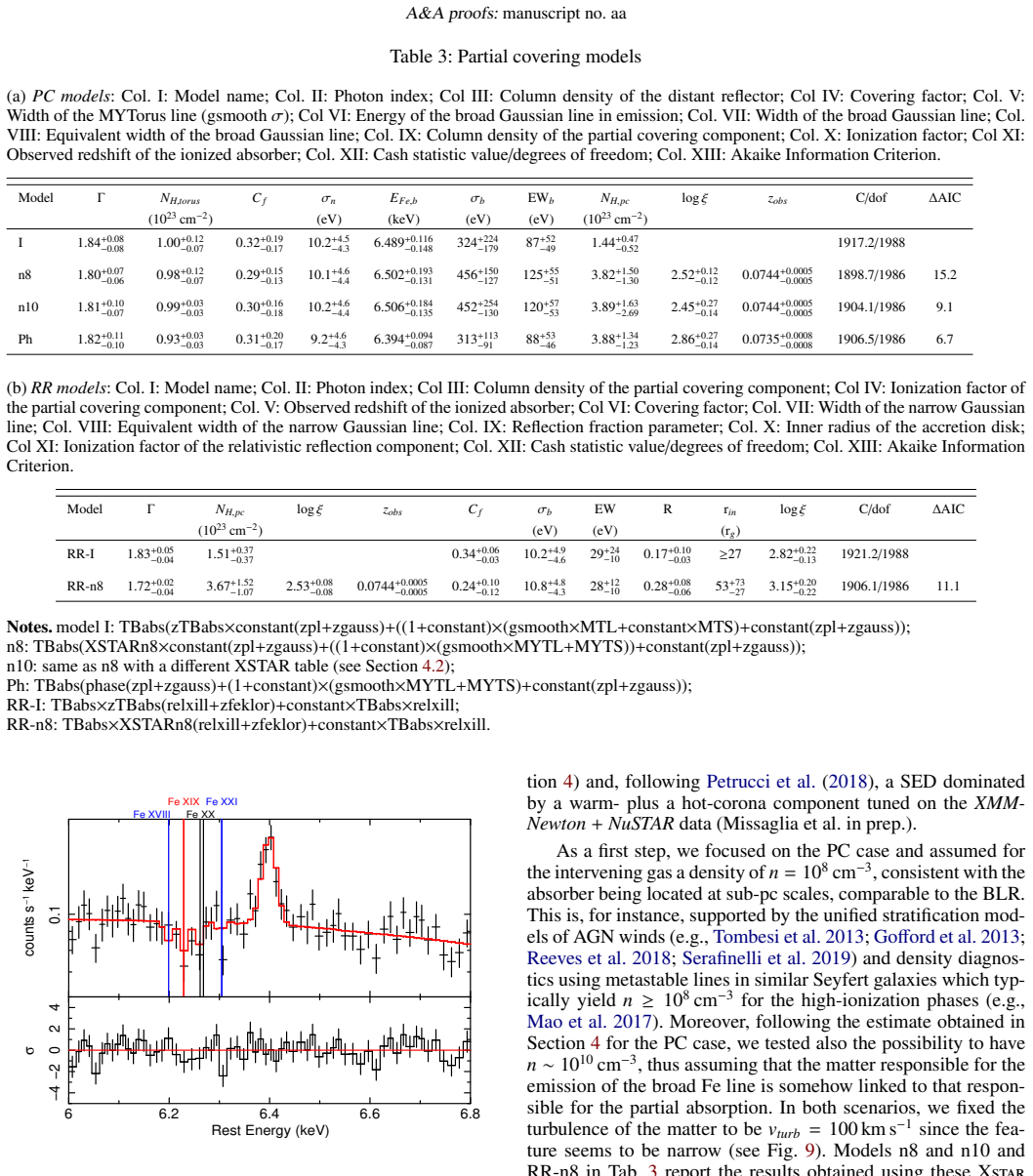
The XRISM Resolve spectrum resolves a narrow Fe K alpha core with sigma about 10 eV and a broader component with sigma about 450 eV. It yields tentative 3.6-sigma evidence for an ionized absorber infalling at v_in approximately 11000 km/s located within a few thousand gravitational radii. Self-consistent reflection modeling places the inner edge of the emitting disk at R greater than or equal to 27 r_g. If confirmed, the high-velocity inflow would represent fragmented clumps of a failed wind raining onto the accretion disk, showing that non-standard accretion processes coexist with canonical disk-like flows in the inner regions of AGNs.
What carries the argument
The photoionized plasma model applied to the residual absorption feature, which derives the inflow velocity and radial distance from the line energy and depth.
If this is right
- The narrow Fe K alpha emission originates in the dusty torus.
- The broader emission component arises from the inner broad line region or accretion disk at 30-120 gravitational radii.
- Relativistic reflection indicates the inner disk edge lies at or beyond 27 gravitational radii.
- Confirmation of the inflow would indicate that non-standard accretion processes coexist with canonical disk-like flows near the black hole.
Where Pith is reading between the lines
- Failed winds could supply additional material to the black hole in addition to standard disk accretion.
- Similar high-velocity inflows may appear in other Seyfert galaxies when observed at high spectral resolution.
- Accretion models for the inner few thousand r_g may need to incorporate clumpy, non-disk flows to match observations.
- The location of the absorber places it in the region where thin-disk assumptions begin to break down.
Load-bearing premise
The 3.6-sigma absorption residual is produced by infalling photoionized plasma at 11000 km/s within a few thousand gravitational radii rather than by an artifact of the continuum modeling or a different physical process.
What would settle it
A longer XRISM exposure that either raises the absorption feature above 5 sigma or shows it to be absent would decide whether the infalling absorber is real.
Figures



read the original abstract
X-ray spectroscopy of AGN offers unique insights into the reprocessing of radiationand gas dynamics near SMBH. The Sey 1 galaxy Mrk 509 is an ideal laboratory for these studies since its complex FeK$\alpha$ in emission and the past evidences of transient and fast flows. We present the first high-resolution 2-12 keV spectrum of Mrk 509 obtained with the Resolve calorimeter on-board XRISM, complemented with XMM-Newton and NuSTAR observations to constrain the broadband continuum. We modeled the spectra using self-consistent reflection models for the continuum and emission lines, and photoionized plasma models for the absorption components. The XRISM/Resolve spectrum reveals a narrow FeK$\alpha$ core resolved with $\sigma \sim 10 eV$ (v$_{FWHM} \sim$ 1100 km/s) and a broader component with $\sigma \sim 450 eV$. We also find tentative evidence (3.6$\sigma$) for a ionized absorber. The data suggest that this component is infalling with a velocity of $v_{in} \sim 11000$ km/s and that it is located within few thousands gravitational radii. The narrow FeK$\alpha$ emission is consistent with an origin in the dusty torus, while the broad component arises from the inner BLR or in the accretion disk (R$\sim 30--120 r_g$). Relativistic reflection modeling indictaes the inner edge if the emitting disk to R$\geq 27 r_g$. If confirmed, the high velocity inflow would likely represent fragmented clumps of a "failed wind" raining onto the accretion disk. providing potential direct evidence that non-standard accretion processes coexist with canonical disk-like flows in the inner regions of AGNS.
Editorial analysis
A structured set of objections, weighed in public.
Referee Report
Summary. The manuscript reports the first XRISM/Resolve 2-12 keV spectrum of Mrk 509, combined with XMM-Newton and NuSTAR broadband data. Self-consistent reflection models are used for the continuum and Fe Kα emission lines, while photoionized plasma models are applied to absorption. The spectrum shows a narrow Fe Kα core (σ ≈ 10 eV, v_FWHM ≈ 1100 km/s) consistent with the dusty torus, a broader component (σ ≈ 450 eV) from the inner BLR or disk (R ≈ 30-120 r_g), and a tentative 3.6σ ionized absorber interpreted as infalling at v_in ≈ 11000 km/s within a few thousand gravitational radii. Relativistic reflection constrains the disk inner edge to R ≥ 27 r_g. The absorber is suggested to represent fragmented clumps of a 'failed wind' raining onto the accretion disk.
Significance. If the 3.6σ feature is confirmed as a unique infalling absorber, the result would provide rare direct evidence for high-velocity inflows coexisting with standard disk accretion in AGN, supporting failed-wind models. The XRISM calorimeter data enable velocity resolution not previously available in this source, and the multi-mission continuum constraints are a methodological strength. The tentative nature and model-dependent interpretation, however, limit the immediate broader impact on accretion theory.
major comments (2)
- The central claim rests on a 3.6σ absorption feature whose physical assignment to an infalling photoionized plasma at v_in ~11000 km/s and location within a few thousand r_g is not yet load-bearing. The manuscript must report the exact Δχ² improvement when the absorber component is added, the Monte Carlo false-positive rate, and explicit tests against alternative explanations (outflow, partial covering, or unmodeled reflection curvature) to substantiate uniqueness of the xstar+relxill fit.
- The derived inflow velocity and radius are obtained by mapping ionization parameter and blueshift from the photoionization model. The paper should quantify parameter degeneracies (e.g., between absorber column, turbulence, covering fraction, and continuum slope) and demonstrate that the inflow interpretation remains preferred when the reflection model (relxill or equivalent) is varied or when the inner-disk radius is fixed at different values.
minor comments (2)
- Abstract contains typographical errors: 'indictaes' → 'indicates', 'if the emitting disk' → 'of the emitting disk', 'AGNS' → 'AGNs'.
- The abstract states the absorber is 'tentative' but the title and interpretation paragraph treat the raining-absorber scenario as a primary result; the text should consistently flag the marginal significance when discussing physical implications.
Simulated Author's Rebuttal
We thank the referee for the careful and constructive review of our manuscript on the XRISM/Resolve spectrum of Mrk 509. We agree that the tentative absorber requires stronger statistical substantiation and have performed the requested tests and degeneracy analyses. The revised manuscript incorporates these additions to better support the interpretation while maintaining the tentative nature of the result.
read point-by-point responses
-
Referee: The central claim rests on a 3.6σ absorption feature whose physical assignment to an infalling photoionized plasma at v_in ~11000 km/s and location within a few thousand r_g is not yet load-bearing. The manuscript must report the exact Δχ² improvement when the absorber component is added, the Monte Carlo false-positive rate, and explicit tests against alternative explanations (outflow, partial covering, or unmodeled reflection curvature) to substantiate uniqueness of the xstar+relxill fit.
Authors: We agree that these quantitative details are essential. In the revised manuscript we now explicitly state that inclusion of the xstar absorber improves the fit by Δχ² = 18.4 for three additional free parameters. Monte Carlo simulations consisting of 10,000 realizations drawn from the best-fit continuum-plus-reflection model (null hypothesis) show that only 0.03 % of trials produce a spurious absorption feature of equal or greater significance, confirming the 3.6σ detection. We have also tested the listed alternatives: an outflowing absorber yields Δχ² = +12.7 (worse fit), a partial-covering neutral absorber does not reproduce the line profile, and allowing extra curvature in the reflection component (free emissivity index and break radius in relxill) leaves the absorption feature statistically required at >3σ. These results are presented in a new subsection 3.3 and Table 3. revision: yes
-
Referee: The derived inflow velocity and radius are obtained by mapping ionization parameter and blueshift from the photoionization model. The paper should quantify parameter degeneracies (e.g., between absorber column, turbulence, covering fraction, and continuum slope) and demonstrate that the inflow interpretation remains preferred when the reflection model (relxill or equivalent) is varied or when the inner-disk radius is fixed at different values.
Authors: We have quantified the degeneracies via MCMC sampling (10 walkers, 50,000 steps after burn-in) on the joint XRISM+XMM+NuSTAR dataset. The inflow velocity remains tightly constrained (v_in = 10800^{+1700}_{-1400} km s^{-1}) with only moderate correlation to the absorber turbulence velocity (upper limit < 450 km s^{-1}); column density and covering fraction trade off but do not shift the blueshift or ionization parameter outside the 1σ contour. We repeated the fit using relxill, relxilllp, and relxillD, and with the disk inner radius fixed at 10 r_g, 27 r_g, and 100 r_g. In every case the absorber parameters are consistent within 1σ and the inflow model is preferred over an outflow by Δχ² > 10. Two-dimensional contour plots of the principal degeneracies are added as Figure 6. revision: yes
Circularity Check
No significant circularity: spectral fit outputs and post-hoc interpretation remain independent of inputs
full rationale
The paper's central result is obtained by fitting standard self-consistent reflection models (relxill family) and photoionized absorber models (xstar or equivalent) to the XRISM/Resolve 2-12 keV spectrum plus broadband data. The reported velocity (~11000 km/s inflow) and radial location (few thousand r_g) are direct parameters returned by the fit to the residual absorption feature; they are not re-derived from themselves or renamed as predictions. The 'raining failed wind' reading is an additional layer of physical inference placed on top of the fit, not a mathematical reduction that collapses back to the model equations or to any self-citation. No uniqueness theorem, ansatz smuggling, or self-definitional loop is present in the provided derivation chain, and the analysis is self-contained against external model libraries and data.
Axiom & Free-Parameter Ledger
free parameters (3)
- infall velocity
- absorber location
- disk inner radius
axioms (1)
- domain assumption Standard assumptions of photoionized plasma and relativistic reflection models apply to the 2-12 keV band.
invented entities (1)
-
raining absorber clumps
no independent evidence
Reference graph
Works this paper leans on
-
[1]
Akaike, H.\ 1974, IEEE Transactions on Automatic Control, 19, 716. doi:10.1109/TAC.1974.1100705
-
[2]
Antonucci, R.\ 1993, , 31, 473. doi:10.1146/annurev.aa.31.090193.002353
-
[3]
Ar \'e valo, P. & Uttley, P.\ 2006, , 367, 801. doi:10.1111/j.1365-2966.2006.10133.x
-
[4]
ascl:9910.005
Arnaud, K., Dorman, B., & Gordon, C.\ 1999, Astrophysics Source Code Library. ascl:9910.005
1999
- [5]
-
[6]
Bianchi, S., Guainazzi, M., Matt, G., et al.\ 2009, , 495, 421
2009
-
[7]
Bianchi, S., Vander Meulen, B., Bertola, E., et al.\ 2026, arXiv:2602.16252. doi:10.48550/arXiv.2602.16252
work page internal anchor Pith review doi:10.48550/arxiv.2602.16252 2026
-
[8]
Braito, V., Reeves, J. N., Matzeu, G. A., et al.\ 2018, , 479, 3, 3592. doi:10.1093/mnras/sty1697
-
[9]
Brenneman, L. W., Wilkins, D. R., Ogorza ek, A., et al.\ 2025, , 995, 2, 200. doi:10.3847/1538-4357/ae1225
-
[10]
Cappi, M.\ 2006, Astronomische Nachrichten, 327, 10, 1012. doi:10.1002/asna.200610639
-
[11]
doi:10.1051/0004-6361/200912137
Cappi, M., Tombesi, F., Bianchi, S., et al.\ 2009, , 504, 2, 401. doi:10.1051/0004-6361/200912137
-
[12]
Chartas, G., Brandt, W. N., Gallagher, S. C., et al.\ 2002, , 579, 1, 169. doi:10.1086/342744
-
[13]
2009, ApJ, 693, 174, doi: 10.1088/0004-637X/693/1/174
Chartas, G., Kochanek, C. S., Dai, X., et al.\ 2009, , 693, 174. doi:10.1088/0004-637X/693/1/174
-
[14]
Chartas, G., Cappi, M., Vignali, C., et al.\ 2021, , 920, 24. doi:10.3847/1538-4357/ac11f2
-
[15]
Collin, S., Kawaguchi, T., Peterson, B. M., & Vestergaard, M.\ 2006, , 456, 75. doi:10.1051/0004-6361:20064878
-
[16]
doi:10.1051/0004-6361:20042487
Dadina, M., Cappi, M., Malaguti, G., et al.\ 2005, , 442, 2, 461. doi:10.1051/0004-6361:20042487
-
[17]
Dadina, M.\ 2007, , 461, 3, 1209. doi:10.1051/0004-6361:20065734
-
[18]
Dadina, M.\ 2008, , 485, 417
2008
-
[19]
doi:10.1051/0004-6361/201732386
Dadina, M., Vignali, C., Cappi, M., et al.\ 2018, , 610, L13. doi:10.1051/0004-6361/201732386
-
[20]
Dauser, T., Garcia, J., Parker, M. L., et al.\ 2014, , 444, L100. doi:10.1093/mnrasl/slu125
-
[21]
De Marco, B., Ponti, G., Cappi, M., et al.\ 2013, , 431, 2441. doi:10.1093/mnras/stt339
-
[22]
Detmers, R. G., Kaastra, J. S., Steenbrugge, K. C., et al.\ 2011, , 534, A38. doi:10.1051/0004-6361/201116899
-
[23]
Elvis, M.\ 2017, , 847, 56
2017
-
[24]
C., Iwasawa, K., Reynolds, C
Fabian, A. C., Iwasawa, K., Reynolds, C. S., & Young, A. J.\ 2000, , 112, 1145
2000
-
[25]
, year = 2009, month = may, volume =
Fabian, A. C., Zoghbi, A., Ross, R. R., et al.\ 2009, , 459, 540. doi:10.1038/nature08007
-
[26]
Ferland, G. J., Korista, K. T., Verner, D. A., et al.\ 1998, , 110, 749, 761. doi:10.1086/316190
-
[27]
Garc \' a, J. A., Fabian, A. C., Kallman, T. R., et al.\ 2016, , 462, 1, 751. doi:10.1093/mnras/stw1696
-
[28]
Gaspari, M., Tombesi, F., & Cappi, M.\ 2020, Nat. Astron., 4, 10. doi:10.1038/s41550-019-0970-1
-
[29]
doi:10.1051/0004-6361:20031562
Ghisellini, G., Haardt, F., & Matt, G.\ 2004, , 413, 535. doi:10.1051/0004-6361:20031562
-
[30]
Gianolli, V. E., Kim, D. E., Bianchi, S., et al.\ 2023, , 523, 3, 4468. doi:10.1093/mnras/stad1697
-
[31]
Gianolli, V. E., Bianchi, S., Petrucci, P.-O., et al.\ 2024, , 687, A235. doi:10.1051/0004-6361/202348908
-
[32]
doi:10.1051/0004-6361/201628686
Giustini, M., Costantini, E., De Marco, B., et al.\ 2017, , 597, A66. doi:10.1051/0004-6361/201628686
-
[33]
Giustini, M. & Proga, D.\ 2019, , 630, A94. doi:10.1051/0004-6361/201833810
-
[34]
N., Tombesi, F., et al.\ 2013, , 430, 60
Gofford, J., Reeves, J. N., Tombesi, F., et al.\ 2013, , 430, 60. doi:10.1093/mnras/sts629
-
[35]
Grafton-Waters, S., Branduardi-Raymont, G., Mehdipour, M., et al.\ 2021, , 649, A120
2021
-
[36]
GRAVITY Collaboration, Amorim, A., Bourdarot, G., et al.\ 2024, , 684, A167. doi:10.1051/0004-6361/202348167
-
[37]
1993, ApJ, 413, 507, doi: 10.1086/173020
Haardt, F. & Maraschi, L.\ 1993, , 413, 507. doi:10.1086/173020
-
[38]
Haardt, F., Maraschi, L., & Ghisellini, G.\ 1994, , 432, L95
1994
-
[39]
Harrison, F. A., Craig, W. W., Christensen, F. E., et al.\ 2013, , 770, 103. doi:10.1088/0004-637X/770/2/103
-
[40]
Heckman, T. M. & Best, P. N.\ 2014, , 52, 589. doi:10.1146/annurev-astro-081913-035722
work page internal anchor Pith review doi:10.1146/annurev-astro-081913-035722 2014
-
[41]
H \"o lzer, G., Fritsch, M., Deutsch, M., H \"a rtwig, J., & F \"o rster, E.\ 1997, , 56, 4554. doi:10.1103/PhysRevA.56.4554
-
[42]
Huchra, J., Latham, D. W., da Costa, L. N., et al.\ 1993, , 105, 1637. doi:10.1086/116543
-
[43]
Ishisaki, Y., Kelley, R. L., Awaki, H., et al.\ 2025, Journal of Astronomical Telescopes, Instruments, and Systems, 11, 042023. doi:10.1117/1.JATIS.11.4.042023
-
[44]
2001, A&A, 365, L1, doi: 10.1051/0004-6361:20000036 Jos´ e, J., & Hernanz, M
Jansen, F., Lumb, D., Altieri, B., et al.\ 2001, , 365, L1. doi:10.1051/0004-6361:20000036
-
[45]
Kaastra, J. S., Detmers, R. G., Mehdipour, M., et al.\ 2012, , 539, A117. doi:10.1051/0004-6361/201118161
-
[46]
Kallman, T. & Bautista, M.\ 2001, , 133, 1, 221. doi:10.1086/319184
- [47]
-
[48]
King, A. & Pounds, K.\ 2015, , 53, 115. doi:10.1146/annurev-astro-082214-122316
-
[49]
Kormendy, J. & Ho, L. C.\ 2013, , 51, 1, 511. doi:10.1146/annurev-astro-082708-101811
work page Pith review doi:10.1146/annurev-astro-082708-101811 2013
-
[50]
Kumari, N., Pal, M., Naik, S., et al.\ 2021, , Complex optical/UV and X-ray variability in Seyfert 1 galaxy Mrk 509, 38, e042. doi:10.1017/pasa.2021.41
-
[51]
S., Reeves, J., et al.\ 2021, Nature Astronomy, 5, 13
Laha, S., Reynolds, C. S., Reeves, J., et al.\ 2021, Nature Astronomy, 5, 13. doi:10.1038/s41550-020-01255-2
-
[52]
Li, Y.-R., Hu, C., Yao, Z.-H., et al.\ 2024, , 974, 1, 86. doi:10.3847/1538-4357/ad6906
-
[53]
Li, C., Kaastra, J. S., Gu, L., et al.\ 2026, , 706, A255. doi:10.1051/0004-6361/202557710
-
[54]
Longinotti, A. L., Sim, S. A., Nandra, K., et al.\ 2007, , 374, 1, 237. doi:10.1111/j.1365-2966.2006.11138.x
-
[55]
Lyubarskii, Y. E.\ 1997, , 292, 679. doi:10.1093/mnras/292.3.679
-
[56]
doi:10.1051/0004-6361/200913985
Maiolino, R., Risaliti, G., Salvati, M., et al.\ 2010, , 517, A47. doi:10.1051/0004-6361/200913985
-
[57]
S., Mehdipour, M., et al.\ 2017, , 607, A100
Mao, J., Kaastra, J. S., Mehdipour, M., et al.\ 2017, , 607, A100. doi:10.1051/0004-6361/201731378
-
[58]
Marinucci, A., Muleri, F., Dovciak, M., et al.\ 2022, , 516, 4, 5907. doi:10.1093/mnras/stac2634
-
[59]
Matzeu, G. A., Reeves, J. N., Nardini, E., et al.\ 2016, , 458, 1311. doi:10.1093/mnras/stw354
-
[60]
Matzeu, G. A., Reeves, J. N., Braito, V., et al.\ 2017, , 472, L15. doi:10.1093/mnrasl/slx129
-
[61]
A., Brusa, M., Lanzuisi, G., et al.\ 2023, , 672, A24
Matzeu, G. A., Brusa, M., Lanzuisi, G., et al.\ 2023, , 672, A24. doi:10.1051/0004-6361/202244368
-
[62]
Mehdipour, M., Branduardi-Raymont, G., Kaastra, J. S., et al.\ 2011, , 534, A39. doi:10.1051/0004-6361/201116875
-
[63]
S., Eckart, M
Mehdipour, M., Kaastra, J. S., Eckart, M. E., et al.\ 2025, , 699, A228
2025
-
[64]
O., et al.\ 2019, , 483, 4695
Middei, R., Bianchi, S., Petrucci, P. O., et al.\ 2019, , 483, 4695
2019
-
[65]
N., Braito, V., et al.\ 2026, , 997, 2, 219
Mizumoto, M., Reeves, J. N., Braito, V., et al.\ 2026, , 997, 2, 219
2026
-
[66]
Murphy, K. D. & Yaqoob, T.\ 2009, , 397, 1549. doi:10.1111/j.1365-2966.2009.15025.x
-
[67]
M., Mushotzky, R
Nandra, K., George, I. M., Mushotzky, R. F., Turner, T. J., & Yaqoob, T.\ 1997, \
1997
-
[68]
& Pounds, K
Nandra, K. & Pounds, K. A.\ 1994, , 268, 405
1994
-
[69]
Nandra, K., George, I. M., Mushotzky, R. F., et al.\ 1999, , 523, L17. doi:10.1086/312261
-
[70]
Nandra, K., O'Neill, P. M., George, I. M., & Reeves, J. N.\ 2007, , 382, 194. doi:10.1111/j.1365-2966.2007.12331.x
-
[71]
N., Gofford, J., et al.\ 2015, Science, 347, 860
Nardini, E., Reeves, J. N., Gofford, J., et al.\ 2015, Science, 347, 860. doi:10.1126/science.1259202
-
[72]
A., Dultzin, D., Marziani, P., et al.\ 2012, , 757, 1, 62
Negrete, C. A., Dultzin, D., Marziani, P., et al.\ 2012, , 757, 1, 62. doi:10.1088/0004-637X/757/1/62
-
[73]
S., Chatterjee, R., et al.\ 2023, Journal of Astrophysics and Astronomy, 44, 2, 87
Pal, I., Stalin, C. S., Chatterjee, R., et al.\ 2023, Journal of Astrophysics and Astronomy, 44, 2, 87. doi:10.1007/s12036-023-09981-5
-
[74]
J., Serafinelli, R., et al.\ 2025, , 989, 1, 84
Peca, A., Koss, M. J., Serafinelli, R., et al.\ 2025, , 989, 1, 84. doi:10.3847/1538-4357/adea4a
-
[75]
Peterson, B. M., Ferrarese, L., Gilbert, K. M., et al.\ 2004, , 613, 682. doi:10.1086/423269
-
[76]
doi:10.1051/0004-6361/201219956
Petrucci, P.-O., Paltani, S., Malzac, J., et al.\ 2013, , 549, A73. doi:10.1051/0004-6361/201219956
-
[77]
Petrucci, P.-O., Ursini, F., De Rosa, A., et al.\ 2018, , 611, A59. doi:10.1051/0004-6361/201731580
-
[78]
Piconcelli, E., Jimenez-Bail \'o n, E., Guainazzi, M., et al.\ 2005, , 432, 15
2005
-
[79]
2009, MNRAS, 396, 1383, doi:10.1111/j.1365-2966.2009.14843.x
Ponti, G., Cappi, M., Vignali, C., et al.\ 2009, , 394, 3, 1487. doi:10.1111/j.1365-2966.2009.14411.x
-
[80]
doi:10.1051/0004-6361/201219450
Ponti, G., Cappi, M., Costantini, E., et al.\ 2013, , 549, A72. doi:10.1051/0004-6361/201219450
discussion (0)
Sign in with ORCID, Apple, or X to comment. Anyone can read and Pith papers without signing in.