Benchmarking the Dual Fermion approach on the Falicov-Kimball model
Pith reviewed 2026-05-08 18:18 UTC · model grok-4.3
The pith
Ladder Dual Fermion matches exact Monte Carlo results for the Falicov-Kimball model more closely than dynamical mean-field theory across most observables.
A machine-rendered reading of the paper's core claim, the machinery that carries it, and where it could break.
Core claim
The authors demonstrate that ladder Dual Fermion calculations agree better with the exact Monte Carlo solution of the Falicov-Kimball model than dynamical mean-field theory does for thermodynamics, electronic structure, and momentum-frequency susceptibilities. They simultaneously show that the same Dual Fermion implementation deviates more from the exact density-chemical-potential relation in the doped case. The central claim is therefore that Dual Fermion outperforms its parent mean-field method on this model while still requiring further validation on quantities tied to orbital filling.
What carries the argument
The ladder Dual Fermion approximation, which augments the local dynamical mean-field solution by summing selected nonlocal diagrams in dual fermion variables to restore momentum dependence.
If this is right
- Diagrammatic extensions can be used with greater for models where nonlocal correlations dominate the thermodynamics and response functions.
- Benchmarking against solvable limits remains necessary before applying the method to materials with multiple orbital species.
- The observed discrepancy in orbital density versus chemical potential indicates that filling-controlled quantities may still require separate checks even when other observables improve.
- Combined frequency-momentum data become reliable enough to extract concrete predictions for instabilities once the method is validated.
Where Pith is reading between the lines
- Similar benchmarks on the Hubbard model at intermediate doping could test whether the density-chemical-potential limitation is specific to the Falicov-Kimball interaction or general.
- The result motivates development of self-consistent or higher-order diagram resummations inside Dual Fermion that restore accurate particle-number relations.
- If the density deviation persists across implementations, practitioners may prefer to fix the chemical potential externally rather than rely on the computed filling.
Load-bearing premise
That the particular ladder diagrams and numerical implementation chosen here are representative of how Dual Fermion will behave on other models containing inequivalent orbitals.
What would settle it
Exact Monte Carlo data for the same Falicov-Kimball parameters showing that Dual Fermion errors exceed dynamical mean-field theory errors in the majority of susceptibility or spectral functions.
Figures




read the original abstract
Strong electronic correlations generally require non-perturbative treatment. Local correlations are captured by dynamical mean-field theory while nonlocal correlations can be treated with diagrammatic extensions such as the Dual Fermion approach. Dual Fermion is built on physically motivated, but in principle uncontrolled approximations, so careful benchmarking is needed to understand the strengths and limitations of the method. In this work, we benchmark ladder Dual Fermion and dynamical mean-field theory for the Falicov-Kimball model with the exact classical Monte Carlo solution. We focus on the thermodynamics, electronic structure and susceptibility, especially at the combined frequency and momentum structure, and find that Dual Fermion clearly outperforms dynamical mean-field theory. Somewhat surprisingly, Dual Fermion is not as accurate for the relation between orbital density versus chemical potential in the doped system. These results demonstrate the need for rigorous benchmarking of diagrammatic extensions of dynamical mean-field theory for models with inequivalent orbitals, which is essential for modelling materials.
Editorial analysis
A structured set of objections, weighed in public.
Referee Report
Summary. The paper benchmarks the ladder Dual Fermion approach against dynamical mean-field theory using the exact classical Monte Carlo solution as reference for the Falicov-Kimball model. It evaluates performance on thermodynamics, electronic structure, and susceptibilities (especially combined frequency-momentum structure) and reports that Dual Fermion outperforms DMFT in most quantities while being less accurate for the orbital density versus chemical potential relation in the doped regime. The authors conclude by stressing the importance of such benchmarks for models with inequivalent orbitals.
Significance. If the results hold, this work is significant because it supplies a direct, quantitative validation of a diagrammatic extension of DMFT against an independent exact solver on a model containing both itinerant and localized orbitals. The explicit identification of both the general improvement and the specific limitation in the doped case supplies useful guidance for applying the method to realistic materials. The use of an exact Monte Carlo reference is a clear strength that avoids circularity in the comparison.
minor comments (3)
- The abstract states the main findings clearly but does not mention the specific interaction strength or temperature range employed in the benchmark; adding one sentence with these parameters would improve immediate context for readers.
- Figure captions for the susceptibility plots (combined frequency-momentum structure) could be expanded to explicitly state the momentum path and frequency range shown, aiding interpretation of the reported improvement over DMFT.
- A short sentence in the discussion section noting that the observed limitation is specific to the ladder approximation and the Falicov-Kimball model (rather than claiming generality) would further align the text with the scoped nature of the study.
Simulated Author's Rebuttal
We thank the referee for the careful reading of the manuscript and the positive recommendation to accept. The referee's summary accurately reflects the scope and conclusions of our benchmarking study on the ladder Dual Fermion approach for the Falicov-Kimball model.
read point-by-point responses
-
Referee: No specific major comments were provided; the referee recommends acceptance based on the quantitative validation against exact Monte Carlo results and the identification of both improvements and limitations of the method.
Authors: We appreciate the referee's recognition of the value of such benchmarks for diagrammatic extensions of DMFT, particularly for models with inequivalent orbitals. No revisions are required in response to this report. revision: no
Circularity Check
No significant circularity: benchmarking against independent exact Monte Carlo
full rationale
The paper's core contribution is a direct numerical comparison of ladder Dual Fermion and DMFT approximations to the exact classical Monte Carlo solution on the Falicov-Kimball model. All reported performance differences in thermodynamics, spectra, and susceptibilities are obtained by running independent solvers on the same Hamiltonian and comparing outputs to the exact reference; no parameter is fitted to the target observables and then re-used as a 'prediction,' and no uniqueness theorem or ansatz is imported via self-citation to force the result. The single noted discrepancy (orbital density vs. chemical potential in the doped regime) is explicitly flagged by the authors rather than derived from the method itself. The derivation chain therefore remains self-contained and externally falsifiable.
Axiom & Free-Parameter Ledger
axioms (1)
- domain assumption Classical Monte Carlo provides the exact solution for the Falicov-Kimball model at finite temperature.
Reference graph
Works this paper leans on
-
[1]
E. Dagotto, Correlated electrons in high-temperature superconductors, Reviews of Modern Physics66, 763 (1994)
work page 1994
-
[2]
N. F. Mott, Metal-insulator transition, Reviews of Mod- ern Physics40, 677 (1968)
work page 1968
-
[3]
P. Hansmann, T. Ayral, L. Vaugier, P. Werner, and S. Biermann, Long-range coulomb interactions in sur- face systems: A first-principles description within self- consistently combinedGWand dynamical mean-field theory, Phys. Rev. Lett.110, 166401 (2013)
work page 2013
- [4]
- [5]
-
[6]
Esslinger, Fermi-Hubbard physics with atoms in an optical lattice, Annu
T. Esslinger, Fermi-Hubbard physics with atoms in an optical lattice, Annu. Rev. Condens. Matter Phys.1, 129 (2010)
work page 2010
-
[7]
M. Qin, T. Sch¨ afer, S. Andergassen, P. Corboz, and E. Gull, The Hubbard model: A computational perspec- tive, Annual Review of Condensed Matter Physics13, 275 (2022)
work page 2022
-
[8]
D. P. Arovas, E. Berg, S. A. Kivelson, and S. Raghu, The Hubbard model, Annual review of condensed matter physics13, 239 (2022)
work page 2022
-
[9]
A. Georges, G. Kotliar, W. Krauth, and M. J. Rozen- berg, Dynamical mean-field theory of strongly correlated fermion systems and the limit of infinite dimensions, Rev. Mod. Phys.68, 13 (1996)
work page 1996
-
[10]
W. Metzner and D. Vollhardt, Correlated lattice fermions ind=∞dimensions, Phys. Rev. Lett.62, 324 (1989)
work page 1989
-
[11]
P. C. Hohenberg, Existence of long-range order in one and two dimensions, Phys. Rev.158, 383 (1967)
work page 1967
-
[12]
N. D. Mermin and H. Wagner, Absence of ferromag- netism or antiferromagnetism in one- or two-dimensional isotropic Heisenberg models, Phys. Rev. Lett.17, 1133 (1966)
work page 1966
- [13]
-
[14]
M. H. Hettler, A. N. Tahvildar-Zadeh, M. Jarrell, T. Pr- uschke, and H. R. Krishnamurthy, Nonlocal dynami- cal correlations of strongly interacting electron systems, Phys. Rev. B58, R7475 (1998)
work page 1998
-
[15]
M. H. Hettler, M. Mukherjee, M. Jarrell, and H. R. Kr- ishnamurthy, Dynamical cluster approximation: Nonlo- cal dynamics of correlated electron systems, Phys. Rev. B61, 12739 (2000)
work page 2000
-
[16]
G. Kotliar, S. Y. Savrasov, G. P´ alsson, and G. Biroli, Cellular dynamical mean field approach to strongly cor- related systems, Phys. Rev. Lett.87, 186401 (2001)
work page 2001
-
[17]
A. Schiller and K. Ingersent, Systematic 1/dcorrections to the infinite-dimensional limit of correlated lattice elec- tron models, Phys. Rev. Lett.75, 113 (1995)
work page 1995
- [18]
-
[19]
J. Vuˇ ciˇ cevi´ c, N. Wentzell, M. Ferrero, and O. Parcollet, Practical consequences of the luttinger-ward functional multivaluedness for cluster dmft methods, Phys. Rev. B 97, 125141 (2018)
work page 2018
-
[20]
A. N. Rubtsov, M. I. Katsnelson, and A. I. Lichtenstein, Dual fermion approach to nonlocal correlations in the Hubbard model, Phys. Rev. B77, 033101 (2008)
work page 2008
-
[21]
A. Rubtsov, M. Katsnelson, and A. Lichtenstein, Dual boson approach to collective excitations in correlated 14 fermionic systems, Annals of Physics327, 1320 (2012)
work page 2012
- [22]
-
[23]
A. M. Sengupta and A. Georges, Non-fermi-liquid behav- ior near aT= 0 spin-glass transition, Phys. Rev. B52, 10295 (1995)
work page 1995
- [24]
- [25]
-
[26]
W. Metzner, M. Salmhofer, C. Honerkamp, V. Meden, and K. Sch¨ onhammer, Functional renormalization group approach to correlated fermion systems, Rev. Mod. Phys. 84, 299 (2012)
work page 2012
-
[27]
C. Taranto, S. Andergassen, J. Bauer, K. Held, A. Katanin, W. Metzner, G. Rohringer, and A. Toschi, From infinite to two dimensions through the functional renormalization group, Phys. Rev. Lett.112, 196402 (2014)
work page 2014
-
[28]
T. Ayral and O. Parcollet, Mott physics and spin fluc- tuations: A unified framework, Phys. Rev. B92, 115109 (2015)
work page 2015
-
[29]
T. Ayral and O. Parcollet, Mott physics and spin fluctu- ations: A functional viewpoint, Phys. Rev. B93, 235124 (2016)
work page 2016
- [30]
-
[31]
T. Ayral and O. Parcollet, Mott physics and collective modes: An atomic approximation of the four-particle ir- reducible functional, Phys. Rev. B94, 075159 (2016)
work page 2016
-
[32]
E. A. Stepanov, V. Harkov, and A. I. Lichtenstein, Con- sistent partial bosonization of the extended hubbard model, Phys. Rev. B100, 205115 (2019)
work page 2019
- [33]
-
[34]
T. Sch¨ afer, F. Geles, D. Rost, G. Rohringer, E. Arrigoni, K. Held, N. Bl¨ umer, M. Aichhorn, and A. Toschi, Fate of the false Mott-Hubbard transition in two dimensions, Phys. Rev. B91, 125109 (2015)
work page 2015
-
[35]
J. P. F. LeBlanc, A. E. Antipov, F. Becca, I. W. Bulik, G. K.-L. Chan, C.-M. Chung, Y. Deng, M. Ferrero, T. M. Henderson, C. A. Jim´ enez-Hoyos, E. Kozik, X.-W. Liu, A. J. Millis, N. V. Prokof’ev, M. Qin, G. E. Scuseria, H. Shi, B. V. Svistunov, L. F. Tocchio, I. S. Tupitsyn, S. R. White, S. Zhang, B.-X. Zheng, Z. Zhu, and E. Gull (Simons Collaboration on...
work page 2015
-
[36]
T. Sch¨ afer, N. Wentzell, F.ˇSimkovic, Y.-Y. He, C. Hille, M. Klett, C. J. Eckhardt, B. Arzhang, V. Harkov, F.-M. Le R´ egent, A. Kirsch, Y. Wang, A. J. Kim, E. Kozik, E. A. Stepanov, A. Kauch, S. Andergassen, P. Hansmann, D. Rohe, Y. M. Vilk, J. P. F. LeBlanc, S. Zhang, A.-M. S. Tremblay, M. Ferrero, O. Parcollet, and A. Georges, Tracking the footprints...
work page 2021
-
[37]
L. M. Falicov and J. C. Kimball, Simple model for semiconductor-metal transitions: Smb 6 and transition- metal oxides, Phys. Rev. Lett.22, 997 (1969)
work page 1969
-
[38]
J. K. Freericks and V. Zlati´ c, Exact dynamical mean-field theory of the Falicov-Kimball model, Rev. Mod. Phys. 75, 1333 (2003)
work page 2003
-
[39]
M. M. Ma´ ska, R. Lema´ nski, J. K. Freericks, and C. J. Williams, Pattern formation in mixtures of ultracold atoms in optical lattices, Phys. Rev. Lett.101, 060404 (2008)
work page 2008
-
[40]
A. E. Antipov, Y. Javanmard, P. Ribeiro, and S. Kirch- ner, Interaction-tuned Anderson versus Mott localiza- tion, Phys. Rev. Lett.117, 146601 (2016)
work page 2016
-
[41]
A. E. Antipov, E. Gull, and S. Kirchner, Critical expo- nents of strongly correlated fermion systems from dia- grammatic multiscale methods, Phys. Rev. Lett.112, 226401 (2014)
work page 2014
-
[42]
H. Hafermann, G. Li, A. N. Rubtsov, M. I. Katsnelson, A. I. Lichtenstein, and H. Monien, Efficient perturbation theory for quantum lattice models, Phys. Rev. Lett.102, 206401 (2009)
work page 2009
-
[43]
S. Iskakov, A. E. Antipov, and E. Gull, Diagrammatic monte carlo for dual fermions, Phys. Rev. B94, 035102 (2016)
work page 2016
-
[44]
K. Astleithner, A. Kauch, T. Ribic, and K. Held, Par- quet dual fermion approach for the falicov-kimball model, Phys. Rev. B101, 165101 (2020)
work page 2020
-
[45]
Hubbard, Electron correlations in narrow energy bands, Proceedings of the Royal Society of London
J. Hubbard, Electron correlations in narrow energy bands, Proceedings of the Royal Society of London. Series A. Mathematical and Physical Sciences276, 238 (1963)
work page 1963
-
[46]
M. C. Gutzwiller, Effect of correlation on the ferromag- netism of transition metals, Phys. Rev. Lett.10, 159 (1963)
work page 1963
-
[47]
J. Kanamori, Electron correlation and ferromagnetism of transition metals, Progress of Theoretical Physics30, 275 (1963)
work page 1963
-
[48]
E. G. C. P. van Loon, H. Hafermann, and M. I. Kat- snelson, Precursors of the insulating state in the square- lattice Hubbard model, Phys. Rev. B97, 085125 (2018)
work page 2018
-
[49]
M. E. Newman and G. T. Barkema, Monte Carlo methods in statistical physics (Claren- don Press, 1999)
work page 1999
-
[50]
H. U. R. Strand, Two-particle response function tool-box (TPRF) for TRIQS,https://github.com/TRIQS/tprf (2019)
work page 2019
-
[51]
U. Brandt and C. Mielsch, Thermodynamics and cor- relation functions of the falicov-kimball model in large dimensions, Zeitschrift f¨ ur Physik B Condensed Matter 75, 365 (1989)
work page 1989
- [52]
- [53]
-
[54]
A. E. Antipov, aeantipov/fk df (2015)
work page 2015
-
[55]
P. Tscheppe, M. Klett, H. Menke, S. Andergassen, N. En- derlein, P. Hansmann, and T. Sch¨ afer, Coherent cellular dynamical mean-field theory: a real-space quantum em- bedding approach to disorder in strongly correlated elec- tron systems (2025), arXiv:2503.10364 [cond-mat.str-el]
-
[56]
E. Gull, M. Ferrero, O. Parcollet, A. Georges, and A. J. Millis, Momentum-space anisotropy and pseudogaps: A 15 comparative cluster dynamical mean-field analysis of the doping-driven metal-insulator transition in the two- dimensional Hubbard model, Phys. Rev. B82, 155101 (2010)
work page 2010
-
[57]
W. Wu, M. S. Scheurer, S. Chatterjee, S. Sachdev, A. Georges, and M. Ferrero, Pseudogap and Fermi- surface topology in the two-dimensional Hubbard model, Phys. Rev. X8, 021048 (2018)
work page 2018
-
[58]
F. ˇSimkovic IV, R. Rossi, A. Georges, and M. Ferrero, Origin and fate of the pseudogap in the doped hubbard model, Science385, eade9194 (2024)
work page 2024
-
[59]
M. Chatzieleftheriou, A. N. Rudenko, Y. Sidis, S. Bier- mann, and E. A. Stepanov, Nature of momentum- and orbital-dependent magnetic fluctuations in sr2ruo4, Phys. Rev. B112, 195118 (2025)
work page 2025
-
[60]
E. A. Stepanov, Fingerprints of a charge ice state in the doped mott insulator Nb 3Cl8, Phys. Rev. B112, 045131 (2025)
work page 2025
-
[61]
M. Chatzieleftheriou, S. Biermann, and E. A. Stepanov, Local and nonlocal electronic correlations at the metal- insulator transition in the two-dimensional Hubbard Model, Phys. Rev. Lett.132, 236504 (2024)
work page 2024
-
[62]
O. Parcollet, M. Ferrero, T. Ayral, H. Hafermann, I. Krivenko, L. Messio, and P. Seth, Triqs: A toolbox for research on interacting quantum systems, Computer Physics Communications196, 398 (2015)
work page 2015
-
[63]
J. Kaye, K. Chen, and O. Parcollet, Discrete Lehmann representation of imaginary time Green’s functions, Phys. Rev. B105, 235115 (2022)
work page 2022
-
[64]
J. Kaye, K. Chen, and H. U. Strand, libdlr: Efficient imaginary time calculations using the discrete Lehmann representation, Computer Physics Communications280, 108458 (2022)
work page 2022
-
[65]
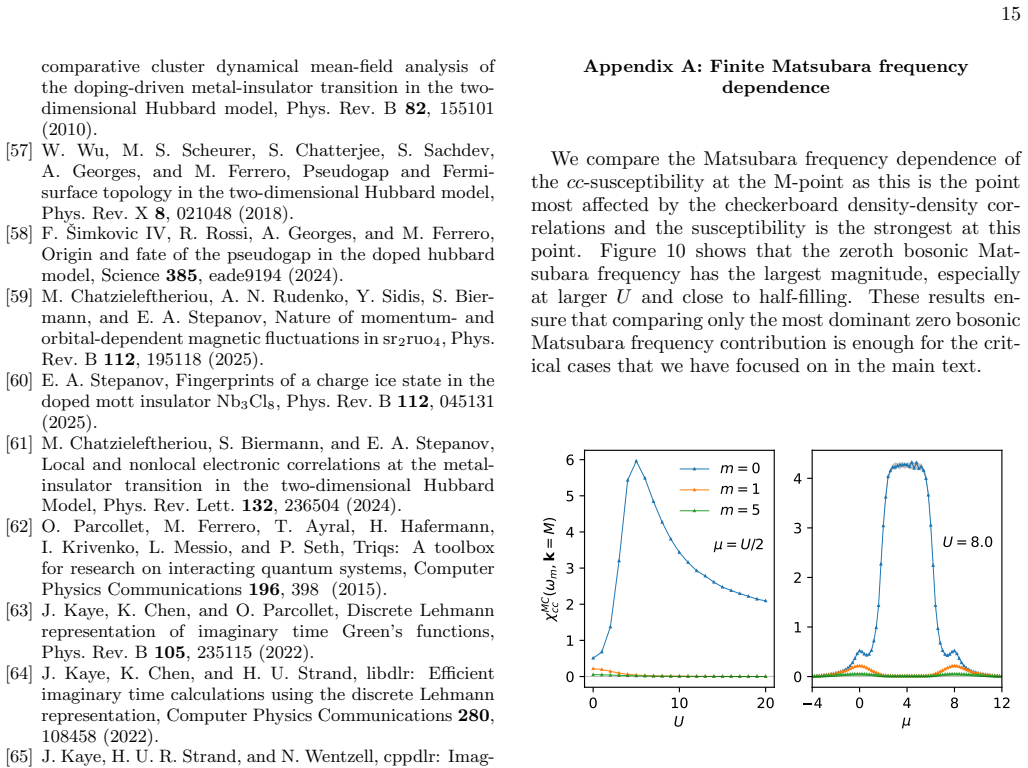
J. Kaye, H. U. R. Strand, and N. Wentzell, cppdlr: Imag- inary time calculations using the discrete Lehmann rep- resentation, Journal of Open Source Software9, 6297 (2024). Appendix A: Finite Matsubara frequency dependence We compare the Matsubara frequency dependence of thecc-susceptibility at the M-point as this is the point most affected by the checker...
work page 2024
-
[66]
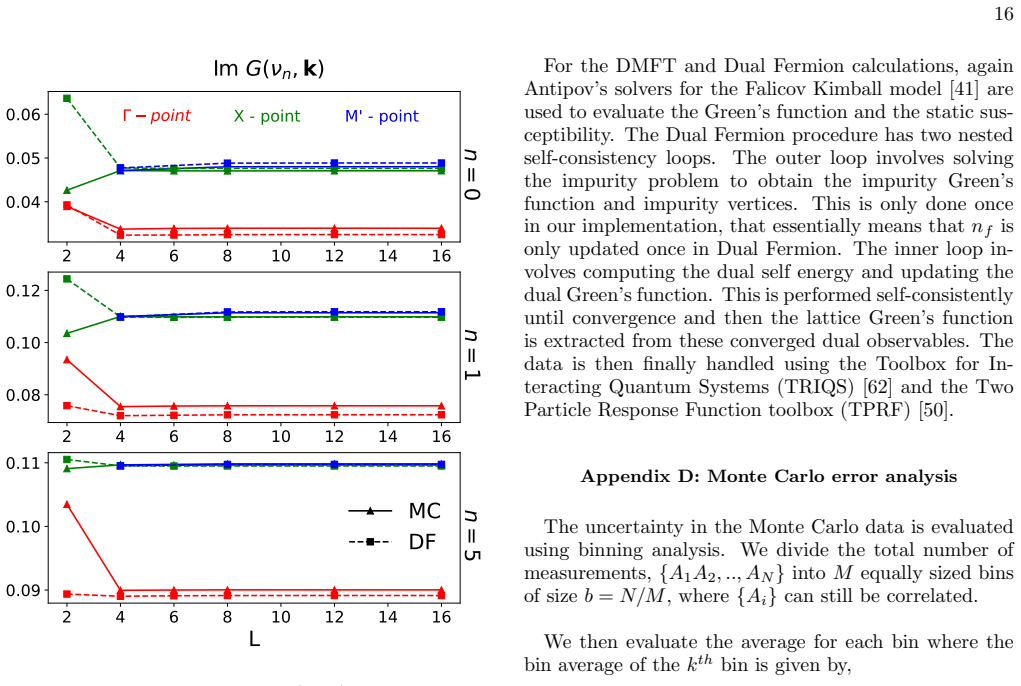
and the Two Particle Response Function toolbox (TPRF) [50]. To compress the Green’s functions, we use the imaginary-frequency Discrete Lehmann representation (DLR) [63–65] to evaluate Eq. (12) on a restricted, well-chosen set of Matsubara frequencies from which the entire Matsubara Green’s function can be reconstructed. For the calculation ofG (2), bubble...
discussion (0)
Sign in with ORCID, Apple, or X to comment. Anyone can read and Pith papers without signing in.