Recognition: unknown
Charging-up and reverse charging-up phenomena in a double-mask triple GEM detector
Pith reviewed 2026-05-09 22:21 UTC · model grok-4.3
The pith
GEM detectors show gain increasing from dielectric charging-up under high radiation and relaxing back via reverse charging-up when the rate drops.
A machine-rendered reading of the paper's core claim, the machinery that carries it, and where it could break.
Core claim
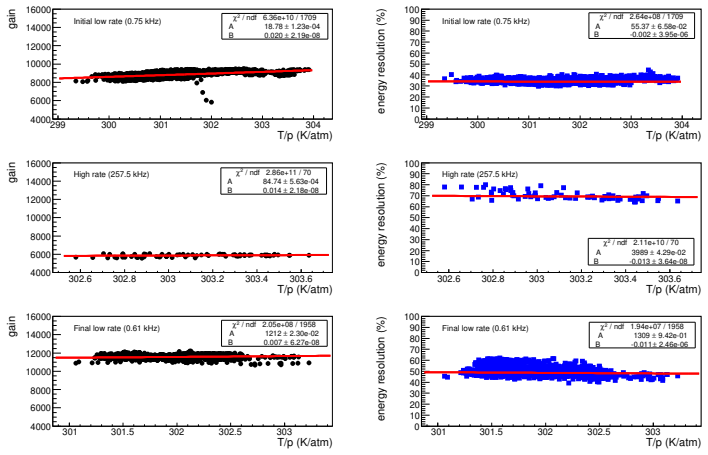
In the double-mask triple GEM chamber, the gain increases gradually with time at a fixed high irradiation rate due to charging-up of the Kapton dielectric in the foils, and upon reduction of the irradiation rate, the gain relaxes gradually towards its initial value due to the complementary reverse charging-up phenomenon.
What carries the argument
Charging-up and reverse charging-up of the dielectric (Kapton) material in the GEM foils, which modifies the electric field distribution and thereby the gas amplification factor.
If this is right
- The gain reaches a stable plateau after sufficient time under constant high irradiation.
- Lowering the irradiation rate causes the gain to return toward its starting value on a measurable timescale.
- Gain history must be considered when operating GEM detectors in environments with varying particle rates.
- The Ar/CO2 (70/30) measurements quantify the magnitude and time constants of both effects for this chamber geometry.
Where Pith is reading between the lines
- Similar dielectric charging may affect long-term stability in other micropattern detectors that contain insulating foils.
- Rate-history-dependent calibration could reduce systematic errors in tracking data from variable-rate experiments.
- Varying the gas mixture or foil surface treatment might alter the charging time constants and improve operational stability.
Load-bearing premise
The observed gain variations are caused by charging and reverse charging of the GEM foil dielectric rather than by gas effects, temperature changes, or other experimental artifacts.
What would settle it
No relaxation of the gain back to its initial value after the irradiation rate is reduced, while holding voltage, gas mixture, and temperature fixed.
Figures





read the original abstract
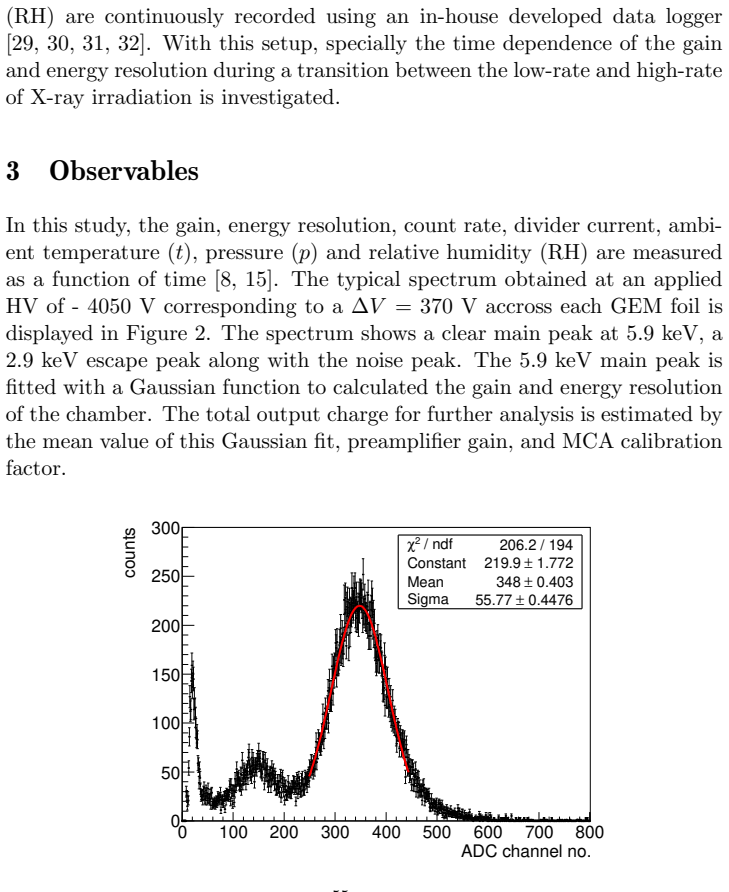
The Gas Electron Multiplier (GEM) detectors are widely used in high-energy physics (HEP) experiments as tracking devices because of their excellent position resolution and to handle high particle rates capability. Charging-up effect is a well known phenomenon in GEM detectors because of the presence of the dielectric medium -- Kapton in the foil. Charging-up of GEM foil takes place when it is exposed to high radiation after application of high voltage. A new phenomenon of reverse charging-up, a complementary behaviour is also observed when the irradiation rate is reduced, where the gain relaxes gradually towards its initial value. In this study, the charging-up and reverse charging-up effects are investigated for a double-mask triple GEM chamber operated with an Argon and Carbon dioxide (70/30) gas mixture. The measurements provide a detailed understanding of the gain variation under irradiation and its stabilisation behaviour. The experimental setup, methodology and results are presented in this article.
Editorial analysis
A structured set of objections, weighed in public.
Referee Report
Summary. The manuscript reports experimental observations of the well-known charging-up effect in a double-mask triple GEM detector operated in Ar/CO2 (70/30), where gain changes occur upon initial exposure to high radiation after HV application due to charge accumulation on the Kapton dielectric. It additionally claims a new complementary phenomenon of 'reverse charging-up,' in which reducing the irradiation rate causes the gain to relax gradually back toward its initial value. The work presents the detector setup, irradiation methodology, and time-dependent gain curves to document these stabilization behaviors.
Significance. If the reverse charging-up effect can be isolated from environmental artifacts, the result would be useful for understanding time-dependent gain stability in GEM detectors under varying particle rates, which is relevant for high-rate tracking applications in HEP. The paper's strength lies in its direct experimental documentation of both charging and relaxation behaviors in a standard triple-GEM configuration; however, the absence of controls for confounding variables limits the immediate impact.
major comments (1)
- Experimental section (rate-change protocol): The central claim that the observed gradual gain increase upon irradiation-rate reduction is due to reverse charging-up (discharge of surface charge on the Kapton) is not isolated from possible gas-density, pressure, temperature, or HV-ripple effects. No quantitative monitoring data or control runs at constant rate with deliberate environmental perturbations are reported, so the relaxation timescale cannot yet be attributed unambiguously to dielectric relaxation rather than artifacts.
minor comments (2)
- The abstract and introduction should explicitly state the typical irradiation rates (e.g., in Hz/cm²) and the magnitude of the observed gain variations (with uncertainties) to allow readers to assess the practical importance of the effect.
- Figure captions for the gain-vs-time plots should include the exact timing of rate changes and any simultaneous environmental sensor readings if available.
Simulated Author's Rebuttal
We thank the referee for their careful reading of the manuscript and for highlighting the importance of isolating the reverse charging-up effect from possible experimental artifacts. We provide a point-by-point response to the major comment below and will revise the manuscript to improve clarity on this issue.
read point-by-point responses
-
Referee: Experimental section (rate-change protocol): The central claim that the observed gradual gain increase upon irradiation-rate reduction is due to reverse charging-up (discharge of surface charge on the Kapton) is not isolated from possible gas-density, pressure, temperature, or HV-ripple effects. No quantitative monitoring data or control runs at constant rate with deliberate environmental perturbations are reported, so the relaxation timescale cannot yet be attributed unambiguously to dielectric relaxation rather than artifacts.
Authors: We acknowledge that the original manuscript does not report quantitative monitoring data or dedicated control runs, which limits the strength of the attribution. In the revised version we will add a new subsection to the experimental section that presents the recorded stability of temperature (variations <0.3 °C), pressure (<0.2 %), and gas flow rate during all measurements, together with the HV supply ripple specification. We will also include a brief discussion showing that the observed relaxation time constants (tens of minutes) are inconsistent with the much faster timescales expected for gas-density or HV-ripple fluctuations under our controlled conditions. While new control runs with deliberate perturbations are not feasible without additional beam time, the complementary charging-up and reverse-charging-up curves obtained in the same detector and gas mixture provide internal consistency supporting the dielectric interpretation. These additions will be incorporated in the next manuscript version. revision: partial
Circularity Check
No circularity: purely observational experimental report with no derivations or fitted predictions
full rationale
The paper reports direct experimental measurements of gain variations in a triple GEM detector under varying irradiation rates in Ar/CO2 gas, observing charging-up upon rate increase and reverse charging-up (gain relaxation) upon rate decrease. No equations, first-principles derivations, parameter fits, or predictions are presented that could reduce to inputs by construction. The central claims rest on time-dependent gain curves and qualitative interpretation of dielectric surface charge effects, without self-citations, ansatzes, or uniqueness theorems. This is a standard empirical study self-contained against external benchmarks such as independent rate-change experiments or RC time-constant calculations from literature.
Axiom & Free-Parameter Ledger
axioms (1)
- domain assumption Standard model of gas electron multiplication in GEM foils assumes charge accumulation on dielectric surfaces affects local electric field and gain.
Reference graph
Works this paper leans on
-
[1]
Sauli, Nucl
F. Sauli, Nucl. Instrum. Meth. A 386 (1997) 531
1997
-
[2]
Buzulutskov, Instrum
A.F. Buzulutskov, Instrum. Exp. Tech. 50 (2007) 287
2007
-
[3]
Ketzer et al., Nucl
B. Ketzer et al., Nucl. Instrum. Meth. A 535 (2004) 314
2004
-
[4]
Sharma, Czech
A. Sharma, Czech. J. Phys. 56 (2006) C235
2006
-
[5]
ALICE Collaboration, Upgrade of the ALICE Time Projection Cham- ber, CERN-LHCC-2013-020, ALICE-TDR-016
2013
-
[6]
CMS Muon Group collaboration, GEM detectors for the Upgrade of the CMS Muon Forward system, J. Phys. Conf. Ser. 1390 (2019) 012116
2019
-
[7]
Adak et al., JINST 11 (2016) T10001
R.P. Adak et al., JINST 11 (2016) T10001
2016
-
[9]
CBM Collaboration, https://www.cbm.gsi.de/
-
[10]
Galatyuk, Nucl
T. Galatyuk, Nucl. Phys. A 982 (2019) 163
2019
-
[11]
ALICE Collaboration, JINST 16 (2021) P03022
2021
-
[12]
Bachmann et al., Nucl
S. Bachmann et al., Nucl. Instrum. Meth. A 479 (2002) 294
2002
-
[13]
RD51 Collaboration, JINST 3 (2008) P08007
2008
-
[14]
Chatterjee et al., Nucl
S. Chatterjee et al., Nucl. Instrum. Meth. A 936 (2019) 491
2019
-
[15]
Mandal et al., Nucl
S. Mandal et al., Nucl. Instrum. Meth. A 1064 (2024) 169389. 13
2024
-
[16]
Abbaneo et al., IEEE Trans
D. Abbaneo et al., IEEE Trans. Nucl. Sci. 50 (2003) 1174
2003
-
[17]
Bressan et al., Nucl
A. Bressan et al., Nucl. Instrum. Meth. A 424 (1999) 321
1999
-
[18]
Chatterjee et al., JINST 15 (2020) T09011
S. Chatterjee et al., JINST 15 (2020) T09011
2020
-
[19]
Chatterjee et al., Nucl
S. Chatterjee et al., Nucl. Instrum. Meth. A 1014 (2021) 165749
2021
-
[20]
Chatterjee et al., Nucl
S. Chatterjee et al., Nucl. Instrum. Meth. A 1049 (2023) 168110
2023
-
[21]
Altunbas et al., Nucl
C. Altunbas et al., Nucl. Instrum. Meth. A 490 (2002) 177
2002
-
[22]
Abbrescia et al., Nucl
M. Abbrescia et al., Nucl. Instrum. Meth. A 593 (2008) 263
2008
-
[23]
Silva et al., JINST 14 (2019) C08004
J. Silva et al., JINST 14 (2019) C08004
2019
-
[24]
Del Papa et al., JINST 13 (2018) P08014
C. Del Papa et al., JINST 13 (2018) P08014
2018
-
[25]
Bucciantonio et al., Mod
M. Bucciantonio et al., Mod. Phys. Lett. A 30 (2015) 1540024
2015
-
[26]
Sahu et al., JINST 12 (2017) C05006
S. Sahu et al., JINST 12 (2017) C05006
2017
-
[27]
CDT CASCADE Detector Technologies GmbH, Germany, www.n- cdt.com
-
[28]
Long-term stability study of single-mask triple GEM detector: impact of continuous irradiation
S. Mandal et al., arXiv:2604.07381 [physics.ins-det]
work page internal anchor Pith review Pith/arXiv arXiv
-
[29]
Zhao et al., JINST 9 (2014) C12046
W. Zhao et al., JINST 9 (2014) C12046
2014
-
[30]
Chatterjee et al., Nucl
S. Chatterjee et al., Nucl. Instrum. Meth. A 1046 (2023) 167747
2023
-
[31]
Anderson et al., Nucl
J. Anderson et al., Nucl. Instrum. Meth. A 978 (2020) 164390
2020
-
[32]
Mandal et al., Proc
S. Mandal et al., Proc. DAE Symp. Nucl. Phys. 69 (2025) 1299-1300
2025
-
[33]
Chatterjee, Performance Studies of Gas Electron Multiplier Detector for the Muon Chamber of High Rate CBM Experiment at FAIR, Ph.D
S. Chatterjee, Performance Studies of Gas Electron Multiplier Detector for the Muon Chamber of High Rate CBM Experiment at FAIR, Ph.D. Thesis, University of Calcutta, 2023. 14
2023
discussion (0)
Sign in with ORCID, Apple, or X to comment. Anyone can read and Pith papers without signing in.