Profiles of the Power Density and Other Properties of Hydrogen Magnetohydrodynamic Generators at Conditions
Pith reviewed 2026-05-09 18:41 UTC · model grok-4.3
The pith
Hydrogen MHD generators can exceed 1000 MW per cubic meter power density at low pressure with cesium seeding.
A machine-rendered reading of the paper's core claim, the machinery that carries it, and where it could break.
Core claim
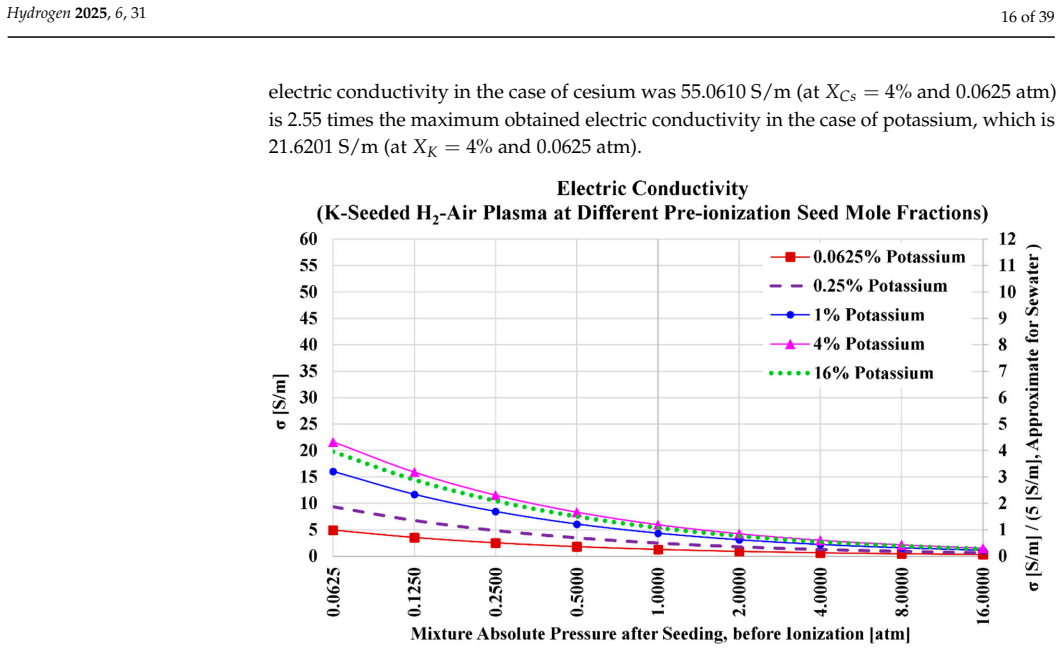
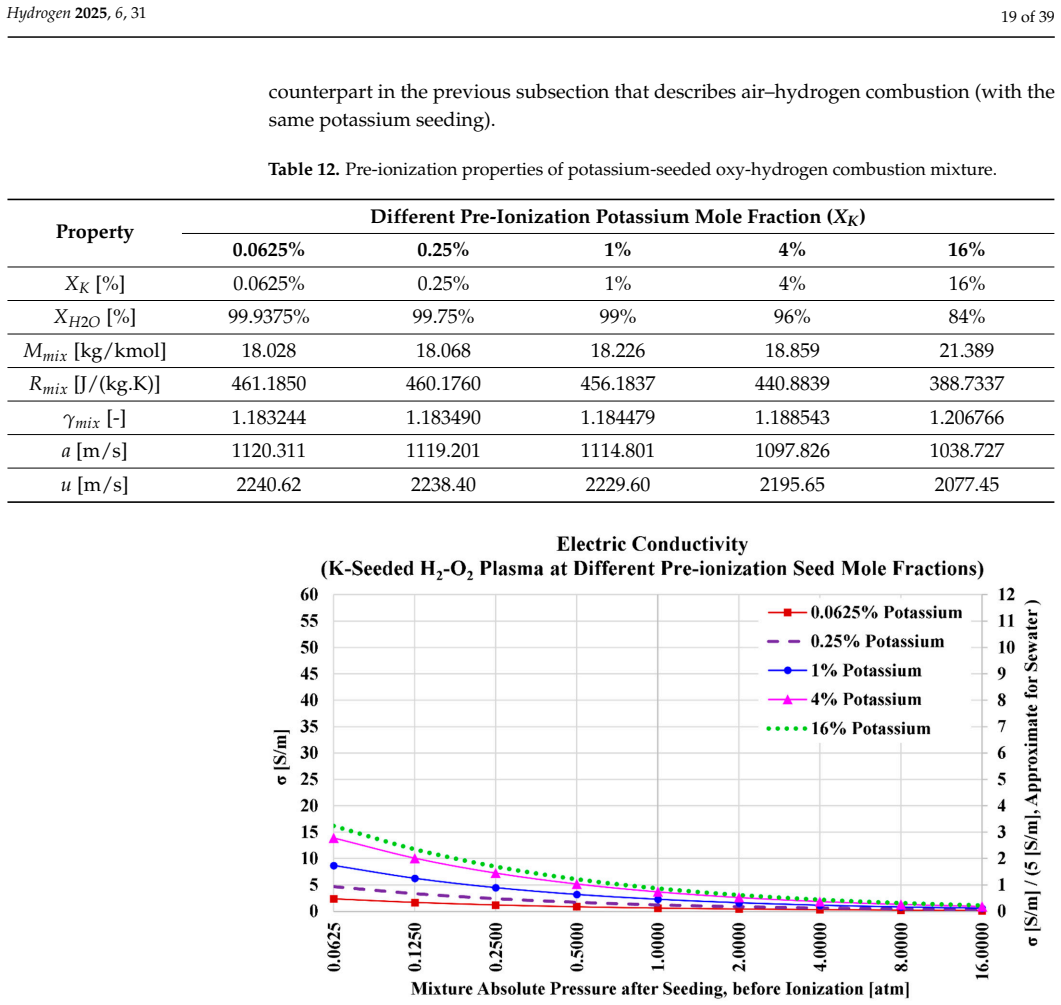
In a typical OCMHD supersonic channel with thermal equilibrium plasma accelerated at a Mach number of two while subject to a 5 T magnetic field at 2300 K, the ideal power density can reach levels beyond 1000 MW/m³ provided that the total absolute pressure is reduced to about 0.1 atm and cesium is used for seeding rather than potassium.
What carries the argument
Thermal-equilibrium plasma conductivity computed from seeded hydrogen combustion products, inserted into the volumetric power-density expression for flow at Mach 2 under an applied 5 T field.
If this is right
- Power density rises to more than 1000 MW/m³ once total pressure falls to 0.1 atm with cesium seeding.
- Cesium seeding yields higher conductivity and power density than potassium seeding at the lowest pressures tested.
- The sweeps across pressure and seed fraction locate the combinations that maximize ideal output.
- Choice of air versus pure oxygen as oxidizer produces smaller changes in power density than changes in pressure or seed type.
Where Pith is reading between the lines
- If the ideal model holds in practice, these generators could produce compact stationary power units fed by hydrogen or its derivatives.
- Real hardware would need to minimize boundary-layer and non-equilibrium losses to approach the predicted densities at 0.1 atm.
- The same parameter study could be repeated at slightly different Mach numbers or field strengths to test robustness.
Load-bearing premise
The plasma stays in thermal equilibrium so that conductivity follows the chosen model at Mach 2, 5 T, and 2300 K for every pressure and seed fraction examined, while real-device losses, boundary layers, and non-equilibrium effects remain negligible.
What would settle it
Direct measurement of volumetric electric power output in a laboratory seeded-hydrogen plasma flow at 0.1 atm total pressure, Mach 2 velocity, 5 T field, and 2300 K with cesium seeding would show whether the density actually exceeds 1000 MW/m³.
Figures





read the original abstract
Hydrogen and some of its derivatives (such as e-methanol, e-methane, and e-ammonia) are promising energy carriers that have the potential to replace conventional fuels, thereby eliminating their harmful environmental impacts. An innovative use of hydrogen as a zero-emission fuel is forming weakly ionized plasma by seeding the combustion products of hydrogen with a small amount of an alkali metal vapor (cesium or potassium). This formed plasma can be used as a working fluid in supersonic open-cycle magnetohydrodynamic (OCMHD) power generators. In these OCMHD generators, direct-current (DC) electricity is generated straightforwardly without rotary turbogenerators. In the current study, we quantitatively and qualitatively explore the levels of electric conductivity and the resultant volumetric electric output power density in a typical OCMHD supersonic channel, where thermal equilibrium plasma is accelerated at a Mach number of two (Mach 2) while being subject to a strong applied magnetic field (applied magnetic-field flux density) of five teslas (5 T), and a temperature of 2300 K (2026.85 {\deg}C). We varied the total pressure of the pre-ionization seeded gas mixture between 1/16 atm and 16 atm. We also varied the seed level between 0.0625% and 16% (pre-ionization mole fraction). We also varied the seed type between cesium and potassium. We also varied the oxidizer type between air (oxygen-nitrogen mixture, 21-79% by mole) and pure oxygen. Our results suggest that the ideal power density can reach exceptional levels beyond 1000 MW/m3 (or 1 kW/cm3) provided that the total absolute pressure can be reduced to about 0.1 atm only and cesium is used for seeding rather than potassium.
Editorial analysis
A structured set of objections, weighed in public.
Referee Report
Summary. The manuscript calculates electric conductivity and volumetric power density for weakly ionized plasmas formed from hydrogen combustion products seeded with cesium or potassium, in a supersonic open-cycle MHD generator channel at Mach 2, 5 T, and 2300 K. Parametric sweeps are performed over total pressure (1/16 atm to 16 atm), seed mole fraction (0.0625% to 16%), seed species, and oxidizer (air vs. pure oxygen). The central claim is that ideal power densities can exceed 1000 MW/m³ at ~0.1 atm when cesium is used for seeding.
Significance. If the underlying conductivity model is accurate under the stated conditions, the results indicate that OCMHD generators could achieve exceptionally high power densities, offering a pathway for direct, high-efficiency conversion of hydrogen-derived chemical energy to electricity without turbomachinery. The broad parametric exploration supplies concrete operating windows that could inform device design, although the absence of model validation or uncertainty quantification at the extreme low-pressure end limits the immediate engineering utility.
major comments (1)
- [Results and Discussion (low-pressure cases)] The headline result (>1000 MW/m³ at ~0.1 atm with Cs seeding) is load-bearing on the assumption that the chosen thermal-equilibrium conductivity model remains valid at 0.1 atm, Mach 2, 5 T, and 2300 K. At this pressure the mean free path lengthens, electron-neutral collision frequency drops, and the premise Te = Tg can fail, directly affecting σ and therefore the power density P = σ u² B² K(1-K). No kinetic simulation, sensitivity study to Te ≠ Tg, or experimental benchmark is supplied for the low-pressure regime.
minor comments (2)
- [Abstract] The abstract and early sections refer to 'ideal power density' without stating the explicit expression used or the value adopted for the load factor K.
- [Results] No error bars, sensitivity ranges, or uncertainty estimates are attached to the reported conductivity or power-density values despite the parametric nature of the study.
Simulated Author's Rebuttal
We thank the referee for their thorough review and valuable feedback on our manuscript. The primary concern raised pertains to the validity of our thermal equilibrium assumption in the low-pressure regime, which we address below.
read point-by-point responses
-
Referee: [Results and Discussion (low-pressure cases)] The headline result (>1000 MW/m³ at ~0.1 atm with Cs seeding) is load-bearing on the assumption that the chosen thermal-equilibrium conductivity model remains valid at 0.1 atm, Mach 2, 5 T, and 2300 K. At this pressure the mean free path lengthens, electron-neutral collision frequency drops, and the premise Te = Tg can fail, directly affecting σ and therefore the power density P = σ u² B² K(1-K). No kinetic simulation, sensitivity study to Te ≠ Tg, or experimental benchmark is supplied for the low-pressure regime.
Authors: We agree that the validity of the thermal-equilibrium conductivity model is crucial for the headline results at low pressures. Our calculations use a standard model based on thermal equilibrium and Saha ionization, which is common in OCMHD studies. While non-equilibrium effects (Te ≠ Tg) may occur at 0.1 atm due to longer mean free paths, the high temperature (2300 K) and seed concentrations ensure sufficient collisions to maintain approximate equilibrium in many practical scenarios, as per established plasma physics. The manuscript does not include kinetic simulations or benchmarks as it is a parametric numerical exploration using equilibrium assumptions. We will revise the paper to include a discussion of this limitation, providing estimates of the electron energy balance and referencing literature on when the equilibrium approximation holds in MHD generators. This will strengthen the manuscript by clarifying the scope of the results. revision: partial
Circularity Check
No circularity: forward parametric simulation of conductivity and power density from input plasma conditions
full rationale
The paper conducts a parametric exploration by varying total pressure (1/16 to 16 atm), seed fraction (0.0625% to 16%), seed type (Cs or K), and oxidizer (air or O2), then computes electric conductivity and volumetric power density at fixed Mach 2, 5 T, and 2300 K using a thermal-equilibrium plasma model. The power density expression P = σ u² B² K(1-K) (with u obtained from isentropic relations) is evaluated directly from these inputs; no target power density is used to fit any parameter, no self-definitional loop exists, and no load-bearing self-citation or uniqueness theorem is invoked. The derivation chain is therefore self-contained and non-circular.
Axiom & Free-Parameter Ledger
axioms (1)
- domain assumption Thermal equilibrium plasma at 2300 K with conductivity determined by standard alkali-seeded combustion-product models
Reference graph
Works this paper leans on
-
[1]
The most popular element in the universe
Field, D. The most popular element in the universe. Phys. World 1995, 8, 24. [CrossRef]
work page 1995
-
[2]
Goncharuk, V .V .; Goncharuk, D.K. Water is Everywhere. It Holds Everything, Even a Key to Understanding the Universe. D. I. Mendeleev’s Law is the Prototype of the Universe Constitution.J. Water Chem. Technol. 2019, 41, 341–346. [CrossRef]
work page 2019
-
[3]
Supersulfide biology and translational medicine for disease control
Barayeu, U.; Sawa, T.; Nishida, M.; Wei, F.-Y.; Motohashi, H.; Akaike, T. Supersulfide biology and translational medicine for disease control. Br. J. Pharmacol. 2025. [CrossRef]
work page 2025
-
[4]
Krebs, R.E. The History and Use of Our Earth’s Chemical Elements: A Reference Guide; Greenwood Press: Westport, CT, USA, 2006; Available online: https://books.google.com.om/books?id=D7LOEAAAQBAJ (accessed on 4 April 2025)
work page 2006
-
[5]
Palladium Membranes for Hydrogen Separation
Ma, Y.H. Palladium Membranes for Hydrogen Separation. In Membranes for Energy Conversion; Peinemann, K.-V ., Nunes, S.P ., Eds.; John Wiley & Sons: Weinheim, Germany, 2008; pp. 245–261. Available online: https://books.google.com.om/books?id= KCTyy64_IO8C (accessed on 30 March 2025)
work page 2008
-
[6]
Performance analysis of shell-and-tube dehydrogenation module
Marzouk, O.A. Performance analysis of shell-and-tube dehydrogenation module. Int. J. Energy Res. 2017, 41, 604–610. [CrossRef]
work page 2017
-
[7]
Vergara, D.; Fernández-Arias, P .; Lampropoulos, G.; Antón-Sancho, Á. Hydrogen Revolution in Europe: Bibliometric Review of Industrial Hydrogen Applications for a Sustainable Future. Energies 2024, 17, 3658. [CrossRef]
work page 2024
-
[8]
Decarbonizing the Industry with Green Hydrogen
Altaf, C.T.; Demir, O.; Colak, T.O.; Karagöz, E.; Kurt, M.; Sankir, N.D.; Sankir, M. Decarbonizing the Industry with Green Hydrogen. In Towards Green Hydrogen Generation; John Wiley & Sons, Ltd.: Hoboken, NJ, USA, 2024; pp. 1–48. [CrossRef]
work page 2024
-
[9]
Modeling and optimization of an industrial hydrogen unit in a crude oil refinery
Sarkarzadeh, M.; Farsi, M.; Rahimpour, M.R. Modeling and optimization of an industrial hydrogen unit in a crude oil refinery. Int. J. Hydrogen Energy 2019, 44, 10415–10426. [CrossRef]
work page 2019
-
[10]
Green hydrogen production for oil refining—Finnish case
Moradpoor, I.; Syri, S.; Santasalo-Aarnio, A. Green hydrogen production for oil refining—Finnish case. Renew. Sustain. Energy Rev. 2023, 175, 113159. [CrossRef]
work page 2023
-
[11]
Analysis of Refinery Hydrogen Distribution Systems.Ind
Alves, J.J.; Towler, G.P . Analysis of Refinery Hydrogen Distribution Systems.Ind. Eng. Chem. Res. 2002, 41, 5759–5769. [CrossRef]
work page 2002
-
[12]
Future prospects towards attaining zero- emission of greenhouse gases from crude oil refinery plants
Popoola, L.T.; Nwogbu, C.C.; Taura, U.; Asmara, Y.P .; Nwobodo, L.O.; Agbo, A.O. Future prospects towards attaining zero- emission of greenhouse gases from crude oil refinery plants. Clean. Waste Syst. 2025, 11, 100290. [CrossRef]
work page 2025
-
[13]
Hydrogen-based industry: A prospective transition pathway toward a low-carbon future
Cheng, Y.; Zheng, R.; Liu, Z.; Xie, Z. Hydrogen-based industry: A prospective transition pathway toward a low-carbon future. Natl. Sci. Rev. 2023, 10, nwad091. [CrossRef]
work page 2023
-
[14]
Zhang, Q.; Liu, J.-F.; Gao, Z.-H.; Chen, S.-Y.; Liu, B.-Y. Review on the challenges and strategies in oil and gas industry’s transition towards carbon neutrality in China. Pet. Sci. 2023, 20, 3931–3944. [CrossRef]
work page 2023
-
[15]
An advanced 1D physics-based model for PEM hydrogen fuel cells with enhanced overvoltage prediction
Gass, R.; Li, Z.; Outbib, R.; Jemei, S.; Hissel, D. An advanced 1D physics-based model for PEM hydrogen fuel cells with enhanced overvoltage prediction. Int. J. Hydrogen Energy 2025, 97, 1108–1125. [CrossRef]
work page 2025
-
[16]
Chen, Z.; Shu, C.; Gan, Z.; Cao, J.; Qiu, P .; Sun, X.; Deng, C.; Wu, Y.; Tang, W. Research Progress and Perspectives on Anti-Poisoning Hydrogen Oxidation Reaction Electrocatalysts for Hydrogen Fuel Cells. Small 2025, 21, 2411049. [CrossRef] [PubMed]
work page 2025
-
[17]
Li, Y.H.; Choi, S.S.; Rajakaruna, S. An analysis of the control and operation of a solid oxide fuel-cell power plant in an isolated system. IEEE Trans. Energy Convers. 2005, 20, 381–387. [CrossRef]
work page 2005
-
[18]
Compilation of Smart Cities Attributes and Quantitative Identification of Mismatch in Rankings
Marzouk, O.A. Compilation of Smart Cities Attributes and Quantitative Identification of Mismatch in Rankings. J. Eng. 2022, 2022, 5981551. [CrossRef]
work page 2022
-
[19]
Coordinated Control Strategies for Fuel Cell Power Plant in a Microgrid.IEEE Trans
Sun, L.; Wu, G.; Xue, Y.; Shen, J.; Li, D.; Lee, K.Y. Coordinated Control Strategies for Fuel Cell Power Plant in a Microgrid.IEEE Trans. Energy Convers. 2018, 33, 1–9. [CrossRef]
work page 2018
-
[20]
Genovese, M.; Corigliano, O.; Piraino, F.; Fragiacomo, P . E-fuels infrastructures for heavy-duty applications: Case study of a refueling facility based on green hydrogen. Int. J. Hydrogen Energy, 2025; in press. [CrossRef]
work page 2025
-
[21]
Fozer, D.; Owsianiak, M.; Hauschild, M.Z. Quantifying environmental learning and scaling rates for prospective life cycle assessment of e-ammonia production. Renew. Sustain. Energy Rev. 2025, 213, 115481. [CrossRef]
work page 2025
-
[22]
Sun, S.; Jiang, Q.; Zhao, D.; Cao, T.; Sha, H.; Zhang, C.; Song, H.; Da, Z. Ammonia as hydrogen carrier: Advances in ammonia decomposition catalysts for promising hydrogen production. Renew. Sustain. Energy Rev. 2022, 169, 112918. [CrossRef]
work page 2022
-
[23]
Ammonia for hydrogen storage: Challenges and opportunities.J
Klerke, A.; Christensen, C.H.; Nørskov, J.K.; Vegge, T. Ammonia for hydrogen storage: Challenges and opportunities.J. Mater. Chem. 2008, 18, 2304–2310. [CrossRef]
work page 2008
-
[24]
Marzouk, O.A. Levelized cost of green hydrogen (LCOH) in the Sultanate of Oman using H2A-Lite with polymer electrolyte membrane (PEM) electrolyzers powered by solar photovoltaic (PV) electricity. E3S Web Conf. 2023, 469, 00101. [CrossRef]
work page 2023
-
[25]
Absolute density measurements of ammonia synthetized in N2–H2 mixture discharges
Amorim, J.; Baravian, G.; Sultan, G. Absolute density measurements of ammonia synthetized in N2–H2 mixture discharges. Appl. Phys. Lett. 1996, 68, 1915–1917. [CrossRef]
work page 1996
-
[26]
Hydrogen Road Transport Analysis in the Energy System: A Case Study for Germany through 2050
Reuß, M.; Dimos, P .; Léon, A.; Grube, T.; Robinius, M.; Stolten, D. Hydrogen Road Transport Analysis in the Energy System: A Case Study for Germany through 2050. Energies 2021, 14, 3166. [CrossRef]
work page 2050
-
[27]
Toward More Sustainable Transportation: Green Vehicle Metrics for 2023 and 2024 Model Years
Marzouk, O.A. Toward More Sustainable Transportation: Green Vehicle Metrics for 2023 and 2024 Model Years. InIntelligent Sustainable Systems; Nagar, A.K., Jat, D.S., Mishra, D.K., Joshi, A., Eds.; Springer Nature: Singapore, 2024; pp. 261–272. [CrossRef]
work page 2023
-
[28]
Can hydrogen fuel cell vehicles drive the future of sustainable transportation? An empirical study
Dhingra, S.; Sharma, S.; Jaiswal, A.; Chadha, R.; Suneja, G.; Gupta, A. Can hydrogen fuel cell vehicles drive the future of sustainable transportation? An empirical study. Technol. Sustain. 2025, 4, 181–193. [CrossRef] Hydrogen 2025, 6, 31 28 of 39
work page 2025
-
[29]
Rail transportation by hydrogen vs
Marin, G.D.; Naterer, G.F.; Gabriel, K. Rail transportation by hydrogen vs. electrification—Case study for Ontario, Canada, II: Energy supply and distribution. Int. J. Hydrogen Energy 2010, 35, 6097–6107. [CrossRef]
work page 2010
-
[30]
Marzouk, O.A. Growth in the Worldwide Stock of E-Mobility Vehicles (by Technology and by Transport Mode) and the Worldwide Stock of Hydrogen Refueling Stations and Electric Charging Points between 2020 and 2022. In Construction Materials and Their Processing; Trans Tech Publications Ltd.: Wollerau, Switzerland, 2023; pp. 89–96. [CrossRef]
work page 2020
-
[31]
Galimova, T.; Fasihi, M.; Bogdanov, D.; Breyer, C. Impact of international transportation chains on cost of green e-hydrogen: Global cost of hydrogen and consequences for Germany and Finland. Appl. Energy 2023, 347, 121369. [CrossRef]
work page 2023
-
[32]
Marzouk, O.A. Recommended LEED-Compliant Cars, SUVs, Vans, Pickup Trucks, Station Wagons, and Two Seaters for Smart Cities Based on the Environmental Damage Index (EDX) and Green Score. In Innovations in Smart Cities Applications Volume 7; Ben Ahmed, M., Boudhir, A.A., El Meouche, R., Karas, , ˙I.R., Eds.; Springer Nature: Cham, Switzerland, 2024; pp. 123...
work page 2024
-
[33]
Liu, Y.; Li, Z.; Huang, X.; Liu, F.; Zhou, F.; Lim, M.K. Uncovering determinants and barriers to hydrogen fuel cell vehicle adoption: Evidence from Chongqing, China. Int. J. Hydrogen Energy 2025, 106, 875–887. [CrossRef]
work page 2025
-
[34]
Bianchi, F.R.; Risso, R.; Cardona, L.; Bove, D.; Cannizzaro, F.; Bonardi, L.; Palmisani, E.; Bosio, B. Feasibility analysis of e-Hydrogen, e-Ammonia and e-Methanol synthesis compared with methane to fuel production. Fuel 2025, 384, 133938. [CrossRef]
work page 2025
-
[35]
Renewable hydrogen utilisation for the production of methanol
Galindo Cifre, P .; Badr, O. Renewable hydrogen utilisation for the production of methanol. Energy Convers. Manag. 2007, 48, 519–527. [CrossRef]
work page 2007
-
[36]
Methanol production using hydrogen from concentrated solar energy
Monnerie, N.; Gan, P .G.; Roeb, M.; Sattler, C. Methanol production using hydrogen from concentrated solar energy. Int. J. Hydrogen Energy 2020, 45, 26117–26125. [CrossRef]
work page 2020
-
[37]
Chapter 1—Methanol Production and Applications: An Overview
Dalena, F.; Senatore, A.; Marino, A.; Gordano, A.; Basile, M.; Basile, A. Chapter 1—Methanol Production and Applications: An Overview. In Methanol; Basile, A., Dalena, F., Eds.; Elsevier: Amsterdam, The Netherlands, 2018; pp. 3–28. [CrossRef]
work page 2018
-
[38]
Galimova, T.; Fasihi, M.; Bogdanov, D.; Lopez, G.; Breyer, C. Analysis of green e-methanol supply costs: Domestic production in Europe versus imports via pipeline and sea shipping. Renew. Energy 2025, 241, 122336. [CrossRef]
work page 2025
-
[39]
Sillman, J.; Ylä-Kujala, A.; Hyypiä, J.; Kärri, T.; Tuomaala, M.; Soukka, R. Feasibility assessment of e-methanol value chains: Temporal and regional renewable energy, costs, and climate impacts.Appl. Energy 2025, 391, 125887. [CrossRef]
work page 2025
-
[40]
Performance Analysis of Hydrogen-Powered Gas Turbine Engines: A Parametric Study
Elmeknassi, Y.; He, W.; Adam, A.; Deng, J.; Lou, Z.; Wang, C.; Chen, L. Performance Analysis of Hydrogen-Powered Gas Turbine Engines: A Parametric Study. In Proceedings of the 2024 7th International Conference on Renewable Energy and Power Engineering (REPE), Beijing, China, 25–27 September 2024; pp. 379–385. [CrossRef]
work page 2024
-
[41]
Using Hydrogen as Gas Turbine Fuel.J
Chiesa, P .; Lozza, G.; Mazzocchi, L. Using Hydrogen as Gas Turbine Fuel.J. Eng. Gas. Turbines Power 2005, 127, 73–80. [CrossRef]
work page 2005
-
[42]
Materials challenges in hydrogen-fuelled gas turbines.Int
Stefan, E.; Talic, B.; Larring, Y.; Gruber, A.; Peters, T.A. Materials challenges in hydrogen-fuelled gas turbines.Int. Mater. Rev. 2022, 67, 461–486. [CrossRef]
work page 2022
-
[43]
Nyholm, F.; Toppinen, S.; Saxén, H. Holistic Evaluation Method for Concept-Level Study of Power-to-Liquids Technologies for e-Kerosene Production. Ind. Eng. Chem. Res. 2024, 63, 20264–20286. [CrossRef]
work page 2024
-
[44]
Song, Z.; Zhao, J. Research on the Integrated Development of Nuclear Energy and Aviation Industry Under the Background of “Dual Carbon” Goals. E3S Web Conf. 2024, 573, 03008. [CrossRef]
work page 2024
-
[45]
Marzouk, O.A. Subcritical and supercritical Rankine steam cycles, under elevated temperatures up to 900 ◦C and absolute pressures up to 400 bara. Adv. Mech. Eng. 2024, 16, 16878132231221065. [CrossRef]
work page 2024
-
[46]
Advancing Direct Air Capture Technologies: From Carbon Removal to Sustainable Aviation Fuels
Pacheco, L.S.; Hernández-Gutiérrez, L.E. Advancing Direct Air Capture Technologies: From Carbon Removal to Sustainable Aviation Fuels. In Proceedings of the Copernicus Meetings (EGU General Assembly 2025), Vienna, Austria, 27 April–2 May 2025. [CrossRef]
work page 2025
-
[47]
Gao, R.; Zhang, C.; Jun, K.-W.; Kim, S.K.; Park, H.-G.; Zhao, T.; Wang, L.; Wan, H.; Guan, G. Transformation of CO2 into liquid fuels and synthetic natural gas using green hydrogen: A comparative analysis. Fuel 2021, 291, 120111. [CrossRef]
work page 2021
-
[48]
E-Kerosene Potential for Commercial Aviation Decarbonization
Quaresma, G.; Magalh ães, L.B.; Ferreira, A.F.; Silva, A. E-Kerosene Potential for Commercial Aviation Decarbonization. In Proceedings of the 34th Congress of the International Council of the Aeronautical Sciences (ICAS 2024), Florence, Italy, 9–13 September 2024; ICAS [International Council of the Aeronautical Sciences]: Florence, Italy, 2024. Available ...
work page 2024
-
[49]
Evaluation Method for Power-to-Liquids Concepts for e-Kerosene Production
Nyholm, F.; Saxén, H. Evaluation Method for Power-to-Liquids Concepts for e-Kerosene Production. In Computer Aided Chemical Engineering; Manenti, F., Reklaitis, G.V ., Eds.; Elsevier: Amsterdam, The Netherlands, 2024; pp. 3349–3354. [CrossRef]
work page 2024
-
[50]
Ozkan, M.; Narappa, A.B.; Namboodiri, T.; Chai, Y.; Babu, M.; Jennings, J.S.E.; Gao, Y.; Tasneem, S.; Lam, J.; Talluri, K.R.; et al. Forging a sustainable sky: Unveiling the pillars of aviation e-fuel production for carbon emission circularity. iScience 2024, 27, 109154. [CrossRef]
work page 2024
-
[51]
Diversity in the acceptance of sustainable aviation fuels: Uncovering varying motivational patterns
Schomakers, E.-M.; Engelmann, L.; Ziefle, M. Diversity in the acceptance of sustainable aviation fuels: Uncovering varying motivational patterns. Fuel Commun. 2024, 20, 100129. [CrossRef]
work page 2024
-
[52]
A New Perspective on Battery-Electric Aviation, Part II: Conceptual Design of a 90-Seater
De Vries, R.; Wolleswinkel, R.E.; Hoogreef, M.; Vos, R. A New Perspective on Battery-Electric Aviation, Part II: Conceptual Design of a 90-Seater. In Proceedings of the AIAA SCITECH 2024 Forum, Orlando, FL, USA, 8–12 January 2024; AIAA [American Institute of Aeronautics and Astronautics]: Orlando, FL, USA, 2024; p. 1490. [CrossRef] Hydrogen 2025, 6, 31 29 of 39
work page 2024
-
[53]
Urban air mobility and flying cars: Overview, examples, prospects, drawbacks, and solutions
Marzouk, O.A. Urban air mobility and flying cars: Overview, examples, prospects, drawbacks, and solutions. Open Eng. 2022, 12, 662–679. [CrossRef]
work page 2022
-
[54]
Bhapkar, S.; Sain, C.; Kazula, S. Review and Evaluation of Hydrogen and Air Heat Exchangers for Fuel Cell-Powered Electric Aircraft Propulsion. Eng. Proc. 2025, 90, 62. [CrossRef]
work page 2025
-
[55]
Hydrogen-Powered Aircraft: Hydrogen–electric hybrid propulsion for aviation.IEEE Electrif
Gao, Y.; Jausseme, C.; Huang, Z.; Yang, T. Hydrogen-Powered Aircraft: Hydrogen–electric hybrid propulsion for aviation.IEEE Electrif. Mag. 2022, 10, 17–26. [CrossRef]
work page 2022
-
[56]
Hydrogen as the futuristic fuel for the aviation and aerospace industry—Review
Gunasekar, P .; Manigandan, S.; Kumar, T.R.P . Hydrogen as the futuristic fuel for the aviation and aerospace industry—Review. Aircr. Eng. Aerosp. Technol. 2020, 93, 410–416. [CrossRef]
work page 2020
-
[57]
A two-step computational aeroacoustics method applied to high-speed flows
Marzouk, O.A. A two-step computational aeroacoustics method applied to high-speed flows. Noise Control Eng. J. 2008, 56, 396. [CrossRef]
work page 2008
-
[58]
Hydrogen for aircraft power and propulsion
Petrescu, R.V .V .; Machín, A.; Fontánez, K.; Arango, J.C.; Márquez, F.M.; Petrescu, F.I.T. Hydrogen for aircraft power and propulsion. Int. J. Hydrogen Energy 2020, 45, 20740–20764. [CrossRef]
work page 2020
-
[59]
Hydrogen as aviation fuel: A comparison with hydrocarbon fuels.Int
Contreras, A.; Yi˘ git, S.; Özay, K.; Veziro˘ glu, T.N. Hydrogen as aviation fuel: A comparison with hydrocarbon fuels.Int. J. Hydrogen Energy 1997, 22, 1053–1060. [CrossRef]
work page 1997
-
[60]
Fundamentals of Innovative Aircraft Heat Exchanger Integration for Hydrogen–Electric Propulsion
Gerl, B.; Ronovsky-Bodisch, M.; Ferrari, N.; Berens, M. Fundamentals of Innovative Aircraft Heat Exchanger Integration for Hydrogen–Electric Propulsion. Aerospace 2025, 12, 320. [CrossRef]
work page 2025
-
[61]
Trade-Space Assessment of Liquid Hydrogen Propulsion Systems for Electrified Aircraft
White, A.S.; Waddington, E.; Merret, J.M.; Ansell, P .J.; Hall, D.K. Trade-Space Assessment of Liquid Hydrogen Propulsion Systems for Electrified Aircraft. J. Aircr. 2025, 62, 270–277. [CrossRef]
work page 2025
-
[62]
Karpuk, S.; Freund, Y.; Hanke-Rauschenbach, R. Potential of Hydrogen Fuel Cell Aircraft for Commercial Applications with Advanced Airframe and Propulsion Technologies. Aerospace 2025, 12, 35. [CrossRef]
work page 2025
-
[63]
Metals Production and Metal Oxides Reduction Using Hydrogen: A Review
Rukini, A.; Rhamdhani, M.A.; Brooks, G.A.; Van den Bulck, A. Metals Production and Metal Oxides Reduction Using Hydrogen: A Review. J. Sustain. Metall. 2022, 8, 1–24. [CrossRef]
work page 2022
-
[64]
The perspective of hydrogen direct reduction of iron
Boretti, A. The perspective of hydrogen direct reduction of iron. J. Clean. Prod. 2023, 429, 139585. [CrossRef]
work page 2023
-
[65]
A Review on the Kinetics of Iron Ore Reduction by Hydrogen
Heidari, A.; Niknahad, N.; Iljana, M.; Fabritius, T. A Review on the Kinetics of Iron Ore Reduction by Hydrogen. Materials 2021, 14, 7540. [CrossRef] [PubMed]
work page 2021
-
[66]
Reduction of Iron Oxides with Hydrogen—A Review
Spreitzer, D.; Schenk, J. Reduction of Iron Oxides with Hydrogen—A Review. Steel Res. Int. 2019, 90, 1900108. [CrossRef]
work page 2019
-
[67]
Chen, Q.; Pan, J.; Guo, Z.; Zhu, D. Optimization of four-component furnace burdens with hydrogen-reduced metallized pellets based on blast furnace performance. Int. J. Hydrogen Energy 2025, 100, 596–607. [CrossRef]
work page 2025
-
[68]
Kar, M.K.; Safarian, J. Producing High Purity Metallic Iron from Bauxite Residue Through Hydrogen Reduction Followed by Flux Smelting. ISIJ Int. 2025, 65, 372–383. [CrossRef]
work page 2025
-
[69]
Adami, B.; Hoffelner, F.; Zarl, M.A.; Schenk, J. Strategic Selection of a Pre-Reduction Reactor for Increased Hydrogen Utilization in Hydrogen Plasma Smelting Reduction. Processes 2025, 13, 420. [CrossRef]
work page 2025
-
[70]
Analysis of the theory and practice of hydrogen-enriched blast furnace ironmaking
Sun, M.; Pang, K.; Gu, Z.; Shao, S. Analysis of the theory and practice of hydrogen-enriched blast furnace ironmaking. Int. J. Hydrogen Energy 2025, 127, 702–716. [CrossRef]
work page 2025
-
[71]
Xing, Y.; Luo, Z.; Li, H.; Wang, X.; Kou, M.; Wu, S.; Zou, Z.; Zhou, H. Modelling in-furnace phenomena in a hydrogen-rich low-carbon reduction smelting furnace: Influence of blast parameters of hydrogen-rich gas. Appl. Therm. Eng. 2025, 273, 126494. [CrossRef]
work page 2025
-
[72]
Ho, T.; Karri, V . Basic tuning of hydrogen powered car and artificial intelligent prediction of hydrogen engine characteristics.Int. J. Hydrogen Energy 2010, 35, 10004–10012. [CrossRef]
work page 2010
-
[73]
Hydrogen Internal Combustion Engine Vehicles: A Review
Wróbel, K.; Wróbel, J.; Tokarz, W.; Lach, J.; Podsadni, K.; Czerwi ´ nski, A. Hydrogen Internal Combustion Engine Vehicles: A Review. Energies 2022, 15, 8937. [CrossRef]
work page 2022
-
[74]
Hydrogen-Fueled Automotive Engine Experimental Testing to Provide an Initial Design-Data Base
Swain, M.R.; Pappas, J.M.; Adt, R.R.; Escher, W.J.D. Hydrogen-Fueled Automotive Engine Experimental Testing to Provide an Initial Design-Data Base. In Proceedings of the SAE International Congress and Exposition, Warrendale, PA, USA, 1 February 1981; p. 810350. [CrossRef]
work page 1981
-
[75]
Wang, H.; Li, L.; Huang, J.; Wang, Z.; Wu, S.; Xu, W.; Wang, F.; Hao, L.; Bi, Y. The design and performance tests of customized water-proof welding rods for local-dry underwater welding. Eng. Res. Express 2025. [CrossRef]
work page 2025
-
[76]
Aderouane, F. (Ed.) Materials and Welding. In Design, Construction, and Global Performance Analysis of Offshore Wind Turbines; Springer Nature: Cham, Switzerland, 2025; pp. 15–38. [CrossRef]
work page 2025
-
[77]
Advanced Welding Technologies; John Wiley & Sons: Hoboken, NJ, USA, 2025; ISBN 978-1-394-33190-1
Kunar, S.; Mandal, G. Advanced Welding Technologies; John Wiley & Sons: Hoboken, NJ, USA, 2025; ISBN 978-1-394-33190-1
work page 2025
-
[78]
Use of hydrogen in welding engineering in former times and today.J
Suban, M.; Tušek, J.; Uran, M. Use of hydrogen in welding engineering in former times and today.J. Mater. Process. Technol. 2001, 119, 193–198. [CrossRef]
work page 2001
-
[79]
Zhao, Q.; Li, H.; Lv, J.; Liu, X.; Zhang, F.; Jiang, S.; Ma, L.; Wang, C.; Ni, J.; Peng, G. Adhesive-free bonding fiber optic Fabry–Perot pressure sensor based on oxy-hydrogen flame welding and spiral tube. Opt. Commun. 2020, 476, 126307. [CrossRef] Hydrogen 2025, 6, 31 30 of 39
work page 2020
-
[80]
Oxy-hydrogen gas as a sustainable fuel for the welding industry: Alternative for oxy-acetylene gas
Attah, J.; Mohammed, L.; Nyamful, A.; Donkor, P .; Asamoah, A.; Zainudeen, M.N.; Adjah, J.; Klutse, C.K.; Birikorang, S.A.; Agyemang, F.; et al. Oxy-hydrogen gas as a sustainable fuel for the welding industry: Alternative for oxy-acetylene gas. Clean. Energy Syst. 2024, 9, 100160. [CrossRef]
work page 2024
discussion (0)
Sign in with ORCID, Apple, or X to comment. Anyone can read and Pith papers without signing in.