Recognition: unknown
iGENE: A Differentiable Flux-Tube Gyrokinetic Code in TensorFlow
Pith reviewed 2026-05-08 02:37 UTC · model grok-4.3
The pith
A TensorFlow implementation of a gyrokinetic code allows noisy turbulence gradients to be used for profile predictions.
A machine-rendered reading of the paper's core claim, the machinery that carries it, and where it could break.
Core claim
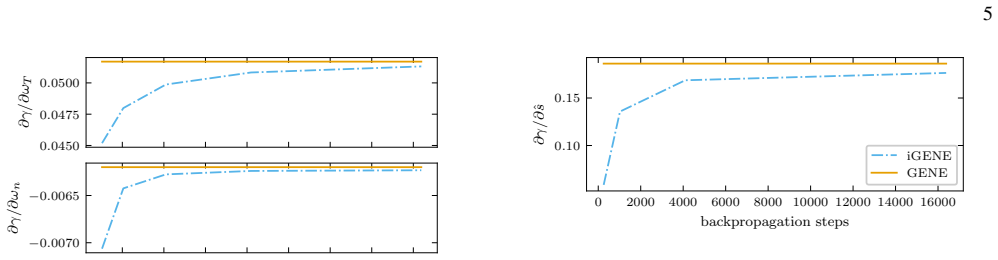
The paper claims that implementing the local nonlinear gyrokinetic model in TensorFlow makes the entire simulation differentiable, so that gradients of outputs with respect to inputs can be computed via automatic differentiation; despite the inherent noise from stochastic turbulence, these gradients remain usable for outer-loop tasks such as predicting plasma profiles.
What carries the argument
Automatic differentiation through the TensorFlow implementation of the electromagnetic flux-tube gyrokinetic model, which carries gradients across the nonlinear turbulence evolution.
Load-bearing premise
That the noisy approximate gradients obtained from stochastic turbulence simulations remain sufficiently informative and stable to drive reliable outer-loop optimization and prediction tasks.
What would settle it
A concrete test would be to run an outer-loop profile prediction with the computed gradients and compare the result against an independent non-gradient method or a high-fidelity reference simulation; large systematic deviation would falsify the usability claim.
Figures




read the original abstract
We present iGENE, a fully-differentiable TensorFlow implementation of the electromagnetic local nonlinear gyrokinetic model, which allows us to compute gradients of any simulation output with respect to any input via automatic differentiation. We show that even if the stochastic nature of turbulence prevents the exact evaluation of gradients of nonlinear quantities of interest, they can still be successfully used to perform outer-loop tasks, such as profile predictions. This work enables the integration of gyrokinetics into automated parameter optimization, uncertainty quantification, sensitivity analysis, and AI workflows.
Editorial analysis
A structured set of objections, weighed in public.
Referee Report
Summary. The manuscript introduces iGENE, a fully differentiable TensorFlow reimplementation of the electromagnetic local nonlinear gyrokinetic model. Automatic differentiation is used to obtain gradients of simulation outputs with respect to inputs. The central claim is that, despite the stochastic nature of turbulence preventing exact gradients of nonlinear quantities, the resulting approximate gradients remain usable for outer-loop tasks such as profile predictions, thereby enabling integration of gyrokinetics into optimization, uncertainty quantification, sensitivity analysis, and AI workflows.
Significance. If the central claim is substantiated with concrete demonstrations, the work would be significant for plasma physics by making flux-tube gyrokinetic simulations natively compatible with gradient-based outer loops. The provision of a TensorFlow-based, machine-checkable differentiable implementation is a clear strength that supports reproducibility and downstream AI integration.
major comments (2)
- [Abstract and §4] Abstract and §4 (results on outer-loop tasks): The claim that approximate gradients 'can still be successfully used' for profile predictions is not accompanied by quantitative evidence such as error metrics, convergence histories, or comparisons against non-differentiable baselines. This demonstration is load-bearing for the central contribution.
- [§3.2] §3.2 (handling of stochasticity): No explicit description is given of how realization dependence or noise in the turbulence is mitigated when computing or applying the gradients (e.g., via ensemble averaging, regularization, or specific AD settings). This directly affects whether the gradients remain informative for outer-loop optimization.
minor comments (2)
- [Figures 3-5] Figure captions and axis labels in the results section should explicitly state the number of turbulence realizations used for each gradient evaluation.
- [§2] The notation for the gyrokinetic distribution function and electromagnetic potentials should be cross-referenced to the original GENE formulation to clarify any TensorFlow-specific reparameterizations.
Simulated Author's Rebuttal
We thank the referee for their constructive and insightful comments on our manuscript. We have carefully reviewed the major comments and provide point-by-point responses below, along with our plans for revision.
read point-by-point responses
-
Referee: [Abstract and §4] Abstract and §4 (results on outer-loop tasks): The claim that approximate gradients 'can still be successfully used' for profile predictions is not accompanied by quantitative evidence such as error metrics, convergence histories, or comparisons against non-differentiable baselines. This demonstration is load-bearing for the central contribution.
Authors: We agree that the central claim would benefit from stronger quantitative support. While §4 illustrates the application of the approximate gradients to profile prediction tasks through concrete examples, we acknowledge that explicit error metrics, convergence histories, and comparisons to non-differentiable baselines are not provided. In the revised manuscript we will expand §4 to include these quantitative elements, such as L2 errors in predicted profiles, iteration counts for convergence, and side-by-side results against gradient-free optimization methods. revision: yes
-
Referee: [§3.2] §3.2 (handling of stochasticity): No explicit description is given of how realization dependence or noise in the turbulence is mitigated when computing or applying the gradients (e.g., via ensemble averaging, regularization, or specific AD settings). This directly affects whether the gradients remain informative for outer-loop optimization.
Authors: We appreciate this observation. Section 3.2 notes the stochastic character of the turbulence but does not detail the practical steps taken to reduce realization dependence when gradients are evaluated. We will revise §3.2 to explicitly describe the mitigation strategy employed, which relies on ensemble averaging over multiple independent turbulence realizations together with a modest level of temporal smoothing; we will also clarify the automatic-differentiation settings used to avoid excessive noise amplification. revision: yes
Circularity Check
No significant circularity identified
full rationale
The paper presents iGENE as a TensorFlow reimplementation of an electromagnetic local nonlinear gyrokinetic model, relying on standard automatic differentiation to obtain gradients. The central claim—that noisy gradients from stochastic turbulence simulations remain usable for outer-loop tasks such as profile prediction—is advanced via software demonstration and empirical examples rather than any derivation that reduces the result to a fitted parameter, self-definition, or self-citation chain. No equations, ansatzes, or uniqueness theorems are invoked that would make the claimed capability tautological with the inputs. The contribution is primarily implementation and validation against external benchmarks, rendering the argument self-contained.
Axiom & Free-Parameter Ledger
axioms (1)
- domain assumption The electromagnetic local nonlinear gyrokinetic model accurately captures essential plasma turbulence physics in the flux-tube limit.
Reference graph
Works this paper leans on
-
[1]
Nuclear fusion , volume=
Survey of disruption causes at JET , author=. Nuclear fusion , volume=. 2011 , publisher=
2011
-
[2]
Advances in Neural Information Processing Systems , volume=
BoTorch: A framework for efficient Monte-Carlo Bayesian optimization , author=. Advances in Neural Information Processing Systems , volume=
-
[3]
Nuclear Fusion , volume=
A statistical approach for the automatic identification of the start of the chain of events leading to the disruptions at JET , author=. Nuclear Fusion , volume=. 2021 , publisher=
2021
-
[4]
Nuclear Fusion , volume=
Automatic disruption classification based on manifold learning for real-time applications on JET , author=. Nuclear Fusion , volume=. 2013 , publisher=
2013
-
[5]
Plasma Physics and Controlled Fusion , volume=
Automatic disruption classification in JET with the ITER-like wall , author=. Plasma Physics and Controlled Fusion , volume=. 2015 , publisher=
2015
-
[6]
Nuclear Fusion , volume=
A machine learning approach based on generative topographic mapping for disruption prevention and avoidance at JET , author=. Nuclear Fusion , volume=. 2019 , publisher=
2019
-
[7]
Nature , volume=
Predicting disruptive instabilities in controlled fusion plasmas through deep learning , author=. Nature , volume=. 2019 , publisher=
2019
-
[8]
Journal of Machine Learning for Modeling and Computing , volume=
Fully convolutional spatio-temporal models for representation learning in plasma science , author=. Journal of Machine Learning for Modeling and Computing , volume=. 2021 , publisher=
2021
-
[9]
Review of scientific instruments , volume=
Feature extraction for improved disruption prediction analysis at JET , author=. Review of scientific instruments , volume=. 2008 , publisher=
2008
-
[10]
Nuclear Fusion , volume=
An advanced disruption predictor for JET tested in a simulated real-time environment , author=. Nuclear Fusion , volume=. 2010 , publisher=
2010
-
[11]
Fusion Engineering and Design , volume=
Results of the JET real-time disruption predictor in the ITER-like wall campaigns , author=. Fusion Engineering and Design , volume=. 2013 , publisher=
2013
-
[12]
fusion Engineering and Design , volume=
Improved feature selection based on genetic algorithms for real time disruption prediction on JET , author=. fusion Engineering and Design , volume=. 2012 , publisher=
2012
-
[13]
Fusion engineering and design , volume=
Global optimization driven by genetic algorithms for disruption predictors based on APODIS architecture , author=. Fusion engineering and design , volume=. 2016 , publisher=
2016
-
[14]
Nuclear Fusion , volume=
Clustering based on the geodesic distance on Gaussian manifolds for the automatic classification of disruptions , author=. Nuclear Fusion , volume=. 2013 , publisher=
2013
-
[15]
Nuclear Fusion , volume=
Adaptive predictors based on probabilistic SVM for real time disruption mitigation on JET , author=. Nuclear Fusion , volume=. 2018 , publisher=
2018
-
[16]
Nuclear Fusion , volume=
Adaptive learning for disruption prediction in non-stationary conditions , author=. Nuclear Fusion , volume=. 2019 , publisher=
2019
-
[17]
Nuclear Fusion , volume=
Stacking of predictors for the automatic classification of disruption types to optimize the control logic , author=. Nuclear Fusion , volume=. 2021 , publisher=
2021
-
[18]
Proceedings of the 15th ACM SIGKDD international conference on Knowledge discovery and data mining , pages=
Time series shapelets: a new primitive for data mining , author=. Proceedings of the 15th ACM SIGKDD international conference on Knowledge discovery and data mining , pages=
-
[19]
Proceedings of the 17th ACM SIGKDD international conference on Knowledge discovery and data mining , pages=
Logical-shapelets: an expressive primitive for time series classification , author=. Proceedings of the 17th ACM SIGKDD international conference on Knowledge discovery and data mining , pages=
-
[20]
2012 IEEE 12th International Conference on Data Mining , pages=
Efficient pattern-based time series classification on gpu , author=. 2012 IEEE 12th International Conference on Data Mining , pages=. 2012 , organization=
2012
-
[21]
proceedings of the 2013 SIAM International Conference on Data Mining , pages=
Fast shapelets: A scalable algorithm for discovering time series shapelets , author=. proceedings of the 2013 SIAM International Conference on Data Mining , pages=. 2013 , organization=
2013
-
[22]
Proceedings of the 20th ACM SIGKDD international conference on Knowledge discovery and data mining , pages=
Learning time-series shapelets , author=. Proceedings of the 20th ACM SIGKDD international conference on Knowledge discovery and data mining , pages=
-
[23]
ACDL-Advanced Course on Data Science & Machine Learning , year=
Learning Multivariate Shapelets with Multi-Layer Neural Networks , author=. ACDL-Advanced Course on Data Science & Machine Learning , year=
-
[24]
2019 IEEE International Conference on Data Mining (ICDM) , pages=
Triple-shapelet networks for time series classification , author=. 2019 IEEE International Conference on Data Mining (ICDM) , pages=. 2019 , organization=
2019
-
[25]
arXiv preprint arXiv:1906.00917 , year=
Learning interpretable shapelets for time series classification through adversarial regularization , author=. arXiv preprint arXiv:1906.00917 , year=
-
[26]
2016 IEEE First International Conference on Data Stream Mining & Processing (DSMP) , pages=
Accelerating recurrent neural network training using sequence bucketing and multi-gpu data parallelization , author=. 2016 IEEE First International Conference on Data Stream Mining & Processing (DSMP) , pages=. 2016 , organization=
2016
-
[27]
Proceedings of the IEEE international conference on computer vision , pages=
Focal loss for dense object detection , author=. Proceedings of the IEEE international conference on computer vision , pages=
-
[28]
Machine learning , volume=
Support-vector networks , author=. Machine learning , volume=. 1995 , publisher=
1995
-
[29]
Nuclear Fusion , volume=
On the transfer of adaptive predictors between different devices for both mitigation and prevention of disruptions , author=. Nuclear Fusion , volume=. 2020 , publisher=
2020
-
[30]
Nature Physics , volume=
Disruption prediction with artificial intelligence techniques in tokamak plasmas , author=. Nature Physics , volume=. 2022 , publisher=
2022
-
[31]
International conference on machine learning , pages=
Batch normalization: Accelerating deep network training by reducing internal covariate shift , author=. International conference on machine learning , pages=. 2015 , organization=
2015
-
[32]
Nuclear fusion , volume=
A cross-tokamak neural network disruption predictor for the JET and ASDEX Upgrade tokamaks , author=. Nuclear fusion , volume=. 2005 , publisher=
2005
-
[33]
Nuclear Fusion , volume=
Adaptive high learning rate probabilistic disruption predictors from scratch for the next generation of tokamaks , author=. Nuclear Fusion , volume=. 2014 , publisher=
2014
-
[34]
Nuclear Fusion , volume=
On-line prediction and mitigation of disruptions in ASDEX Upgrade , author=. Nuclear Fusion , volume=. 2002 , publisher=
2002
-
[35]
Nuclear fusion , volume=
Disruption forecasting at JET using neural networks , author=. Nuclear fusion , volume=. 2003 , publisher=
2003
-
[36]
Fusion Science and Technology , volume=
Viability assessment of a cross-tokamak AUG-JET disruption predictor , author=. Fusion Science and Technology , volume=. 2018 , publisher=
2018
-
[37]
Nuclear Fusion , volume=
Hybrid deep-learning architecture for general disruption prediction across multiple tokamaks , author=. Nuclear Fusion , volume=. 2020 , publisher=
2020
-
[38]
Nuclear Fusion , volume=
Development of an efficient real-time disruption predictor from scratch on JET and implications for ITER , author=. Nuclear Fusion , volume=. 2013 , publisher=
2013
-
[39]
Fusion Science and Technology , volume=
Exploratory machine learning studies for disruption prediction using large databases on DIII-D , author=. Fusion Science and Technology , volume=. 2018 , publisher=
2018
-
[40]
Plasma Physics and Controlled Fusion , volume=
Disruption prediction investigations using machine learning tools on DIII-D and Alcator C-Mod , author=. Plasma Physics and Controlled Fusion , volume=. 2018 , publisher=
2018
-
[41]
Nuclear Fusion , volume=
A real-time machine learning-based disruption predictor in DIII-D , author=. Nuclear Fusion , volume=. 2019 , publisher=
2019
-
[42]
Nuclear Fusion , volume=
Machine learning for disruption warnings on Alcator C-Mod, DIII-D, and EAST , author=. Nuclear Fusion , volume=. 2019 , publisher=
2019
-
[43]
Nuclear fusion , volume=
Timescale and magnitude of plasma thermal energy loss before and during disruptions in JET , author=. Nuclear fusion , volume=. 2005 , publisher=
2005
-
[44]
Nuclear Fusion , volume=
Progress in disruption prevention for ITER , author=. Nuclear Fusion , volume=. 2019 , publisher=
2019
-
[45]
APS Division of Plasma Physics Meeting Abstracts , volume=
Disruption event characterization and forecasting in tokamaks , author=. APS Division of Plasma Physics Meeting Abstracts , volume=
-
[46]
Tokamak disruption event characterization and forecasting research and expansion to real-time application , author=. Proc. IAEA Fusion Energy Conf. , year=
-
[47]
Journal of Nuclear Materials , volume=
Disruptions in ITER and strategies for their control and mitigation , author=. Journal of Nuclear Materials , volume=. 2015 , publisher=
2015
-
[48]
Physics of Plasmas , volume=
Novel aspects of plasma control in ITER , author=. Physics of Plasmas , volume=. 2015 , publisher=
2015
-
[49]
Fusion Science and Technology , volume=
Requirements for triggering the ITER disruption mitigation system , author=. Fusion Science and Technology , volume=. 2016 , publisher=
2016
-
[50]
Deep Learning , chapter=
Ian Goodfellow and Yoshua Bengio and Aaron Courville , publisher=. Deep Learning , chapter=
-
[51]
Fusion Engineering and Design , volume=
Upgraded bolometer system on JET for improved radiation measurements , author=. Fusion Engineering and Design , volume=. 2007 , publisher=
2007
-
[52]
IEEE transactions on acoustics, speech, and signal processing , volume=
Dynamic programming algorithm optimization for spoken word recognition , author=. IEEE transactions on acoustics, speech, and signal processing , volume=. 1978 , publisher=
1978
-
[53]
Lecture notes in computer science , volume=
Gaussian processes in machine learning , author=. Lecture notes in computer science , volume=. 2004 , publisher=
2004
-
[54]
Journal of complexity , volume=
Scrambling Sobol'and Niederreiter--Xing Points , author=. Journal of complexity , volume=. 1998 , publisher=
1998
-
[55]
Neural computation , volume=
Long short-term memory , author=. Neural computation , volume=. 1997 , publisher=
1997
-
[56]
Nuclear Fusion , volume=
Control of the vertical instability in tokamaks , author=. Nuclear Fusion , volume=. 1990 , publisher=
1990
-
[57]
Physical review letters , volume=
Rotation and locking of magnetic islands , author=. Physical review letters , volume=. 1997 , publisher=
1997
-
[58]
and Varoquaux, G
Pedregosa, F. and Varoquaux, G. and Gramfort, A. and Michel, V. and Thirion, B. and Grisel, O. and Blondel, M. and Prettenhofer, P. and Weiss, R. and Dubourg, V. and Vanderplas, J. and Passos, A. and Cournapeau, D. and Brucher, M. and Perrot, M. and Duchesnay, E. , journal=. Scikit-learn: Machine Learning in
-
[59]
Physical Review Letters , volume=
Regime of improved confinement and high beta in neutral-beam-heated divertor discharges of the ASDEX tokamak , author=. Physical Review Letters , volume=. 1982 , publisher=
1982
-
[60]
The journal of machine learning research , volume=
Dropout: a simple way to prevent neural networks from overfitting , author=. The journal of machine learning research , volume=. 2014 , publisher=
2014
-
[61]
Nuclear fusion , volume=
Equilibrium analysis of iron core tokamaks using a full domain method , author=. Nuclear fusion , volume=. 1992 , publisher=
1992
-
[62]
Computer Vision--ECCV 2016: 14th European Conference, Amsterdam, The Netherlands, October 11--14, 2016, Proceedings, Part IV 14 , pages=
Identity mappings in deep residual networks , author=. Computer Vision--ECCV 2016: 14th European Conference, Amsterdam, The Netherlands, October 11--14, 2016, Proceedings, Part IV 14 , pages=. 2016 , organization=
2016
-
[63]
Physics of Plasmas , volume=
Resistive drift-wave turbulence , author=. Physics of Plasmas , volume=. 1995 , publisher=
1995
-
[64]
ACM/JMS Journal of Data Science , year=
Physics-informed neural operator for learning partial differential equations , author=. ACM/JMS Journal of Data Science , year=
-
[65]
Proceedings of the National Academy of Sciences , volume=
Machine learning--accelerated computational fluid dynamics , author=. Proceedings of the National Academy of Sciences , volume=. 2021 , publisher=
2021
-
[66]
Robin Greif , title =. 2023 , publisher =. doi:10.21105/joss.05959 , url =
-
[67]
2023 , eprint=
Physics-Preserving AI-Accelerated Simulations of Plasma Turbulence , author=. 2023 , eprint=
2023
-
[68]
Decoupled Weight Decay Regularization
Decoupled weight decay regularization , author=. arXiv preprint arXiv:1711.05101 , year=
work page internal anchor Pith review arXiv
-
[69]
Sharpness-aware minimization for efficiently improving generalization , author=. arXiv preprint arXiv:2010.01412 , year=
-
[70]
Physics of Plasmas , volume=
StyleGAN as an AI deconvolution operator for large eddy simulations of turbulent plasma equations in BOUT++ , author=. Physics of Plasmas , volume=. 2024 , publisher=
2024
-
[71]
arXiv preprint arXiv:2402.12971 , year=
How temporal unrolling supports neural physics simulators , author=. arXiv preprint arXiv:2402.12971 , year=
-
[72]
Layer normalization , author=. arXiv preprint arXiv:1607.06450 , year=
work page internal anchor Pith review arXiv
-
[73]
arXiv preprint arXiv:2401.05972 , year=
Learning physics-based reduced models from data for the Hasegawa-Wakatani equations , author=. arXiv preprint arXiv:2401.05972 , year=
-
[74]
arXiv preprint arXiv:2405.13232 , year=
A generative machine learning surrogate model of plasma turbulence , author=. arXiv preprint arXiv:2405.13232 , year=
-
[75]
Physics of Plasmas , volume=
Fast modeling of turbulent transport in fusion plasmas using neural networks , author=. Physics of Plasmas , volume=. 2020 , publisher=
2020
-
[76]
AIAA Journal , volume=
Deep learning methods for Reynolds-averaged Navier--Stokes simulations of airfoil flows , author=. AIAA Journal , volume=. 2020 , publisher=
2020
-
[77]
Journal of Computational Physics , volume=
NSFnets (Navier-Stokes flow nets): Physics-informed neural networks for the incompressible Navier-Stokes equations , author=. Journal of Computational Physics , volume=. 2021 , publisher=
2021
-
[78]
Physics of Fluids , volume=
Physics-informed neural networks for solving Reynolds-averaged Navier--Stokes equations , author=. Physics of Fluids , volume=. 2022 , publisher=
2022
-
[79]
Journal of Computational Physics , volume=
DPM: A deep learning PDE augmentation method with application to large-eddy simulation , author=. Journal of Computational Physics , volume=. 2020 , publisher=
2020
-
[80]
Physics of Plasmas , volume=
Applications of large eddy simulation methods to gyrokinetic turbulence , author=. Physics of Plasmas , volume=. 2014 , publisher=
2014
discussion (0)
Sign in with ORCID, Apple, or X to comment. Anyone can read and Pith papers without signing in.