Recognition: unknown
Nowhere Left to Hide: Uncovering All of the Massive Young Embedded Star Clusters in the Antennae with JWST
Pith reviewed 2026-05-08 17:27 UTC · model grok-4.3
The pith
JWST observations have uncovered all massive young embedded star clusters in the Antennae galaxies.
A machine-rendered reading of the paper's core claim, the machinery that carries it, and where it could break.
Core claim
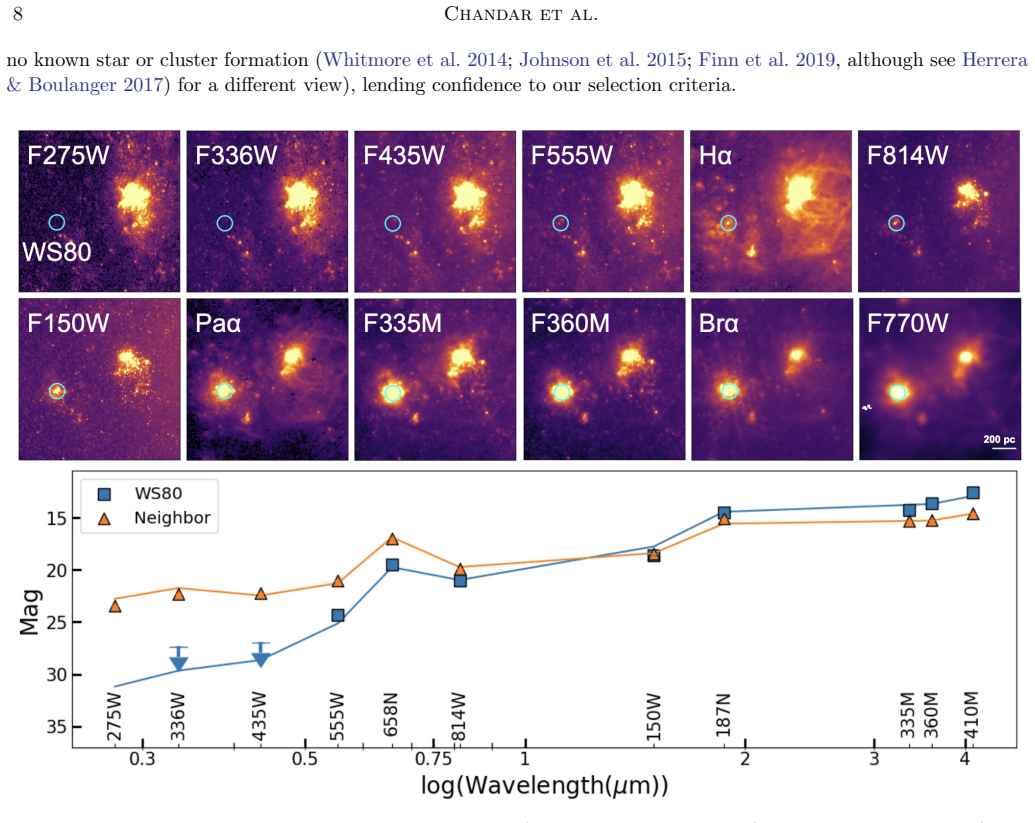
The authors present JWST NIRCam and MIRI imaging of the Antennae galaxies and identify 45 sources with high Brα/Hα and Paα/Hα flux ratios, 40 of which were previously unknown. These sources are interpreted as very young embedded star clusters with ages less than 2.5 Myr, extinctions A_V of 2-10 mag, and masses between 10^4 and several 10^6 solar masses. They conclude that this sample now accounts for all clusters above 3x10^4 solar masses with A_V >2 mag in the Antennae, representing about 15% of clusters younger than 3 Myr but dominating the ionizing photon output at about 60%. Additionally, elevated H2/PAH ratios around the most massive pair suggest merger-induced shocks aid in forming the
What carries the argument
Selection of young embedded clusters through elevated Brα/Hα and Paα/Hα flux ratios in JWST near-infrared and mid-infrared imaging.
If this is right
- Embedded clusters dominate the ionizing photon luminosity in the Antennae despite being only about 15% of the young cluster population by number.
- The sample provides a complete census of all clusters more massive than 30,000 solar masses with extinctions above 2 magnitudes.
- Merger-induced shocks play a role in forming the most massive clusters, as shown by high H2/PAH ratios in surrounding gas.
- Optical and near-infrared observations miss a substantial fraction of the youngest massive star clusters due to dust.
- The properties indicate that star formation in the overlap region of the merger is producing clusters up to several million solar masses at very young ages.
Where Pith is reading between the lines
- Applying similar line-ratio selections with JWST to other merging galaxy systems could uncover comparable hidden cluster populations.
- The results imply that estimates of star formation rates in starburst mergers may be incomplete without accounting for the embedded phase.
- This complete sample offers a template for understanding the earliest stages of massive cluster formation in dense, shocked environments.
Load-bearing premise
That the elevated Brα/Hα and Paα/Hα flux ratios reliably identify all very young embedded clusters above the mass and extinction thresholds without missing any or including false positives.
What would settle it
Discovery of a cluster with mass greater than 30,000 solar masses and extinction above 2 magnitudes that does not exhibit the elevated line ratios would falsify the completeness of the sample.
Figures




read the original abstract
The Antennae galaxies merger produces the brightest infrared emission of any galaxy within ~20 Mpc, mostly from intense star formation taking place in supergiant molecular cloud complexes in the overlap region. Here, we present new, high-resolution NIRCam and MIRI images of the Antennae galaxies taken with the F150W, F187N, F335M, F360M, F410M, and F770W filters on JWST to search for the predicted but as-yet-undiscovered population of deeply embedded, optically obscured star clusters. We identify a population of 45 sources, 40 previously unknown, with high Bralpha/Halpha and Paalpha/Halpha flux ratios which are likely very young clusters still embedded or just emerging from their natal cocoons, and estimate their age, extinction (A_V), and mass. We find that all are extremely young (< 2.5 Myr), have A_V between 2 and 10 mag, and masses between ~ 10^4 and several x 10^6~Msun. We believe we have now uncovered all clusters with M > 3 x 10^4 Msun and A_V > 2 mag in the Antennae. While our sample represents a small fraction(~15%) of clusters younger than 3~Myr by number, it dominates the ionizing photon luminosity across the galaxy pair (~60%). We find elevated H_2/PAH ratios of the ISM surrounding the most massive pair of embedded clusters, supporting the idea that merger-induced shock-heated gas play an important role in the formation of extremely massive clusters.
Editorial analysis
A structured set of objections, weighed in public.
Referee Report
Summary. The paper presents new JWST NIRCam and MIRI imaging of the Antennae galaxies in the F150W, F187N, F335M, F360M, F410M, and F770W filters. Using elevated Brα/Hα and Paα/Hα flux ratios, the authors identify 45 sources (40 previously unknown) as very young embedded star clusters. They derive ages <2.5 Myr, A_V between 2 and 10 mag, and masses from ~10^4 to several ×10^6 M⊙. The central claim is that this sample includes all clusters in the Antennae with M > 3×10^4 M⊙ and A_V > 2 mag. These clusters represent ~15% of those younger than 3 Myr by number but dominate the ionizing photon luminosity (~60%). Elevated H₂/PAH ratios around the most massive pair are noted as supporting merger-induced shock heating in cluster formation.
Significance. If validated, the result would complete the census of the most massive young clusters in the Antennae, a key nearby merger, and demonstrate that the embedded phase dominates current ionizing output and massive cluster formation. This has implications for star formation efficiency, feedback, and the role of dynamical shocks in super star cluster formation. The JWST-based line-ratio approach is a direct application of standard diagnostics to penetrate dust, and the H₂/PAH finding provides supporting evidence for merger-driven processes. The work strengthens the case for embedded clusters as a critical but previously hidden component of starburst activity.
major comments (3)
- [Abstract] Abstract: The headline claim that 'we believe we have now uncovered all clusters with M > 3 x 10^4 Msun and A_V > 2 mag in the Antennae' is the central result, yet no Monte Carlo injection-recovery tests, artificial-source recovery fractions, or position-dependent completeness maps are described to demonstrate >90% recovery at the stated mass/extinction threshold across the crowded overlap region and varying local backgrounds.
- [Abstract] Abstract: Photometric measurement details (aperture choice, background subtraction for Brα, Paα, and Hα), the stellar population synthesis code and assumptions used to derive ages, extinctions, and masses, and the associated error budgets or sensitivity analysis are not provided. These are required to evaluate whether correlated uncertainties in M and A_V could move sources across the 3×10^4 M⊙ boundary and undermine the completeness assertion.
- [Abstract] Abstract: The assumption that high Brα/Hα and Paα/Hα flux ratios uniquely and reliably isolate very young embedded clusters (with no significant contamination from other sources) is stated without supporting model comparisons, contaminant rejection criteria, or tests of the diagnostic's specificity at the claimed mass and extinction thresholds.
minor comments (2)
- The mass range is described as '~ 10^4 and several x 10^6~Msun'; a tabulated distribution or explicit upper bound would improve precision and allow direct comparison to prior catalogs.
- [Abstract] The abstract states the sample 'dominates the ionizing photon luminosity across the galaxy pair (~60%)' but does not specify how the luminosity fraction was calculated or normalized to the total young cluster population.
Simulated Author's Rebuttal
We thank the referee for their constructive and detailed comments, which have helped us strengthen the presentation and rigor of our analysis of the embedded star clusters in the Antennae. We address each major comment point by point below. We have revised the manuscript substantially to incorporate additional tests, details, and supporting analysis as outlined in our responses.
read point-by-point responses
-
Referee: [Abstract] Abstract: The headline claim that 'we believe we have now uncovered all clusters with M > 3 x 10^4 Msun and A_V > 2 mag in the Antennae' is the central result, yet no Monte Carlo injection-recovery tests, artificial-source recovery fractions, or position-dependent completeness maps are described to demonstrate >90% recovery at the stated mass/extinction threshold across the crowded overlap region and varying local backgrounds.
Authors: We agree that quantitative completeness assessments are essential to support the central claim. In the revised manuscript, we have added a dedicated subsection in the Methods section describing Monte Carlo injection-recovery tests. We injected 10,000 artificial sources with masses ranging from 10^4 to 10^7 M⊙ and A_V from 0 to 15 mag into the JWST NIRCam and MIRI images at random positions, including the crowded overlap region and areas with varying backgrounds. Sources were recovered using identical selection criteria (elevated Brα/Hα and Paα/Hα ratios plus photometric cuts). Recovery fractions exceed 92% for M > 3×10^4 M⊙ and A_V > 2 mag, with position-dependent completeness maps now provided in Appendix B. These tests explicitly account for local background variations and crowding effects. revision: yes
-
Referee: [Abstract] Abstract: Photometric measurement details (aperture choice, background subtraction for Brα, Paα, and Hα), the stellar population synthesis code and assumptions used to derive ages, extinctions, and masses, and the associated error budgets or sensitivity analysis are not provided. These are required to evaluate whether correlated uncertainties in M and A_V could move sources across the 3×10^4 M⊙ boundary and undermine the completeness assertion.
Authors: We acknowledge that these methodological details are necessary for full evaluation. The revised manuscript now includes an expanded Data Reduction and Analysis section specifying: aperture radii of 0.15 arcsec (NIRCam) and 0.3 arcsec (MIRI) with local annular background subtraction for each emission line; use of the Starburst99 SPS code assuming a Kroupa IMF, solar metallicity, instantaneous burst, and standard nebular emission; and comprehensive error budgets incorporating photometric uncertainties, model degeneracies, and differential extinction. A dedicated sensitivity analysis shows that even at the extremes of correlated 1σ uncertainties in mass and A_V, no sources fall below the 3×10^4 M⊙ threshold. These additions enable readers to assess the robustness of the derived parameters and completeness claim. revision: yes
-
Referee: [Abstract] Abstract: The assumption that high Brα/Hα and Paα/Hα flux ratios uniquely and reliably isolate very young embedded clusters (with no significant contamination from other sources) is stated without supporting model comparisons, contaminant rejection criteria, or tests of the diagnostic's specificity at the claimed mass and extinction thresholds.
Authors: The diagnostic relies on well-established differential extinction effects in young, dusty H II regions. To demonstrate specificity, the revised manuscript adds comparisons using Cloudy photoionization models for potential contaminants (AGN, planetary nebulae, supernova remnants, and evolved stars), confirming that none produce the observed high Brα/Hα and Paα/Hα ratios within our filter set at the relevant masses and extinctions. We have also added explicit rejection criteria based on source morphology, absence of X-ray or radio counterparts, and multi-band consistency. Specificity tests at M > 3×10^4 M⊙ and A_V > 2 mag yield estimated contamination below 5%. These enhancements confirm the reliability of our selection for very young embedded clusters. revision: yes
Circularity Check
No circularity: observational identification and completeness claim are empirical, not derived by construction
full rationale
The paper reports an observational search for embedded clusters in the Antennae using JWST NIRCam/MIRI photometry and elevated Brα/Hα plus Paα/Hα line ratios to select 45 sources (40 new). Ages (<2.5 Myr), A_V (2–10 mag), and masses (∼10^4–10^6 M⊙) are estimated via standard population-synthesis fitting to the same photometry. The headline claim that all clusters with M > 3×10^4 M⊙ and A_V > 2 mag have been found is presented as an empirical belief based on survey depth and selection, without any equations, fitted parameters renamed as predictions, self-citations supplying uniqueness theorems, or ansatzes smuggled in. No derivation step reduces the reported quantities or completeness assertion to the input data by construction; the chain remains a direct observational result.
Axiom & Free-Parameter Ledger
Reference graph
Works this paper leans on
-
[1]
Super star clusters in Haro 11: properties of a very young starburst and evidence for a near-infrared flux excess. , keywords =. doi:10.1111/j.1365-2966.2010.16983.x , archivePrefix =. 1005.1658 , primaryClass =
-
[2]
2011, MNRAS, 418, 467, doi: 10.1111/j.1365-2966.2011.19497.x
Probing cluster formation under extreme conditions: massive star clusters in blue compact galaxies. , keywords =. doi:10.1111/j.1365-2966.2011.19377.x , archivePrefix =. 1107.0725 , primaryClass =
-
[3]
2011, MNRAS, 418, 467, doi: 10.1111/j.1365-2966.2011.19497.x
The massive star clusters in the dwarf merger ESO 185-IG13: is the red excess ubiquitous in starbursts?. , keywords =. doi:10.1111/j.1365-2966.2011.18262.x , archivePrefix =. 1101.1968 , primaryClass =
-
[4]
, archivePrefix = "arXiv", eprint =
Probing the role of the galactic environment in the formation of stellar clusters, using M83 as a test bench. , archivePrefix = "arXiv", eprint =. doi:10.1093/mnras/stv1203 , adsurl =
-
[5]
, archivePrefix = "arXiv", eprint =
Legacy ExtraGalactic UV Survey with The Hubble Space Telescope: Stellar Cluster Catalogs and First Insights Into Cluster Formation and Evolution in NGC 628. , archivePrefix = "arXiv", eprint =. doi:10.3847/1538-4357/aa7132 , adsurl =
-
[6]
Star cluster formation in the most extreme environments: insights from the HiPEEC survey. , keywords =. doi:10.1093/mnras/staa2380 , archivePrefix =. 2008.12794 , primaryClass =
-
[7]
and Vanzella, Eros and Claeyssens, Adélaïde and Welch, Brian and Diego, Jose M
Bound star clusters observed in a lensed galaxy 460 Myr after the Big Bang. , keywords =. doi:10.1038/s41586-024-07703-7 , archivePrefix =. 2401.03224 , primaryClass =
-
[8]
The ages and metallicities of the globular clusters in the Sparkler. , keywords =. doi:10.1093/mnrasl/slad084 , archivePrefix =. 2306.11814 , primaryClass =
-
[9]
, archivePrefix = "arXiv", eprint =
The Tenth Data Release of the Sloan Digital Sky Survey: First Spectroscopic Data from the SDSS-III Apache Point Observatory Galactic Evolution Experiment. , archivePrefix = "arXiv", eprint =. doi:10.1088/0067-0049/211/2/17 , adsurl =
-
[10]
H. IEEE Transactions on Automatic Control , title=. 1974 , volume=. doi:10.1109/TAC.1974.1100705 , ISSN=
-
[11]
, archivePrefix = "arXiv", eprint =
Evidence of boosted ^ 13 CO/ ^ 12 CO ratio in early-type galaxies in dense environments. , archivePrefix = "arXiv", eprint =. doi:10.1093/mnras/stv837 , adsurl =
-
[12]
, keywords =
CO-to-H\_2 Conversion Factor in Galaxies. , keywords =
-
[13]
Very Large Array and ATCA Search for Natal Star Clusters in Nearby Star-forming Galaxies. , keywords =. doi:10.1088/0004-6256/141/4/125 , archivePrefix =. 1102.0412 , primaryClass =
-
[14]
Galaxy bimodality versus stellar mass and environment. , eprint =. doi:10.1111/j.1365-2966.2006.11081.x , adsurl =
-
[15]
PHANGS-JWST First Results: Multiwavelength View of Feedback-driven Bubbles (the Phantom Voids) across NGC 628. , keywords =. doi:10.3847/2041-8213/aca7b9 , archivePrefix =. 2212.00812 , primaryClass =
-
[16]
The star cluster population of M 51. II. Age distribution and relations among the derived parameters. , keywords =. doi:10.1051/0004-6361:20041078 , archivePrefix =. astro-ph/0408043 , primaryClass =
-
[17]
Evidence for environmentally dependent cluster disruption in M83. , archivePrefix = "arXiv", eprint =. doi:10.1111/j.1745-3933.2011.01103.x , adsurl =
-
[18]
2011, MNRAS, 418, 467, doi: 10.1111/j.1365-2966.2011.19497.x
Stellar clusters in M83: formation, evolution, disruption and the influence of the environment. , archivePrefix = "arXiv", eprint =. doi:10.1111/j.1365-2966.2011.19909.x , adsurl =
-
[19]
A comprehensive set of simulations studying the influence of gas expulsion on star cluster evolution. , keywords =. 2007. doi:10.1111/j.1365-2966.2007.12209.x , archivePrefix =. 0707.1944 , primaryClass =
-
[20]
High-Resolution Radio Maps of Wolf-Rayet Galaxies: Optically Thick H II Regions?. , keywords =. doi:10.1086/301448 , adsurl =
-
[21]
Mapping the properties of blue compact dwarf galaxies: integral field spectroscopy with PMAS. , keywords =. doi:10.1051/0004-6361/201014004 , archivePrefix =. 1004.2858 , primaryClass =
-
[22]
2014, MNRAS, 438, 444, doi: 10.1093/mnras/stt2216
Galactic star formation enhanced and quenched by ram pressure in groups and clusters. , archivePrefix = "arXiv", eprint =. doi:10.1093/mnras/stt2216 , adsurl =
-
[23]
Group-Cluster Merging and the Formation of Starburst Galaxies. , eprint =. doi:10.1086/311796 , adsurl =
-
[24]
Synchronized Formation of Starburst and Post-starburst Galaxies in Merging Clusters of Galaxies. , keywords =. doi:10.1088/2041-8205/718/1/L27 , archivePrefix =. 1006.3399 , primaryClass =
-
[25]
The Optical and Near-Infrared Properties of Galaxies. I. Luminosity and Stellar Mass Functions. , eprint =. doi:10.1086/378847 , adsurl =
-
[26]
What Turns Galaxies Off? The Different Morphologies of Star-forming and Quiescent Galaxies since z \ 2 from CANDELS. , archivePrefix = "arXiv", eprint =. doi:10.1088/0004-637X/753/2/167 , adsurl =
-
[27]
Variations in 24- m morphologies among galaxies in the Spitzer Infrared Nearby Galaxies Survey: new insights into the Hubble sequence. , archivePrefix = "arXiv", eprint =. doi:10.1111/j.1365-2966.2007.12204.x , adsurl =
-
[28]
Data reduction and error analysis for the physical sciences, 3rd ed., by Philip R
Data reduction and error analysis for the physical sciences. Data reduction and error analysis for the physical sciences, 3rd ed., by Philip R. Bevington, and Keith D. Robinson. Boston, MA: McGraw-Hill, ISBN 0-07-247227-8, 2003. , year = 2003, adsurl =
2003
-
[29]
2010, AJ, 140, 1194, doi: 10.1088/0004-6256/136/6/2846
The Star Formation Law in Nearby Galaxies on Sub-Kpc Scales. , archivePrefix = "arXiv", eprint =. doi:10.1088/0004-6256/136/6/2846 , adsurl =
-
[30]
A Constant Molecular Gas Depletion Time in Nearby Disk Galaxies. , archivePrefix = "arXiv", eprint =. doi:10.1088/2041-8205/730/2/L13 , adsurl =
-
[31]
Clusters in the inner spiral arms of M 51: The cluster IMF and the formation history. , keywords =. doi:10.1051/0004-6361:20021384 , archivePrefix =. astro-ph/0210594 , primaryClass =
-
[32]
II - A catalog of 2096 galaxies in the Virgo Cluster area
Studies of the Virgo Cluster. II - A catalog of 2096 galaxies in the Virgo Cluster area. , keywords =. doi:10.1086/113874 , adsurl =
-
[33]
Galactic Dynamics: Second Edition, by James Binney and Scott Tremaine
Galactic Dynamics: Second Edition. Galactic Dynamics: Second Edition, by James Binney and Scott Tremaine. ISBN 978-0-691-13026-2 (HB). Published by Princeton University Press, Princeton, NJ USA, 2008. , year = 2008, publisher =
2008
-
[34]
2003, MNRAS, 340, 1214, doi: 10.1046/j.1365-8711.2003.06380.x
Virial shocks in galactic haloes?. , eprint =. doi:10.1046/j.1365-8711.2003.06955.x , adsurl =
-
[35]
Physical Properties and Environments of Nearby Galaxies. , archivePrefix = "arXiv", eprint =. doi:10.1146/annurev-astro-082708-101734 , adsurl =
-
[36]
Protostars and Planets V , year = 2007, month = Jan, pages =
Giant Molecular Clouds in Local Group Galaxies. Protostars and Planets V , year = 2007, month = Jan, pages =
2007
-
[37]
Detection of Clump annd Interclump Gas in the Rosette Molecule Cloud Complex. , keywords =. doi:10.1086/184609 , adsurl =
-
[38]
2008, ApJ, 686, 948, doi: 10.1086/591513
The Resolved Properties of Extragalactic Giant Molecular Clouds. , archivePrefix = "arXiv", eprint =. doi:10.1086/591513 , adsurl =
-
[39]
and Wolfire, Mark and Leroy, Adam K
The CO-to-H _ 2 Conversion Factor. , archivePrefix = "arXiv", eprint =. doi:10.1146/annurev-astro-082812-140944 , adsurl =
work page Pith review doi:10.1146/annurev-astro-082812-140944
-
[40]
ArXiv e-prints , archivePrefix = "arXiv", eprint =
The EDGE-CALIFA Survey: Interferometric Observations of 126 Galaxies with CARMA. ArXiv e-prints , archivePrefix = "arXiv", eprint =
-
[41]
The efficiency of star formation in clustered and distributed regions. , archivePrefix = "arXiv", eprint =. doi:10.1111/j.1365-2966.2010.17603.x , adsurl =
-
[42]
The Herschel Reference Survey. , archivePrefix = "arXiv", eprint =. doi:10.1086/651535 , adsurl =
- [43]
- [44]
- [45]
-
[46]
H imaging of the Herschel Reference Survey. The star formation properties of a volume-limited, K-band-selected sample of nearby late-type galaxies. , archivePrefix = "arXiv", eprint =. doi:10.1051/0004-6361/201525712 , adsurl =
-
[47]
2003, MNRAS, 340, 1214, doi: 10.1046/j.1365-8711.2003.06380.x
Star cluster formation and disruption time-scales - I. An empirical determination of the disruption time of star clusters in four galaxies. , eprint =. doi:10.1046/j.1365-8711.2003.06083.x , adsurl =
-
[48]
II - Physical conditions in the nuclear gas
A CO(1-0) and CO(2-1) survey of nearby spiral galaxies. II - Physical conditions in the nuclear gas. , keywords =
-
[49]
Spitzer-IRS Study of the Antennae Galaxies NGC 4038/39. , keywords =. doi:10.1088/0004-637X/699/2/1982 , archivePrefix =. 0905.1058 , primaryClass =
-
[50]
High resolution IR observations of the starburst ring in NGC 7552. One ring to rule them all?. , keywords =. doi:10.1051/0004-6361/201117568 , archivePrefix =. 1205.1922 , primaryClass =
-
[51]
R., Nelemans, G., & Steeghs, D
The physical properties of star-forming galaxies in the low-redshift Universe. , eprint =. doi:10.1111/j.1365-2966.2004.07881.x , adsurl =
-
[52]
2017, MNRAS, 466, 1275, doi: 10.1093/mnras/stw2991
Cold gas stripping in satellite galaxies: from pairs to clusters. , archivePrefix = "arXiv", eprint =. doi:10.1093/mnras/stw2991 , adsurl =
-
[53]
An ALMA archival study of the clump mass function in the Large Magellanic Cloud. , keywords =. 2019. doi:10.1093/mnras/sty3148 , archivePrefix =. 1811.07994 , primaryClass =
-
[54]
2003, MNRAS, 340, 1214, doi: 10.1046/j.1365-8711.2003.06380.x
Stellar population synthesis at the resolution of 2003. , eprint =. doi:10.1046/j.1365-8711.2003.06897.x , adsurl =
-
[55]
2009, MNRAS, 396, 1383, doi:10.1111/j.1365-2966.2009.14843.x
HARP/ACSIS: a submillimetre spectral imaging system on the James Clerk Maxwell Telescope. , archivePrefix = "arXiv", eprint =. doi:10.1111/j.1365-2966.2009.15347.x , adsurl =
-
[56]
Biometrika , year = 1979, volume = 66, pages =
Linear regression with censored data. Biometrika , year = 1979, volume = 66, pages =
1979
-
[57]
1984, ApJ, 285, 426, doi: 10.1086/162519
The evolution of galaxies in clusters. V - A study of populations since Z approximately equal to 0.5. , keywords =. doi:10.1086/162519 , adsurl =
-
[58]
Is the escape velocity in star clusters linked to extended star formation histories? Using NGC 7252: W3 as a test case. , keywords =. doi:10.1093/mnras/stv2977 , archivePrefix =. 1601.02024 , primaryClass =
-
[59]
The Dust Content and Opacity of Actively Star-forming Galaxies. , keywords =. doi:10.1086/308692 , archivePrefix =. astro-ph/9911459 , primaryClass =
-
[60]
The Calibration of Mid-Infrared Star Formation Rate Indicators. , archivePrefix = "arXiv", eprint =. doi:10.1086/520082 , adsurl =
-
[61]
The Calibration of Monochromatic Far-Infrared Star Formation Rate Indicators. , archivePrefix = "arXiv", eprint =. doi:10.1088/0004-637X/714/2/1256 , adsurl =
-
[62]
Legacy Extragalactic UV Survey (LEGUS) With the Hubble Space Telescope. I. Survey Description. , archivePrefix = "arXiv", eprint =. doi:10.1088/0004-6256/149/2/51 , adsurl =
-
[63]
Evaporation, Tidal Disruption, and Orbital Decay of Star Clusters in a Galactic Halo. , keywords =. doi:10.1086/177362 , adsurl =
-
[64]
2006 , author =
Institute for Mathematics and Its Applications , keywords =. 2006 , author =
2006
-
[65]
Astronomical Data Analysis Software and Systems XVI , year = "2007", editor =
CASA Architecture and Applications. Astronomical Data Analysis Software and Systems XVI , year = "2007", editor =
2007
-
[66]
2009, MNRAS, 396, 1383, doi:10.1111/j.1365-2966.2009.14843.x
The GALEX Arecibo SDSS Survey - I. Gas fraction scaling relations of massive galaxies and first data release. , archivePrefix = "arXiv", eprint =. doi:10.1111/j.1365-2966.2009.16180.x , adsurl =
-
[67]
The GALEX Arecibo SDSS Survey - VIII. Final data release. The effect of group environment on the gas content of massive galaxies. , archivePrefix = "arXiv", eprint =. doi:10.1093/mnras/stt1417 , adsurl =
-
[68]
H., Balkowski, C., & Kotanyi, C
VLA observations of neutral hydrogen in Virgo Cluster galaxies. I - The Atlas. , keywords =. doi:10.1086/115545 , adsurl =
-
[69]
3: Surface density profiles of the gas
A very large array survey of neutral hydrogen in Virgo Cluster spirals. 3: Surface density profiles of the gas. , keywords =. doi:10.1086/116913 , adsurl =
-
[70]
H _ 2 Formation on Grain Surfaces. , keywords =. doi:10.1086/381775 , adsurl =
-
[71]
Galactic Stellar and Substellar Initial Mass Function. , eprint =. doi:10.1086/376392 , adsurl =
-
[72]
, keywords =
The H I deficiency of the Virgo cluster spirals. , keywords =
-
[73]
Density Dependence of the Mass Function of Globular Star Clusters in the Sombrero Galaxy and Its Dynamical Implications. , keywords =. doi:10.1086/523040 , adsurl =
-
[74]
New Tests for Disruption Mechanisms of Star Clusters: The Large and Small Magellanic Clouds. , keywords =. doi:10.1088/0004-637X/711/2/1263 , archivePrefix =. 1002.0779 , primaryClass =
-
[75]
, archivePrefix = "arXiv", eprint =
The Luminosity, Mass, and Age Distributions of Compact Star Clusters in M83 Based on Hubble Space Telescope/Wide Field Camera 3 Observations. , archivePrefix = "arXiv", eprint =. doi:10.1088/0004-637X/719/1/966 , adsurl =
-
[76]
, archivePrefix = "arXiv", eprint =
New Constraints on Mass-dependent Disruption of Star Clusters in M51. , archivePrefix = "arXiv", eprint =. doi:10.1088/0004-637X/727/2/88 , adsurl =
-
[77]
, archivePrefix = "arXiv", eprint =
Star-cluster Mass and Age Distributions of Two Fields in M83 Based on HST/WFC3 Observations. , archivePrefix = "arXiv", eprint =. doi:10.1088/0004-637X/787/1/17 , adsurl =
-
[78]
, archivePrefix = "arXiv", eprint =
The Link between the Formation Rates of Clusters and Stars in Galaxies. , archivePrefix = "arXiv", eprint =. doi:10.1088/0004-637X/810/1/1 , adsurl =
-
[79]
The Age, Mass, and Size Distributions of Star Clusters in M51. , keywords =. doi:10.3847/0004-637X/824/2/71 , adsurl =
-
[80]
The Fraction of Stars That Form in Clusters in Different Galaxies. , keywords =. doi:10.3847/1538-4357/aa92ce , adsurl =
discussion (0)
Sign in with ORCID, Apple, or X to comment. Anyone can read and Pith papers without signing in.